
SpaceX Completes Historic $75 Billion IPO, Vaulting Valuation Past $2 Trillion
SpaceX made the largest stock market debut in history, raising $75 billion and pushing its valuation over $2 trillion on its first day of trading. The landmark IPO also elevated founder Elon Musk's net worth past $1 trillion, making him the world's first trillionaire.
By Factlen Editorial Team
- Institutional Analysts
- Focus on the massive valuation premium and the lack of traditional profitability.
- Retail Investors & Enthusiasts
- View the IPO as a historic opportunity to participate in the space economy.
- Space & Tech Visionaries
- Celebrate the capital raise as the necessary fuel for Mars colonization and AI integration.
- Global Regulators & Watchdogs
- Express concern over unprecedented wealth concentration and chaotic international allocation mechanics.
What's not represented
- · Competitors in the aerospace sector (e.g., Blue Origin, legacy defense contractors)
- · Environmental groups concerned about the ecological impact of increased launch cadences
Why this matters
The SpaceX IPO democratizes investment in the commercial space economy and artificial intelligence infrastructure, allowing retail investors to own a stake in the company building the future of orbital technology. It also represents a massive shift in global wealth, officially minting the world's first trillionaire.
Key points
- SpaceX raised $75 billion in the largest initial public offering in history.
- The stock closed its first day up 19%, pushing the company's valuation past $2.1 trillion.
- Elon Musk's net worth surpassed $1 trillion, making him the world's first trillionaire.
- The company bypassed traditional price discovery, setting a fixed IPO price of $135 per share.
- SpaceX allocated an unusually high 30% of its shares to retail investors.
- Despite the massive valuation, SpaceX remains unprofitable as it invests heavily in Starship and AI infrastructure.
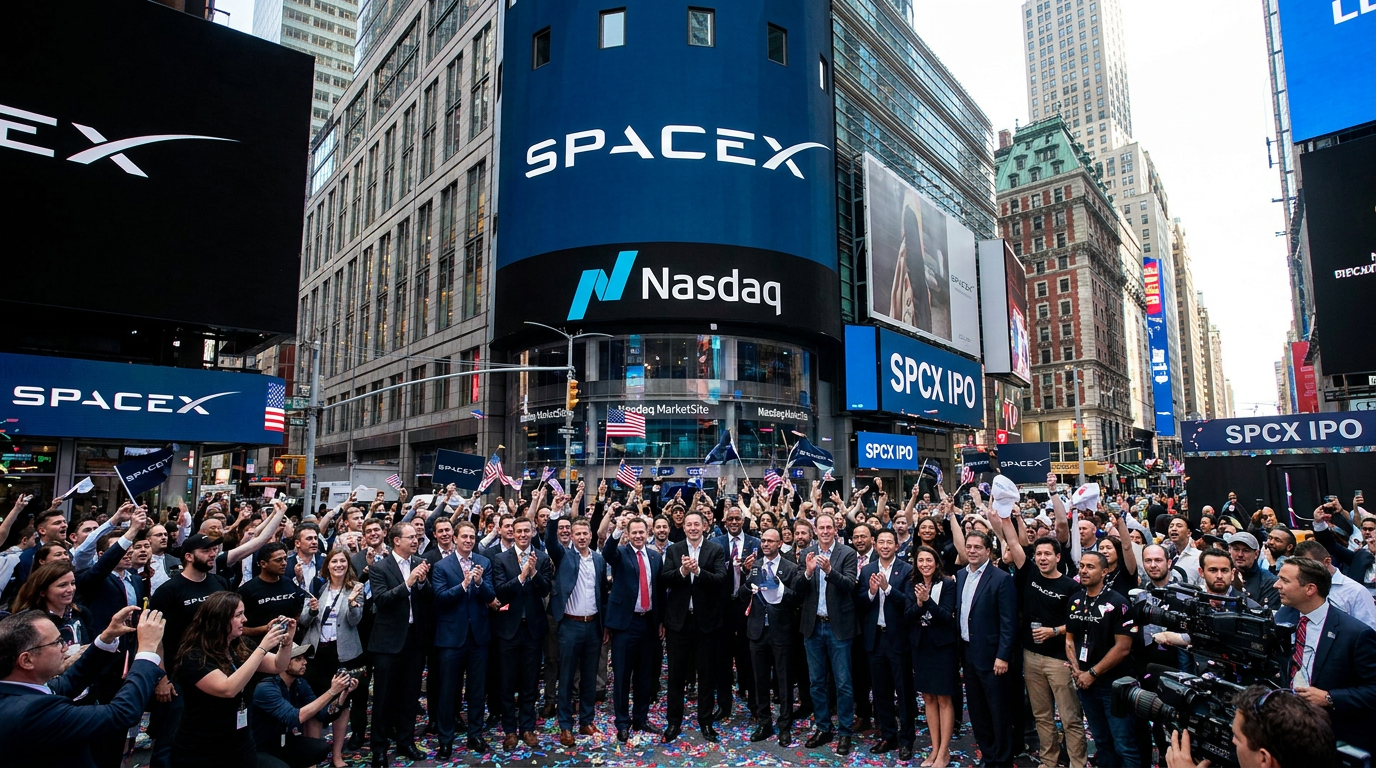
SpaceX has officially executed the largest initial public offering in the history of global finance. On Friday, June 12, the aerospace and artificial intelligence conglomerate debuted on the Nasdaq under the ticker symbol SPCX, raising an unprecedented $75 billion.[1][5][7]
The stock opened at $150—well above its fixed offering price of $135—and surged as high as $176.52 during intraday trading. By the time the closing bell rang, shares settled at $160.95, marking a 19% first-day gain that pushed the company's market capitalization past the $2.1 trillion threshold.[1][2][3]
This astronomical valuation instantly positioned SpaceX as the sixth most valuable publicly traded company in the United States, leapfrogging established tech giants and even surpassing the market cap of Elon Musk's other flagship enterprise, Tesla.[3][4][5]
The sheer scale of the offering shattered the previous record held by Saudi Aramco's $29 billion debut in 2019. Demand was overwhelming, with institutional and retail investors placing orders totaling more than $350 billion—nearly four times the available supply of 555.6 million shares.[4][7]

In a highly unusual move for a mega-cap IPO, SpaceX bypassed the traditional Wall Street price-discovery mechanism. Instead of offering an indicative price range and narrowing it through weeks of institutional bookbuilding, the company dictated a strict, take-it-or-leave-it price of $135 per share.[1][8]
The offering was also uniquely structured to democratize access. SpaceX reserved up to 30% of its shares for retail investors—roughly three times the standard allocation for a major IPO. Brokerages lowered their participation thresholds, allowing customers with as little as $2,000 in their accounts to request shares.[6][8]
The offering was also uniquely structured to democratize access.
The financial windfall from the debut reverberated immediately, minting a new class of billionaires among early investors and turning thousands of current and former SpaceX employees into millionaires overnight.[2][4]
At the top of the cap table, the IPO pushed Elon Musk's personal net worth past $1.1 trillion, making him the first documented trillionaire in modern history. Musk retains a massive 42% equity stake in the newly public entity and wields 82.4% of its voting power through a dual-class share structure.[1][2][4]
While the market's reception was euphoric, financial analysts are quick to point out the stark contrast between SpaceX's valuation and its current balance sheet. Unlike highly profitable trillion-dollar peers such as Apple or Alphabet, SpaceX remains unprofitable, having booked an $8.7 billion loss between the start of 2025 and March 2026.[3][8]

Investors, however, appear to be pricing in a future dominated by the company's expanding monopolies in space infrastructure and artificial intelligence. In February 2026, SpaceX acquired Musk's AI startup, xAI, in a move that fundamentally expanded the aerospace company's mandate.[1][3]
The integration of xAI positions SpaceX to build orbital data centers, leveraging the vacuum and cold of space to cool massive AI compute clusters while using its Starlink satellite network for high-bandwidth data transmission back to Earth.[1][3]
The global scramble for a piece of the SpaceX pie has already triggered international regulatory scrutiny. In South Korea, the financial watchdog launched an expanded inspection into Mirae Asset Securities after the brokerage failed to secure its expected allocation of SpaceX shares, leaving local investors empty-handed.[9]

How we got here
December 2025
Elon Musk publicly confirms intentions to take SpaceX public in mid-2026.
February 2026
SpaceX acquires Musk's artificial intelligence startup, xAI, merging aerospace and AI operations.
May 20, 2026
SpaceX publicly files its S-1 prospectus with the SEC, revealing its financial details and space-based data center plans.
June 3, 2026
The company bypasses traditional price discovery, setting a fixed IPO price of $135 per share.
June 12, 2026
SpaceX debuts on the Nasdaq, raising $75 billion and closing its first day with a valuation over $2 trillion.
Viewpoints in depth
Retail Investors & Enthusiasts
View the IPO as a historic opportunity to participate in the space economy.
For years, everyday investors were locked out of SpaceX's meteoric private market growth. By allocating 30% of the offering to retail accounts, the company allowed retail traders to buy into the vision of multiplanetary life and orbital AI infrastructure. Enthusiasts see the $135 fixed price as a fair entry point into a company they believe will define the 21st century, celebrating the democratization of what is typically an exclusive institutional event.
Institutional Analysts
Focus on the massive valuation premium and the lack of traditional profitability.
Wall Street veterans note that a $2.1 trillion valuation places SpaceX in the same league as Alphabet and Apple, despite the aerospace firm losing $8.7 billion over the last five quarters. They caution that the stock's pricing is entirely forward-looking, dependent on the flawless execution of Starship and the unproven economics of space-based AI data centers. For these analysts, the stock represents a high-risk, high-reward bet on Elon Musk's ability to execute.
Space & Tech Visionaries
Celebrate the capital raise as the necessary fuel for Mars colonization and AI integration.
Industry advocates argue that traditional financial metrics fail to capture SpaceX's true value. The $75 billion raised is viewed as the ultimate war chest required to fund the staggering costs of establishing a permanent human presence on Mars. For this camp, the IPO is less about quarterly earnings and more about securing the financial runway for species-level technological leaps, including the integration of xAI to build orbital data centers.
Global Regulators & Watchdogs
Express concern over unprecedented wealth concentration and chaotic international allocation mechanics.
Watchdogs are scrutinizing the dual-class share structure that gives a single individual—now the world's first trillionaire—82.4% voting control over a $2 trillion public entity. Additionally, the chaotic international allocation process, which left major overseas brokerages empty-handed and triggered regulatory reviews in countries like South Korea, has raised questions about the fairness and transparency of the global distribution.
What we don't know
- How quickly SpaceX can achieve profitability to justify its $2 trillion valuation.
- Whether the integration of xAI and the concept of space-based data centers will prove technologically and economically viable.
- How the massive influx of public capital will alter the company's historically agile and risk-tolerant engineering culture.
Key terms
- Initial Public Offering (IPO)
- The process by which a private company offers shares to the public for the first time, transitioning into a publicly traded entity.
- Market Capitalization
- The total value of a publicly traded company's outstanding shares, calculated by multiplying the current share price by the total number of shares.
- Dual-class share structure
- A corporate setup where different classes of shares have different voting rights, allowing founders to maintain control of the company despite selling equity.
- Bookbuilding
- The traditional process where investment banks gather indications of interest from institutional investors to determine the final price of an IPO.
- xAI
- An artificial intelligence company founded by Elon Musk, which was acquired by SpaceX in February 2026 to integrate AI infrastructure with aerospace.
Frequently asked
What was the SpaceX IPO price?
SpaceX priced its shares at a fixed $135 each, bypassing the traditional Wall Street method of offering a price range.
How much is SpaceX worth now?
After its first day of trading, SpaceX reached a market capitalization of approximately $2.1 trillion.
Did Elon Musk become a trillionaire?
Yes. The surge in SpaceX's valuation, combined with his 42% equity stake, pushed Musk's estimated net worth past $1.1 trillion.
Can anyone buy SpaceX stock now?
Yes. The stock is now publicly traded on the Nasdaq exchange under the ticker symbol SPCX.
Is SpaceX a profitable company?
Not currently. Despite its massive valuation, the company reported an $8.7 billion loss between early 2025 and March 2026 as it invests heavily in research and development.
Sources
Source coverage
9 outlets
4 viewpoints surfaced






[1]The GuardianSpace & Tech Visionaries
SpaceX made the biggest stock market debut in history
Read on The Guardian →[2]Business InsiderRetail Investors & Enthusiasts
SpaceX stock popped in its first day of trading
Read on Business Insider →[3]CBS NewsInstitutional Analysts
SpaceX makes blockbuster stock market debut
Read on CBS News →[4]El PaísSpace & Tech Visionaries
SpaceX becomes one of the world's leading tech giants
Read on El País →[5]BNN BloombergInstitutional Analysts
SpaceX vaults over US$2 trillion valuation as stock jumps after record IPO
Read on BNN Bloomberg →[6]FidelityRetail Investors & Enthusiasts
SpaceX IPO participation guide
Read on Fidelity →[7]SpaceXSpace & Tech Visionaries
SpaceX Confirms Pricing of Initial Public Offering
Read on SpaceX →[8]CNBCInstitutional Analysts
SpaceX: To the moon for investors or a bumpy ride? Here's what experts say
Read on CNBC →[9]BloombergGlobal Regulators & Watchdogs
Failed SpaceX IPO Allocation Prompts Korea to Widen Mirae Review
Read on Bloomberg →
More in business
See all 5 stories →AI Infrastructure
SpaceX Raises Record $85.7 Billion in Historic IPO to Fund Orbital AI Infrastructure
7 sources
AI Economics
The Compute-First Era: How AI is Rewriting the Rules of Venture Capital
6 sources
Fed Watch
Federal Reserve Holds Rates Steady as New Chair Kevin Warsh Signals Hawkish Pivot
8 sources
Every angle. Every day.
Get business stories with full source coverage and perspective breakdowns delivered to your inbox.