
SpaceX Completes Historic $75 Billion IPO, Revealing Massive Starlink Revenue and AI Pivot
SpaceX has executed the largest initial public offering in history, raising $75 billion and achieving a $2 trillion market capitalization while publicly disclosing its internal financials for the first time.
By Factlen Editorial Team
- Space and Tech Optimists
- Viewing the IPO as a necessary funding mechanism for interplanetary expansion and AI dominance.
- Financial Skeptics
- Raising concerns over massive capital expenditures, unprofitability, and potential shareholder dilution.
- Retail Investors
- Celebrating the democratization of access to one of the world's most valuable private companies.
What's not represented
- · Terrestrial telecom competitors facing disruption from Starlink's capitalization.
- · Environmental groups concerned about the ecological impact of accelerated Starship launches.
- · Government regulators tasked with overseeing a private company with unprecedented orbital dominance.
Why this matters
The public listing of SpaceX democratizes access to the commercial space economy, allowing retail investors to own a stake in humanity's interplanetary infrastructure. The newly revealed financials also prove that space-based telecommunications and orbital AI computing are now viable, multi-billion-dollar industries.
Key points
- SpaceX completed the largest IPO in history, raising $75 billion at a fixed price of $135 per share.
- The stock surged 19% on its first day of trading, pushing the company's market capitalization past $2 trillion.
- Newly public S-1 filings revealed $18.7 billion in 2025 revenue, with Starlink accounting for 61% of the total.
- SpaceX is pivoting heavily into AI, confirming its acquisition of xAI and a $1.25 billion monthly compute contract with Anthropic.
- Despite massive revenue growth, the company posted a $4.28 billion net loss in Q1 2026 due to heavy infrastructure spending.
- The company allocated an unprecedented 30% of its IPO float to retail investors.
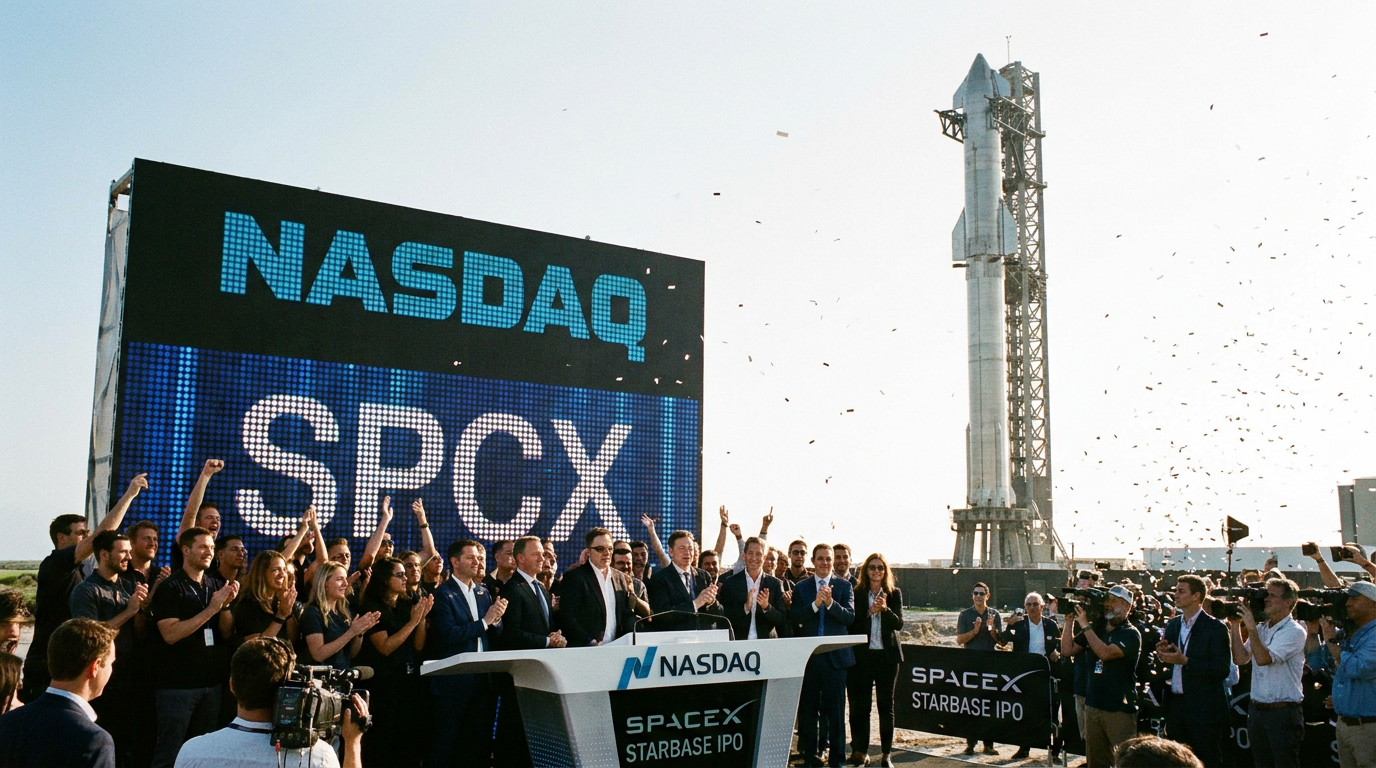
On June 12, 2026, Space Exploration Technologies Corp. completed the largest initial public offering in global financial history. Trading under the ticker symbol SPCX on the Nasdaq and the newly launched Nasdaq Texas, the aerospace giant priced its shares at a fixed $135, successfully raising an unprecedented $75 billion. The landmark event marks a structural shift in the commercial space industry, transitioning Elon Musk's two-decade-old private venture into a publicly traded behemoth. The sheer scale of the offering bypassed traditional Wall Street bookbuilding conventions, signaling immense confidence from both the underwriters and the company's leadership.[1][2][7]
The market reaction to the debut was immediate and staggering. Demand for the offering was heavily oversubscribed, with institutional and retail investors placing orders for over $250 billion in shares prior to the listing. When trading officially opened on Friday morning, the stock immediately jumped to $150 per share. By the closing bell, SPCX had settled at $160.95, representing a 19% gain from its initial offering price. This first-day surge pushed SpaceX's implied market capitalization past the $2 trillion mark, cementing its position among the world's most valuable technology companies alongside Apple, Microsoft, and Nvidia.[2][5][8]
To fully grasp the magnitude of the SPCX offering, it is necessary to contextualize it against historical financial precedents. Prior to this week, the record for the largest IPO in history belonged to the state-owned oil giant Saudi Aramco, which raised $25.6 billion during its 2019 debut. SpaceX's $75 billion raise nearly triples that milestone, entirely rewriting the playbook for mega-cap public listings. Furthermore, it dwarfs the largest American tech IPOs, such as Alibaba's $21.8 billion raise in 2014 and Meta's $16 billion debut in 2012, establishing a new ceiling for capital formation in the public markets.[1][4][8]

For over twenty years, SpaceX's internal financials and operational metrics were closely guarded private secrets, subject only to speculation by industry analysts. The mandatory release of its Form S-1 registration statement finally provided the public with empirical evidence of the company's economic engine. The comprehensive filing revealed that SpaceX generated $18.7 billion in total revenue for the full year of 2025, representing a robust 33% year-over-year increase from 2024. This transparency offers the first verifiable look at how the company monetizes its dominance in orbital launch services and global satellite connectivity.[4][7]
Crucially, the S-1 data demonstrates that the primary driver of this massive revenue stream is not the company's famous reusable Falcon 9 rockets, but rather its orbital internet constellation. Starlink accounted for $11.4 billion—or roughly 61%—of SpaceX's total 2025 revenue. The recurring subscription model of the low-Earth orbit satellite network has effectively transformed the aerospace manufacturer into a global telecommunications giant. By providing high-speed broadband to remote regions, maritime vessels, and commercial airlines, Starlink has created a highly predictable cash flow engine that underpins the company's more experimental ventures.[3][7]

However, the most surprising evidence buried within the S-1 filing was SpaceX's aggressive and heavily capitalized expansion into artificial intelligence infrastructure. The regulatory documents officially confirmed the company's February 2026 acquisition of xAI, Elon Musk's standalone artificial intelligence venture, integrating it directly into the aerospace firm's balance sheet. This consolidation brings advanced large language models, supercomputing clusters, and neural network development directly under the SpaceX corporate umbrella. It signals a strategic pivot that extends far beyond traditional aerospace engineering and satellite deployment, positioning the company to dominate the physical infrastructure required for the next generation of artificial general intelligence.[6]
The filing also detailed massive, previously undisclosed contracted revenue from the broader AI sector, proving that this pivot is already monetized. Anthropic, a leading artificial intelligence research company, has agreed to pay SpaceX approximately $1.25 billion per month for dedicated computing power through the year 2029. Furthermore, SpaceX disclosed a $60 billion option to acquire the AI coding agent startup Cursor later this year. These massive figures indicate that SpaceX is leveraging its orbital infrastructure to deploy space-based, solar-powered data centers capable of handling the immense compute loads required by next-generation AI models.[6][7]
The filing also detailed massive, previously undisclosed contracted revenue from the broader AI sector, proving that this pivot is already monetized.
This convergence of technologies suggests that public market investors are not simply buying shares in a traditional rocket launch provider. Instead, they are investing in a highly integrated conglomerate that merges aerospace logistics, global broadband connectivity, and advanced AI computing infrastructure into a single unified ecosystem. The strategic vision outlined in the prospectus positions SpaceX as the foundational backbone for the next century of technological advancement. By leveraging its launch monopoly, the company aims to move data processing and global communications off-planet, bypassing terrestrial energy grid constraints and regulatory bottlenecks to create a truly orbital digital economy.[2][7]
Beyond its technological implications, the SpaceX IPO is notable for its structural democratization of equity. Historically, Wall Street underwriters reserve only 5% to 10% of a mega-cap IPO's float for retail investors, prioritizing institutional clients and hedge funds. In a stark departure from this norm, SpaceX allocated an unprecedented 30% of its shares directly to the retail market. This decision allowed everyday traders and space enthusiasts to participate in the historic listing, aligning the company's capital structure with its populist mission of making humanity a spacefaring civilization.[7]
The sheer scale of the company's public valuation has also fundamentally reshaped global wealth metrics. With SPCX closing its first day of trading well above a $2 trillion market capitalization, the financial landscape witnessed a historic personal milestone. Elon Musk, who retains roughly a 42% equity stake and 85% voting control of the company, saw his net worth surge exponentially. Based on his combined holdings in SpaceX, Tesla, and other ventures, the listing officially made Musk the world's first trillionaire.[8]
Despite the historic success and euphoric market reception of the listing, the S-1 filing also provided transparent evidence of the company's deep financial vulnerabilities. While revenue is growing rapidly, SpaceX is not currently profitable on a Generally Accepted Accounting Principles (GAAP) basis. In the first quarter of 2026 alone, the company posted a staggering net loss of $4.28 billion, adding to an accumulated deficit of over $41 billion. This transparent uncertainty highlights the immense financial risks inherent in the company's ambitious operational roadmap.[7]

This massive quarterly deficit is largely driven by unprecedented capital expenditures required to maintain the company's technological edge. According to the filings, SpaceX is burning approximately $2.5 billion per quarter solely on AI infrastructure. This is in addition to the heavy depreciation costs associated with constantly replenishing the Starlink satellite constellation, and the billions being poured into the ongoing research, development, and explosive testing of the Starship heavy-lift launch vehicle. The company is effectively funding three capital-intensive mega-projects simultaneously.[4][7]
Investors must also carefully weigh the explicit risks outlined in the company's amended regulatory filings. In early June, just days before the IPO, SpaceX filed an amendment to its S-1 containing a critical 13-word warning: 'We may issue a significant amount of equity in connection with future transactions.' Financial analysts view this clause as a clear signal that the company plans to dilute existing shareholders to fund its massive acquisition pipeline, particularly the pending $60 billion option for the AI startup Cursor.[6]
Ultimately, market analysts note that this dilution risk and heavy cash burn are tied directly to the company's founding mission. The $75 billion raised in the IPO is not intended for near-term dividends or share buybacks; it is explicitly earmarked to finance SpaceX's most ambitious and capital-intensive goals, primarily the establishment of a self-sustaining human colony on Mars. The public offering provides the war chest necessary to transition Starship from a developmental prototype into a reliable interplanetary transport system.[2]
As SpaceX transitions from a nimble private disruptor into a heavily scrutinized, publicly traded behemoth, the operational dynamics of the company will inevitably undergo a profound shift. Executive leadership must now balance the relentless quarterly earnings demands, margin pressures, and transparency requirements of Wall Street with its multi-decade, highly experimental interplanetary ambitions. The inherent tension between delivering short-term shareholder value and funding a mission to Mars will define the company's corporate governance for the foreseeable future, testing whether a public corporation can successfully execute a project designed to alter the trajectory of human civilization.[3]
The overwhelming success of the SPCX listing proves that public markets are willing to underwrite massive, capital-intensive technological visions, provided the underlying revenue engines—like the Starlink constellation—show verifiable evidence of scale and consumer demand. The $75 billion IPO has successfully secured the unprecedented funding required for the next era of commercial space exploration and AI infrastructure development. However, whether institutional patience will extend to the costly, high-risk, and decades-long endeavor of reaching and colonizing Mars remains the defining question for the world's newest $2 trillion company.[4][5]
How we got here
April 2026
SpaceX confidentially submits its draft S-1 registration statement to the SEC.
May 20, 2026
The public S-1 is filed, revealing SpaceX's internal financials for the first time.
June 3, 2026
SpaceX bypasses traditional bookbuilding, setting a fixed IPO price of $135 per share.
June 11, 2026
The offering officially prices, securing $75 billion in capital.
June 12, 2026
Shares begin trading on the Nasdaq under the ticker SPCX, closing up 19%.
Viewpoints in depth
Space and Tech Optimists
Viewing the IPO as a necessary funding mechanism for interplanetary expansion and AI dominance.
For technological optimists, the $75 billion raised is not just a financial milestone, but the capital required to make humanity multi-planetary. They point to Starlink's massive $11.4 billion revenue engine as proof that SpaceX can successfully commercialize space. Furthermore, the integration of xAI and massive computing contracts with Anthropic suggest the company is positioning itself as the foundational infrastructure for the next century of technological advancement.
Financial Skeptics
Raising concerns over massive capital expenditures, unprofitability, and potential shareholder dilution.
Financial analysts and skeptics focus heavily on the 'transparent uncertainty' revealed in the S-1 filing. Despite the $1.77 trillion valuation, SpaceX posted a $4.28 billion net loss in the first quarter of 2026 alone. Skeptics argue that the $2.5 billion quarterly burn rate on AI infrastructure, combined with the explicit warnings of future equity dilution to fund acquisitions like Cursor, presents a highly risky proposition for public market investors who demand near-term profitability.
Retail Market Participants
Celebrating the democratization of access to one of the world's most valuable private companies.
A significant narrative surrounding the IPO is its structural break from Wall Street tradition. By allocating 30% of the float to retail investors—roughly three times the standard for mega-cap offerings—SpaceX allowed everyday traders to participate in the historic listing. For this camp, the IPO represents a shift in how generational wealth-building opportunities are distributed, moving away from exclusive institutional access toward broader public ownership.
What we don't know
- Whether public market investors will tolerate the massive, multi-billion dollar quarterly losses required to fund the Mars colonization effort.
- How the $60 billion option to acquire the AI startup Cursor will be financed, and whether it will significantly dilute current shareholders.
- The exact timeline for when SpaceX expects its heavy capital expenditures to translate into GAAP profitability.
Key terms
- Initial Public Offering (IPO)
- The process by which a private company offers shares of its stock to the public for the first time.
- S-1 Filing
- A registration document required by the SEC that provides detailed financial and business information before a company goes public.
- Float
- The number of a corporation's shares that are available for trading by the public.
- Capital Expenditure (Capex)
- Funds used by a company to acquire, upgrade, and maintain physical assets such as property, industrial buildings, or equipment.
- Dilution
- A reduction in the ownership percentage of a share of stock caused by the issuance of new shares.
Frequently asked
How much did SpaceX raise in its IPO?
SpaceX raised $75 billion by selling 555.5 million shares at $135 each, making it the largest initial public offering in history.
Is SpaceX a profitable company?
While SpaceX generated $18.7 billion in revenue in 2025, it is not currently profitable on a GAAP basis, posting a $4.28 billion net loss in Q1 2026 due to heavy infrastructure investments.
What is the ticker symbol for SpaceX?
SpaceX trades on the Nasdaq and Nasdaq Texas under the ticker symbol SPCX.
Why did SpaceX acquire AI companies?
SpaceX is integrating artificial intelligence with its space infrastructure, securing massive computing contracts and positioning itself as a combined aerospace and AI conglomerate.
Sources
Source coverage
8 outlets
3 viewpoints surfaced








[1]ReutersRetail Investors
SpaceX sells $75 billion in shares in record IPO
Read on Reuters →[2]CBS NewsRetail Investors
SpaceX stock soars 19% on first day of trading following record-breaking $75 billion IPO
Read on CBS News →[3]NasdaqSpace and Tech Optimists
SpaceX (SPCX): Rocket Company Launches Historic IPO
Read on Nasdaq →[4]SEC
Space Exploration Technologies Corp. Form S-1 Registration Statement
Read on SEC →[5]ForbesRetail Investors
SpaceX IPO broke records, raising $75 billion
Read on Forbes →[6]The Motley FoolFinancial Skeptics
SpaceX's amended IPO filing contains a 13-word warning
Read on The Motley Fool →[7]BitMEX ResearchFinancial Skeptics
SpaceX IPO Date, Price, and Trading Strategy: What the S-1 Actually Tells You
Read on BitMEX Research →[8]Fast CompanySpace and Tech Optimists
SpaceX stock rises after record-breaking IPO; Elon Musk becomes world's first trillionaire
Read on Fast Company →

Every angle. Every day.
Get science stories with full source coverage and perspective breakdowns delivered to your inbox.