
Solid-State Batteries: The Breakthrough Tech Rewriting the Rules of EVs
After years of laboratory development, solid-state batteries are finally entering real-world production in 2026. By replacing flammable liquid electrolytes with solid materials, the technology promises to double EV ranges, slash charging times, and virtually eliminate battery fires.
By Factlen Editorial Team
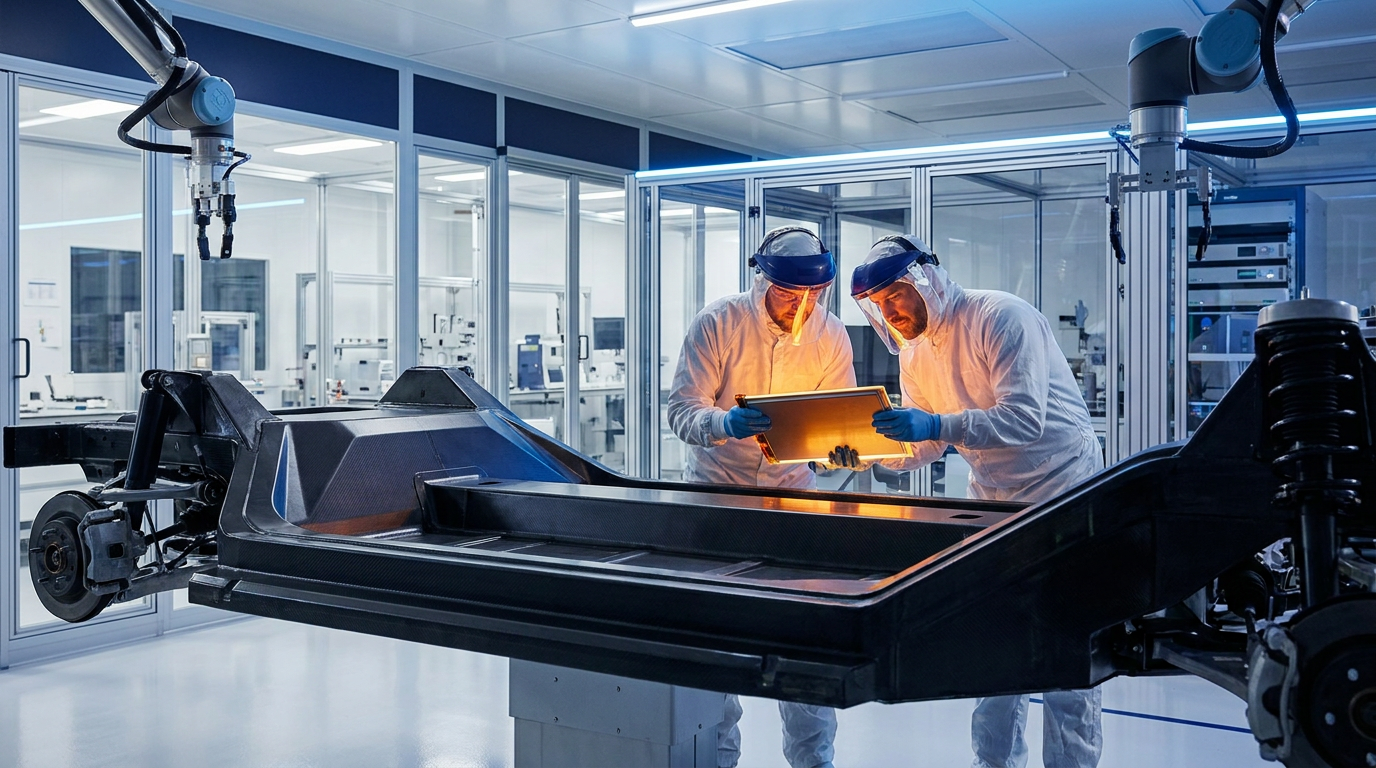
- Automotive Optimists
- Focus on the massive performance leaps and imminent 2027-2028 rollout targets that will solve range anxiety.
- Technical & Market Analysts
- Emphasize the immense manufacturing challenges, high initial costs, and the reality that mass adoption is a 2030s story.
What's not represented
- · Raw Material Suppliers
- · Current EV Owners
Why this matters
Solid-state batteries are poised to eliminate the biggest hurdles to electric vehicle adoption: range anxiety, long charging times, and battery fire risks. By fundamentally changing the chemistry of how cars store power, this technology will make the next generation of EVs lighter, safer, and capable of driving over 600 miles on a 10-minute charge.
Key points
- Solid-state batteries replace flammable liquid electrolytes with solid materials, drastically improving safety.
- The technology can achieve energy densities of 400-500 Wh/kg, nearly double that of current lithium-ion cells.
- Automakers have demonstrated prototype cells capable of charging from 10% to 80% in just 10 to 15 minutes.
- Manufacturing challenges and high costs mean early adoption will be limited to premium vehicles.
- Major automakers like Toyota and Volkswagen are targeting 2027-2028 for mass-market production.
For the past decade, the electric vehicle industry has been chasing a singular, elusive breakthrough. While today's lithium-ion batteries have successfully brought EVs into the mainstream, they are fundamentally constrained by chemistry, leaving drivers to grapple with range anxiety, heavy vehicle weights, and lingering safety concerns. The solution to these bottlenecks has long been theorized in laboratories: the solid-state battery. Often described as the "holy grail" of energy storage, this technology promises to double driving ranges, slash charging times to mere minutes, and virtually eliminate the risk of battery fires.[1]
For years, solid-state technology seemed perpetually five years away. But in 2026, the timeline has violently accelerated. The technology is finally escaping the laboratory and hitting the asphalt. In a landmark test, Mercedes-Benz recently drove an EQS sedan equipped with prototype solid-state cells over 1,200 kilometers (745 miles) across three European countries on a single charge. Simultaneously, battery manufacturers like China's Greater Bay Technology have announced that their first mass-producible all-solid-state cells are rolling off assembly lines this year.[2][4]
To understand why this shift is so monumental, it helps to look inside the battery powering your smartphone or current EV. A traditional lithium-ion battery consists of two electrodes—an anode and a cathode—separated by a liquid electrolyte. When the battery charges or discharges, lithium ions swim back and forth through this liquid bath. While effective, this liquid electrolyte is the root cause of almost every limitation in modern electric vehicles.[7]
The liquid is heavy, it takes up valuable physical space, and most critically, it is composed of highly flammable organic solvents. A solid-state battery elegantly solves these problems by replacing the liquid bath with a solid separator—typically made of advanced ceramics, glass, or sulfide-based polymers. This single architectural change unlocks a cascade of physical and chemical advantages that fundamentally alter what an electric vehicle can do.[1][7]

The most immediate benefit is a massive leap in energy density—the amount of power a battery can hold relative to its weight. Because solid electrolytes are structurally rigid, they allow engineers to use pure lithium-metal anodes instead of the bulky graphite used in today's cells. Current top-tier lithium-ion batteries max out at an energy density of roughly 250 to 300 watt-hours per kilogram (Wh/kg). The new generation of solid-state cells is consistently hitting 400 to 500 Wh/kg in testing.[2][3]
For the driver, this density translates directly into freedom. Automakers can take two distinct paths with this new chemistry. They can keep the battery pack the same size as today's models, effectively doubling the vehicle's range to well over 600 miles. Alternatively, they can cut the battery size and weight in half while maintaining a standard 300-mile range, resulting in lighter, more agile, and vastly more efficient vehicles.[4][6]
Beyond range, solid-state technology fundamentally rewrites the rules of charging. When a traditional lithium-ion battery is fast-charged, the liquid electrolyte heats up rapidly, degrading the battery's lifespan and risking a thermal event if pushed too hard. Solid electrolytes, by contrast, are remarkably thermally stable. They can handle a massive, rapid influx of electrical current without degrading or overheating.[3][6]
Beyond range, solid-state technology fundamentally rewrites the rules of charging.
The real-world numbers are staggering. Automakers like Toyota, alongside battery developers like QuantumScape, have demonstrated solid-state cells capable of charging from 10% to 80% capacity in just 10 to 15 minutes. This effectively mirrors the time it takes to fill a traditional combustion engine vehicle with gasoline, removing one of the final psychological barriers to mass EV adoption.[5][6]

Safety is another arena where solid-state batteries offer a generational leap. The terrifying, hard-to-extinguish fires occasionally associated with electric vehicles are driven by "thermal runaway"—a chain reaction fueled by the combustible liquid electrolyte. By removing the flammable liquid entirely, solid-state batteries drastically reduce the risk of catastrophic fires, even if the battery pack is physically punctured in a severe collision.[1][7]
This thermal stability also pays dividends in extreme weather. Traditional EVs notoriously lose up to 30% of their range in freezing temperatures because the liquid electrolyte becomes viscous, acting like molasses and slowing the movement of ions. Solid electrolytes are largely impervious to these temperature swings, ensuring that a vehicle delivers consistent range and performance whether it is operating in a blizzard or a heatwave.[6]
If the physics are so superior, the obvious question is why these batteries aren't already in every driveway. The answer lies in the microscopic complexities of manufacturing. When a solid-state battery charges, lithium ions must perfectly plate themselves against the solid separator. If the manufacturing is not flawless, microscopic metal spikes called "dendrites" can form, eventually piercing the solid layer and short-circuiting the cell.[3]
Preventing dendrite growth requires manufacturing environments with near-atomic levels of precision, which is astronomically expensive. Market analysts estimate that early solid-state batteries cost between $400 and $800 per kilowatt-hour to produce. By comparison, mature lithium-ion batteries currently cost around $130 per kilowatt-hour. Scaling up from bespoke laboratory prototypes to automated gigafactory volumes is a multi-billion-dollar engineering hurdle.[8]

Despite the costs, the automotive industry has committed to a definitive timeline. While 2026 is the year of pilot programs and limited-run prototype testing, the mass market is bracing for the end of the decade. Toyota, which holds over a thousand patents in the space, has publicly targeted 2027 to 2028 for the rollout of its first mass-produced solid-state EVs. Nissan and Volkswagen are aggressively pursuing similar late-decade production targets.[5][6]
In the interim, the industry is not standing still. "Semi-solid-state" batteries, which use a hybrid approach combining a solid separator with a small amount of liquid or gel electrolyte, are already bridging the gap. These hybrid cells offer a middle ground of improved safety and density and are currently powering select premium EVs in the Chinese market, serving as a vital stepping stone for global supply chains.[3]
The shift to solid-state also carries profound environmental implications. Because these batteries require significantly less heavy cooling infrastructure and can utilize more abundant materials, early lifecycle analyses suggest they could reduce the overall carbon footprint of an EV battery by up to 24%. Furthermore, the move toward lithium-metal anodes reduces the industry's reliance on graphite, a supply chain currently bottlenecked by geopolitical tensions.[8]

The transition away from liquid electrolytes will not happen overnight, and lithium-ion batteries will continue to dominate affordable vehicles for years to come. However, the underlying physics are no longer in doubt. With billions of dollars in capital deployed and the first production cells finally rolling off assembly lines, solid-state batteries have transitioned from a theoretical dream to the definitive future of global transportation.[1][5]
How we got here
1950s–1980s
Early researchers discover that certain solid crystals and polymers can conduct ions, laying the theoretical groundwork for solid-state energy storage.
2010s
Lithium-ion batteries become the global standard for EVs, but engineers begin hitting the chemical limits of liquid electrolytes.
2022–2024
Billions of dollars flow into battery startups like QuantumScape and Factorial, resulting in successful lab-scale solid-state prototypes.
2026
The technology moves to the real world, with Mercedes-Benz testing a 1,200-km prototype and manufacturers opening the first pilot production lines.
2027–2028
Major automakers, led by Toyota and Nissan, plan to launch their first mass-produced solid-state electric vehicles to the public.
Viewpoints in depth
The Automakers' View
Legacy car manufacturers see solid-state as the key to unlocking mass EV adoption.
For legacy automakers like Toyota, Volkswagen, and Mercedes-Benz, solid-state technology is the ultimate differentiator. By promising 600-mile ranges and 10-minute charge times, they believe they can finally win over consumers who have resisted electric vehicles due to range anxiety and charging inconvenience. These companies are investing billions to hit aggressive 2027-2028 mass-production targets, viewing the technology not just as an upgrade, but as an existential necessity to compete with established EV leaders.
The Analysts' View
Market experts caution that scaling the technology from the lab to the gigafactory will be slow and expensive.
While acknowledging the superior physics of solid-state cells, supply chain analysts and market realists urge caution regarding the timeline. They point out that manufacturing solid electrolytes requires near-perfect, clean-room conditions to prevent microscopic defects. Because early production runs will yield high failure rates and cost up to five times more than traditional lithium-ion cells, analysts predict that solid-state batteries will be confined to luxury vehicles and hypercars until at least the early 2030s.
What we don't know
- Exactly how quickly manufacturing costs will fall once gigafactory-scale production begins.
- Whether unforeseen long-term degradation issues will emerge once solid-state batteries are subjected to years of real-world driving conditions.
Key terms
- Solid-State Battery
- A battery that uses a solid electrolyte, rather than a liquid or gel, to move ions between its electrodes.
- Electrolyte
- The medium inside a battery that allows electrical charge (ions) to flow between the cathode and the anode.
- Energy Density
- The amount of energy a battery can store relative to its weight or size, typically measured in watt-hours per kilogram (Wh/kg).
- Thermal Runaway
- A dangerous chain reaction within a battery cell where excessive heat causes a rapid, uncontrollable increase in temperature, often leading to fires.
- Dendrites
- Microscopic, needle-like metal structures that can grow inside a battery during charging, potentially piercing the separator and causing a short circuit.
Frequently asked
When can I buy an EV with a solid-state battery?
While some pilot vehicles and premium models are testing the technology in 2026, mass-market availability from major automakers like Toyota and Volkswagen is targeted for the 2027 to 2028 timeframe.
Will solid-state batteries make electric cars cheaper?
Eventually, yes. However, early solid-state batteries will be significantly more expensive to produce than current lithium-ion cells. Prices are expected to drop as manufacturing scales up in the early 2030s.
Are solid-state batteries completely fireproof?
While not entirely immune to extreme heat, they are vastly safer than lithium-ion batteries because they eliminate the highly flammable liquid electrolyte, drastically reducing the risk of thermal runaway.
Sources
Source coverage
8 outlets
2 viewpoints surfaced








[1]Car and DriverAutomotive Optimists
What Are Solid-State Batteries, and Why Do They Matter for EVs?
Read on Car and Driver →[2]ElectrekAutomotive Optimists
Solid-state EV batteries are coming sooner than expected after another breakthrough
Read on Electrek →[3]Edison ExplainsTechnical & Market Analysts
Solid-State Batteries & EV Tech Insights
Read on Edison Explains →[4]EleportAutomotive Optimists
New Battery Technologies 2026 Are Changing The Industry. Here's How
Read on Eleport →[5]Afseth MillarTechnical & Market Analysts
Solid-State Battery Market Roadmap
Read on Afseth Millar →[6]Lease ElectricAutomotive Optimists
Toyota Targets 2027 for First Solid-State Battery EV
Read on Lease Electric →[7]Autovista24Technical & Market Analysts
What is an EV solid-state battery?
Read on Autovista24 →[8]Chasing CarsTechnical & Market Analysts
When will solid state batteries arrive for EVs?
Read on Chasing Cars →
Every angle. Every day.
Get automotive stories with full source coverage and perspective breakdowns delivered to your inbox.