
Solid-State Batteries in 2026: The Car Buyer's Explainer
After a decade of promises, solid-state EV batteries are finally moving from the lab to the production line in 2026. Here is how the technology works, who is building it, and what it means for your next car purchase.
By Factlen Editorial Team
- Aggressive Adopters
- Focus on rapid commercialization, semi-solid stepping stones, and China's 2026 regulatory push.
- Methodical Developers
- Emphasize careful testing, manufacturing durability, and the 2027-2028 timeline of legacy Japanese automakers.
- Industry Realists
- Highlight the immense manufacturing costs and the reality that early models will be strictly luxury vehicles.
What's not represented
- · Lithium-ion battery manufacturers defending current tech
- · Raw material mining companies supplying solid electrolytes
- · Independent EV repair technicians
Why this matters
Solid-state batteries are poised to eliminate the two biggest hurdles to EV adoption: range anxiety and charging times. Understanding this timeline helps car buyers decide whether to invest in a current lithium-ion EV today or wait for the next generation of automotive technology.
Key points
- Solid-state batteries replace flammable liquid electrolytes with stable solid materials, drastically reducing fire risks.
- The technology aims to double the energy density of current EVs, enabling ranges of over 600 miles and 10-minute charging.
- China is set to release the world's first official solid-state EV battery standard in July 2026 to accelerate domestic production.
- Legacy automakers like Toyota and Nissan are targeting 2027 to 2028 for their first consumer-ready solid-state vehicles.
For over a decade, the automotive industry has treated solid-state batteries as the ultimate "holy grail"—a revolutionary technology that always seemed perpetually five years away. But in 2026, the landscape is shifting from laboratory prototypes to actual production lines. Major automakers across Japan, China, and Europe are now committing billions of dollars to commercialize what is widely considered the most significant leap in energy storage since the invention of the lithium-ion cell.[8]
The urgency surrounding this transition is palpable, driven by the promise of electric vehicles that can travel over 600 miles on a single charge, refuel in ten minutes, and operate safely in extreme temperatures. While consumers will not see budget-friendly solid-state cars on dealership lots tomorrow, 2026 marks the critical inflection point where the underlying manufacturing infrastructure is finally being built.[3][8]
To understand why this matters, it helps to look at the chemistry powering today's EVs. Conventional lithium-ion batteries rely on a liquid electrolyte—a chemical solution that shuttles ions back and forth between the battery's anode and cathode during charging and discharging. While effective, this liquid is inherently flammable. If the battery is punctured in a crash or overheats due to a short circuit, the liquid can ignite, leading to a dangerous chain reaction known as thermal runaway.[8]
Solid-state batteries eliminate this vulnerability by replacing the liquid solution with a stable, non-flammable solid material, typically made of ceramics, glass, sulfides, or solid polymers. Because the solid electrolyte is vastly more heat-resistant, the risk of catastrophic fires is drastically reduced. Comparative testing has shown that thermal events in solid-state systems do not begin until temperatures reach nearly 250 degrees Celsius, compared to just 90 degrees for traditional lithium-ion cells.[8]

Beyond safety, the true prize of solid-state technology is energy density—the amount of power a battery can hold relative to its physical weight. Today's best liquid-based lithium-ion batteries deliver an energy density of roughly 200 to 300 watt-hours per kilogram (Wh/kg). By safely utilizing lithium metal anodes, which are prone to short-circuiting in liquid batteries, solid-state designs are targeting 400 to 500 Wh/kg.[7][8]
For the average car buyer, this mathematical leap translates to a profound real-world benefit: range anxiety could soon be a relic of the past. A solid-state battery pack of the exact same physical size and weight as a current EV battery could theoretically double the vehicle's driving range, pushing flagship sedans and SUVs well past the 600-mile (1,000-kilometer) mark without adding bulk to the chassis.[2][3]

The race to bring this technology to the masses has triggered a fierce geopolitical and industrial sprint, with China currently setting the pace. In a major regulatory milestone, the Chinese government is preparing to introduce the world's first official solid-state EV battery standard in July 2026.[1]
The race to bring this technology to the masses has triggered a fierce geopolitical and industrial sprint, with China currently setting the pace.
This new standard, developed by the China Automotive Technology and Research Center, is designed to cut through industry marketing jargon. It establishes strict definitions for what qualifies as a liquid, semi-solid, or all-solid-state battery, categorizing them further by their specific electrolyte materials and conducting ions. By defining the rules of the road, China aims to accelerate domestic mass production and cement its dominance in the global battery supply chain.[1][7]
Chinese automakers are already moving aggressively to capitalize on this framework. Dongfeng Motor recently announced plans to begin mass production of solid-state batteries in the second half of 2026, targeting a staggering 1,000-kilometer range for its upcoming vehicles. Other domestic giants, including GAC Group and FAW, are actively testing semi-solid and solid-state prototypes in real-world conditions, backed by heavy government subsidies.[1][2][7]
Meanwhile, legacy Japanese automakers are executing their own meticulously phased rollouts. Toyota, which holds thousands of patents in solid-state technology, has received regulatory approval to begin manufacturing its next-generation cells in Japan starting in 2026.[5]
Despite viral rumors suggesting a Toyota solid-state vehicle is already on the market, the company's official roadmap is far more measured. Toyota is currently building a large-scale solid electrolyte pilot plant in collaboration with petroleum giant Idemitsu Kosan, which is expected to be completed by the end of 2027. The automaker aims to launch its first consumer-ready solid-state EVs in the 2027 to 2028 timeframe, likely debuting under the premium Lexus brand.[3][4]

Nissan is following a remarkably similar timeline. The company has successfully stacked 23 battery layers into a single solid-state prototype and is operating a pilot production line at its Yokohama plant. Nissan has publicly committed to launching its first in-house solid-state EV by fiscal year 2028.[6]
To achieve this, Nissan is partnering with European and American tech firms, including Gelion and LiCAP Technologies, to develop cost-effective sulfur-based cathodes and dry-electrode manufacturing processes. Nissan executives believe that once solid-state batteries reach price parity with combustion engines—a milestone targeted for 2030—the technology will enable the electrification of heavy-duty pickup trucks and large SUVs that currently struggle with battery weight.[6]
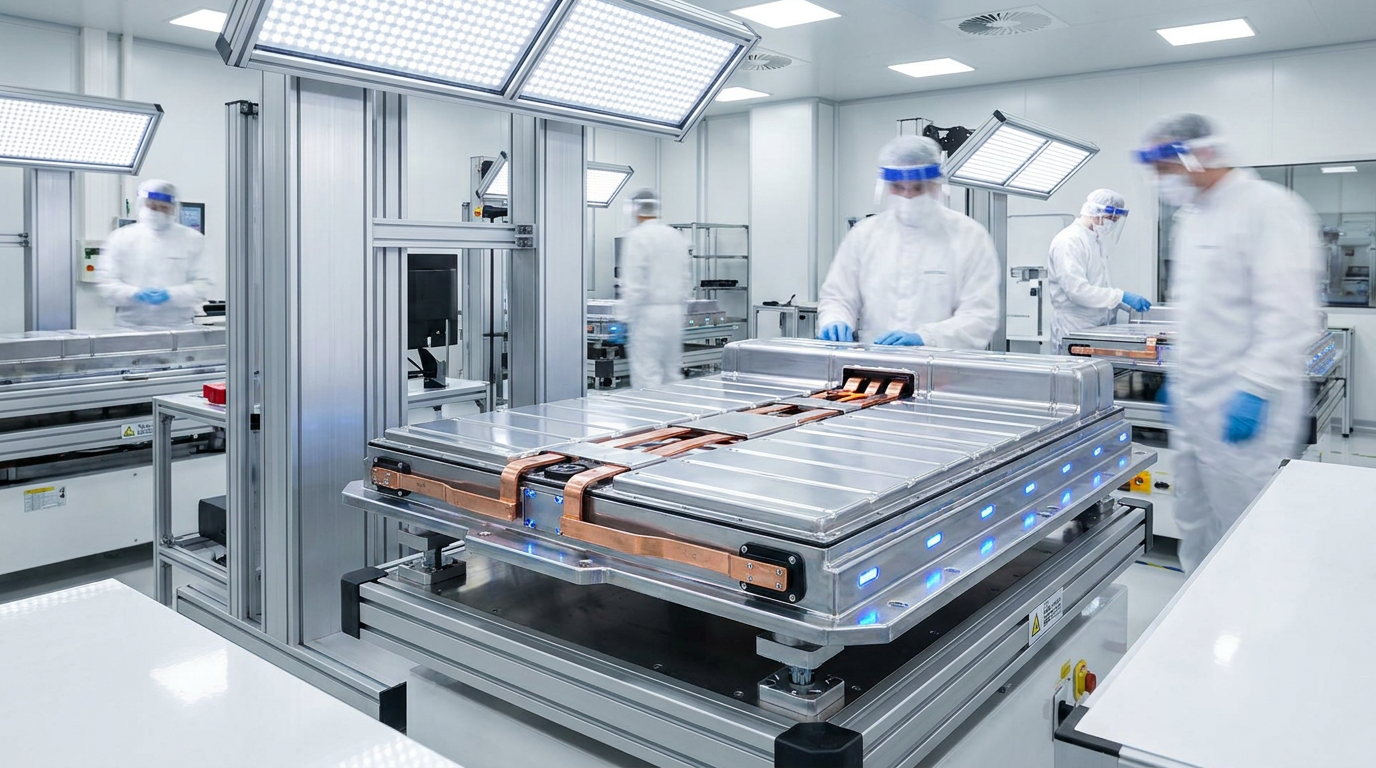
However, the transition to a solid-state future will not happen overnight. The manufacturing hurdles remain immense. Solid electrolytes, particularly the highly conductive sulfide-based materials favored by Toyota, are notoriously sensitive to moisture and air. Assembling these batteries requires hyper-sterile, ultra-dry manufacturing environments and hermetic sealing techniques that add significant complexity and cost to the production line.[4][7]
Because of these steep initial manufacturing costs, the first wave of solid-state EVs arriving between 2026 and 2028 will not be aimed at the budget-conscious buyer. Industry analysts expect the technology to debut exclusively in high-end luxury flagships, sports cars, and premium commercial vehicles where buyers can absorb the premium pricing.[5][7]

In the interim, the automotive market is entering what engineers call the "semi-solid" era. Rather than a sudden leap from liquid to solid, many automakers are introducing hybrid batteries that use a high percentage of solid materials mixed with a small amount of liquid electrolyte to bridge the gap in manufacturing feasibility.[1][7]
For consumers shopping for an EV today, the impending arrival of solid-state technology presents a fascinating dilemma. While the 2026 to 2028 window promises revolutionary advancements in range and charging speed, today's lithium-ion vehicles remain highly capable, increasingly affordable, and backed by mature charging networks. Solid-state batteries are no longer a myth, but they will take several more years to democratize the electric vehicle market fully.[4][8]
How we got here
2020
Toyota demonstrates an early prototype solid-state vehicle, but acknowledges manufacturing challenges delay commercialization.
Jan 2025
Nissan officially opens its all-solid-state EV battery pilot production line at its Yokohama plant.
Dec 2025
China's National Automotive Standardization Technical Committee releases the first draft of its solid-state battery standards.
July 2026
China is scheduled to release the finalized, official regulatory standard for solid-state EV batteries.
2027–2028
Major automakers including Toyota and Nissan target the launch of their first consumer-ready solid-state vehicles.
Viewpoints in depth
Legacy Automakers
Established brands like Toyota and Nissan are taking a methodical, in-house approach to solid-state development.
For legacy giants, the priority is durability and scale rather than being first to market with a prototype. Toyota and Nissan are investing heavily in proprietary pilot plants and securing their own supply chains for complex materials like sulfide electrolytes. Their timelines—targeting 2027 to 2028 for consumer-ready vehicles—reflect the immense engineering challenge of ensuring these batteries can survive a 15-year vehicle lifespan without degrading, rather than just performing well in a laboratory.
Chinese Manufacturers
Domestic Chinese brands are aggressively pushing for early commercialization backed by government standards.
Automakers like Dongfeng and GAC Group are treating solid-state technology as a sprint, aiming to lock in global dominance much like they did with traditional lithium-ion cells. By pushing for mass production as early as late 2026 and establishing the world's first official regulatory standards, China intends to define the global market. They are highly willing to deploy 'semi-solid' hybrid batteries immediately as a stepping stone to capture consumer attention and market share.
Battery Startups & Suppliers
Specialized tech firms are providing the crucial breakthrough components that make mass production possible.
While automakers build the cars, specialized firms are solving the chemistry. Companies like Gelion and LiCAP Technologies are developing sulfur-based cathodes and dry-electrode manufacturing processes that eliminate the need for toxic solvents. These suppliers argue that the true bottleneck isn't battery chemistry, but manufacturing cost—and their proprietary techniques are the only way to bring solid-state prices down to parity with combustion engines.
What we don't know
- The exact retail premium automakers will charge for early solid-state models compared to their lithium-ion counterparts.
- How solid-state batteries will degrade over a 10-to-15-year real-world vehicle lifespan, as lab cycle testing cannot perfectly simulate a decade of varied weather and driving habits.
- Whether the global supply chain can scale the production of specialized solid electrolyte materials, such as sulfides, quickly enough to meet 2030 mass-market targets.
Key terms
- Solid-State Battery
- A battery that uses a solid electrolyte (like ceramics or glass) instead of a liquid or gel to conduct ions between its electrodes.
- Electrolyte
- The medium inside a battery that allows electrical charge (ions) to flow between the cathode and the anode.
- Thermal Runaway
- A dangerous chain reaction where a battery cell overheats and catches fire, often spreading to adjacent cells.
- Energy Density
- The amount of energy a battery can store relative to its weight or size, usually measured in watt-hours per kilogram (Wh/kg).
- Semi-Solid Battery
- A transitional battery design that uses mostly solid materials but retains a small amount of liquid electrolyte to ease manufacturing.
Frequently asked
Will solid-state batteries make current EVs obsolete?
No. Current lithium-ion EVs will remain highly capable and supported for decades. Solid-state technology will initially be an expensive premium option, much like a larger engine upgrade, rather than an immediate replacement for all EVs.
How fast can a solid-state battery charge?
Automakers are targeting a 10-minute fast-charge time to replenish the battery from 10% to 80%, significantly closing the gap with traditional gas station refueling times.
Why are solid-state batteries safer?
They replace the flammable liquid electrolyte found in traditional batteries with a stable solid material, drastically reducing the risk of fire or thermal runaway even if the battery is punctured or overheated.
When can I actually buy a solid-state EV?
While some semi-solid models are entering the Chinese market now, true all-solid-state vehicles from major brands like Toyota and Nissan are slated to hit consumer dealerships between 2027 and 2028.
Sources
Source coverage
8 outlets
3 viewpoints surfaced








[1]ElectrekAggressive Adopters
China to release first solid-state EV battery standard in July 2026
Read on Electrek →[2]CarsGuideAggressive Adopters
Game-changing solid-state batteries are back on the agenda
Read on CarsGuide →[3]CBT NewsMethodical Developers
Toyota to launch solid-state battery production by 2026
Read on CBT News →[4]EV WorldMethodical Developers
Toyota's solid-state battery timeline: Fact vs. Fiction
Read on EV World →[5]Green Car ReportsMethodical Developers
Toyota to manufacture solid-state batteries in Japan starting in 2026
Read on Green Car Reports →[6]CarBuzzMethodical Developers
Nissan Remains Committed To Solid-State Batteries By 2028
Read on CarBuzz →[7]The Battery Show AsiaIndustry Realists
The Roadmap to All-Solid-State: 2026–2028
Read on The Battery Show Asia →[8]to7motorAggressive Adopters
The Chemistry Behind Solid-State Batteries
Read on to7motor →
Every angle. Every day.
Get shopping stories with full source coverage and perspective breakdowns delivered to your inbox.