
Smart Rings vs. Smartwatches: The 2026 Guide to Choosing Your Health Tracker
As ambient computing matures, the choice between a smart ring and a smartwatch comes down to a fundamental trade-off: passive, distraction-free health monitoring versus real-time, active performance data.
By Factlen Editorial Team
- Ambient Health Advocates
- Prioritize passive tracking and reduced screen time to minimize digital fatigue.
- Active Performance Trackers
- Value real-time data, structured workout guidance, and standalone device capabilities.
- Hardware Analysts
- Focus on sensor accuracy, battery efficiency, and long-term market adoption trends.
What's not represented
- · Medical professionals who rely on FDA-cleared wearable data for remote patient monitoring.
- · Budget-conscious consumers who find both premium smartwatches and smart rings prohibitively expensive.
Why this matters
Wearable technology has split into two distinct philosophies. Choosing the right form factor determines whether your device actually improves your health habits or simply becomes another source of digital fatigue and battery anxiety.
Key points
- Smart rings excel at passive health tracking, offering superior comfort for sleep and cleaner resting data from finger arteries.
- Smartwatches remain the undisputed choice for active workouts, providing real-time GPS pacing, on-screen guidance, and standalone connectivity.
- Battery life heavily favors smart rings, which typically last 4 to 7 days, compared to the 1 to 2 days typical of AMOLED smartwatches.
- The choice ultimately depends on whether a user wants an active digital coach demanding attention or an invisible sensor operating in the background.
- A growing trend in 2026 is the dual-wearable user, who relies on a ring for 24/7 ambient health data and a watch strictly for deliberate exercise.
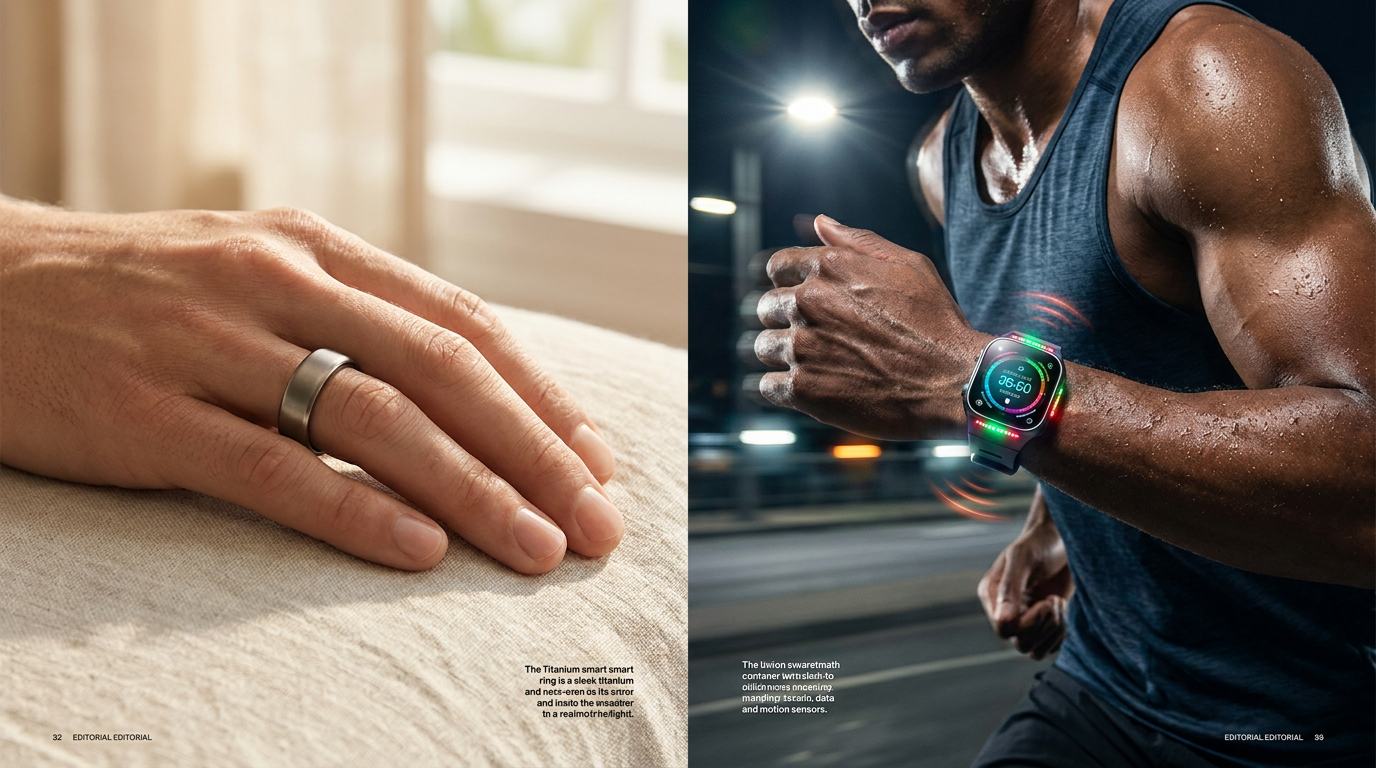
For a decade, the standard approach to digital health tracking required strapping a vibrating, glowing mini-computer to the wrist. Users accepted the constant notifications, the daily charging rituals, and the bulky sleep experience as the necessary cost of understanding their bodies. But the wearable landscape of 2026 has fractured into two distinct philosophies. On one side, the traditional smartwatch continues to evolve into a powerful, standalone wrist-computer. On the other, the smart ring has emerged as the champion of ambient computing—tiny, passive sensors that gather clinical-grade data without demanding a fraction of the user's attention.[1][2]
The core trade-off between these two form factors is no longer about which device has the better sensors, but rather how much of your daily life you are willing to hand over to a screen. Smartwatches are built for active engagement, designed to keep you connected, paced, and informed in real time. Smart rings, conversely, are built for invisibility. They operate on the premise that the best technology stays out of your way, collecting data silently and presenting insights only when you choose to open a companion app on your phone.[2][5]
When analyzing the case for the smart ring, sleep tracking and physical comfort stand as the primary arguments. The evidence for this advantage is rooted in both hardware design and human anatomy. Sleeping with a metal and glass watch case strapped to the wrist often causes friction, skin irritation, and a dull ache for side-sleepers. A smart ring, weighing just a few grams, effectively disappears on the finger. Furthermore, the arteries in the finger sit closer to the surface than those in the wrist, allowing the ring's photoplethysmography (PPG) sensors to capture cleaner heart rate variability (HRV) and temperature data during the night.[2][6]
The case against the smartwatch in the sleep category is defined by digital friction. Beyond the physical bulk, smartwatches introduce the risk of accidental screen illumination at three in the morning or poorly timed haptic buzzes that disrupt the very sleep cycles the user is attempting to optimize. For individuals whose primary goal is understanding their recovery, resting baselines, and sleep architecture, the smartwatch often introduces more problems than it solves.[2]

However, when shifting the analysis to active workouts and real-time performance, the case for the smartwatch becomes overwhelming. The evidence lies in the device's ability to deliver immediate, actionable feedback. Premium smartwatches feature built-in GPS, electrocardiogram (ECG) capabilities, and high-resolution sampling that records data at one-minute intervals or faster. A runner can glance at their wrist mid-stride to check their heart rate zone, adjust their pacing, or navigate a complex trail map—functions that are physically impossible on a screenless ring.[3][4]
The case against the smart ring for athletes is its complete reliance on post-workout analysis. While rings can accurately track general daily activity, step counts, and basic metabolic burn, they cannot guide a structured interval session. If you leave your phone in the gym locker, a smart ring becomes a purely passive sensor with no output you can actually use in the moment. It cannot tell you to speed up, it cannot map your route, and it cannot stream music to your headphones.[3][4]
Battery life presents another explicit trade-off, heavily favoring the ambient approach. The case for the smart ring is built on endurance and reduced mental load. Because they lack power-hungry displays and constant cellular connectivity, modern smart rings routinely deliver four to seven days of continuous battery life. Many platforms now include portable charging cases, allowing the ring to top up passively while the user showers, meaning the device can theoretically go weeks without needing to be plugged into a wall socket.[4][5]
Battery life presents another explicit trade-off, heavily favoring the ambient approach.
The case against the smartwatch regarding power management is the persistent reality of battery anxiety. Despite efficiency improvements, most popular AMOLED smartwatches still require charging every one to two days. Features like always-on displays, bright watch faces, and active GPS tracking drain the battery rapidly. This creates a daily charging chore that often forces users to choose between wearing the watch to track their sleep or leaving it on the nightstand to ensure it has enough power for the next day's workout.[4][5]

The final major trade-off centers on digital distraction versus standalone capability. The case for the smartwatch is its ability to temporarily replace the smartphone. With cellular models, users can leave their phones at home while running errands or exercising, secure in the knowledge that they can still make emergency calls, pay for groceries via NFC, and receive critical messages. The smartwatch acts as a powerful tether to the digital world.[3][5]
The case against that tether is notification fatigue. For remote workers, founders, and anyone attempting to cultivate deep focus, a smartwatch can feel like a constant assault on their attention. The smart ring offers a sanctuary from this connectivity. It provides the peace of mind that health metrics are being rigorously tracked without the psychological burden of step goals, stand rings, and incoming emails hijacking the user's peripheral vision.[2]
This stark division in utility has led to a growing trend in 2026: the dual-wearable user. Rather than viewing the categories as mutually exclusive, many experienced health optimizers now wear a mechanical timepiece or keep their wrists bare during the workday while a smart ring handles background health and sleep tracking. They then strap on a dedicated sports watch exclusively for deliberate training sessions, leveraging the strengths of both form factors without suffering their respective compromises.[3][4]
Ultimately, the smart ring fits well when your primary goals are sleep optimization, passive recovery tracking, and reducing daily screen time. It is the ideal choice for individuals who want clinical-grade health insights but refuse to wear a miniature computer on their wrist, or for watch collectors who wish to continue wearing traditional mechanical timepieces without sacrificing modern health data.[1][2][3]

Conversely, the smart ring does not fit when you are a dedicated athlete who relies on real-time pacing, GPS mapping, or mid-workout heart rate checks. It is also a poor choice for users who want to leave their smartphones behind but still need access to digital payments, music streaming, or emergency communications.[3][4]
The smartwatch fits well when you view your wearable as an active coach and a digital assistant. It is the superior tool for runners, cyclists, and fitness enthusiasts who need immediate visual feedback to guide their performance. It also serves perfectly for those who rely heavily on wrist-based apps to manage their daily schedules and communications.[3][5]
The smartwatch does not fit when physical comfort during sleep is your highest priority, or when you are actively trying to minimize digital interruptions. If the thought of another device demanding your attention or needing a daily charge causes hesitation, the ambient, silent tracking of a smart ring will serve your health journey far better.[2][5]
How we got here
2015
The modern smartwatch era begins in earnest, establishing the wrist as the primary location for digital health tracking and notifications.
2020
Early smart rings gain traction among biohackers and elite athletes, proving that finger-based sleep tracking can rival clinical sleep studies.
2024
Major tech giants enter the smart ring market, validating the form factor and pushing the technology into the mainstream consumer consciousness.
2026
The wearable market officially bifurcates, with consumers actively choosing between the active engagement of a watch and the passive, ambient tracking of a ring.
Viewpoints in depth
Ambient Health Advocates
Prioritize passive tracking and reduced screen time to minimize digital fatigue.
This camp argues that the best technology should be invisible. They point to the rising tide of notification fatigue and argue that strapping a glowing screen to the wrist undermines mental well-being. For these users, the smart ring's ability to gather highly accurate sleep and recovery data without demanding attention represents the true future of health optimization. They view smartwatches as overly intrusive gadgets rather than pure health tools.
Active Performance Trackers
Value real-time data, structured workout guidance, and standalone device capabilities.
Athletes and fitness enthusiasts in this camp maintain that health data is only useful if it can be acted upon in the moment. They argue that a screenless device is fundamentally crippled during a run or a gym session, where checking heart rate zones or GPS pacing is critical. For this group, the smartwatch's ability to act as a standalone digital hub—handling music, payments, and navigation—far outweighs the inconvenience of daily charging or a bulkier sleep experience.
Hardware Analysts
Focus on sensor accuracy, battery efficiency, and long-term market adoption trends.
Industry analysts observe that the wearable market is splitting into highly specialized niches. They note that finger-based PPG sensors often provide cleaner resting data due to the proximity of arteries to the skin surface, giving rings a technical edge in sleep architecture analysis. However, they also highlight that smartwatches retain a massive advantage in high-frequency sampling and GPS tracking. Analysts predict that rather than one form factor killing the other, the most dedicated consumers will increasingly adopt both devices for different parts of their day.
What we don't know
- Whether upcoming non-invasive blood glucose monitoring sensors will be miniaturized enough to fit into a smart ring, or if they will remain exclusive to larger smartwatches.
- How the long-term durability of smart ring batteries will hold up after hundreds of charge cycles, given that their tiny cells cannot be easily replaced by the user.
Key terms
- Ambient Computing
- Technology that operates in the background of your life, collecting data and performing tasks without requiring active interaction or a screen.
- Photoplethysmography (PPG)
- An optical sensor technology used in wearables that shines light into the skin to measure changes in blood volume, calculating heart rate and respiration.
- Heart Rate Variability (HRV)
- The measure of the time variation between consecutive heartbeats, used as a key indicator of physical recovery, stress levels, and overall nervous system health.
- AMOLED Display
- A bright, high-contrast screen technology commonly used in premium smartwatches, known for vibrant colors but higher battery consumption compared to passive screens.
Frequently asked
Can a smart ring track my runs without my phone?
No. While a smart ring can track your heart rate and estimate your steps during a run, it lacks built-in GPS and a screen. You will not be able to see your pace in real time or map your route unless you carry your smartphone with you.
Are smart rings more accurate than smartwatches for sleep?
Generally, yes. The arteries in the finger are closer to the surface than those in the wrist, allowing the ring's sensors to capture cleaner heart rate variability (HRV) and temperature data. Additionally, their lightweight design makes them less likely to shift out of place during the night.
Do I have to pay a monthly subscription for a smart ring?
It depends on the brand. Some leading platforms require a monthly subscription to access detailed health insights. However, newer competitors entering the market in 2025 and 2026 are increasingly offering their hardware with no ongoing subscription fees.
Can I wear a smart ring while lifting weights?
It is generally not recommended to wear a smart ring while gripping heavy metal barbells or dumbbells, as the pressure can scratch the ring or cause discomfort. Many users take their rings off during heavy lifting sessions or use a smartwatch instead.
Sources
Source coverage
6 outlets
3 viewpoints surfaced


[1]BackerrockHardware Analysts
Smart Ring vs Smartwatch: Which Wearable Category Is Winning on Kickstarter?
Read on Backerrock →[2]TechglimmerAmbient Health Advocates
SmartRing vs Smartwatch: Why Smart Rings Win in 2026
Read on Techglimmer →[3]SmartletActive Performance Trackers
Smartwatch vs connected ring: Why screens and sensors matter
Read on Smartlet →[4]AI WearablesAmbient Health Advocates
AI Smart Rings Explained: When a Ring Makes More Sense Than a Watch
Read on AI Wearables →[5]VertuActive Performance Trackers
Smart Ring vs. Smartwatch: Choosing the Perfect Tech Christmas Gift for 2025
Read on Vertu →[6]National Institutes of HealthHardware Analysts
Smart Ring in Clinical Medicine: A Systematic Review
Read on National Institutes of Health →

More in shopping
See all 5 stories →

Every angle. Every day.
Get shopping stories with full source coverage and perspective breakdowns delivered to your inbox.