
Smart Ring vs. Smartwatch: Which Wearable Form Factor Wins in 2026?
As the wearable tech market fractures into two distinct philosophies, consumers must choose between the active coaching of a smartwatch and the passive, continuous monitoring of a smart ring.
By Factlen Editorial Team
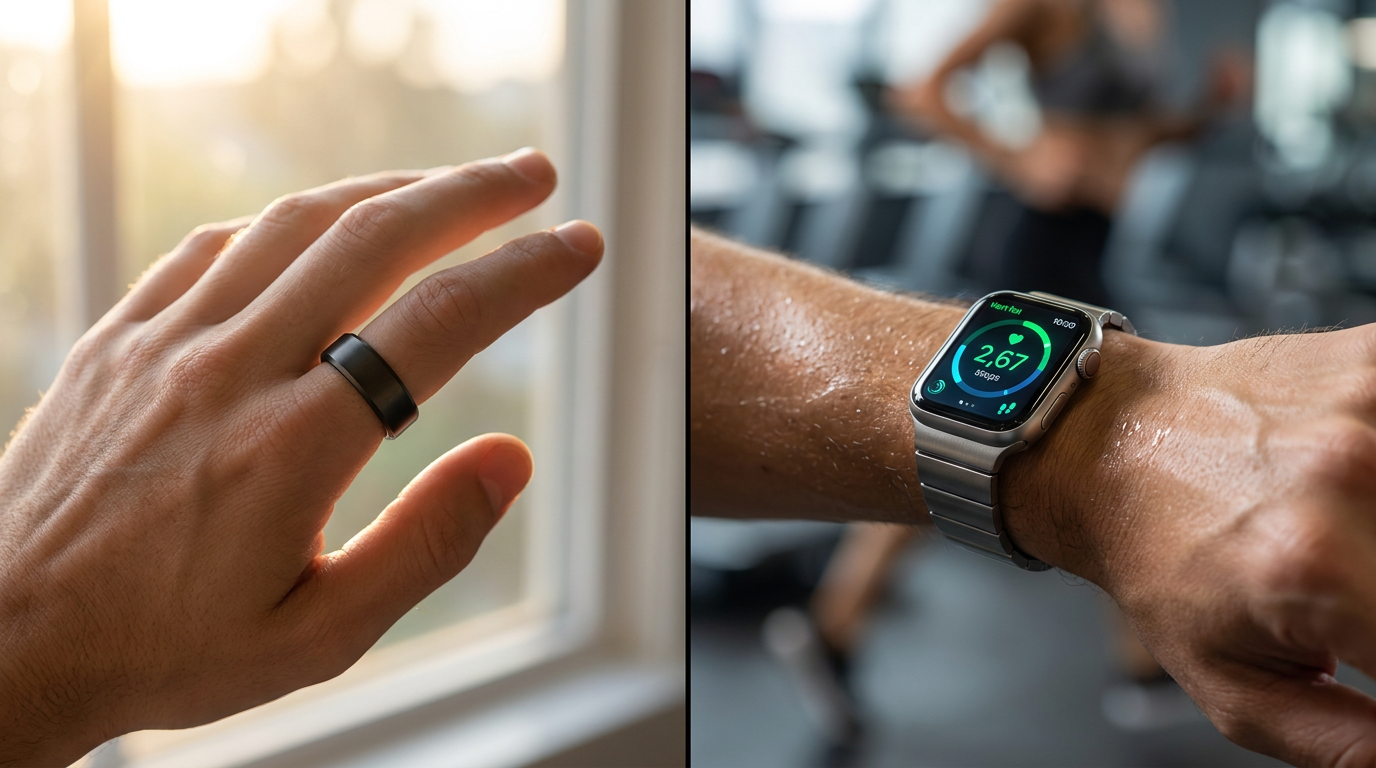
- Passive Health Advocates
- Argue that the best wearable is one that disappears into the background, prioritizing continuous sleep and recovery data over real-time alerts.
- Active Fitness Loyalists
- Value real-time performance metrics, GPS tracking, and the ability to adjust workout intensity on the fly using a wrist display.
- Hybrid Adopters
- Believe no single device is perfect, opting to use a smartwatch for daytime workouts and a smart ring for overnight recovery.
What's not represented
- · Traditional watch enthusiasts who refuse wrist wearables
- · Medical professionals prescribing clinical-grade monitors
Why this matters
Choosing the right wearable form factor determines whether you will actually use the device consistently enough to improve your sleep, manage stress, and reach your fitness goals in 2026.
Key points
- The wearable market has split into two distinct form factors: active smartwatches and passive smart rings.
- Smart rings excel at continuous wearability and overnight biometric accuracy due to their lightweight, screenless design.
- Smartwatches remain the superior choice for active fitness tracking, offering real-time GPS, pacing data, and heart rate zones.
- Clinical studies show smart rings achieve up to 79% agreement with medical sleep labs, outperforming wrist-based sensors.
- While smartwatches require charging every 1-2 days, smart rings offer 5-7 days of uninterrupted battery life.
- Many smart rings require ongoing monthly subscriptions for full data access, increasing their long-term cost of ownership.
The wearable health technology market has reached a fascinating inflection point in 2026, fracturing into two distinct and competing philosophies: the active, screen-based smartwatch and the passive, screenless smart ring. With the global wearable sector surging past seventy-two billion dollars, consumers are no longer simply asking which brand to buy. Instead, they are facing a fundamental choice about which form factor actually serves their daily habits and long-term health goals. The decision dictates not just what data is collected, but how the user interacts with their own biology throughout the day and night.[2][8]
The core difference between the two devices lies in their demand for attention. Smartwatches are designed to be interactive hubs, providing real-time feedback, vibrating alerts, and a glowing dashboard of daily metrics. Smart rings, conversely, operate invisibly in the background. They are built on the premise that the most effective health tracker is one the user forgets they are wearing. This philosophical divide shapes every aspect of the hardware, from sensor placement and battery life to the psychological impact of digital notifications on the wrist.[1][5]
For the smart ring, the primary argument centers on continuous, frictionless wearability. Because premium rings weigh as little as two to three grams and lack a distracting display, users are significantly more likely to wear them twenty-four hours a day. The evidence for this compliance is striking, particularly when the sun goes down. Industry data suggests that while a large portion of smartwatch owners remove their devices before bed due to physical bulk or battery anxiety, smart ring users boast near-universal overnight wear rates. This uninterrupted contact is the holy grail of baseline health monitoring.[3][5]

However, the case against the smart ring is its inherent lack of real-time utility. Without a display or a haptic vibration motor, a ring cannot alert a runner that their heart rate has spiked into the red zone, nor can it guide an anxious user through a paced breathing exercise during a stressful meeting. It is a one-way street of data collection. Users must pull out their smartphones and open an app to glean any actionable insights, which introduces friction for athletes who rely on immediate feedback to pace their physical efforts.[2][4]
Conversely, the smartwatch excels as an active, dynamic fitness coach. The argument for the watch is rooted in its sheer versatility: it is simultaneously a precision GPS tracker, a communication device, and a real-time biometric dashboard strapped securely to the wrist. The evidence supporting smartwatches for active individuals is robust. During high-intensity interval training, outdoor cycling, or swimming, the watch provides immediate visual feedback on heart rate zones, pace, and accumulated cardiovascular strain, empowering users to adjust their effort mid-workout without breaking stride.[1][6]
The case against the smartwatch, however, is its intrusiveness. The constant barrage of text notifications, calendar alerts, and move reminders, combined with the physical presence of a forty-to-eighty-gram metal and glass chassis, can contribute to digital fatigue. For many users, bringing another screen into the bedroom disrupts the very sleep they are attempting to measure. The wrist-worn form factor can also clash with traditional mechanical timepieces or formal attire, forcing users to choose between fashion and fitness tracking.[3][8]
The case against the smartwatch, however, is its intrusiveness.
When comparing biometric accuracy, the battleground shifts depending on the specific metric being measured. For resting heart rate and heart rate variability—the gold-standard indicators of physical recovery and stress—clinical studies increasingly favor the finger over the wrist. The finger possesses a higher density of blood vessels near the surface of the skin and experiences significantly less movement during sleep than the wrist. This physiological reality allows the optical sensors in smart rings to capture cleaner, more consistent cardiovascular data overnight.[7][8]
Independent validation studies from sleep laboratories demonstrate this advantage clearly. Premium smart rings routinely achieve up to seventy-nine percent agreement with medical-grade polysomnography for complex sleep stage classification. In these same controlled environments, leading smartwatches typically hover between sixty and sixty-five percent agreement. While neither consumer device matches the perfection of a clinical sleep lab, the ring provides a demonstrably sharper picture of deep and rapid-eye-movement sleep cycles, making it the superior tool for recovery analysis.[7]

Yet, when the user wakes up and begins to exercise, the smartwatch reclaims the accuracy crown. Wrist-based sensors, when secured tightly by a silicone or nylon strap, are far less susceptible to the motion artifacts that plague ring sensors. Activities that involve heavy gripping—such as weightlifting, rowing, or tennis—can temporarily push the ring's sensors away from the skin, resulting in dropped heart rate readings. The smartwatch's stable placement on the forearm ensures a reliable optical connection even during rigorous, dynamic movements.[2][7]
Battery life forces another significant trade-off between the two form factors. A typical flagship smartwatch, burdened by a bright OLED display and constant Bluetooth communication, requires charging every one to two days. This frequent charging cycle creates inevitable gaps in health data, most often during the night when the user leaves the watch on the nightstand. In contrast, smart rings routinely deliver five to seven days of continuous battery life. This longevity ensures that vital baseline metrics like skin temperature are captured without interruption.[1][3][5]

The financial comparison extends far beyond the initial hardware purchase, introducing a complex calculation for consumers. While smartwatches generally cost between two hundred and five hundred dollars upfront, they rarely require ongoing software fees to access the data they collect. Smart rings, while often priced similarly or slightly lower at retail, frequently lock their most valuable insights—such as daily readiness scores and detailed sleep analysis—behind monthly subscription paywalls. This can add hundreds of dollars to the total cost of ownership over a few years, though newer entrants are beginning to challenge this model with subscription-free alternatives.[3][4][5]
Ultimately, the smart ring fits exceptionally well when a user prioritizes sleep optimization, passive recovery tracking, and a minimalist aesthetic. It is the ideal choice for individuals who want deep physiological insights without the distraction of another screen, or for those who prefer to wear traditional mechanical watches during the day. The smart ring does not fit when a user needs real-time pacing data for marathon training, wants to leave their smartphone at home during outdoor workouts, or relies heavily on their wearable for mobile payments and text notifications.[2][8]

Conversely, the smartwatch fits perfectly for the data-hungry athlete who uses real-time metrics to dictate their training intensity. It remains the undisputed champion for active fitness tracking, outdoor navigation, and seamless digital connectivity. For those unwilling to compromise, a growing cohort of hybrid adopters is choosing to wear both: relying on the smartwatch to conquer the day's workouts, and slipping on the smart ring to quietly monitor the night's recovery.[1][6]
How we got here
2015
Smartwatches enter the mainstream consciousness with the launch of the first Apple Watch.
2018
Oura launches its Generation 2 ring, proving that comprehensive health tracking can fit on a finger.
2022
Independent sleep laboratory studies begin confirming that ring-based sensors can match or exceed wrist-based sensors for resting biometrics.
2024
Samsung enters the smart ring market with the Galaxy Ring, validating the form factor for mainstream Android users.
2026
The wearable market splits evenly between active wrist displays and passive finger sensors, with AI-driven health insights standard on both.
Viewpoints in depth
The Passive Health Advocate
Prioritizes continuous, frictionless data collection over real-time alerts.
This camp argues that the most valuable health metrics—resting heart rate, heart rate variability, and sleep architecture—are best captured when the body is at rest. They view screens and notifications as active stressors that interfere with the very recovery they are trying to measure. For these users, the smart ring's 'set it and forget it' nature ensures years of consistent baseline data without the digital fatigue associated with wrist-worn computers.
The Active Fitness Loyalist
Values real-time performance metrics and the ability to adjust training on the fly.
Athletes and fitness enthusiasts in this camp argue that health tracking is only useful if it can actively guide behavior in the moment. They rely on the smartwatch's display to stay within specific heart rate zones during a run, track GPS routes without a phone, and monitor live pacing. To them, a smart ring is merely a passive observer, whereas a smartwatch is an active coach that directly influences the outcome of a workout.
The Hybrid Adopter
Combines both form factors to maximize the strengths of each device.
Recognizing the inherent trade-offs of both devices, this growing segment refuses to compromise. They strap on a smartwatch during the day to manage notifications, track outdoor runs, and pay for groceries. At night, they place the bulky watch on the charger and slip on a smart ring to capture high-fidelity sleep and recovery data. This dual-device strategy yields the most comprehensive health picture, albeit at a significantly higher financial cost.
What we don't know
- Whether upcoming non-invasive blood glucose monitoring technology will be miniaturized enough to fit inside a smart ring.
- How the widespread elimination of subscription fees by newer ring manufacturers will impact the business models of established market leaders.
- If future smartwatches can reduce their physical bulk and battery consumption enough to match the overnight comfort of smart rings.
Key terms
- Photoplethysmography (PPG)
- An optical technology used in wearables that shines light into the skin to measure blood flow and calculate heart rate.
- Heart Rate Variability (HRV)
- The fluctuation in the time intervals between adjacent heartbeats, used as a key indicator of physical recovery and stress.
- Polysomnography (PSG)
- The comprehensive, medical-grade sleep study used as the gold standard to test the accuracy of consumer sleep trackers.
- SpO2 Sensor
- A feature that estimates the oxygen saturation level in your blood, often used to detect breathing disturbances during sleep.
Frequently asked
Can a smart ring track my heart rate during a run?
Yes, but it lacks a screen to show you real-time data, and heavy gripping motions can sometimes disrupt the optical sensor's accuracy compared to a tightly strapped watch.
Do all smart rings require a monthly subscription?
No. While market leaders like Oura charge a monthly fee for full data access, newer competitors like RingConn and Samsung offer subscription-free models.
Which device is better for tracking sleep apnea risk?
Both can monitor blood oxygen drops, but certain smartwatches currently hold FDA and CE-mark clearances specifically for sleep apnea screening, giving them a clinical edge.
Can I wear both a smart ring and a smartwatch?
Yes, many users adopt a hybrid approach, wearing a smartwatch during the day for active fitness tracking and switching to a smart ring at night for comfortable sleep monitoring.
Sources
Source coverage
8 outlets
3 viewpoints surfaced








[1]MashableHybrid Adopters
Oura Ring vs Apple Watch: The best fitness tracker for 2025
Read on Mashable →[2]TechRadarActive Fitness Loyalists
Smart ring vs smartwatch: Which fitness tracking wearable is best for you?
Read on TechRadar →[3]BGRPassive Health Advocates
Smart Rings Vs. Smartwatches: Which Is Better For Sleep Tracking?
Read on BGR →[4]ForbesHybrid Adopters
Best Smart Rings 2026
Read on Forbes →[5]WareablePassive Health Advocates
Best smart rings 2026: Oura and top alternatives tested
Read on Wareable →[6]PCMagActive Fitness Loyalists
The Best Fitness Trackers We've Tested for 2026
Read on PCMag →[7]MediumHybrid Adopters
Apple Watch vs WHOOP vs Oura vs Garmin: What the Science Actually Says
Read on Medium →[8]Wearable Wellness GuidePassive Health Advocates
Compare Stress Trackers: Smartwatches vs Smart Rings (2026 Guide)
Read on Wearable Wellness Guide →

More in shopping
See all 5 stories →

Every angle. Every day.
Get shopping stories with full source coverage and perspective breakdowns delivered to your inbox.