
Smart Bassinets vs. Traditional: Weighing the Costs, Tech, and Sleep Benefits
High-tech smart bassinets promise to act as a virtual night nurse, but their steep price tags and potential for creating sleep associations have parents questioning if the upgrade is worth it. A side-by-side comparison reveals when the technology is a lifesaver and when a traditional $100 bassinet is the better choice.
By Factlen Editorial Team
- Tech-Forward Parents
- View smart bassinets as a necessary investment for maternal recovery and maximizing family sleep.
- Minimalist Parents
- Argue that expensive tech is unnecessary, preferring traditional methods that avoid creating sleep associations.
- Pediatric & Safety Experts
- Emphasize that safety comes from a firm, flat surface, not from technology, and warn against tech dependency.
What's not represented
- · Families with multiples (twins/triplets) who face compounded costs and space constraints.
- · Parents in rural areas without reliable Wi-Fi, which is required for many smart bassinet features.
Why this matters
Choosing between a traditional and smart bassinet is one of the most expensive and consequential decisions new parents make. Understanding the trade-offs between cost, convenience, and sleep associations helps families optimize their budget and protect their own postpartum rest.
Key points
- Traditional bassinets offer a simple, affordable, and highly portable sleep solution without the risk of creating tech-dependent sleep associations.
- Smart bassinets act as a virtual night nurse, using automated motion and white noise to soothe waking infants and extend parental sleep.
- All bassinets, regardless of price, must adhere to AAP guidelines requiring a firm, flat, and clear sleep surface.
- The steep $1,500+ cost of smart bassinets can be mitigated through monthly rental programs or the secondary resale market.
- Smart bassinets are ideal for parents lacking nighttime support, while traditional models suit budget-conscious families preferring low-tech environments.
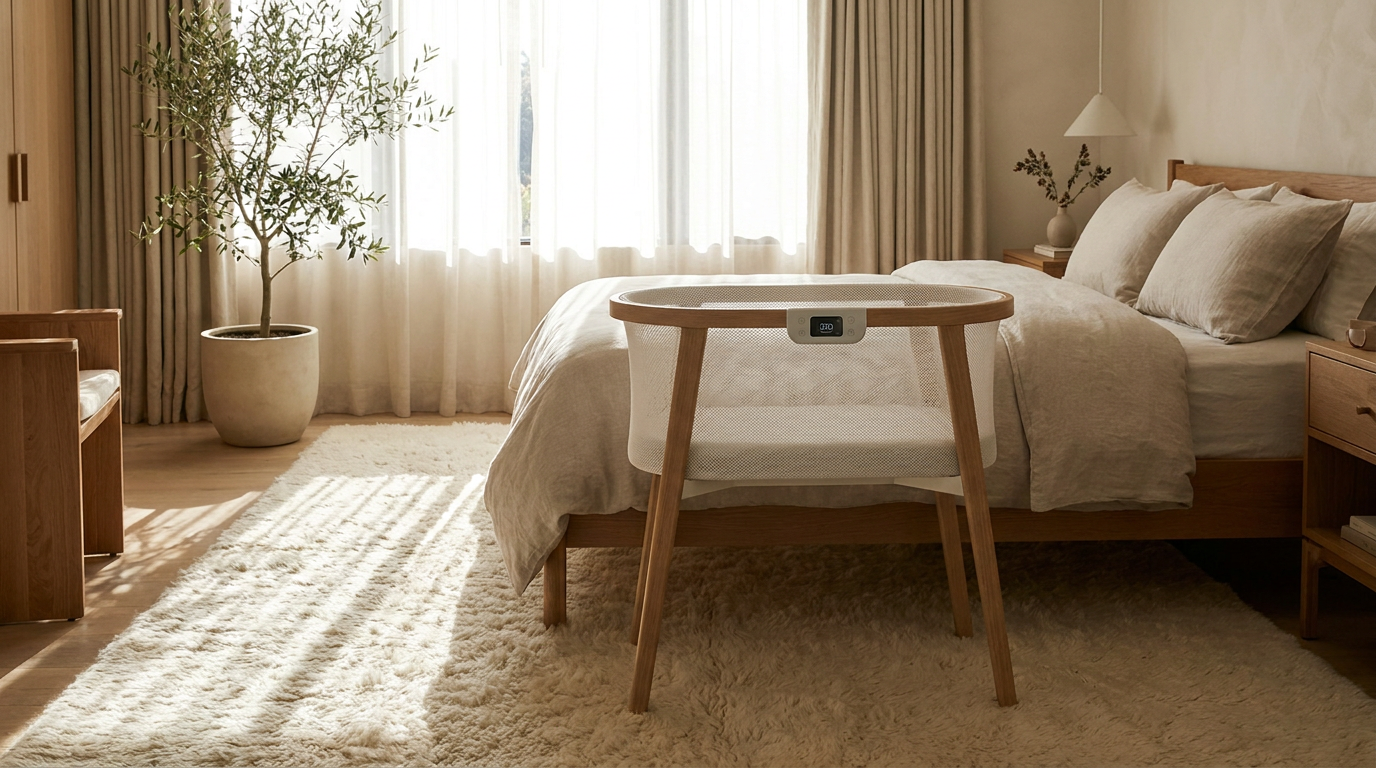
Standing in the baby aisle or scrolling through endless nursery gear lists, modern parents face a high-stakes decision that pits tradition against technology. For decades, the standard bassinet—a simple, cozy basket on legs—was the undisputed champion of the newborn phase. Today, a new category of "smart bassinets" promises to act as a virtual night nurse, using algorithms, microphones, and motors to soothe a fussy infant back to sleep. With prices for high-tech models soaring past $1,500, compared to traditional options hovering around $100, families are forced to weigh the financial cost against the promise of a few extra hours of desperately needed rest.[4][6]
Before evaluating the trade-offs, it is crucial to establish the baseline of infant sleep safety. The American Academy of Pediatrics (AAP) maintains strict guidelines: babies must sleep alone, on their backs, and on a firm, flat, non-inclined surface. Whether a bassinet costs $50 or $2,000, it must meet these fundamental criteria to be considered safe. Pediatricians emphasize that while smart bassinets offer motion and sound to soothe, these are optional comfort features, not safety enhancements. A traditional bassinet that meets Consumer Product Safety Commission (CPSC) standards is just as safe as its robotic counterpart.[1][5]
The argument for traditional bassinets centers on simplicity, portability, and affordability. These low-tech sleepers require no wall outlets, no Wi-Fi connections, and no monthly app subscriptions. Because they are lightweight, parents can easily roll them from the bedroom to the living room, keeping the baby close during daytime naps. Financially, they represent a minimal investment for a piece of furniture that a child will outgrow in roughly six months. For families prioritizing a minimalist nursery or operating on a strict budget, the traditional bassinet delivers exactly what is required without unnecessary complications.[2][7]

The primary case against the traditional bassinet is that the parents themselves must serve as the engine. When an infant stirs at 2:00 AM, a standard bassinet remains perfectly still. It falls entirely on the sleep-deprived caregiver to lean over the bed, manually rock the baby, or provide soothing shushes until the child settles. For parents recovering from a difficult delivery, such as a C-section, or those without extended family nearby to help share the nighttime burden, this manual intervention can quickly lead to profound exhaustion.[2][4]
The evidence supporting traditional bassinets is rooted in generations of successful use. Millions of infants have learned to connect their sleep cycles in stationary beds. Furthermore, pediatric nurses note that babies who start in traditional bassinets often have an easier time transitioning to a full-size crib later on, as they have not developed a reliance on constant motion to fall asleep. By avoiding tech dependency from day one, parents bypass the eventual hurdle of weaning their child off automated rocking.[5][7]
The evidence supporting traditional bassinets is rooted in generations of successful use.
Conversely, the case for smart bassinets—dominated by brands like Snoo and Cradlewise—relies on their ability to proactively intervene. These devices use built-in microphones to detect early signs of waking and automatically respond with escalating levels of white noise and motion. Proponents describe this technology as an "extra set of hands" that can calm a baby before they escalate to a full cry. For many families, this translates to longer stretches of uninterrupted sleep, which can be a critical lifeline for maternal mental health and overall family well-being.[3][6]
The argument against smart bassinets is heavily anchored in their exorbitant cost and the potential for creating stubborn sleep associations. Retail prices ranging from $1,695 to $1,999 make them inaccessible to many, and recent moves to lock features behind $20 monthly app subscriptions have frustrated consumers. Additionally, sleep experts warn that relying on constant motion can backfire when the baby outgrows the bassinet at six months. If an infant has never learned to fall asleep on a stationary surface, the transition to a standard crib can be highly disruptive.[2][4]

The evidence regarding smart bassinets is mixed but generally positive regarding short-term sleep outcomes. Pediatricians acknowledge that the combination of white noise and rhythmic motion effectively mimics the womb, often helping newborns settle faster. Some models even boast FDA authorization for keeping babies safely on their backs. However, critics point out that no peer-reviewed study conclusively proves smart bassinets provide better long-term sleep habits than traditional methods, and they emphasize that every baby's temperament is different—some simply do not respond to automated rocking.[1][6]
To bridge the massive price gap, a robust secondary market and rental economy have emerged. Instead of paying nearly $1,700 upfront, parents can rent a premium smart bassinet for approximately $159 per month. Over a typical five-month usage period, this cuts the total cost in half. Alternatively, buying a certified pre-loved unit or purchasing secondhand on community marketplaces allows families to recoup a significant portion of the investment upon resale. However, buyers must navigate warranty limitations and hygiene concerns when purchasing used gear.[3][4]

Ultimately, a smart bassinet fits well when parents have the disposable income to invest in potential sleep optimization, or when they are facing a severe lack of nighttime support. It is an excellent choice for families where both parents must return to work quickly, or for mothers recovering from complicated births who physically struggle to manually soothe their infant multiple times a night. In these scenarios, the technology genuinely serves as a valuable, albeit temporary, household assistant.[2][6]
A smart bassinet does not fit well when a family is operating on a tight budget, as the financial stress may outweigh the sleep benefits. It is also unnecessary for parents who prefer a low-tech parenting approach or those who have a "unicorn baby" that naturally sleeps well without intervention. For families who want a seamless transition to a crib without the hassle of weaning off motion settings, a high-quality traditional bassinet remains the most practical and proven choice.[5][7]
How we got here
1990s
The AAP launches the 'Back to Sleep' campaign, establishing the modern baseline for safe infant sleep.
2016
The Snoo Smart Sleeper is introduced, creating the premium smart bassinet category.
2021
The CPSC implements strict new federal safety standards for all infant sleep products, banning inclined sleepers.
2024
Major smart bassinet brands begin introducing monthly subscription fees to unlock premium app features.
Viewpoints in depth
Tech-Forward Parents
Advocates for using technology to mitigate the physical toll of newborn sleep deprivation.
For parents who embrace nursery technology, a smart bassinet is not a luxury but a critical tool for postpartum survival. They argue that the ability of a device to automatically soothe a stirring infant before they fully wake can add hours of sleep back into a family's night. This camp often points out that the upfront cost, while steep, is cheaper than hiring a night nurse or sleep consultant, making it a pragmatic investment for working parents.
Minimalist Parents
Skeptics who prefer low-tech solutions and warn against the financial trap of baby gear.
Minimalist and budget-conscious parents argue that the baby industry preys on the anxieties of sleep-deprived families. They point out that generations of infants have slept perfectly well in stationary, $100 bassinets. Furthermore, this camp highlights the hidden costs of smart devices—such as monthly app subscriptions and poor resale value—and warns that relying on automated rocking can create stubborn sleep associations that make the eventual transition to a standard crib much more difficult.
Pediatric & Safety Experts
Medical professionals focused strictly on evidence-based safe sleep guidelines.
Pediatricians and safety experts maintain a neutral stance on the technology itself, focusing entirely on the ABCs of safe sleep: Alone, on the Back, in a clear Crib or bassinet. They emphasize that while motion and white noise are effective soothing tools, they are not safety features. Experts warn parents never to use aftermarket accessories or inclined sleepers, reminding them that a firm, flat mattress is the only non-negotiable requirement for infant sleep, regardless of how much the bassinet costs.
What we don't know
- Whether long-term reliance on automated rocking during the newborn phase impacts a child's self-soothing abilities in toddlerhood.
- How the secondary market for smart bassinets will hold up as manufacturers increasingly lock features behind subscription paywalls.
Key terms
- Smart Bassinet
- An infant bed equipped with sensors, motors, and audio to automatically detect crying and soothe a baby with motion and sound.
- AAP Safe Sleep Guidelines
- Recommendations by the American Academy of Pediatrics emphasizing that babies must sleep alone, on their backs, and on a firm, flat surface.
- Sleep Association
- A specific condition, such as rocking or white noise, that a baby learns to rely on in order to fall asleep.
- Weaning Mode
- A setting on smart bassinets that stops the automated rocking, helping the baby adjust to a stationary surface before moving to a crib.
Frequently asked
Do smart bassinets prevent SIDS?
No. While some smart bassinets promote safe back-sleeping, the AAP states that no device can prevent Sudden Infant Death Syndrome. Safety comes from a firm, flat, clear sleep surface.
How long can a baby use a bassinet?
Most babies outgrow a standard or smart bassinet by six months of age, or as soon as they can roll over or push up on their hands and knees.
Can you rent a smart bassinet?
Yes. Companies offer monthly rental programs, typically around $159 per month, which can significantly reduce the overall cost compared to purchasing a new unit.
Do smart bassinets create bad sleep habits?
They can create an association with motion. To prevent this, experts recommend using the bassinet's 'weaning mode' to gradually reduce movement before transitioning the baby to a stationary crib.
Sources
Source coverage
7 outlets
3 viewpoints surfaced







[1]American Academy of PediatricsPediatric & Safety Experts
Safe Sleep
Read on American Academy of Pediatrics →[2]What to ExpectTech-Forward Parents
Best Bassinet Buying Guide
Read on What to Expect →[3]BabylistTech-Forward Parents
Snoo vs Cradlewise: Which Smart Crib Is Right for You?
Read on Babylist →[4]Baby Gear NerdMinimalist Parents
Snoo vs Cradlewise Bassinet? A must-have or expensive gimmick?
Read on Baby Gear Nerd →[5]HarborPediatric & Safety Experts
Smart Bassinets: What Parents Need to Know (From a Pediatric Nurse)
Read on Harbor →[6]Happiest BabyTech-Forward Parents
Is SNOO Worth It?
Read on Happiest Baby →[7]EmbarkMinimalist Parents
10 Gadgets You Might Not Need As a New Mom
Read on Embark →

More in shopping
See all 5 stories →

Every angle. Every day.
Get shopping stories with full source coverage and perspective breakdowns delivered to your inbox.