
Rivian R2 vs. Tesla Model Y: The 2026 Electric SUV Showdown
Rivian's highly anticipated R2 has finally hit the streets, offering a rugged, boxy alternative to Tesla's ubiquitous Model Y. With native Supercharger access and competitive range, the R2 presents the first genuine threat to Tesla's dominance in the mid-size electric SUV market.
By Factlen Editorial Team
- Value & Efficiency Commuters
- Buyers prioritizing immediate affordability, proven reliability, and maximum on-road efficiency.
- Adventure & Utility Seekers
- Drivers who need maximum cargo space, rugged durability, and off-road competence.
- Autonomy & Tech Watchers
- Industry observers focused on the future of self-driving hardware and software interfaces.
What's not represented
- · Long-term Maintenance Mechanics
- · Budget-Constrained Buyers
Why this matters
The $45,000 to $60,000 mid-size SUV segment is the primary gateway for families switching to electric vehicles. Having two highly capable, distinct options forces both automakers to innovate on price, software, and utility, directly benefiting consumers.
Key points
- The Rivian R2 launches in summer 2026 as a direct competitor to the Tesla Model Y.
- The R2 offers a boxier design, yielding 90.1 cubic feet of cargo space versus the Model Y's 76.
- With 9.6 inches of ground clearance, the R2 is highly capable off-road.
- The R2 Performance Launch Edition achieves 109 MPGe, slightly beating the Model Y Performance.
- Rivian includes a native NACS port for seamless access to the Tesla Supercharger network.
- Tesla maintains an immediate price advantage, with base models available in the low $40,000s.
For years, the Tesla Model Y has not just led the electric vehicle market—it has defined it. Combining long range, practical utility, and the industry's most reliable charging network, it became the default recommendation for anyone seeking a mid-size electric SUV. But the summer of 2026 has brought the first genuine challenger to Tesla's throne: the Rivian R2. Designed specifically to capture the mainstream market, the R2 scales down the rugged charm of Rivian's flagship R1S into a more manageable, affordable footprint.[2][5][6]
The stakes for this showdown are massive. Industry analysts point to the $40,000 to $60,000 SUV segment as the critical battleground for widespread EV adoption. This is where families compare monthly payments and where automakers have the greatest opportunity to convert gasoline vehicle owners. For Rivian, the R2 is a chance to transition from a niche adventure brand to a household name. For Tesla, it marks the first time in years that a competitor has arrived with a realistic chance of pulling away its core demographic.[6]
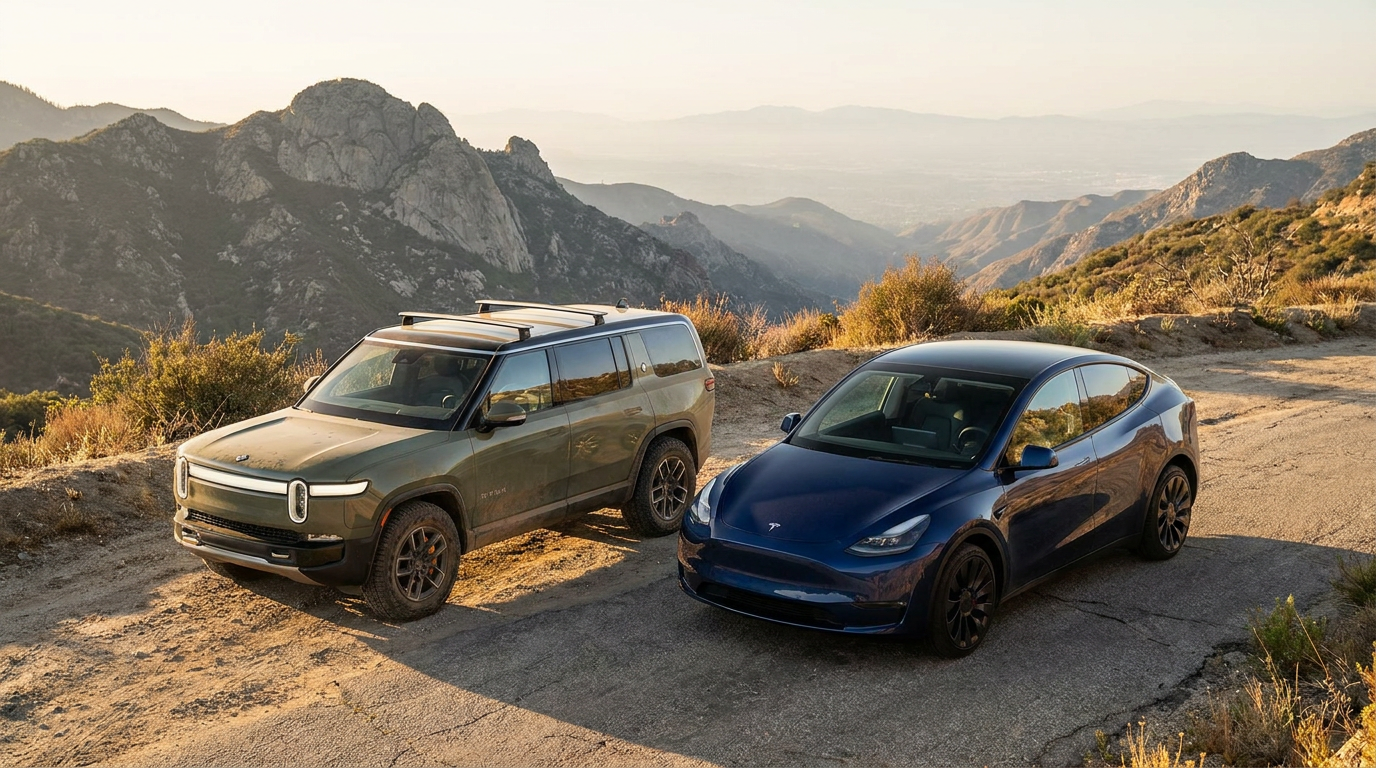
The most immediate difference between the two vehicles is their design philosophy. The Model Y relies on a teardrop shape optimized for aerodynamic efficiency, while the R2 embraces the upright, boxy aesthetics of a traditional SUV. This translates directly into utility. While the two vehicles share a nearly identical width, the R2's taller profile and boxier greenhouse yield a cavernous 90.1 cubic feet of total cargo space with the seats folded, representing a 19 percent advantage over the Model Y's 76 cubic feet.[1][4][5]

That rugged design is more than just an aesthetic choice; it dictates where these vehicles can go. The R2 boasts 9.6 inches of ground clearance—a full 60 percent more than the Model Y's 6.0 inches. Combined with aggressive approach and departure angles, the R2 is legitimately trail-capable. Reviewers testing the R2 in the mountains of Utah found that its liftoff regenerative braking is perfectly calibrated to incorporate friction braking on steep dirt descents, holding the vehicle at a steady crawl with barely any driver effort.[1][3]
Despite its brick-like aerodynamics, the R2 delivers a surprising blow in efficiency. The dual-motor R2 Performance Launch Edition achieves a 109 MPGe combined rating, edging out the Model Y Performance's 104 MPGe. This is a remarkable engineering feat considering the R2 is roughly 370 pounds heavier and sits three inches taller. Both vehicles offer excellent range, with the R2 Performance delivering an EPA-estimated 330 miles and the Model Y Long Range pushing up to 314 miles, ensuring range anxiety is largely a non-issue for either camp.[1][2][7]

When it comes to getting up to speed, neither SUV disappoints. The R2 Performance Launch Edition packs 656 horsepower and 609 pound-feet of torque, rocketing from zero to 60 mph in just 3.6 seconds. However, the two vehicles deliver their power very differently. The Model Y features a lower, firmer suspension and more direct steering, making it feel genuinely sporty and athletic on a twisty road. The R2, by contrast, has lighter, slower steering but excels in ride quality. Its adaptive dampers and coil springs neatly round off road imperfections, providing a highly comfortable, stable ride that avoids the harshness sometimes felt in firmer EVs.[2][3][7]
When it comes to getting up to speed, neither SUV disappoints.
Historically, Tesla held a trump card in any comparison: the Supercharger network. But the 2026 landscape has leveled that playing field. The Rivian R2 features a native North American Charging Standard (NACS) port built directly into the vehicle, granting seamless, adapter-free access to Tesla's vast charging infrastructure. With a peak fast-charging rate of 230 kilowatts, the R2 can charge from 10 to 80 percent in under 30 minutes, effectively neutralizing Tesla's biggest historical advantage.[2][3]
The technological approaches of the two companies diverge sharply when it comes to advanced driver-assistance systems. Tesla relies entirely on a vision-based system, using only cameras to power its automated driving features. Rivian has opted for a redundant 'belt and suspenders' approach for the R2, equipping the SUV with high-resolution cameras, radar, and the architecture to support future LiDAR integration. This triple-layer redundancy is designed to cross-verify physical reality, aiming to eventually support point-to-point hands-free driving without constant human supervision.[2][4]

Pricing remains a complex factor in this comparison. The Rivian R2 generated massive hype with its promised $45,000 starting price, but those entry-level models will not arrive until 2027. The models hitting the streets in the summer of 2026 are the Performance Launch Editions, which start at $59,485. Meanwhile, the Tesla Model Y remains highly accessible today, with base models starting in the low $40,000 range and Performance trims hovering around $51,490, giving Tesla a distinct immediate advantage in affordability.[1][2][3][4][7]
Weighing the trade-offs for the Tesla Model Y reveals a highly refined, proven machine. The arguments for the Tesla include its immediate price advantage, sporty and engaging handling, and a software ecosystem that has been polished over millions of miles. The evidence is clear in its sales dominance and unmatched efficiency at lower price tiers. The arguments against the Model Y center on its ubiquitous, teardrop design that blends into traffic, its firmer ride quality, and a lack of true off-road capability due to its low ground clearance.[1][7]
The trade-off analysis for the Rivian R2 paints a picture of a highly capable newcomer. The arguments for the R2 are its massive cargo utility, exceptional ride comfort, and genuine off-road prowess backed by 9.6 inches of clearance. The evidence shows it matches or beats Tesla in high-end efficiency and range while offering a fresh, adventurous aesthetic. The arguments against the R2 include the steep $60,000 price tag for early adopters, slower steering dynamics, and an infotainment interface that reviewers note has a steeper learning curve than Tesla's minimalist approach.[1][3][5][7]

Ultimately, the Tesla Model Y fits well when you want the safest, most proven commuter vehicle on the market. It is the ideal choice for budget-conscious buyers who want immediate delivery of a highly efficient, sporty EV with a flawless software experience. It does not fit well if you regularly venture off paved roads, need maximum vertical cargo space for bulky gear, or simply want a vehicle that stands out in a crowded parking lot.
The Rivian R2 fits well when your weekends involve dirt roads, camping gear, or outdoor sports. It is perfect for families who prioritize a comfortable, rounded-off ride over sporty handling, and who appreciate the airy, upright cabin of a traditional SUV. It does not fit well if you are strictly shopping under a $50,000 budget in 2026, or if you prefer the low-slung, dart-like handling of a performance crossover. For the first time, EV buyers don't have to compromise—they just have to choose their adventure.
How we got here
March 2024
Rivian officially unveils the R2, announcing a $45,000 target base price.
Early 2026
Tesla continues to dominate global EV sales with the Model Y, maintaining its position as the benchmark.
June 2026
Rivian begins media drives and initial deliveries of the $59,485 R2 Performance Launch Edition.
Late 2027
Expected arrival of the entry-level $45,000 Rivian R2 models.
Viewpoints in depth
Value & Efficiency Commuters
Buyers prioritizing immediate affordability, proven reliability, and maximum on-road efficiency.
This camp heavily favors the Tesla Model Y. They point to Tesla's track record of building millions of vehicles, ensuring a polished software experience and a robust service network. For these buyers, the Model Y's lower starting price today and its slightly lighter, more aerodynamic teardrop shape make it the ultimate pragmatic choice. They view Rivian's off-road features as unnecessary weight and cost for a vehicle that will primarily navigate suburban parking lots.
Adventure & Utility Seekers
Drivers who need maximum cargo space, rugged durability, and off-road competence.
This perspective champions the Rivian R2 as a return to true SUV form. They argue that the Model Y is essentially a lifted hatchback, whereas the R2's 9.6 inches of ground clearance and boxy greenhouse provide genuine utility. This camp values the ability to throw muddy gear into a massive 90.1-cubic-foot cargo area and tackle steep dirt trails on the weekend without scraping the battery pack. For them, the R2's comfortable, rounded-off ride is vastly superior to Tesla's firm, sporty suspension.
Autonomy & Tech Watchers
Industry observers focused on the future of self-driving hardware and software interfaces.
This group is fascinated by the diverging philosophies between the two automakers. They scrutinize Tesla's commitment to a vision-only approach, which relies entirely on cameras and AI to navigate. In contrast, they applaud Rivian's 'belt and suspenders' strategy for the R2, which incorporates cameras, radar, and future LiDAR support. While they acknowledge Tesla's current software is more mature, they believe Rivian's redundant sensor suite offers a safer, more robust foundation for true hands-free driving in the future.
What we don't know
- Exactly when the $45,000 base model of the Rivian R2 will enter mass production.
- How Rivian's long-term software reliability will compare to Tesla's mature ecosystem at scale.
- Whether Tesla will introduce a significant price cut or hardware refresh to counter the R2's launch.
Key terms
- MPGe
- Miles Per Gallon Equivalent: A metric used by the EPA to compare the energy consumption of electric vehicles to the fuel economy of gas-powered cars.
- NACS
- North American Charging Standard: The charging plug design developed by Tesla, which Rivian and other automakers have adopted for seamless Supercharger access.
- LiDAR
- A remote sensing method that uses light in the form of a pulsed laser to measure ranges, providing high-resolution 3D mapping for autonomous driving.
- Regenerative Braking
- A system that recovers energy normally lost during braking and feeds it back into the battery, slowing the car when the driver lifts off the accelerator.
Frequently asked
When can I buy a $45,000 Rivian R2?
The base model is expected to arrive in late 2027. The models launching in summer 2026 are the Performance Launch Editions, starting around $59,485.
Does the Rivian R2 use Tesla Superchargers?
Yes, the R2 comes with a native NACS port, allowing adapter-free access to the Tesla Supercharger network.
Which SUV has more cargo space?
The Rivian R2 offers 90.1 cubic feet of total storage with the seats folded, compared to the Model Y's 76 cubic feet.
Is the Rivian R2 actually good off-road?
Yes, with 9.6 inches of ground clearance and clever liftoff regenerative braking, reviewers found it highly capable on steep dirt trails.
Sources
Source coverage
7 outlets
3 viewpoints surfaced







[1]ElectrekAdventure & Utility Seekers
Rivian R2 vs Tesla Model Y spotted side-by-side: Detailed size comparison
Read on Electrek →[2]EdmundsAutonomy & Tech Watchers
2027 Rivian R2 First Impression
Read on Edmunds →[3]Car and DriverAdventure & Utility Seekers
2027 Rivian R2 First Drive: From Normal, Is Normal
Read on Car and Driver →[4]ForbesAutonomy & Tech Watchers
Rivian R2 Is Imminent: How It Stacks Up Against The Tesla Model Y
Read on Forbes →[5]Top GearAdventure & Utility Seekers
Rivian R2 Review: A dutiful daily EV equipped for weekend excursions
Read on Top Gear →[6]TechieBuzzValue & Efficiency Commuters
Tesla Model Y vs Rivian R2: The 2026 Showdown
Read on TechieBuzz →[7]CarwowValue & Efficiency Commuters
Rivian R2 vs Tesla Model Y: prices and standard equipment
Read on Carwow →

Every angle. Every day.
Get automotive stories with full source coverage and perspective breakdowns delivered to your inbox.