
Rivian R2 vs. Tesla Model Y: Comparing the 2026 Electric Crossovers
The 2026 Tesla Model Y 'Juniper' refresh brings refined comfort and value, while the all-new Rivian R2 counters with rugged utility and massive cargo space.
By Factlen Editorial Team
- Value and Efficiency Prioritizers
- Focus on the Model Y's lower price, aerodynamic range, and proven software.
- Outdoor Utility Advocates
- Focus on the Rivian R2's ground clearance, cargo space, and rugged design.
- Neutral Automotive Analysts
- Weighing the exact dimensions, specs, and overall driving dynamics of both vehicles.
What's not represented
- · Traditional legacy automakers losing market share to these EV-only brands
- · Budget-constrained buyers who find both vehicles too expensive
Why this matters
For buyers entering the electric vehicle market, choosing between the Model Y and the R2 dictates whether you prioritize aerodynamic highway efficiency and immediate affordability, or rugged outdoor capability and maximum cargo space.
Key points
- The 2026 Tesla Model Y 'Juniper' update significantly reduces cabin noise and improves ride comfort with new frequency-dependent dampers.
- The Rivian R2 offers 90.1 cubic feet of cargo space and 9.6 inches of ground clearance, dwarfing the Model Y's utility metrics.
- Tesla maintains a strong pricing advantage, with the Model Y starting at $41,630 compared to the R2 Launch Edition's $57,990.
- Both vehicles utilize the NACS charging port, giving Rivian drivers full access to Tesla's Supercharger network.
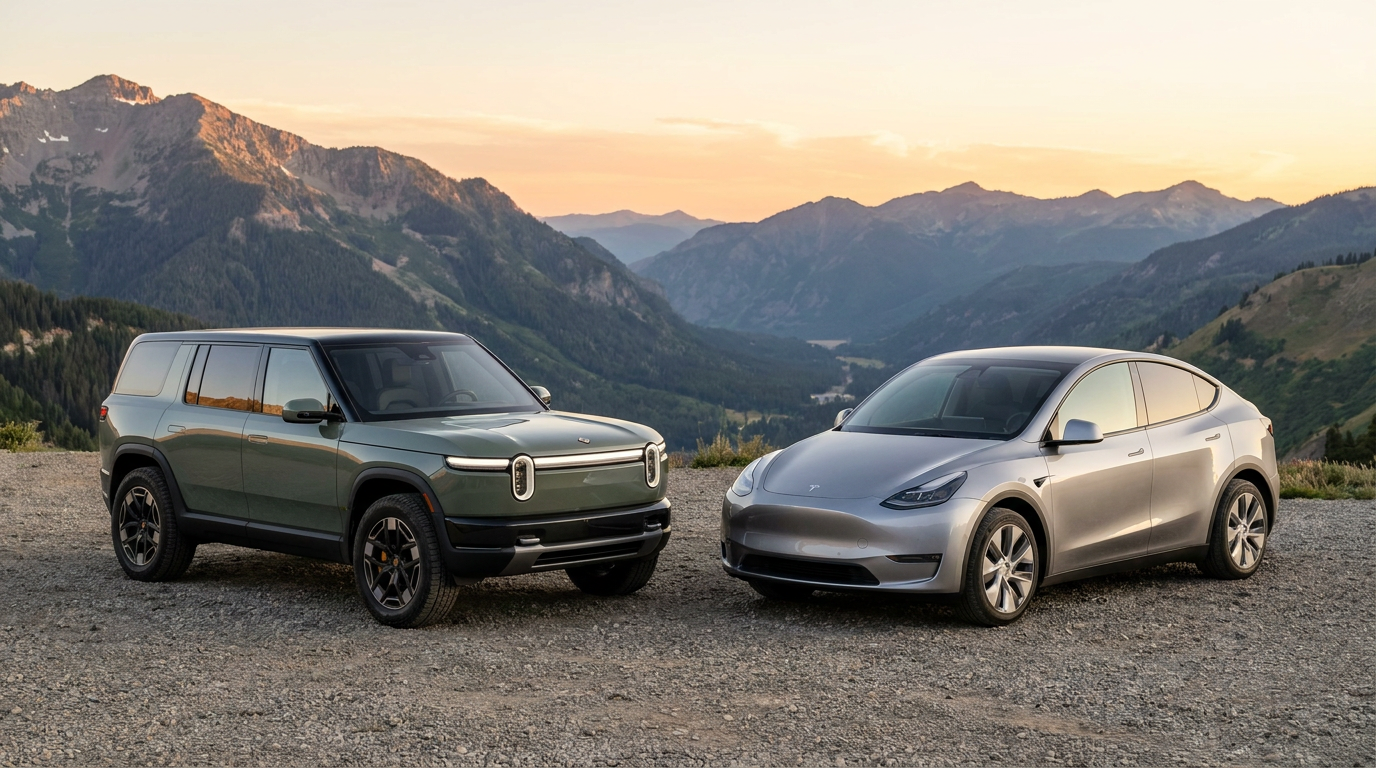
The electric crossover market has reached a pivotal maturation point in 2026, shifting from early-adopter novelties to highly refined, uncompromising daily drivers. At the center of this evolution is a heavyweight matchup between the industry's reigning champion and its most formidable challenger. Tesla has introduced its heavily anticipated "Juniper" refresh for the Model Y, addressing long-standing critiques with a significantly quieter cabin, upgraded materials, and a completely retuned suspension. Meanwhile, Rivian has launched the R2, a more compact, accessible, and highly anticipated sibling to its flagship R1S SUV. Together, these two vehicles represent the most compelling options for buyers seeking a mid-size electric SUV, yet they take fundamentally different approaches to solving the exact same transportation equation.[3][6]
The contrast between the two vehicles begins immediately with their core design philosophies. The Tesla Model Y prioritizes aerodynamic slipperiness above all else, utilizing a sleek, sloped roofline and a new razor-thin "Horizon" LED light bar that cuts through the air with minimal resistance. This teardrop shape is meticulously engineered to maximize every single kilowatt-hour of energy stored in the battery pack. In stark contrast, the Rivian R2 embraces a boxy, upright silhouette that proudly sacrifices some aerodynamic efficiency in favor of rugged utility and classic SUV proportions. The R2 looks like a traditional off-roader, complete with a flat roof, vertical rear end, and a commanding stance that immediately signals its adventurous intentions to anyone who sees it on the road.[1][5]
When evaluating the financial arguments for each vehicle, the evidence heavily favors the Tesla Model Y for immediate affordability and overall value. The 2026 Model Y starts at an incredibly accessible $41,630, maintaining Tesla's aggressive, high-volume pricing strategy designed to dominate market share. Rivian's pricing structure, however, requires more patience or a significantly larger budget. While the company has promised a $45,000 base model for 2027, the currently available R2 Performance Launch Edition commands a steep $57,990, with a mid-tier Premium trim arriving later this year at $53,990. For buyers cross-shopping the two vehicles today, the Rivian demands a noticeable financial premium over the established, highly refined Tesla.[4][7]

Despite their vastly different shapes, the efficiency battle between the two is surprisingly close. The Model Y's aerodynamic advantage translates to excellent highway range, with the Long Range All-Wheel Drive version capable of pushing past 320 real-world miles on a single charge. However, Rivian has engineered the R2 to be remarkably efficient despite its blunt nose and 4,960-pound curb weight. The R2 Performance trim achieves an impressive combined rating of 109 MPGe—slightly edging out the Model Y Performance's 104 MPGe. Furthermore, both vehicles now utilize the North American Charging Standard (NACS), meaning Rivian drivers have the exact same seamless access to Tesla's expansive Supercharger network, effectively neutralizing what used to be Tesla's single biggest competitive moat.[1][4][5]
Out on the road, the driving dynamics of each SUV highlight their distinct personalities and engineering priorities. The case for the Model Y's ride quality rests on its brand-new frequency-dependent dampers, which allow the suspension to absorb city potholes softly while stiffening instantly to provide support for sharp corners. Tesla has also achieved a remarkable 22 percent reduction in road noise through the extensive use of 360-degree acoustic glass, transforming the previously loud cabin into a serene, luxury-like environment. The Rivian R2, utilizing a traditional coil suspension over electronic dampers, delivers a smooth, even-keeled ride that remains wonderfully composed even over rough, broken pavement. While the Tesla feels sportier and more connected to the asphalt, the Rivian offers a relaxed, commanding view of the road ahead.[3][6][8]
Out on the road, the driving dynamics of each SUV highlight their distinct personalities and engineering priorities.
Interior design further separates the two competitors, catering to entirely different tastes. The argument for the Model Y centers on extreme minimalism and seamless digital integration. The 2026 update introduces premium cloth fabric lining, RGB wraparound ambient lighting, and an 8.0-inch rear passenger screen, but it controversially removes physical steering column stalks, moving turn signals to steering wheel buttons. The Rivian R2 takes a much more tactile, traditional approach. While it features dual digital screens for instrumentation and infotainment, it retains physical controls for the turn signals, wipers, and gear selector. The R2 also includes clever physical features like a power-rolling rear glass window and massive front door pockets, appealing strongly to buyers who prefer tactile feedback over navigating touchscreen menus.[2][4][6]

When it comes to cargo and utility, the evidence overwhelmingly supports the Rivian R2. The R2's boxy greenhouse and slightly longer wheelbase translate into a cavernous interior that maximizes every inch of its footprint. With the second-row seats folded flat and including the spacious front trunk, the R2 offers 90.1 cubic feet of total storage space. This represents a massive 19 percent increase over the Model Y's 76 cubic feet. The upright walls and flat roofline of the Rivian make it significantly easier to load bulky, square items like antique furniture, large coolers, or oversized dog crates. In contrast, the Model Y's sloping rear glass severely limits the height of cargo that can be pushed all the way to the back of the trunk, forcing owners to pack more strategically.[1][7]
The divergence between the two vehicles is most apparent when the pavement ends and the dirt begins. The Rivian R2 is engineered from the ground up with genuine trail capability in mind, boasting an impressive 9.6 inches of ground clearance alongside 25-degree approach and 26-degree departure angles. It features dedicated off-road driving modes and can comfortably navigate shallow water crossings, rutted trails, and craggy rocks without scraping its underbelly. The Tesla Model Y, with its modest 6.0 inches of ground clearance, is strictly a street-focused vehicle. While its sophisticated dual-motor all-wheel-drive system handles snow, heavy rain, and slick conditions with absolute aplomb, it lacks the physical clearance and suspension articulation required for anything more challenging than a well-graded gravel driveway leading to a cabin.[1][3]

Weighing the trade-offs, the Rivian R2 fits well when buyers prioritize outdoor utility, require maximum cargo capacity for gear, and prefer the tactile reassurance of physical controls. It is the ideal choice for those who want an electric vehicle that feels like a traditional, rugged SUV and are willing to pay a premium for that distinct character. The R2 seamlessly blends daily driving comfort with weekend adventure readiness. Conversely, the Rivian R2 does not fit well when budget is the absolute strictest constraint, as its launch editions carry a hefty premium. It also may not appeal to drivers who prioritize sports-car-like handling on twisty mountain roads, where its taller stance and off-road tires naturally introduce more body roll than a lower, stiffer vehicle.[2][4][8]
On the other hand, the Tesla Model Y fits well when buyers demand the absolute maximum range, efficiency, and features per dollar spent. It excels for daily commuters who value a whisper-quiet cabin, seamless software integration, and a sleek, aerodynamic profile that maximizes highway efficiency on long road trips. It remains the pragmatic, high-value choice for the vast majority of typical driving needs. However, the Tesla Model Y does not fit well when frequent off-roading is required, or when hauling tall, bulky cargo is a regular necessity. Furthermore, it may alienate drivers who absolutely refuse to adapt to a stalk-less steering wheel, as the reliance on steering-wheel buttons for turn signals requires a noticeable adjustment period for those accustomed to traditional controls.[5][6][7]
How we got here
2020
Tesla launches the original Model Y, which quickly becomes the world's best-selling electric vehicle.
March 2024
Rivian officially unveils the R2, promising a more affordable, mid-size alternative to its flagship R1S.
Early 2026
Tesla releases the 'Juniper' refresh for the Model Y, featuring major suspension and interior upgrades.
Mid 2026
The first Rivian R2 Performance Launch Edition models begin arriving to customers.
Viewpoints in depth
Outdoor Utility Advocates
Drivers who prioritize rugged capability, cargo space, and physical controls.
This camp heavily favors the Rivian R2. They argue that an SUV should be fundamentally capable of leaving the pavement, pointing to the R2's 9.6 inches of ground clearance and dedicated off-road modes as essential features. Furthermore, they value the massive 90.1 cubic feet of cargo space for hauling camping gear, dogs, and sports equipment. For these buyers, the aerodynamic efficiency of a teardrop shape is less important than the practical utility of a boxy greenhouse and the tactile safety of physical turn signal stalks.
Value and Efficiency Prioritizers
Buyers focused on maximizing range, charging speed, and features per dollar.
This perspective aligns strongly with the Tesla Model Y. Advocates point out that the vast majority of SUV owners rarely go off-road, making aerodynamic efficiency and highway range far more valuable in daily life. They cite the Model Y's lower starting price of $41,630 as unbeatable value, especially when combined with its whisper-quiet cabin and advanced software integration. For this group, adapting to a stalk-less steering wheel is a minor trade-off for accessing the most proven electric powertrain on the market at a highly competitive price point.
What we don't know
- Whether Rivian will hit its target timeline for the $45,000 base model R2 in 2027.
- How the long-term reliability of Tesla's new frequency-dependent dampers will compare to the outgoing suspension.
- Exact real-world range degradation for the R2 in extreme winter conditions.
Key terms
- NACS
- The North American Charging Standard, originally developed by Tesla, which is now the universal plug type for most new electric vehicles.
- MPGe
- Miles Per Gallon Equivalent, a metric used to compare the energy efficiency of electric vehicles to traditional gas-powered cars.
- Frequency-dependent dampers
- A suspension technology that automatically adjusts its stiffness based on the type of road surface, providing a softer ride over bumps and firmer support in corners.
- Acoustic glass
- Specially laminated glass designed to block exterior wind and road noise from entering the vehicle's cabin.
Frequently asked
Does the Rivian R2 use the Tesla Supercharger network?
Yes, the Rivian R2 comes equipped with the NACS charge port natively, allowing seamless access to Tesla's Supercharger network without an adapter.
Which vehicle has more cargo space?
The Rivian R2 offers significantly more room, with 90.1 cubic feet of total storage compared to the Model Y's 76 cubic feet.
Did Tesla remove the turn signal stalks on the 2026 Model Y?
Yes, the 2026 'Juniper' update removes physical steering column stalks, moving the turn signals to buttons on the steering wheel.
Can the Tesla Model Y go off-road?
While its all-wheel drive handles snow and dirt roads well, its 6.0 inches of ground clearance makes it unsuitable for serious off-roading compared to the Rivian R2.
Sources
Source coverage
8 outlets
3 viewpoints surfaced







[1]ElectrekNeutral Automotive Analysts
Rivian R2 vs Tesla Model Y spotted side-by-side: Detailed size comparison
Read on Electrek →[2]Car and DriverOutdoor Utility Advocates
2027 Rivian R2 First Drive: From Normal, Is Normal
Read on Car and Driver →[3]Top GearNeutral Automotive Analysts
Rivian R2 (US) review
Read on Top Gear →[4]EdmundsNeutral Automotive Analysts
Rivian R2 review 2026
Read on Edmunds →[5]CarwowValue and Efficiency Prioritizers
Rivian R2 vs Tesla Model Y: prices and standard equipment
Read on Carwow →[6]BEV PrimeValue and Efficiency Prioritizers
Tesla Model Y Juniper Review 2026
Read on BEV Prime →[7]CarsDirectValue and Efficiency Prioritizers
Compare the 2027 Rivian R2 to the 2026 Tesla Model Y
Read on CarsDirect →[8]Men's JournalOutdoor Utility Advocates
The Rivian R2 Is the Best New Car I've Driven in Years
Read on Men's Journal →
Every angle. Every day.
Get automotive stories with full source coverage and perspective breakdowns delivered to your inbox.