
reMarkable 2 vs. Kindle Scribe: Which E-Ink Tablet Fits Your Workflow in 2026
The e-ink tablet market has matured into a clear divide between reading-first hybrids and writing-first purists. We break down the trade-offs between the Amazon Kindle Scribe and the reMarkable 2 to help you find the right digital notebook.
By Factlen Editorial Team
- Focus Purists
- Professionals and creatives who seek to eliminate digital distractions and replicate the feel of paper.
- Ecosystem Readers
- Users who value seamless access to massive book libraries and integrated audiobooks.
- Versatility Seekers
- Tech enthusiasts who want their e-ink device to function as a fully capable Android tablet.
What's not represented
- · Budget-conscious students seeking sub-$200 options
- · Color e-ink early adopters
Why this matters
Choosing the right e-ink tablet dictates whether you end up with a distraction-free productivity tool or a frustratingly limited gadget. Understanding the specific trade-offs between reading clarity and writing tactility ensures you invest in a device that actually fits your daily workflow.
Key points
- The Kindle Scribe excels in reading clarity with a 300 ppi backlit display.
- The reMarkable 2 offers a superior, pencil-like writing experience on a 226 ppi unlit screen.
- Amazon's tablet integrates seamlessly with Kindle libraries and Audible.
- reMarkable provides advanced software tools like layers and shape recognition for professionals.
- Neither device is suitable for users seeking full Android app capabilities or web browsing.
The e-ink tablet market has matured significantly by 2026, shifting from niche gadgets to essential productivity tools. As buyers seek refuge from the constant notifications and eye strain of traditional screens, the decision often narrows down to a fundamental trade-off: pure, distraction-free focus versus multi-functional convenience. The landscape now offers highly specialized tools designed to solve specific workflow problems.[2][4]
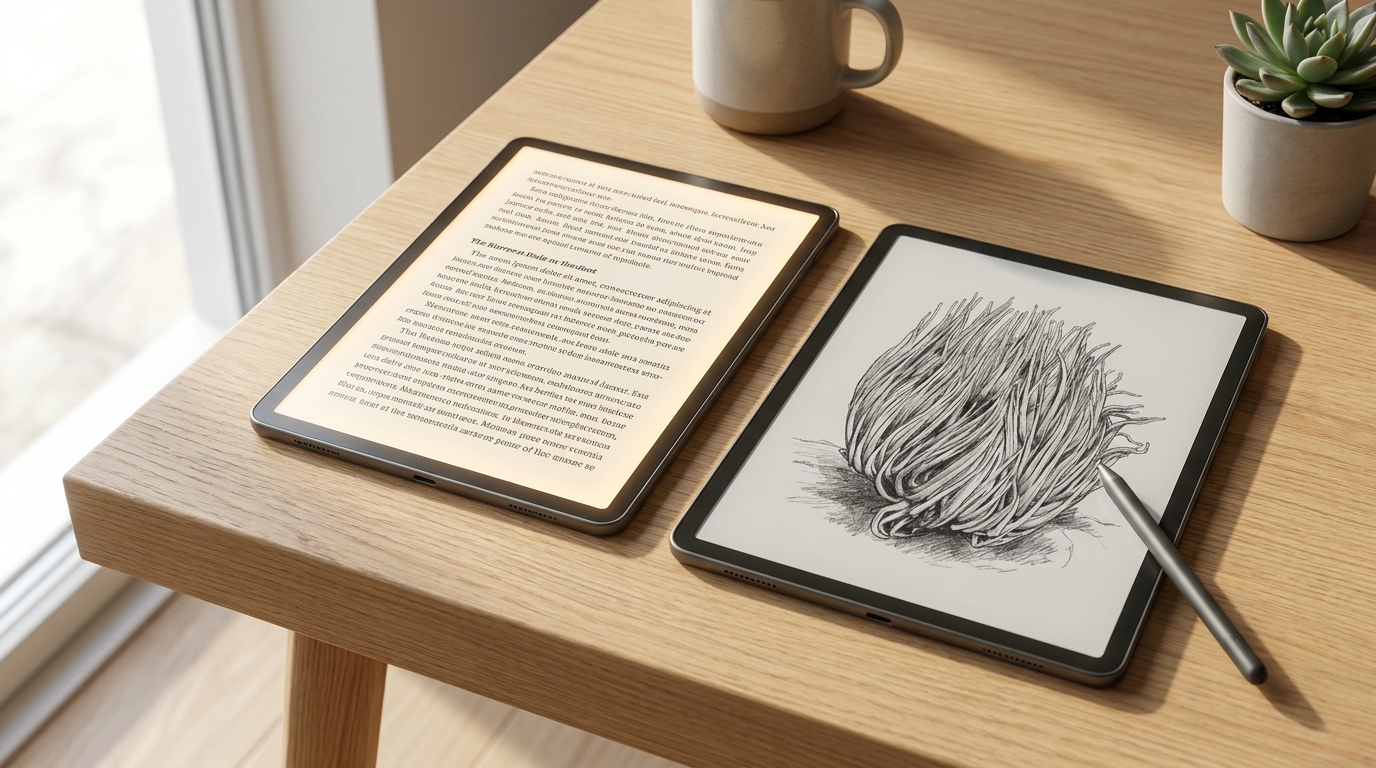
At the center of this debate are two dominant devices that represent opposing philosophies. The reMarkable 2, despite its age, remains the veteran purist's choice, offering an uncompromising digital notebook experience. On the other side sits the Amazon Kindle Scribe, a hybrid device that grafts robust note-taking capabilities onto the world's most popular e-reader platform.[1][5]
The argument for the Amazon Kindle Scribe begins with its display technology and sheer versatility. The evidence lies in its 10.2-inch screen, which boasts a crisp 300-pixel-per-inch resolution and an adjustable front light capable of reaching 94 nits. This makes it exceptionally capable for reading dense text and working in dimly lit environments like airplane cabins or dark bedrooms.[1][2]
Furthermore, the case for the Scribe is bolstered by its seamless integration into the Amazon ecosystem. Users with extensive Kindle libraries or Audible subscriptions can transition effortlessly between reading, listening via Bluetooth, and annotating texts. Its Premium Pen, which features a dedicated shortcut button for instantly switching to a highlighter or eraser, adds a layer of modern convenience to the writing workflow.[1][5]

However, the case against the Kindle Scribe centers on its writing feel and software limitations. Because the device incorporates lighting layers over the e-ink display, the stylus sits slightly further from the digital ink. Reviewers note that writing on the Scribe feels smoother—akin to a ballpoint pen on a whiteboard—which lacks the tactile, scratchy feedback of real paper. Additionally, its note-taking software remains relatively basic, lacking advanced organizational tools.[1][5]
Conversely, the argument for the reMarkable 2 focuses entirely on its unmatched, hyper-focused writing experience. The evidence is immediately apparent in its hardware: at just 4.7 millimeters thick and weighing 403.5 grams, it is significantly thinner and lighter than the Scribe. Its Wacom EMR stylus technology and micro-textured screen provide a pencil-like grit that closely mimics the friction of physical paper.[4][5]
Conversely, the argument for the reMarkable 2 focuses entirely on its unmatched, hyper-focused writing experience.
The case for the reMarkable 2 extends to its sophisticated software ecosystem. Designed explicitly for professionals and creatives, the interface supports complex layer management, shape recognition, and a highly refined companion app that syncs flawlessly with Google Drive and Microsoft OneDrive. For users managing complex projects or marking up extensive PDFs, these organizational tools are indispensable.[2][5]
Battery life serves as another critical point of comparison where the two devices diverge based on their feature sets. The Kindle Scribe's 42-day battery life is heavily dependent on how often the front light is used, but it generally offers weeks of endurance for standard reading and writing. The convenience of a backlit screen requires a slight compromise in absolute longevity.[2]

The reMarkable 2, unburdened by LEDs or background syncing processes, delivers a similarly impressive multi-week battery life. However, its active stylus ecosystem—particularly the Marker Plus with its physical eraser—draws praise for requiring zero charging, ensuring the pen is always ready the moment inspiration strikes.[1][5]
The primary case against the reMarkable 2 is its lack of a backlight and lower screen resolution. With a 226-pixel-per-inch display that relies entirely on ambient light, the device becomes virtually unusable in dark rooms. Furthermore, the financial evidence shows a steeper barrier to entry; while the Scribe frequently retails around $399 with a pen included, the reMarkable 2 costs roughly $449 and locks some of its best cloud-syncing features behind a monthly Connect subscription after a 100-day trial.[1][2]
When evaluating the trade-offs, the Kindle Scribe fits well when the buyer is primarily an avid reader who wants to annotate books, requires a backlit screen for nighttime use, and prefers a smoother, ballpoint-style writing feel. It offers exceptional value for those already entrenched in the Amazon ecosystem who want a single device for reading and light note-taking.[1][3]

The reMarkable 2 fits well when the user demands a dedicated, distraction-free environment for deep work. It is the superior choice for lawyers, writers, and designers who need robust organizational tools, PDF markup capabilities, and the most authentic pen-to-paper tactile feedback available on the market.[1][5]
Neither device fits well when a user expects the full functionality of a traditional tablet. Buyers looking to browse the web, watch videos, or download Android applications from the Google Play Store will find both the Scribe and reMarkable severely limiting, as their operating systems are intentionally locked down to prevent distractions.[2][3]
For those specific needs, Android-based e-ink hybrids like the Boox Note Air 4 Pro offer a more appropriate, albeit more complex, solution. Ultimately, the 2026 e-ink landscape rewards buyers who honestly assess their daily workflows, choosing between reading convenience and writing purity rather than searching for an impossible all-in-one compromise.[3][4]
How we got here
Late 2020
reMarkable 2 launches, setting a new industry standard for thinness and paper-like writing feel.
Late 2022
Amazon enters the large-format e-ink market with the Kindle Scribe, adding stylus support to its popular e-reader line.
2024
Amazon releases software updates for the Scribe, significantly improving its previously bare-bones note-taking tools.
Early 2026
Both devices remain top sellers in their respective niches, representing the core divide between reading-first and writing-first tablets.
Viewpoints in depth
The Avid Reader's View
Prioritizes text clarity, ecosystem access, and the ability to read in any lighting condition.
For users whose primary goal is consuming books and documents, the Kindle Scribe is viewed as a massive upgrade to the traditional e-reader. This camp argues that the 300 ppi screen and adjustable warm lighting are non-negotiable features for late-night reading. They view the note-taking capabilities not as the main event, but as a highly convenient bonus that allows them to annotate their existing Amazon library without carrying a separate device.
The Deep-Work Professional's View
Values distraction-free environments, tactile feedback, and robust document organization.
Professionals such as lawyers, writers, and designers often champion the reMarkable 2 specifically because of what it lacks. In this view, the absence of a backlight, web browser, and app store is a feature, not a bug—it enforces focus. They point to the superior Wacom EMR stylus, which provides a scratchy, pencil-like friction, and the software's ability to handle complex layers and PDF markups as evidence that the reMarkable remains the ultimate tool for serious, uninterrupted thought.
The Power User's View
Demands full app support and versatility beyond basic reading and writing.
A growing segment of the e-ink market finds both the Scribe and the reMarkable 2 too restrictive. These users argue that if they are spending over $400 on a tablet, it should be able to run Microsoft Office, sync with Notion, and browse the web. They point to Android-based alternatives like the Boox Note Air series as the true future of the category, accepting a steeper learning curve and occasional screen ghosting in exchange for the freedom of the Google Play Store.
What we don't know
- Whether Amazon will introduce advanced layer management in future Scribe software updates.
- When reMarkable will officially retire the reMarkable 2 in favor of a purely color-focused lineup.
Key terms
- E-Ink (Electronic Ink)
- A display technology that mimics the appearance of ordinary ink on paper, reflecting light rather than emitting it to reduce eye strain.
- Wacom EMR
- Electromagnetic Resonance technology that allows a stylus to interact with a screen without needing a battery or Bluetooth pairing.
- PPI (Pixels Per Inch)
- A measurement of screen resolution and pixel density; a higher number indicates sharper, crisper text and images.
- Front Light
- LEDs positioned around the edges of an e-ink display that shine light across the screen rather than directly into the user's eyes.
Frequently asked
Can I read Kindle books on the reMarkable 2?
No, the reMarkable 2 does not support the Kindle app or DRM-protected Amazon books. It primarily handles DRM-free EPUBs and PDFs.
Does the Kindle Scribe require a subscription to take notes?
No, all of the Kindle Scribe's note-taking features are available out of the box without a recurring subscription.
Which device is better for drawing and sketching?
The reMarkable 2 is superior for artists due to its support for layers, varied brush types, and a screen texture that closely mimics real paper.
Can either tablet connect to the internet?
Both connect to Wi-Fi for syncing documents and downloading updates, but neither features a traditional web browser for surfing the internet.
Sources
Source coverage
6 outlets
3 viewpoints surfaced






[1]PCMagEcosystem Readers
Amazon Kindle Scribe vs. ReMarkable 2: Which Ereader Is Better for Writing?
Read on PCMag →[2]EngadgetVersatility Seekers
The best E Ink tablets for 2026
Read on Engadget →[3]RoipadEcosystem Readers
The Ultimate Guide to E-Ink Tablets for Note-Taking and Reading (2026 Edition)
Read on Roipad →[4]eReaders ForumFocus Purists
2026 Buyer's Guide: Top E-Paper Devices
Read on eReaders Forum →[5]Magherally LensFocus Purists
Kindle Scribe vs reMarkable 2: Which E-Ink Tablet Is Right for You?
Read on Magherally Lens →[6]IGNVersatility Seekers
These Are the Best E-Ink Tablets
Read on IGN →

Every angle. Every day.
Get meta stories with full source coverage and perspective breakdowns delivered to your inbox.