
Quantum Computing Enters the 'Fault-Tolerant Era' as Logical Qubits and Room-Temperature Tech Advance
A series of breakthroughs in error correction and room-temperature photonics has moved quantum computing out of the theoretical phase and into tangible engineering.
By Factlen Editorial Team
- Superconducting Scaling Advocates
- Believe that massive infrastructure and surface code error correction are the fastest paths to quantum advantage.
- Alternative Architecture Pioneers
- Argue that novel physics like neutral atoms and room-temperature photonics will bypass the cryogenic cooling bottleneck.
- Classical Computing Defenders
- Maintain that conventional GPUs will remain the dominant force for decades, viewing quantum utility as a distant milestone.
What's not represented
- · Cybersecurity experts preparing for post-quantum encryption
- · Pharmaceutical researchers awaiting molecular simulation tools
Why this matters
Reliable quantum computers will eventually revolutionize drug discovery, materials science, and artificial intelligence by solving optimization problems that would take classical supercomputers millennia to crack.
Key points
- The quantum industry has shifted focus from raw physical qubits to stable, error-corrected 'logical qubits.'
- Microsoft and Quantinuum successfully created 12 highly accurate logical qubits, drastically reducing error rates.
- IBM deployed its Nighthawk processor, aiming for verified quantum advantage by the end of 2026.
- Stanford researchers developed a nanoscale device that entangles photons and electrons at room temperature.
For decades, quantum computing has been trapped in the "almost there" zone—a theoretical powerhouse that struggled to perform reliable calculations in the real world. But in the first half of 2026, the industry crossed a critical threshold. Researchers are officially declaring the dawn of the "fault-tolerant foundation era," a phase where adding more qubits to a system actually reduces error rates rather than amplifying noise. This marks a fundamental shift from building fragile experimental rigs to engineering reliable computational platforms.[1]
The core bottleneck of quantum computing has always been decoherence. Unlike classical bits, which stably represent zeros and ones, quantum bits (qubits) can exist in multiple states simultaneously. However, these physical qubits are incredibly fragile. Slight temperature fluctuations, stray magnetic fields, or electromagnetic noise cause them to lose their quantum state within milliseconds. For years, this meant that any complex calculation would quickly degrade into an expensive random number generator.[2]
To solve this, the industry has fundamentally shifted its primary metric of success. Instead of boasting about raw counts of noisy physical qubits, the focus is now entirely on "logical qubits." A logical qubit is a virtual, highly stable unit of computation created by networking hundreds or thousands of physical qubits together using advanced error-correction algorithms. This redundancy allows the system to detect and fix errors on the fly without destroying the delicate quantum information.[1][2]

The evidence that this error-correction approach works at scale is now definitive. Google's "Willow" processor recently demonstrated that its surface code error correction can protect quantum information across deep circuits. In a landmark benchmark, Willow executed a complex calculation in under five minutes that would take a classical supercomputer billions of years to complete, proving that error correction can yield tangible performance gains.[2][6]
Building on this momentum, Microsoft and Quantinuum achieved a major milestone by creating 12 highly accurate logical qubits. By applying active syndrome extraction to a 32-qubit processor, the teams ran over 14,000 independent circuits without a single error. This breakthrough achieved logical error rates 800 times lower than the underlying physical qubits, proving that algorithms can now be made stable enough for real-world applications.[1][6]
With error correction proving viable, hardware manufacturers are locking in aggressive timelines for "verified quantum advantage"—the point where a quantum machine definitively outperforms classical supercomputers on a useful task. IBM has publicly staked its reputation on achieving this milestone by the end of 2026, moving away from vague promises and putting concrete dates, numbers, and measurable milestones on the table.[2][6]
IBM's confidence is backed by its newly deployed Nighthawk processor. The 120-qubit system features advanced tunable couplers that provide significantly more connectivity than previous generations. Nighthawk currently handles 5,000 two-qubit gates—the quantum equivalent of operations—with plans to scale to 15,000 gates by 2028. This provides the raw computational depth needed to run variational algorithms and observable estimation tasks.[2][6]

IBM's confidence is backed by its newly deployed Nighthawk processor.
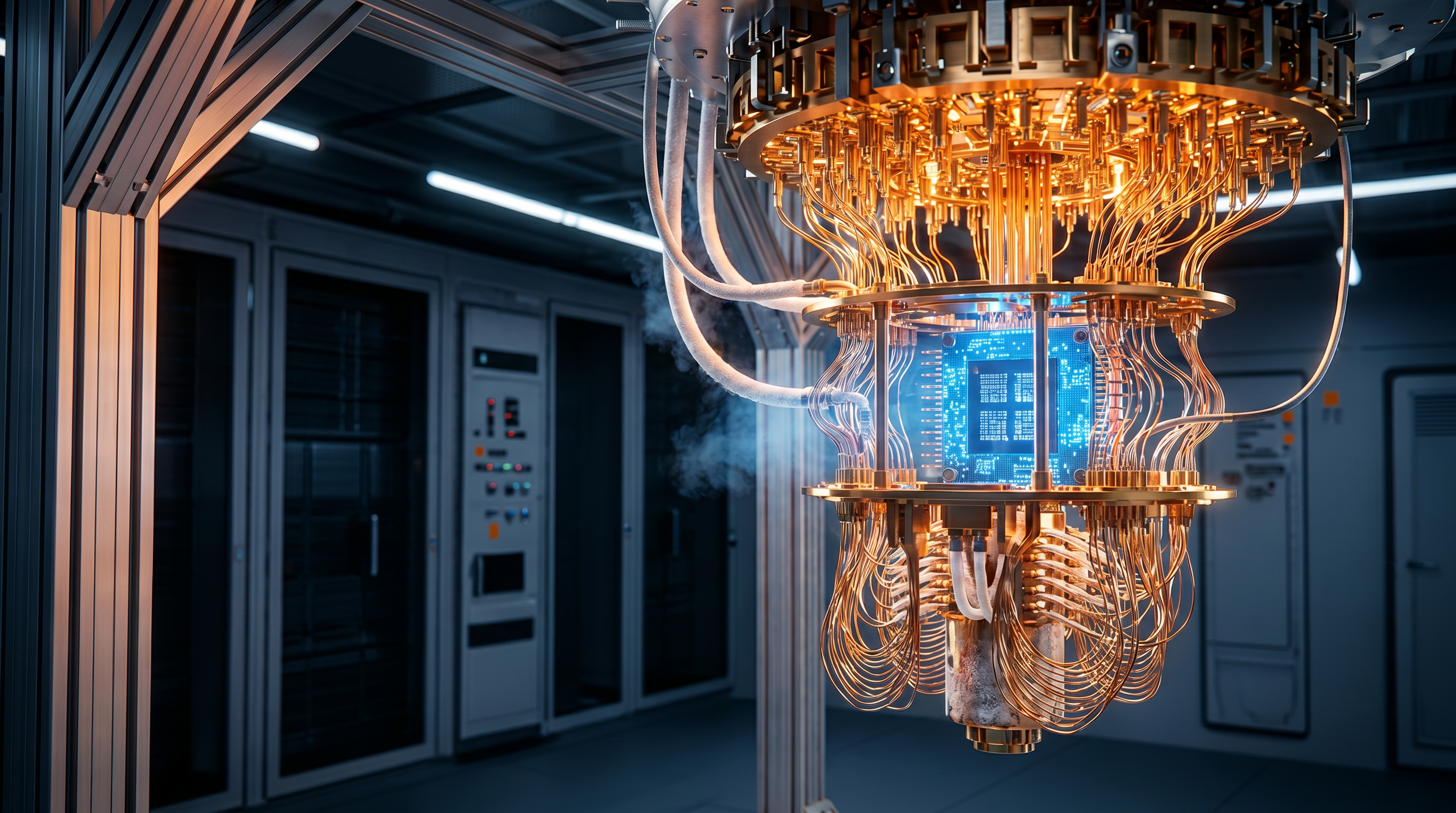
Despite these advances in error correction, a massive physical hurdle remains: extreme cooling. Conventional superconducting qubits require operating temperatures near absolute zero (about -459 degrees Fahrenheit) to prevent thermal energy from destroying the qubits' states. These massive cryogenic cooling systems make quantum computers incredibly expensive, power-hungry, and confine them to specialized, warehouse-sized data centers.[2][4]
However, a breakthrough published in May 2026 offers a glimpse of a radically different, more accessible future. Researchers at Stanford University successfully developed a nanoscale optical device that functions at room temperature while linking the quantum properties of light and electrons. This overcomes one of the most stubborn barriers in quantum engineering and opens the door to entirely new architectures.[3][4]
Detailed in the journal Nature Communications, the Stanford device uses "twisted light" to entangle photons with electron spins in a specialized semiconductor heterostructure. By utilizing high-quality-factor chiroptical cavities, the team created stable qubits without the need for extreme refrigeration. This valley-selective emission technique proves that quantum states can be manipulated in ambient conditions.[3][4]

While the researchers caution that putting a quantum computer in a cell phone remains a "10-plus-year plan," the room-temperature breakthrough paves the way for smaller, cheaper quantum systems. In the near term, this technology could revolutionize secure quantum communications, advanced sensor networks, and optical interconnects that link massive quantum data centers together.[3]
Beyond superconducting circuits and twisted light, alternative architectures are also accelerating. Atom Computing is rapidly scaling neutral-atom systems that use optical tweezers to arrange atoms in 3D lattices, aiming for thousands of qubits by 2027. Meanwhile, recent progress in decoding Majorana qubits—which are inherently resistant to noise due to their topological properties—promises smaller and more reliable components that require less overhead for error correction.[1][2][5]

The consensus among industry trackers is that the timeline for widespread impact is compressing. While skeptics maintain that classical GPUs will dominate artificial intelligence and optimization for decades, the leading quantum hardware companies now project that commercially useful quantum computing will arrive before the end of the decade, pulling fault-tolerant timelines forward by several years.[5]
The transition from theoretical physics to tangible engineering is now complete. The remaining challenges—scaling logical qubits from the dozens to the thousands required to break modern encryption or simulate complex molecules—are immense. However, they are now viewed as complex engineering and manufacturing problems rather than fundamental mysteries of physics, marking the true beginning of the quantum era.[1][5]
How we got here
2024-2025
Google demonstrates surface code error correction at scale with its Willow processor.
Early 2026
Microsoft and Quantinuum successfully create 12 highly accurate logical qubits.
Feb 2026
IBM deploys the Nighthawk processor, handling 5,000 two-qubit gates.
May 2026
Stanford researchers publish a breakthrough room-temperature quantum device using twisted light.
Viewpoints in depth
Superconducting Scaling Advocates
Focusing on scaling superconducting systems through massive infrastructure and error correction.
Hardware giants like IBM and Google believe that brute-forcing the decoherence problem through massive engineering is the most reliable path forward. By building larger cryogenic systems and refining surface code error correction, they argue that superconducting circuits will reach verified quantum advantage first. Their roadmaps prioritize scaling the number of two-qubit gates and physical qubits to create a robust foundation for logical qubits, accepting the high infrastructure costs as a necessary trade-off.
Alternative Architecture Pioneers
Pushing novel physics to bypass the cryogenic cooling bottleneck.
Researchers and startups focusing on neutral atoms, trapped ions, and photonics argue that superconducting systems are too bulky and expensive to scale globally. Companies like Atom Computing are using optical tweezers to arrange atoms in 3D lattices, while academic teams like those at Stanford are proving that quantum entanglement can survive at room temperature using twisted light. This camp believes that the ultimate winner in the quantum race will be the architecture that can be miniaturized and integrated into existing optical networks without requiring warehouse-sized refrigerators.
Classical Computing Defenders
Arguing that conventional GPUs will remain the dominant force for decades.
Skeptics and traditional hardware manufacturers point out that classical computing is not standing still. As AI drives massive investments in GPU clusters, the benchmark for "quantum advantage" keeps moving further away. This perspective emphasizes that while logical qubits are a scientific breakthrough, scaling them from a dozen to the millions required for commercial utility is an economic and engineering hurdle that will keep quantum computers relegated to niche laboratory experiments for the foreseeable future.
What we don't know
- Whether the Stanford room-temperature technology can be scaled into a multi-qubit processor.
- Exactly how many logical qubits will be required to achieve verified quantum advantage in commercial applications.
- If the massive energy requirements of cryogenic cooling will limit the widespread deployment of superconducting quantum data centers.
Key terms
- Logical Qubit
- A highly stable, virtual unit of quantum computation created by networking multiple physical qubits together with error-correction algorithms.
- Decoherence
- The process where qubits lose their fragile quantum state due to environmental noise or temperature, causing calculation errors.
- Verified Quantum Advantage
- The milestone where a quantum computer definitively solves a meaningful problem faster or more efficiently than the best classical supercomputer.
- Surface Code
- A specific error-correction method that arranges physical qubits in a two-dimensional grid to detect and fix errors on the fly.
Frequently asked
Will quantum computers replace my laptop?
No. Classical computers are highly efficient for everyday tasks like web browsing and word processing. Quantum computers will act as specialized accelerators for complex optimization, cryptography, and chemistry problems.
What is the difference between a physical and logical qubit?
Physical qubits are the actual hardware components, which are highly prone to errors from environmental noise. Logical qubits are stable, error-corrected units made by grouping many physical qubits together.
Why is the room-temperature breakthrough important?
Most quantum computers require massive, expensive cooling systems to reach near absolute zero. Operating at room temperature could eventually allow quantum chips to be miniaturized and widely deployed outside of specialized data centers.
Sources
Source coverage
6 outlets
3 viewpoints surfaced






[1]SpinQuantaAlternative Architecture Pioneers
2026 Qubit Breakthroughs: Quantum Computing Enters the “Fault-Tolerant Foundation Era”
Read on SpinQuanta →[2]MediumSuperconducting Scaling Advocates
The quantum computing industry just had its iPhone moment
Read on Medium →[3]ScienceDailyAlternative Architecture Pioneers
Stanford quantum computing breakthrough uses twisted light to work without extreme cooling
Read on ScienceDaily →[4]Nature CommunicationsAlternative Architecture Pioneers
Room-temperature valley-selective emission in Si-MoSe2 heterostructures enabled by high-quality-factor chiroptical cavities
Read on Nature Communications →[5]QolourClassical Computing Defenders
Quantum Computing Timeline Predictions
Read on Qolour →[6]AI UncoveredSuperconducting Scaling Advocates
Top 15 New Quantum Computing Breakthroughs
Read on AI Uncovered →

Every angle. Every day.
Get science stories with full source coverage and perspective breakdowns delivered to your inbox.