
Physicists Power On the First Working Nuclear Clocks, Unlocking New Era for Deep Space and Dark Matter
Two independent research teams have successfully built the world's first functioning nuclear clocks using the isotope Thorium-229. The breakthrough promises to revolutionize deep-space navigation and the search for dark matter by measuring time via the atomic nucleus rather than electron shells.
By Factlen Editorial Team
- Precision Metrologists
- Focused on the resilience and accuracy of global timekeeping infrastructure.
- Astrophysicists & Cosmologists
- Focused on using the clock as a sensor to probe the fundamental laws of the universe.
- Quantum Engineers
- Focused on the materials science and laser technology required to make the clock function.
What's not represented
- · Space Agency Mission Planners
- · Global Positioning System (GPS) Operators
Why this matters
Timekeeping underpins modern civilization, from GPS networks to financial markets. By shifting the 'pendulum' from the fragile electron shell to the robust atomic nucleus, nuclear clocks promise navigation systems that cannot be jammed, spacecraft that can steer themselves through deep space, and sensors sensitive enough to detect the invisible dark matter shaping our universe.
Key points
- Two independent research teams have successfully built the world's first functioning nuclear clocks.
- The devices measure time using energy jumps within the atomic nucleus, rather than the electron shell.
- Thorium-229 is the only known isotope with a nuclear energy jump small enough to be triggered by a laser.
- Nuclear clocks are highly resistant to environmental noise, paving the way for portable, ultra-stable timekeeping.
- The technology could enable autonomous deep-space navigation and help detect ultralight dark matter.
- Widespread deployment is currently limited by the extreme scarcity of Thorium-229 and the need for complex laser infrastructure.
For half a century, physicists have chased a theoretical holy grail of timekeeping: a clock driven not by the flutter of electrons, but by the dense, unyielding heart of an atom. That decades-long pursuit has now crossed the finish line. Two independent research teams have successfully powered on the world’s first functioning nuclear clocks, marking a paradigm shift in quantum metrology.[1][2][3]
Modern civilization runs on atomic clocks. They synchronize global GPS networks, timestamp high-frequency financial transactions, and guide deep-space probes. These devices measure time by tuning laser light to the exact frequency required to make an atom's electrons jump between energy levels. However, electrons orbit on the fragile outer edge of an atom, leaving them vulnerable to stray electromagnetic fields and temperature fluctuations.[1][5]
A nuclear clock bypasses the electron shell entirely. Instead, it measures time using energy jumps within the atom’s nucleus, where protons and neutrons are tightly bound by the strong nuclear force. Because the nucleus is shielded from external environmental noise by the surrounding electron cloud, a nuclear clock promises to be vastly more stable and resilient than its atomic predecessors.[5][8]
The challenge has always been access. The energy required to excite a typical nucleus is immense, usually demanding high-energy gamma rays that cannot be controlled with the precision of a laser. Enter Thorium-229. This rare isotope is a "precious gift" of nature—the only known atomic nucleus in the periodic table with an energy jump small enough to be triggered by ultraviolet light.[2][6]

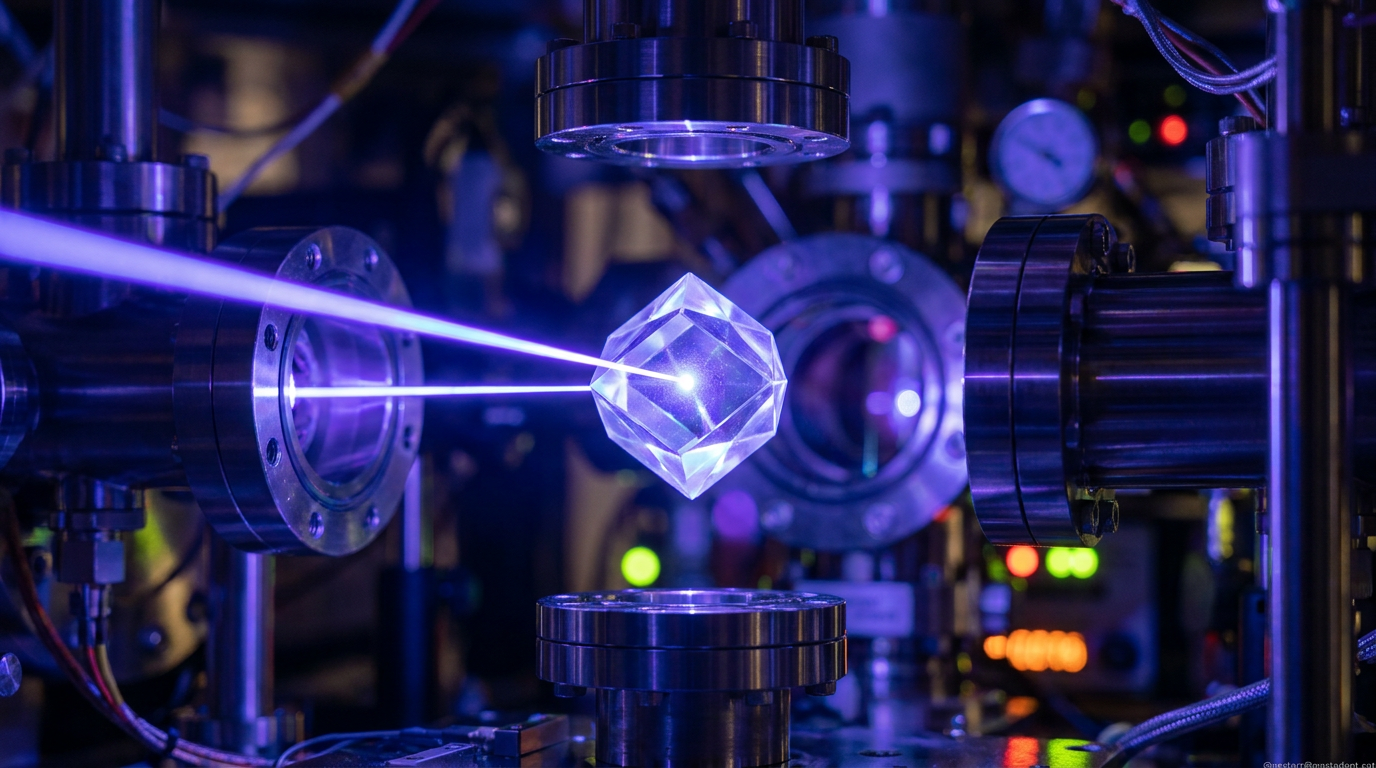
Unlocking that transition required specialized optics. Researchers recently achieved a critical milestone by developing a continuous-wave vacuum ultraviolet (VUV) laser operating at exactly 148.4 nanometers. This ultra-narrow linewidth laser provided the precise "key" needed to excite the thorium nucleus without relying on massive particle accelerators.[4][7]
The primary claim driving the excitement around nuclear clocks is their unprecedented resilience to environmental interference. The evidence for this claim comes from the clock's solid-state architecture. Unlike the best atomic clocks, which require atoms to be suspended in cumbersome, ultra-cold vacuum chambers, the new nuclear clocks embed thorium ions directly into a solid crystal of calcium fluoride.[2][7]
By substituting calcium ions with thorium, researchers created a local defect structure that allows billions of nuclei to contribute to the clock signal simultaneously. Recent quantum-state-resolved spectroscopy tests demonstrated that the crystal-bound thorium nuclei maintained their precise "ticking" across significant temperature variations, from 150 Kelvin up to room temperature, proving their inherent resistance to thermal noise.[8]
A secondary claim is that the technology can be radically miniaturized. While the initial crystal-based prototypes proved the concept, growing the specialized transparent crystals is slow and requires large amounts of radioactive material. To solve this, a coalition of researchers recently demonstrated an alternative "jeweler's trick": electroplating a microscopic thin film of thorium oxide onto a stainless-steel disc.[6]
A secondary claim is that the technology can be radically miniaturized.
When struck by the VUV laser, the electroplated thorium nuclei absorb the energy and transfer it to nearby electrons, generating a directly measurable electric current. This breakthrough achieves the same precise nuclear excitation using a fraction of the material, providing strong evidence that nuclear clocks could eventually be miniaturized from room-sized laboratory setups into portable, smartphone-sized devices.[6]
The ultimate goal is for nuclear clocks to surpass the precision of optical atomic clocks. To measure the nuclear "ticks," researchers coupled the thorium crystal to an optical frequency comb—a highly accurate "light ruler." By establishing a phase-coherent link between the VUV laser and a world-class strontium atomic clock, they achieved fractional uncertainties that already rival top-tier atomic systems, with a clear theoretical path to surpass them.[5][7]

The implications for astronomy and astrophysics are profound, beginning with deep-space navigation. Currently, spacecraft cannot navigate autonomously; they rely on Earth-based atomic clocks to calculate their position via delayed radio signals across millions of miles of space.[6][8]
A portable, solid-state nuclear clock would allow a probe to carry its own primary time standard. Immune to the radiation and electromagnetic storms of deep space, the onboard clock would enable the spacecraft to calculate its own trajectory in real-time. This autonomy reduces the need for constant Earth intervention and frees up critical payload mass for scientific instruments.[6]
Beyond navigation, the nuclear clock serves as a fundamentally new type of sensor for the cosmos. Because atomic clocks rely on electrons, they are governed by electromagnetism. The nuclear clock, however, is governed by the strong nuclear force. Comparing the ticking rates of the two clocks over time allows physicists to test whether the fundamental constants of nature are truly constant.[2][3]
This dual-clock comparison offers a highly sensitive trap for ultralight dark matter. If this hypothetical, invisible substance interacts with the strong nuclear force as it washes through our solar system, it would cause minute, periodic shifts in the thorium clock's frequency—shifts that an atomic clock would not register.[2][8]

The evidence for this application is already materializing. In their initial results, the European research team used their prototype nuclear clock to evaluate constraints for ultralight dark matter. Even in its first iteration, the clock's sensitivity to certain dark matter candidates rivaled or beat the most advanced atomic clocks in existence.[2][3]
Despite these triumphs, significant uncertainties remain before nuclear clocks can be widely deployed. The most pressing bottleneck is the scarcity of Thorium-229 itself. The isotope does not occur naturally; it must be harvested from the decay of weapons-grade Uranium-233. Current estimates suggest there are only about 40 grams of Thorium-229 available worldwide.[6]
Furthermore, while the clock's "pendulum" (the thorium crystal) is solid-state and compact, the "gears" required to read it are not. The vacuum ultraviolet lasers and optical frequency combs currently needed to excite and measure the nucleus still rely on complex, highly sensitive laboratory infrastructure that cannot yet be easily transported.[1][5]
Nevertheless, the activation of the first nuclear clocks represents the realization of a 50-year dream. By successfully harnessing the atomic nucleus as a timekeeper, physicists have not only secured the future of resilient navigation but have also forged a new lens through which to study the deepest mysteries of the universe.[1][3]
How we got here
1970s
First evidence emerges of a uniquely low-energy nuclear isomer in Thorium-229.
2003
Physicists first formally propose using the Thorium-229 nucleus as the basis for an ultra-precise clock.
2016
Researchers in Munich directly prove the existence of the Thorium-229 isomer, boosting laser development efforts.
2024
JILA and TU Wien successfully measure the absolute frequency of the thorium nuclear transition using a frequency comb.
Late 2025
UCLA and Manchester researchers demonstrate that thorium can be electroplated onto steel, simplifying the clock's architecture.
June 2026
Independent teams report the first fully functioning nuclear clocks, successfully comparing their ticks to standard atomic clocks.
Viewpoints in depth
Precision Metrologists
Focused on the resilience and accuracy of global timekeeping infrastructure.
For metrologists, the primary appeal of the nuclear clock is its immunity to environmental noise. Because the nucleus is shielded by the electron cloud, it is vastly less susceptible to stray electromagnetic fields and temperature shifts that routinely disrupt atomic clocks. This camp views the solid-state thorium crystal as the ultimate solution for GPS-denied environments, secure communications, and power grid synchronization, prioritizing the development of portable, field-ready devices over pure physics experiments.
Astrophysicists & Cosmologists
Focused on using the clock as a sensor to probe the fundamental laws of the universe.
Cosmologists view the nuclear clock not just as a timekeeper, but as a novel observatory. Because the clock's 'ticks' are governed by the strong nuclear force rather than electromagnetism, comparing its rate against a standard atomic clock creates a highly sensitive trap for new physics. This camp is actively using the clock's frequency shifts to search for ultralight dark matter and to test whether the fundamental constants of nature—such as the fine-structure constant—have subtly changed over the lifespan of the universe.
Quantum Engineers
Focused on the materials science and laser technology required to make the clock function.
The engineering camp is focused on overcoming the immense technical bottlenecks of nuclear timekeeping. Their primary concerns are the extreme scarcity of Thorium-229—with only about 40 grams available globally—and the difficulty of generating stable vacuum ultraviolet (VUV) laser light. This group champions breakthroughs like electroplating thorium onto steel and developing continuous-wave 148.4 nm lasers, arguing that the clock's true potential relies entirely on miniaturizing the massive optical infrastructure currently required to read the nuclear signal.
What we don't know
- How quickly the massive vacuum ultraviolet lasers and frequency combs can be miniaturized into portable devices.
- Whether the global supply of Thorium-229 (currently estimated at 40 grams) can be artificially expanded to support widespread commercial use.
- If the minute frequency shifts observed in future nuclear clocks will definitively prove the existence of ultralight dark matter.
Key terms
- Thorium-229
- A rare radioactive isotope with a uniquely low-energy nuclear transition, making it the only known candidate for a nuclear clock.
- Vacuum Ultraviolet (VUV) Laser
- A specialized laser operating at extremely short wavelengths, required to trigger the energy jump in the thorium nucleus.
- Optical Frequency Comb
- A laser tool that acts as a highly precise 'light ruler,' used to count the rapid oscillations of light waves in atomic and nuclear clocks.
- Strong Nuclear Force
- The fundamental force that holds protons and neutrons together inside an atom's nucleus.
- Fractional Uncertainty
- A measure of a clock's precision, representing the tiny fraction of a second it might gain or lose over a specific period.
Frequently asked
What is the difference between an atomic clock and a nuclear clock?
Atomic clocks measure time by tracking the energy jumps of electrons orbiting an atom. Nuclear clocks measure time by tracking energy jumps inside the atom's tightly bound central nucleus.
Why is Thorium-229 so important?
It is the only known atomic nucleus in the periodic table with an energy jump small enough to be triggered by a laser, making it the sole candidate for a nuclear clock.
How will this help space exploration?
Current spacecraft rely on delayed timing signals from Earth to navigate. A portable nuclear clock would allow probes to calculate their own trajectories autonomously in deep space.
Can I get a nuclear clock in my phone?
Not yet. While the solid-state thorium crystal is small, the lasers and optical equipment required to read the clock currently fill a laboratory.
Sources
Source coverage
8 outlets
3 viewpoints surfaced








[1]New ScientistQuantum Engineers
First working nuclear clock heralds a new era in timekeeping
Read on New Scientist →[2]Science NewsAstrophysicists & Cosmologists
Clocks made from an atomic nucleus just ticked on for the first time
Read on Science News →[3]GizmodoAstrophysicists & Cosmologists
Physicists Just Built the First-Ever Nuclear Clock
Read on Gizmodo →[4]CGTNQuantum Engineers
China achieves 148 nm laser breakthrough, clearing key hurdle for nuclear clock
Read on CGTN →[5]NISTPrecision Metrologists
Major Leap for Nuclear Clock Paves Way for Ultraprecise Timekeeping
Read on NIST →[6]University of California, Los AngelesQuantum Engineers
An old jeweler's trick could unlock next-generation nuclear clocks
Read on University of California, Los Angeles →[7]NatureQuantum Engineers
A solid-state nuclear clock based on thorium-229
Read on Nature →[8]AZoMPrecision Metrologists
Redefining Timekeeping Accuracy with Thorium-229 Nuclear Clock
Read on AZoM →

Every angle. Every day.
Get science stories with full source coverage and perspective breakdowns delivered to your inbox.