
Physicists Build the World's First Working Nuclear Clocks
Two independent research teams have successfully demonstrated the first functioning nuclear clocks using Thorium-229. The solid-state devices promise to revolutionize precision timekeeping and the search for dark matter.
By Factlen Editorial Team
- Fundamental Physics Researchers
- View the clock primarily as a new instrument to test the fundamental constants of nature and hunt for dark matter.
- Applied Metrologists
- Focus on the engineering breakthroughs of solid-state stability and the potential for portable, hyper-accurate timekeeping.
- Science Press
- Emphasize the historical significance of the milestone and its long-term applications for space navigation and communications.
What's not represented
- · Commercial GPS and navigation providers
- · Defense contractors developing portable timing systems
Why this matters
Nuclear clocks are immune to the environmental disturbances that plague current atomic clocks, allowing them to be built as robust, portable solid-state devices. This leap in precision will eventually enhance deep-space navigation, secure communications, and our fundamental understanding of the universe.
Key points
- Two independent teams have built the world's first working nuclear clocks.
- The clocks use Thorium-229 nuclei embedded in a calcium fluoride crystal.
- Unlike atomic clocks, nuclear clocks are highly resistant to electromagnetic interference.
- The solid-state design eliminates the need for cumbersome vacuum chambers.
- Early prototypes are already being used to search for ultralight dark matter.
For decades, the gold standard of timekeeping has been the atomic clock, a device that relies on the quantum leaps of electrons to measure time with astonishing precision. But physicists have long harbored a more ambitious dream: a clock that ticks not by the movement of electrons, but by the subtle shifts within the atomic nucleus itself.[2]
That theoretical dream has now crossed into reality. In a pair of breakthrough papers published this month, two independent research teams—one based in Europe and another in China—have demonstrated the world’s first working nuclear clocks.[2][3]
The milestone, reported by New Scientist and detailed in preprints on arXiv, marks a fundamental leap in metrology. By successfully implementing a feedback loop that stabilizes the clock's operations, the researchers have moved the technology from a conceptual demonstration to a functioning timekeeper.[1][4]
To understand the magnitude of this achievement, one must examine the limitations of current technology. Today's best timekeepers, such as strontium optical lattice clocks, use lasers to excite electrons in a vacuum chamber.[3]

While incredibly accurate, these electron-based clocks have an Achilles' heel: electrons are highly sensitive to external environmental disturbances, such as stray electromagnetic fields. This requires cumbersome, room-sized vacuum and cooling equipment to shield the atoms.[2][3]
A nuclear clock bypasses this vulnerability entirely. Protons and neutrons are bound by the strong nuclear force, tightly packed in the center of the atom. This makes the nucleus virtually immune to the electromagnetic interference that plagues electrons.[3]
However, accessing the nucleus is notoriously difficult. Typical nuclear transitions require massive amounts of energy, usually in the form of X-rays or gamma rays, which are impossible to control with the precision of a laser.[6]
The breakthrough relies entirely on Thorium-229. This specific isotope is a freak of nature, possessing an exceptionally rare "isomeric state." It is the only known atomic nucleus in the universe with an energy jump small enough—just 8.4 electron volts—to be triggered by a tabletop ultraviolet laser.[3][6]
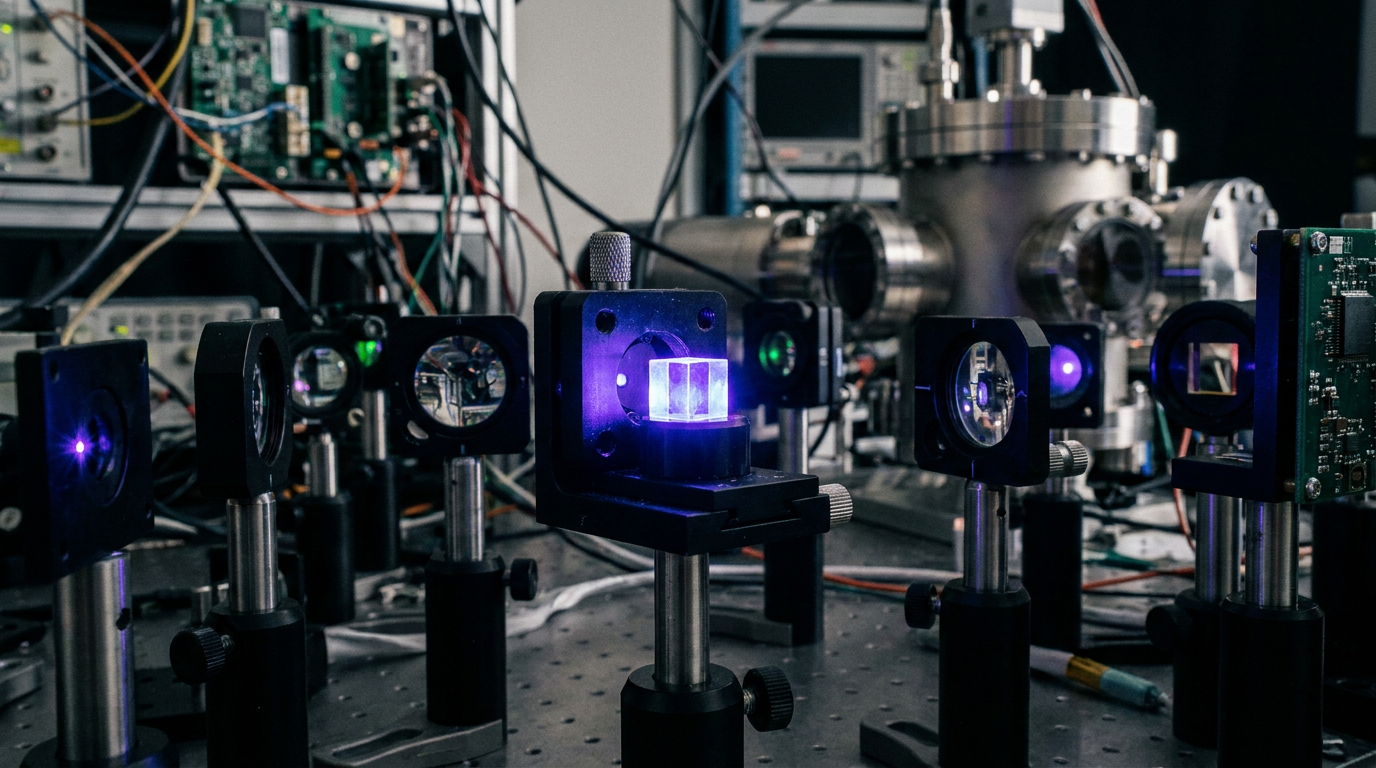
Both the European and Chinese teams capitalized on this unique property. Instead of suspending atoms in a complex vacuum chamber, they embedded Thorium-229 nuclei into a millimeter-sized, room-temperature crystal of calcium fluoride.[4][5]
Both the European and Chinese teams capitalized on this unique property.
This solid-state approach is revolutionary. It allows millions of nuclei to be packed into a tiny, robust crystal, offering a strong, clear signal without the fragility of traditional atomic clocks.[4][6]
The European team, led by researchers at TU Wien and JILA, successfully locked a continuous-wave laser to the 148-nanometer nuclear transition of the embedded thorium. Crucially, they established a rapid feedback loop based on continuous absorption spectroscopy to keep the laser perfectly tuned to the nucleus's "tick."[4]
Meanwhile, the Chinese team utilized a similar calcium fluoride crystal but employed a significantly more powerful laser system to probe the thorium nuclei, achieving comparable stabilization results.[3][5]
The performance of these early prototypes provides strong evidence that the architecture works, though uncertainties remain. The European clock demonstrated a fractional frequency instability approaching 10^-15 over a single day of continuous operation.[4]

While this is an impressive baseline, it is not yet enough to dethrone the absolute best atomic clocks, which boast uncertainties below 10^-18. Researchers project that future iterations of the solid-state nuclear clock could improve by several orders of magnitude, but this remains a theoretical projection requiring further engineering.[4][6]
Beyond merely keeping time, these devices are poised to become powerful new instruments for fundamental physics. Because atomic clocks rely on electromagnetism and nuclear clocks rely on the strong nuclear force, comparing the two could reveal if the fundamental constants of nature are shifting over time.[3][6]
The European team has already begun using their prototype to hunt for ultralight dark matter. By searching for microscopic, periodic fluctuations in the nuclear transition energy, they are probing the universe's hidden mass with a sensitivity that competes with the world's best dark matter detectors.[4]
The path forward requires transparent caution. Both foundational papers are currently undergoing peer review, meaning their long-term stability claims have yet to be independently verified by the broader metrology community.[2][3]
Furthermore, scaling the technology from a laboratory prototype to a deployable device will require years of refinement, particularly in improving the purity of the calcium fluoride crystals and the reliability of the ultraviolet lasers.[3][5]

Yet, the consensus among physicists is one of profound optimism. The successful operation of a feedback-stabilized nuclear clock proves that the hardest theoretical hurdles have been cleared.[3]
In the coming decades, these robust, solid-state timekeepers could find their way out of the laboratory. They hold the potential to revolutionize deep-space navigation, enable hyper-secure communications, and provide GPS-level precision in environments where traditional atomic clocks would fail.[2]
How we got here
2003
Physicists first propose the theoretical concept of a nuclear clock based on Thorium-229.
2024
Researchers successfully measure the exact energy required to trigger the Thorium-229 nuclear transition.
June 2026
Two independent teams publish preprints detailing the first fully operational, feedback-stabilized nuclear clocks.
Viewpoints in depth
Fundamental Physics Researchers
View the clock primarily as a new instrument to test the fundamental constants of nature and hunt for dark matter.
For theoretical physicists, the nuclear clock is less about telling time and more about probing the universe's deepest mysteries. Because the nucleus is governed by the strong nuclear force, comparing its 'ticks' against an electron-based atomic clock could reveal if the fundamental constants of nature are slowly changing. The European team is already using their prototype to search for ultralight dark matter, looking for microscopic drifts in the nuclear transition energy that would indicate dark matter interacting with the strong force.
Applied Metrologists
Focus on the engineering breakthroughs of solid-state stability and the potential for portable, hyper-accurate timekeeping.
Metrologists and engineers emphasize the architectural revolution of moving from a vacuum chamber to a solid-state crystal. Traditional atomic clocks require room-sized cooling and vacuum equipment to shield fragile electrons from electromagnetic noise. By embedding Thorium-229 into a room-temperature calcium fluoride crystal, researchers have proven that ultra-precise timekeeping can eventually be miniaturized and made rugged enough for deployment in space or harsh terrestrial environments.
Skeptics and Pragmatists
Note that significant engineering hurdles remain before nuclear clocks can redefine the global standard for time.
While celebrating the milestone, pragmatic voices in the metrology community note that the current prototypes are still orders of magnitude less accurate than the world's best optical lattice atomic clocks. The current fractional instability of 10^-15 is impressive for a first-generation device, but significant engineering hurdles remain—particularly in refining the purity of the crystals and the stability of the ultraviolet lasers—before nuclear clocks can officially redefine the global standard for the second.
What we don't know
- How quickly engineers can improve the clock's accuracy to surpass current atomic clocks (10^-18 instability).
- Whether the calcium fluoride crystal host will introduce unforeseen long-term instabilities.
- Exactly when this technology will be miniaturized enough for commercial or spaceflight deployment.
Key terms
- Nuclear Clock
- A timekeeping device that measures time based on the energy transitions within an atomic nucleus, rather than its electrons.
- Thorium-229
- A specific radioactive isotope that possesses the only known nuclear energy jump small enough to be triggered by a laser.
- Isomeric Transition
- A shift between different energy states within an atomic nucleus.
- Fractional Frequency Instability
- A metric used to describe how much a clock's 'tick' varies over time; lower numbers indicate higher precision.
- Solid-State
- A system built entirely from solid materials, like a crystal, rather than relying on gases suspended in a vacuum.
Frequently asked
How is a nuclear clock different from an atomic clock?
An atomic clock measures the quantum leaps of electrons orbiting an atom, which are sensitive to outside interference. A nuclear clock measures leaps within the atom's dense nucleus, which is shielded and highly stable.
Why did they use Thorium-229?
Thorium-229 is the only known nucleus in the universe with an energy jump small enough (8.4 electron volts) to be activated by a standard ultraviolet laser.
Will this replace the atomic clocks used for GPS?
Eventually, yes. Because nuclear clocks can be built into solid crystals rather than fragile vacuum chambers, they hold immense promise for robust, portable navigation systems in space and on Earth.
Sources
Source coverage
6 outlets
3 viewpoints surfaced





[1]New ScientistScience Press
First working nuclear clock heralds a new era in timekeeping
Read on New Scientist →[2]GizmodoScience Press
Physicists Just Built the First-Ever Nuclear Clock
Read on Gizmodo →[3]Science NewsApplied Metrologists
Clocks made from an atomic nucleus just ticked on for the first time
Read on Science News →[4]arXiv (Toscani De Col et al.)Fundamental Physics Researchers
A thorium-229 optical nuclear clock with feedback loop
Read on arXiv (Toscani De Col et al.) →A nuclear clock based on 229Th
Read on arXiv (Huang et al.) →[6]UCSB Kavli InstituteFundamental Physics Researchers
229Thorium Atomic Clocks
Read on UCSB Kavli Institute →

Every angle. Every day.
Get science stories with full source coverage and perspective breakdowns delivered to your inbox.