
Open-Source AI Models Are Dramatically Accelerating Global Drug Discovery
A wave of new open-source artificial intelligence tools and datasets released this week is allowing researchers to simulate molecular behavior 10,000 times faster, promising to shave years off the development of new medicines.
By Factlen Editorial Team
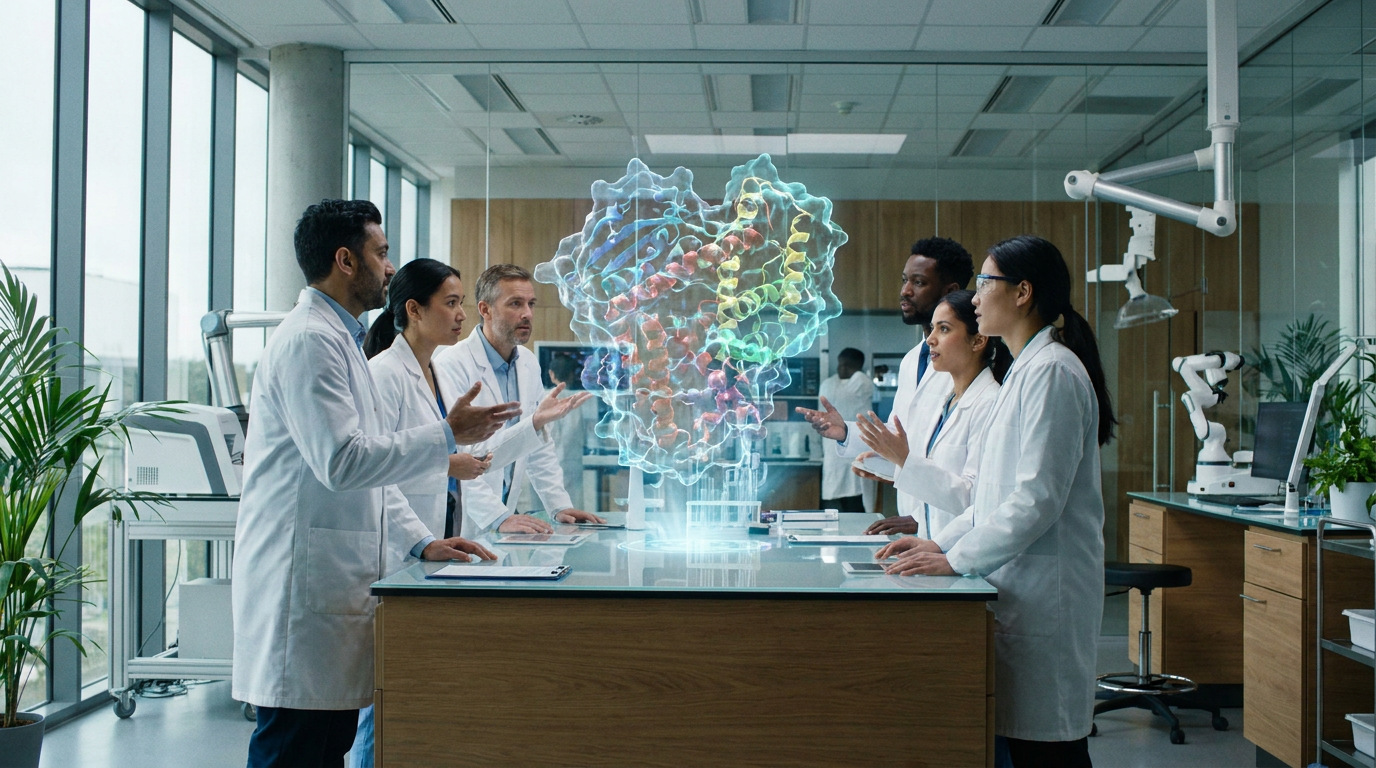
- Academic Researchers
- Scientists emphasize the raw computational power and speed unlocked by these new generative models.
- Open-Source Advocates
- Proponents argue that medical AI tools and datasets must remain freely accessible to democratize global healthcare.
- Clinical Practitioners
- Healthcare providers focus on how AI translates from the lab to the patient's bedside, saving time and preventing errors.
What's not represented
- · Pharmaceutical Executives
- · Regulatory Agencies
Why this matters
Developing a new drug traditionally takes over a decade and billions of dollars. By democratizing access to advanced AI simulations and massive training datasets, researchers worldwide can now identify promising treatments for cancer, rare diseases, and superbugs at a fraction of the cost and time.
Key points
- Researchers at Chalmers University developed an AI model that simulates molecular dynamics 10,000 times faster than traditional methods.
- The OpenBind Consortium, backed by an £8 million UK grant, released massive open-source datasets to train AI for drug design.
- New open-source AI diagnostic tools are being deployed to assist under-resourced hospitals globally.
- A 2026 global survey reveals that AI integration is already saving clinicians an average of 132 hours annually.
The timeline for discovering life-saving drugs is undergoing a radical compression. In mid-June 2026, a convergence of breakthroughs from international research coalitions and universities demonstrated that artificial intelligence is no longer just a theoretical tool for pharmacology—it is actively dismantling the computational bottlenecks that have historically delayed new treatments.[2][4]
The traditional drug development pipeline is notoriously grueling, often requiring over a decade and billions of dollars to move a single candidate from the laboratory to the pharmacy shelf. A vast majority of that time is consumed in the early stages, where scientists must simulate and test millions of molecular combinations. Now, open-source AI models are bypassing these painstaking numerical calculations entirely.[2]
The most striking advancement comes from a joint team at Chalmers University of Technology and the University of Gothenburg in Sweden. Published in the journal Science Advances, their research details a new generative AI model capable of predicting how molecules evolve over time at unprecedented speeds.[1][2]
By learning the underlying dynamics of atomic configurations, the Swedish model bridges femtosecond to nanosecond time-steps. This allows researchers to observe the pathways of molecular transitions without simulating every microscopic motion. The result is a system that operates more than 10,000 times faster than conventional molecular dynamics simulations.[1][2]

"In the long term, AI models like ours could help to identify promising drug candidates more quickly and improve accuracy in the early stages," explained Juan Viguera Diez, a lead researcher on the project. The team hopes this will pave the way for more general techniques that deepen the fundamental understanding of complex diseases.[2]
Crucially, the momentum in medical AI is shifting away from proprietary, closed-door corporate systems and toward global, open-source collaboration. By democratizing access to these powerful models, developers are ensuring that under-resourced hospitals and independent researchers worldwide can leverage cutting-edge diagnostic and discovery tools without prohibitive licensing fees.[4][6]
Crucially, the momentum in medical AI is shifting away from proprietary, closed-door corporate systems and toward global, open-source collaboration.
This collaborative ethos is exemplified by the OpenBind Consortium, an international initiative that recently received an £8 million grant from the UK government. OpenBind is dedicated to accelerating structure-based drug design by curating massive, high-quality datasets and making them freely available to the global scientific community.[3]
Memorial Sloan Kettering Cancer Center (MSK), a key partner in the consortium, announced that OpenBind has released its first major dataset focused on Enterovirus A71—a leading cause of hand, foot, and mouth disease that can trigger severe neurological complications. These protein-ligand structure-affinity datasets are specifically designed to train the next generation of AI models to design better antiviral and cancer therapeutics.[3]
"This is AI-supported research that aims to enable smarter, faster drug discovery—building the computational tools and datasets that will help us design better medicines for patients," noted Dr. John Chodera of MSK. By removing the data silos that typically hinder medical research, OpenBind allows scientists anywhere in the world to build upon a shared foundation of knowledge.[3]

The impact of these AI breakthroughs extends beyond the laboratory and into active clinical settings. According to the 2026 Future Health Index published by Philips, artificial intelligence is already reshaping frontline care by dramatically reducing administrative burdens and enhancing clinical decision-making.[5]
The global survey revealed that nearly half of all clinicians report saving an average of 132 hours annually thanks to AI integration. Rather than simply cutting costs, 56% of healthcare professionals stated that this reclaimed time is being redirected into more thorough, face-to-face patient interactions.[5]
Furthermore, AI is acting as a critical safety net in high-pressure medical environments. The Philips report noted that 39% of clinicians credited AI with helping them identify or prevent a potential medical error at least three times in the past quarter, functioning as a highly reliable second set of eyes.[5]

Industry analysts observe that the narrative surrounding artificial intelligence has matured significantly. The focus has shifted from flashy generative text demos to highly specific, workflow-integrated infrastructure. Tools like MycoBCP, a deep learning system currently helping researchers detect subtle cellular changes in tuberculosis, prove that applied AI is delivering measurable, life-saving outcomes.[7]
As open-source platforms continue to lower the technical barriers to entry, the global healthcare sector is entering an era of unprecedented agility. With models running 10,000 times faster and massive datasets freely available, the next major medical breakthrough may not come from a multi-billion-dollar pharmaceutical giant, but from an independent lab empowered by open-source AI.[2][6][7]
How we got here
2023-2025
Proprietary AI models demonstrate the potential of computational biology, but access remains restricted by high costs and corporate silos.
Early 2026
The UK government awards an £8 million grant to launch the OpenBind project, aiming to democratize structure-based drug design.
June 10, 2026
A new open-source AI model for medical diagnostics is released, targeting under-resourced global hospitals.
June 11, 2026
Chalmers University researchers publish a breakthrough in Science Advances, detailing an AI model that simulates molecular dynamics 10,000 times faster.
June 11, 2026
The OpenBind Consortium releases its first major open-source dataset focused on Enterovirus A71 to accelerate antiviral drug discovery.
Viewpoints in depth
Academic Researchers
Scientists emphasize the raw computational power unlocked by these new models.
For academic researchers, the primary victory is the sheer speed of the new generative models. By bridging femtosecond to nanosecond time-steps, scientists can bypass the grueling numerical calculations that previously bottlenecked molecular dynamics. This allows university labs to screen millions of potential drug candidates in a fraction of the time, shifting their focus from running simulations to analyzing the most promising biological pathways.
Open-Source Advocates
Proponents of open-source technology argue that medical AI must remain accessible to all.
This camp views the release of free datasets and open-weight models as a necessary counterweight to the dominance of massive tech corporations. By ensuring that tools like the OpenBind datasets are freely available, they argue that the global scientific community can innovate collaboratively. This prevents life-saving discoveries from being locked behind prohibitive licensing fees, empowering researchers in developing nations to tackle localized health crises.
Clinical Practitioners
Healthcare providers focus on how AI translates from the lab to the patient's bedside.
For doctors and nurses, the theoretical speed of drug discovery is secondary to the immediate relief AI provides in the clinic. Practitioners highlight that AI is actively reducing their administrative burden, saving an average of 132 hours annually. They view AI not as a replacement for human judgment, but as a vital support system that catches potential medical errors and frees up time for direct patient care.
What we don't know
- It remains unclear how quickly regulatory bodies like the FDA will adapt their approval processes for drug candidates generated entirely by open-source AI models.
- The long-term economic impact on traditional pharmaceutical R&D budgets, as open-source tools lower the barrier to entry, is still unfolding.
Key terms
- Generative AI
- Artificial intelligence capable of generating new data, such as plausible molecular structures, based on the patterns it learned during training.
- Molecular Dynamics
- A computer simulation method for analyzing the physical movements of atoms and molecules over time.
- Protein-Ligand Affinity
- The specific way a drug molecule binds to a target protein in the body, which is crucial for determining how effective a medicine will be.
- Open-Source
- Software or datasets that are released with a license allowing anyone to freely use, study, change, and distribute the technology.
Frequently asked
How does the new AI model speed up drug discovery?
It uses generative machine learning to predict how molecular structures evolve over time, bypassing the need for slow, traditional numerical calculations.
What is the OpenBind Consortium?
It is an international, open-source initiative backed by the UK government that provides free datasets to train AI models for structure-based drug design.
Will this make medicines cheaper?
While it won't happen overnight, reducing the time and computational cost of the early discovery phase is expected to significantly lower the overall cost of developing new drugs.
Is AI replacing human doctors?
No. Current data shows AI is acting as a 'second set of eyes' and reducing administrative tasks, giving doctors more time for face-to-face patient care.
Sources
Source coverage
7 outlets
3 viewpoints surfaced







[1]Science AdvancesAcademic Researchers
Transferable generative models bridge femtosecond to nanosecond time-step molecular dynamics
Read on Science Advances →[2]News-Medical.NetAcademic Researchers
AI breakthrough accelerates molecular simulations for drug discovery
Read on News-Medical.Net →[3]Memorial Sloan Kettering Cancer CenterAcademic Researchers
MSK Research Highlights, June 11, 2026
Read on Memorial Sloan Kettering Cancer Center →[4]The Guardian ChronicleOpen-Source Advocates
New Open-Source AI Model Revolutionizes Medical Research
Read on The Guardian Chronicle →[5]PhilipsClinical Practitioners
AI is changing how care is delivered today
Read on Philips →[6]AI MagazineOpen-Source Advocates
Top 10: Open Source AI Platforms
Read on AI Magazine →[7]Mean CEO's BLOGOpen-Source Advocates
Latest AI breakthroughs News | June, 2026
Read on Mean CEO's BLOG →

More in ai
See all 5 stories →On-Device AI
How Local AI Replaced the Cloud: Running Frontier Models on Your Laptop
0 sources

Enterprise AI
The Rise of Small Language Models: How Enterprises Are Running AI Locally in 2026
0 sources

Drug Discovery
New AI Model Accelerates Molecular Simulations 10,000-Fold, Slashing Drug Discovery Timelines
0 sources

Every angle. Every day.
Get ai stories with full source coverage and perspective breakdowns delivered to your inbox.