
OLED vs. Mini-LED TVs: The 2026 Trade-Off Analysis
As display technology advances in 2026, the choice between OLED and Mini-LED televisions comes down to a strict trade-off between pixel-perfect contrast and sustained, burn-in-free brightness.
By Factlen Editorial Team
- High-Luminance Advocates
- Prioritizes sustained brightness, glare reduction, and burn-in immunity for mixed-use spaces.
- Cinematic Purists
- Advocates for perfect black levels and director-intent accuracy in controlled lighting.
- Value & Size Maximizers
- Focuses on the price-to-performance ratio, particularly for screens 75 inches and larger.
What's not represented
- · Professional Hollywood Colorists
- · Environmental / Energy Consumption Analysts
Why this matters
Choosing the wrong television technology for your specific room lighting and viewing habits can result in washed-out daytime sports or distracting halos during movie nights. Understanding these quantified trade-offs ensures a long-term investment that matches your actual daily use.
Key points
- OLED TVs offer perfect black levels and infinite contrast by turning off individual pixels.
- Mini-LED TVs provide significantly higher sustained brightness, making them ideal for sunlit rooms.
- OLED panels carry a slight risk of burn-in from static images, while Mini-LEDs are immune.
- Tandem OLED technology in 2026 has narrowed the brightness gap, but at a premium price.
As display technology advances in 2026, the old rule of thumb—buying an OLED for dark rooms and an LED for bright rooms—has become vastly more complicated. As consumers shop for their next living room centerpiece, the choice between OLED and Mini-LED represents a fundamental fork in display technology. Rather than searching for a single universal winner, buyers must navigate a careful analysis of trade-offs. Both technologies have reached unprecedented levels of performance, but they achieve their stunning visuals through entirely different methods of manipulating light.[4][6]
To understand the comparison, one must first look at how each screen generates light. OLED, which stands for Organic Light Emitting Diode, is a self-emissive technology. This means that every single one of the 8.3 million pixels on a 4K display acts as its own independent light bulb. When a scene calls for black, those specific pixels simply turn off completely, emitting zero light. This pixel-level control is the foundation of OLED's legendary picture quality, allowing it to render true, inky blackness without any light bleeding into adjacent areas of the screen.[1][4]
Mini-LED takes a completely different, brute-force approach to illumination. Instead of self-emissive pixels, it relies on a traditional LCD panel illuminated by thousands of microscopic LEDs positioned directly behind the screen. These tiny backlights are grouped into local dimming zones—often numbering between 1,500 and 2,000 on modern flagship models. A processor analyzes the image on the screen and dynamically dims or brightens these individual zones to control contrast, attempting to mimic the precision of an OLED while retaining the raw power of an LED backlight.[1][2]
When analyzing the case for OLED, the primary argument rests on pixel-level precision and infinite contrast. Because an OLED panel can place a blindingly bright highlight—like a star or a streetlamp—directly next to a pitch-black void with zero light bleed, the resulting image possesses a three-dimensional depth that backlit screens struggle to replicate. The evidence for this superiority consistently shows up in dark-room testing, where OLEDs deliver perfect black uniformity. For cinematic purists watching letterboxed movies, the black bars at the top and bottom of the screen remain completely invisible.[1][3]

The argument against OLED, however, is its thermal ceiling and the inherent vulnerability of organic degradation. Pushing organic pixels to extreme brightness levels generates heat, which can lead to permanent image retention, commonly known as burn-in, over an extended period. To protect the panel from this damage, OLED televisions utilize an Automatic Brightness Limiter (ABL). This software aggressively dims the screen when displaying large, bright elements like a hockey rink or a snow-covered landscape, meaning sustained full-screen brightness rarely exceeds 300 to 400 nits during daytime viewing.[2][4]
Conversely, the case for Mini-LED centers on overwhelming luminance and long-term durability. Unburdened by organic materials, Mini-LED panels can be pushed to extreme limits without the anxiety of burn-in. The evidence is striking: 2026 flagship models from brands like TCL and Hisense routinely push past 4,000 nits of peak HDR brightness. More importantly, they can hold 2,000 nits across the entire screen indefinitely. This makes them virtually immune to the washing-out effect of afternoon sunlight, delivering a punchy, vibrant image even in rooms with floor-to-ceiling windows.[2][5]
The argument against Mini-LED is the persistent presence of blooming, or haloing. Even with advanced 2026 algorithms managing thousands of dimming zones, a single zone still illuminates thousands of pixels at once. When a bright object, such as white subtitles or a glowing logo, appears against a dark background, a faint halo of light inevitably bleeds into the surrounding black areas. While daytime viewing masks this effect entirely, it can distract viewers in a fully darkened room, breaking the immersion of high-contrast cinematic scenes.[1][4]
The argument against Mini-LED is the persistent presence of blooming, or haloing.
Gaming performance introduces another layer of distinct trade-offs. OLED technology boasts near-instantaneous pixel response times, often measured as low as 0.03 milliseconds. Because the pixels change state almost instantly, this eliminates motion blur entirely, providing ultra-competitive esports players with a pristine, fluid image during fast-paced action. Furthermore, premium OLEDs from brands like LG typically offer four full-bandwidth HDMI 2.1 ports and dedicated gaming optimizer dashboards, making them the ultimate hub for users connecting multiple next-generation consoles and high-end gaming PCs simultaneously without sacrificing any features.[1][6]
Mini-LED displays have closed the gaming gap significantly, with many 2026 models offering variable refresh rates up to 144Hz or even 240Hz. However, because they rely on liquid crystals physically twisting to change color, their transitions are inherently slower than OLEDs, resulting in slight motion smearing during rapid camera pans. Yet, for gamers who play titles with static heads-up displays for eight hours a day, Mini-LED offers a massive advantage: it is a 'forever display' that will never permanently retain those static health bars or minimaps.[2][3]
The 2026 market has introduced new variables that blur these traditional lines. LG's latest G5 series utilizes a Tandem OLED architecture, stacking multiple light-emitting layers to dramatically boost peak brightness up to 4,000 nits while reducing the strain on the organic materials. This innovation significantly narrows the brightness gap, allowing OLED to compete in brighter rooms. However, this cutting-edge panel technology carries a steep premium price tag, keeping it out of reach for the average consumer and preserving Mini-LED's dominance in the value sector.[4][6]

Price-to-performance scaling heavily favors Mini-LED, particularly as screen sizes increase into home theater territory. While a high-quality 65-inch Mini-LED can often be secured for under $1,000, stepping up to a 77-inch or 83-inch OLED requires an exponential jump in budget. For buyers looking to fill a massive wall with an 85-inch or 98-inch display, Mini-LED is often the only financially viable option, offering flagship-level HDR impact for thousands of dollars less than a comparably sized OLED counterpart.[3][5]
Viewing angles also dictate room placement and seating arrangements. OLED panels maintain their color accuracy, contrast, and black levels perfectly, even when viewed from the extreme sides of a wide sectional couch. In contrast, many Mini-LED televisions, particularly those utilizing VA-type LCD panels to maximize contrast, suffer from noticeable color washout and increased blooming when viewed off-center. If your living room requires seating spread far to the left and right of the screen, Mini-LED's picture quality will degrade for those on the edges.[1][4]
Ultimately, OLED technology fits well when the display lives in a light-controlled environment, such as a dedicated basement home theater or a bedroom equipped with blackout curtains. It is the definitive choice for cinematic purists who prioritize absolute shadow detail, viewers with wide seating arrangements, and competitive gamers who demand zero motion blur. When the lights go down, OLED remains the undisputed king of picture quality, delivering an image that perfectly matches the director's original intent without any distracting backlight artifacts.[1][6]
Conversely, OLED does not fit well when the television is placed opposite a south-facing window, where ambient glare will wash out its limited full-screen brightness. It is also a poor fit when the display doubles as a computer monitor displaying static toolbars for eight hours a day, or when buyers are seeking a massive 85-inch screen on a strict budget. In these scenarios, the thermal limits and organic nature of the panel become distinct liabilities rather than premium features.[2][4]

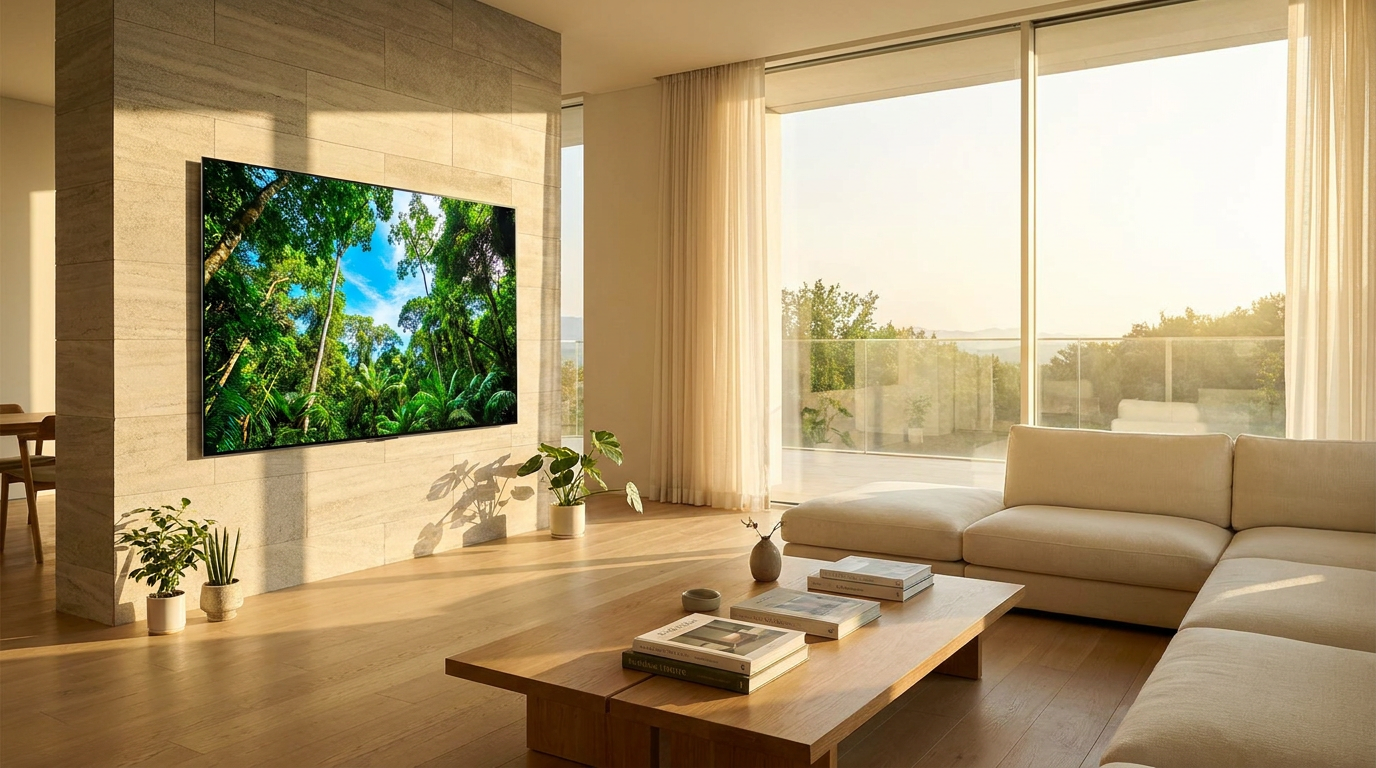
On the other hand, Mini-LED fits well when the television anchors an open-concept, sun-drenched living room where daytime sports viewing is a household priority. It is also the superior choice for PC users, heavy consumers of news channels with static tickers, and buyers looking to maximize screen size and HDR impact without crossing into luxury price tiers. Its ability to sustain massive brightness all day long without the risk of burn-in makes it the most versatile and durable option for mixed-use family spaces.[3][5]
Finally, Mini-LED does not fit well when the primary use case is watching letterboxed movies in pitch darkness. In a fully blacked-out room, the glowing black bars and subtle blooming around bright highlights can break immersion and distract from the visual presentation. If you are highly sensitive to backlight fluctuations, haloing around subtitles, or if you demand pixel-perfect contrast in the dark, the brute-force brightness of a Mini-LED will never fully replicate the surgical precision of a self-emissive OLED panel.[1][4]
How we got here
2013
The first commercial OLED televisions launch, introducing perfect black levels to the consumer market.
2019
Mini-LED technology enters the mainstream, offering a brighter alternative to OLED with improved local dimming.
2024
OLED manufacturers introduce micro-lens array (MLA) technology to boost peak brightness and combat Mini-LED's luminance advantage.
2026
Tandem OLED panels and 4,000-nit Mini-LEDs redefine the flagship market, pushing both technologies to new extremes.
Viewpoints in depth
Home Theater Purists
Viewers who prioritize cinematic accuracy and perfect black levels in dark rooms.
This camp argues that absolute black is the foundation of picture quality, as it provides the canvas for infinite contrast. They point to the fact that Hollywood color grading is performed on reference OLED monitors, making it the only technology capable of displaying a director's true intent without the distracting halos or elevated black levels introduced by LCD backlights.
Bright-Room Viewers & Sports Fans
Users with sunlit living rooms who value sustained brightness and color volume.
For this group, perfect blacks are irrelevant if the screen acts as a mirror during a Sunday afternoon football game. They argue that the sheer luminance of Mini-LED—capable of pushing past 2,000 nits of sustained brightness—cuts through ambient glare and delivers a punchy, vibrant image that OLED simply cannot maintain without aggressive thermal dimming.
PC Users & Heavy Gamers
Consumers who use their displays for static interfaces, HUDs, and productivity.
This perspective prioritizes panel longevity and peace of mind. Because organic materials degrade over time, leaving static elements like taskbars or MMO interfaces on an OLED screen for thousands of hours carries a genuine risk of permanent burn-in. They advocate for Mini-LED as a 'forever display' that offers high refresh rates without the anxiety of babysitting the panel.
What we don't know
- Whether MicroLED technology will become affordable enough in the next five years to render both OLED and Mini-LED obsolete.
- Exactly how long the new Tandem OLED panels will last before showing signs of degradation, as the technology is still in its first generation of consumer use.
Key terms
- OLED (Organic Light Emitting Diode)
- A display technology where every individual pixel generates its own light and can turn off completely to create perfect black.
- Mini-LED
- An LCD display that uses thousands of microscopic LEDs as a backlight, divided into zones that dim independently to improve contrast.
- Local Dimming Zones
- Specific areas of a TV's backlight that can dim or turn off independently to make dark parts of the screen look darker.
- Nits
- A unit of measurement for screen brightness. A higher number of nits means the television can produce a brighter image.
- Blooming (Haloing)
- A visual artifact on backlit TVs where light from a bright object bleeds into the surrounding dark areas of the screen.
- Burn-in
- Permanent image retention on an OLED screen caused by uneven degradation of the organic pixels from displaying static elements for too long.
Frequently asked
Does OLED still suffer from burn-in in 2026?
While 2026 OLEDs feature advanced pixel-shifting and heat-dissipation technologies that drastically reduce the risk, burn-in remains a physical possibility for organic panels if static images are displayed for thousands of hours.
What is blooming on a Mini-LED TV?
Blooming, or haloing, occurs when a bright object is displayed against a dark background. Because a single Mini-LED dimming zone illuminates thousands of pixels, some light bleeds into the surrounding black areas.
Which TV is better for a bright living room?
Mini-LED is significantly better for bright rooms. Its ability to sustain high brightness levels allows it to overpower sunlight and ambient glare without automatically dimming to protect the screen.
Is OLED better for gaming?
OLED is generally preferred for competitive gaming due to its near-instantaneous 0.03ms response time, which eliminates motion blur. However, Mini-LED is safer for games with static heads-up displays played over long periods.
Sources
Source coverage
7 outlets
3 viewpoints surfaced







[1]RTINGSCinematic Purists
Mini LED vs. OLED TVs: Which One Is The Best?
Read on RTINGS →[2]XDA DevelopersHigh-Luminance Advocates
Forget OLED — mini-LED is the real future of displays
Read on XDA Developers →[3]What Hi-Fi?High-Luminance Advocates
Best Mini LED TV 2026: all the top, mid-range and affordable options fully reviewed
Read on What Hi-Fi? →[4]Gadget FlowHigh-Luminance Advocates
OLED vs Mini-LED for a bright room: The trade-off I didn't expect
Read on Gadget Flow →[5]Home Theater ReviewValue & Size Maximizers
Choosing Between Two Premium 65" TVs: OLED vs Mini-LED in 2024
Read on Home Theater Review →[6]StuffCinematic Purists
The LG G5 is the best and brightest OLED TV I've ever laid my eyes on
Read on Stuff →[7]Pulse Electronic ReviewsValue & Size Maximizers
Top 10 Bedroom TVs in 2027 — Best Overall + Best Value
Read on Pulse Electronic Reviews →

More in shopping
See all 5 stories →

Every angle. Every day.
Get shopping stories with full source coverage and perspective breakdowns delivered to your inbox.