
OLED vs. Mini-LED in 2026: The Ultimate Display Comparison
As Mini-LED achieves blinding new brightness levels and OLED pushes the boundaries of organic durability, the choice between the two flagship display technologies has never been tighter. Choosing the right panel now depends entirely on your room lighting and daily viewing habits.
By Factlen Editorial Team
- Bright-Room Viewers
- Everyday consumers dealing with ambient daylight and large living spaces.
- Cinematic Purists
- Home theater enthusiasts who prioritize perfect contrast and shadow detail.
- Productivity Power Users
- Professionals and PC gamers who leave static interfaces on screen for hours.
What's not represented
- · Budget consumers who are priced out of both premium OLED and high-zone Mini-LED markets.
- · Commercial digital signage operators who prioritize 24/7 uptime over cinematic picture quality.
Why this matters
Choosing the wrong display technology can lead to washed-out images in sunny rooms or permanent burn-in from static work apps. Understanding the specific trade-offs between OLED and Mini-LED ensures you invest in a screen that actually fits your daily habits and lighting environment.
Key points
- OLED delivers perfect black levels and infinite contrast by turning individual pixels completely off.
- Mini-LED achieves vastly superior sustained brightness, making it the ideal choice for sunlit rooms.
- While OLED burn-in risk has decreased, Mini-LED remains the only zero-risk option for static productivity work.
- OLED maintains a slight edge in motion clarity with near-instantaneous 0.03-millisecond response times.
- Mini-LED offers significantly better value for buyers seeking massive screens of 85 inches or larger.
The 2026 television and monitor market presents consumers with a spectacular, if slightly overwhelming, dilemma. The choice between OLED and Mini-LED has never been more difficult, as both technologies have spent the last few years aggressively stealing each other's best features. What was once a simple debate between dark-room contrast and bright-room luminance has evolved into a highly nuanced trade-off analysis for buyers.[1][7]
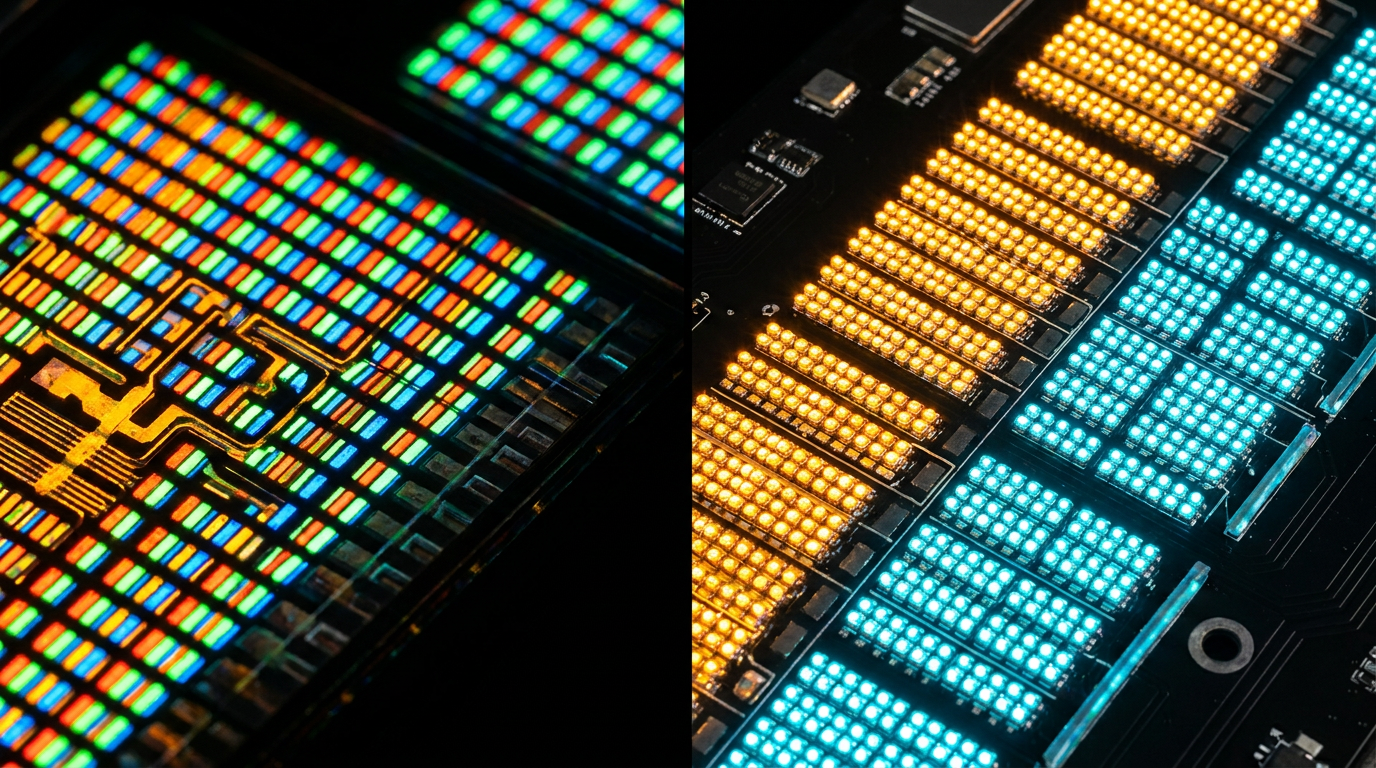
To understand the stakes, it helps to look at the core difference in how these panels generate light. OLED, or Organic Light-Emitting Diode, features self-emissive pixels that create their own light and color independently. Mini-LED, on the other hand, relies on a traditional LCD panel illuminated from behind by thousands of microscopic, inorganic LED lights grouped into highly controlled dimming zones.[1][5][6]
The argument for OLED has always centered on absolute contrast and perfect black levels. Because each of its roughly eight million pixels can turn off completely, dark scenes look incredibly clean and cinematic. There is zero light bleeding into the shadows, resulting in an infinite contrast ratio that gives the image a striking, three-dimensional pop.[1][4]
The evidence for OLED's dominance in dark rooms remains undisputed in 2026. Reviewers and testing laboratories consistently note that for shadow-critical narrative work, color grading, or watching movies in a basement theater, the pixel-level precision of OLED delivers a depth of image that backlight-driven displays simply cannot replicate.[2][7]

Conversely, the argument against OLED focuses on its brightness limitations and the organic nature of its pixels. To protect the panel from overheating and permanent burn-in, OLED displays employ a software mechanism known as an Automatic Brightness Limiter, or ABL.[3][5]
When a scene demands a massive amount of full-screen white—such as a hockey game, a snowy nature documentary, or a bright commercial—the ABL aggressively dims the entire OLED screen. While 2026 models utilizing Micro Lens Array and QD-OLED technology can hit impressive peak highlights in small areas, their sustained full-screen brightness still lags significantly behind the competition.[2][3]
This is exactly where the argument for Mini-LED takes over. By utilizing robust inorganic materials like gallium nitride, Mini-LED displays can be driven to extreme brightness levels without the fear of biological decay, thermal degradation, or aggressive automatic dimming.[2][5]
The evidence for Mini-LED's sheer power is staggering this year. High-end 2026 models are pushing past 5,000 nits of peak brightness and can sustain brilliant, full-screen white images indefinitely. In a living room flooded with afternoon sunlight, a Mini-LED panel effortlessly punches through the glare, maintaining vibrant colors and punchy highlights where an OLED would look noticeably washed out.[3][6][7]

The evidence for Mini-LED's sheer power is staggering this year.
However, the argument against Mini-LED has historically been "blooming" or "haloing"—the distracting glow around bright objects on dark backgrounds, caused by backlight zones illuminating slightly more area than necessary.[1][3]
In 2026, manufacturers have largely mitigated this weakness by packing premium Mini-LED televisions with upwards of 20,000 local dimming zones and highly advanced control algorithms. While slight haloing can still be spotted around stark white subtitles or gaming cursors in pitch-black rooms, the gap in perceived contrast has narrowed dramatically for everyday viewing.[1][7][8]
For gamers and heavy productivity users, the trade-offs shift heavily toward motion clarity and panel longevity. OLED panels boast near-instantaneous response times of roughly 0.03 milliseconds, offering competitive esports players a perfectly clear, blur-free image during rapid camera movements that Mini-LEDs cannot quite match.[1][6][8]
Yet, the specter of burn-in remains a persistent anxiety for OLED owners. Long-term 10,000-hour stress tests reveal that while outright hardware failure is rare, static elements like health bars, taskbars, and coding syntax can still cause differential aging and permanent image retention over years of heavy, daily use.[2][5]

Mini-LED completely eliminates this workflow friction. It provides a "set and forget" experience for professionals who leave static user interfaces on screen for eight to twelve hours a day, showing virtually zero brightness degradation or burn-in risk over the same 10,000-hour lifespan.[2][8]
Price and sizing also dictate the modern buying logic. While OLED remains a premium technology that typically caps out around 83 inches due to manufacturing constraints, Mini-LED has become the undisputed champion of the ultra-large screen market, offering massive 85-inch, 98-inch, and even 115-inch displays at increasingly accessible price points.[4][7]
Ultimately, choosing a winner requires abandoning the idea of a universal "best" display and looking strictly at environmental conditions. OLED fits perfectly when the display lives in a light-controlled or dim room, when the primary diet is cinematic movies or fast-paced gaming, and when the user prioritizes infinite contrast and perfect viewing angles over sheer luminance.[1][4][6]

Conversely, Mini-LED fits best when the screen sits in a bright, sunlit living room, when it serves as a daily productivity monitor displaying static interfaces for hours on end, or when the buyer wants the absolute largest screen size possible for their budget. In 2026, matching the panel to the room is the only metric that truly matters.[2][3][8]
How we got here
2013
LG releases the first commercially successful large-screen OLED TVs, establishing a new benchmark for perfect black levels.
2019
Mini-LED technology enters the consumer market, offering an ultra-bright alternative to traditional LCDs with vastly improved local dimming.
2022
QD-OLED panels are introduced, combining quantum dots with OLED to boost color vibrancy and peak brightness.
2024
Micro Lens Array (MLA) technology is integrated into premium OLEDs, helping them cross the 2,000-nit threshold for specular highlights.
2026
Flagship Mini-LEDs push past 5,000 nits and 20,000 dimming zones, virtually eliminating the historical performance gap in mixed-lighting environments.
Viewpoints in depth
Cinematic Purists
Home theater enthusiasts who prioritize perfect contrast and shadow detail.
For viewers building dedicated, light-controlled home theaters, the conversation begins and ends with OLED. This camp argues that no amount of peak brightness can compensate for the pixel-level precision of self-emissive technology. They point to the absolute absence of blooming and the infinite contrast ratio as essential for preserving the director's original intent in shadow-heavy narrative films. To these purists, the occasional intervention of an Automatic Brightness Limiter is a minor tax to pay for an otherwise flawless, three-dimensional image.
Bright-Room Viewers
Everyday consumers dealing with ambient daylight and large living spaces.
This perspective prioritizes sheer luminance and environmental versatility. Viewers in this camp argue that perfect black levels are irrelevant if the screen is washed out by afternoon sun or reflections from large windows. They champion Mini-LED for its ability to sustain massive full-screen brightness during daytime sports broadcasts and brightly lit video games. Furthermore, they value the cost-to-size ratio, noting that Mini-LED is the only economically viable path to achieving an immersive 85-inch or larger display for family viewing.
Productivity Power Users
Professionals and PC gamers who leave static interfaces on screen for hours.
For software developers, video editors, and MMO gamers, the display is a tool that must withstand grueling, repetitive workloads. This camp strongly favors Mini-LED due to its total immunity to burn-in. They argue that the workflow friction of constantly hiding taskbars, shifting windows, and running pixel-refresh cycles on an OLED is unacceptable for a primary workstation. To these power users, the inorganic stability of Mini-LED provides a necessary 'set and forget' peace of mind over a 10,000-hour lifespan.
What we don't know
- Whether future Micro-LED technology will eventually merge the benefits of both panels at a consumer-friendly price.
- Exactly how much further OLED manufacturers can push peak brightness before thermal degradation becomes unavoidable.
- If software-based dimming algorithms can ever completely eliminate the final traces of Mini-LED blooming in pitch-black rooms.
Key terms
- OLED (Organic Light-Emitting Diode)
- A display technology where each individual pixel generates its own light and color, allowing it to turn off completely for perfect blacks.
- Mini-LED
- An LCD display that uses thousands of microscopic LED lights grouped into zones behind the screen to provide highly controlled, ultra-bright backlighting.
- Blooming (Haloing)
- A visual artifact where light bleeds from a bright object into surrounding dark areas, commonly seen on backlit TVs but absent on OLEDs.
- Automatic Brightness Limiter (ABL)
- A protective software feature in OLEDs that automatically dims the screen when a large portion of the image becomes intensely bright.
- Burn-in
- Permanent image retention caused by the uneven aging of organic pixels when static elements, like logos or taskbars, are displayed for extended periods.
- Nits
- A standard unit of measurement for screen brightness, equivalent to the light of one candle per square meter.
Frequently asked
Does Mini-LED suffer from burn-in?
No, Mini-LED uses inorganic backlights that do not degrade unevenly, making it immune to the permanent burn-in that can affect OLED panels.
Which TV is better for a bright, sunny room?
Mini-LED is the superior choice for bright rooms because it can sustain much higher full-screen brightness without dimming, easily cutting through daytime glare.
Why do OLED screens dim during bright scenes?
OLEDs use an Automatic Brightness Limiter (ABL) to protect their organic pixels from overheating and premature wear when displaying large areas of bright white.
Is OLED still better for gaming?
OLED offers near-instantaneous response times and perfect motion clarity, making it ideal for fast-paced gaming, though Mini-LED is safer for games with static HUDs played over thousands of hours.
Sources
Source coverage
8 outlets
3 viewpoints surfaced








[1]RTINGSCinematic Purists
Mini LED vs OLED: Which Panel Technology Is Better?
Read on RTINGS →[2]KTC PlayProductivity Power Users
Mini-LED vs. OLED for Long-Term Productivity: A 10,000-Hour Burn-In Update
Read on KTC Play →[3]Pocket-lintBright-Room Viewers
What makes mini-LED better than OLED, in some cases?
Read on Pocket-lint →[4]100percent.co.nzCinematic Purists
OLED vs Mini LED: Key Differences
Read on 100percent.co.nz →[5]BGRProductivity Power Users
Mini LED vs. OLED TVs: Which is better?
Read on BGR →[6]ASUSBright-Room Viewers
Mini LED vs OLED: What's the difference?
Read on ASUS →[7]Pixel PrimeCinematic Purists
LED vs QLED vs OLED vs Mini LED - The REAL Winner in 2026
Read on Pixel Prime →[8]RedditProductivity Power Users
OLED vs Mini-Led -> is OLED that much better?
Read on Reddit →

More in shopping
See all 5 stories →
Every angle. Every day.
Get shopping stories with full source coverage and perspective breakdowns delivered to your inbox.