
OLED vs. Mini-LED in 2026: The Definitive TV Technology Comparison
As television panel technology reaches new heights in 2026, the choice between OLED and Mini-LED comes down to a strict trade-off between perfect contrast and overpowering brightness.
By Factlen Editorial Team
- Cinematic Purists
- Prioritizes absolute contrast, perfect black levels, and creator intent above all else.
- Balanced Reviewers
- Focuses on matching the panel technology to the specific environmental conditions of the user's home.
- Bright-Room Pragmatists
- Values sheer luminance, large-screen affordability, and absolute durability for mixed-use spaces.
What's not represented
- · Retail Store Employees
- · Professional TV Calibrators
Why this matters
Televisions are long-term investments that anchor the modern living room. Choosing the wrong panel technology for your specific lighting environment can result in thousands of dollars spent on a display that is either plagued by daytime glare or lacking in cinematic depth.
Key points
- The 2026 TV market is dominated by two highly refined technologies: self-emissive OLED and ultra-bright Mini-LED.
- OLED remains the champion of absolute contrast, perfect black levels, and instantaneous gaming response times.
- Mini-LED delivers unmatched peak brightness up to 5,000 nits, making it ideal for sunlit rooms and daytime sports.
- Tandem OLED architectures have significantly boosted OLED brightness, while advanced dimming zones have reduced Mini-LED blooming.
- The final decision should be based entirely on the room's ambient lighting, viewing angles, and budget.
The 2026 TV market is defined by a fierce, highly refined rivalry between two mature display technologies: OLED and Mini-LED. As consumers look to upgrade their living rooms, the choice is no longer simply about budget, but about matching the panel's underlying physics to the specific environment of the home. Industry experts note that both technologies have seen massive leaps this year, with OLED finding new ways to boost brightness and Mini-LED achieving unprecedented backlight control. The decision ultimately comes down to a side-by-side trade-off analysis of contrast, luminance, and viewing habits.[3][4]
The primary argument for OLED remains its undisputed mastery of contrast and cinematic precision. Because each individual pixel generates its own light and can turn off completely, OLED panels deliver perfect, infinite black levels without any light bleeding into adjacent dark areas. This pixel-level control makes it the ultimate choice for dark-room viewing, where the depth of shadow detail creates a truly immersive, theater-like experience. Reviewers consistently highlight that for movie enthusiasts watching in controlled lighting, OLED's natural image composition and subtle picture decisions are virtually impossible to beat.[1][2][8]
However, the case against OLED centers on its inherent brightness limitations and the premium cost of large-format panels. While 2026 models utilize new "Tandem OLED" stacked architectures to push peak HDR highlights to nearly 2,800 nits, the technology still aggressively dims the full screen during sustained bright scenes to protect the panel. Furthermore, while burn-in risks have been heavily mitigated by modern pixel-shifting algorithms, the anxiety of leaving static news tickers or game HUDs on screen remains a factor for heavy users. Finally, per screen inch, OLED remains significantly more expensive than its LCD counterparts, especially in sizes above 77 inches.[1][2][5][7][8]

On the other side of the aisle, the argument for Mini-LED is built on sheer luminance, environmental versatility, and large-screen value. By utilizing thousands of microscopic light-emitting diodes grouped into dense local dimming zones, these advanced LCD panels can overpower even the most sun-drenched living rooms. Flagship 2026 models are routinely hitting between 3,000 and 5,000 nits of peak brightness, delivering an HDR punch that makes daytime sports and vibrant gaming pop off the screen. For buyers looking to maximize screen size on a budget, Mini-LED offers massive 85-inch and 98-inch displays at a fraction of the cost of an equivalent OLED.[1][2][6][8]
The primary argument against Mini-LED is the slight compromise in absolute contrast and off-axis viewing. Even with advanced algorithms and thousands of dimming zones, Mini-LED TVs cannot completely eliminate "blooming"—a faint halo of light that bleeds around bright objects on dark backgrounds, such as white subtitles over a cinematic letterbox. While top-tier 2026 models have minimized this effect dramatically, it remains visible in extreme edge cases. Additionally, the VA panels typically used in Mini-LED sets often suffer from color degradation when viewed from wide angles, whereas OLED maintains perfect color consistency from any seat in the room.[2][5][6][7]

The primary argument against Mini-LED is the slight compromise in absolute contrast and off-axis viewing.
When comparing gaming performance, the 2026 landscape offers incredible options on both sides, making the choice highly dependent on the specific genre. OLED panels provide near-instantaneous response times and ultra-low input lag, giving competitive players a distinct edge in fast-paced shooters, while perfect blacks make spotting enemies in dark environments significantly easier. Conversely, Mini-LED's sustained high brightness makes vibrant, open-world HDR games look spectacular, and the technology completely eliminates any lingering anxiety over static HUDs causing burn-in during marathon sessions. Both technologies now routinely support 144Hz to 165Hz variable refresh rates, ensuring smooth performance regardless of the panel.[5][7][8]
Environmental impact and long-term durability also play a crucial role in the trade-off analysis. OLED is generally considered the more energy-efficient technology for mixed and dark-content viewing, as displaying black pixels consumes absolutely zero power. Mini-LED, while requiring more energy to drive its intense backlight array, offers absolute peace of mind regarding panel degradation. This makes Mini-LED the safer long-term investment for households that leave the television running all day as a background display, or for commercial environments where static logos are unavoidable.[5][6]
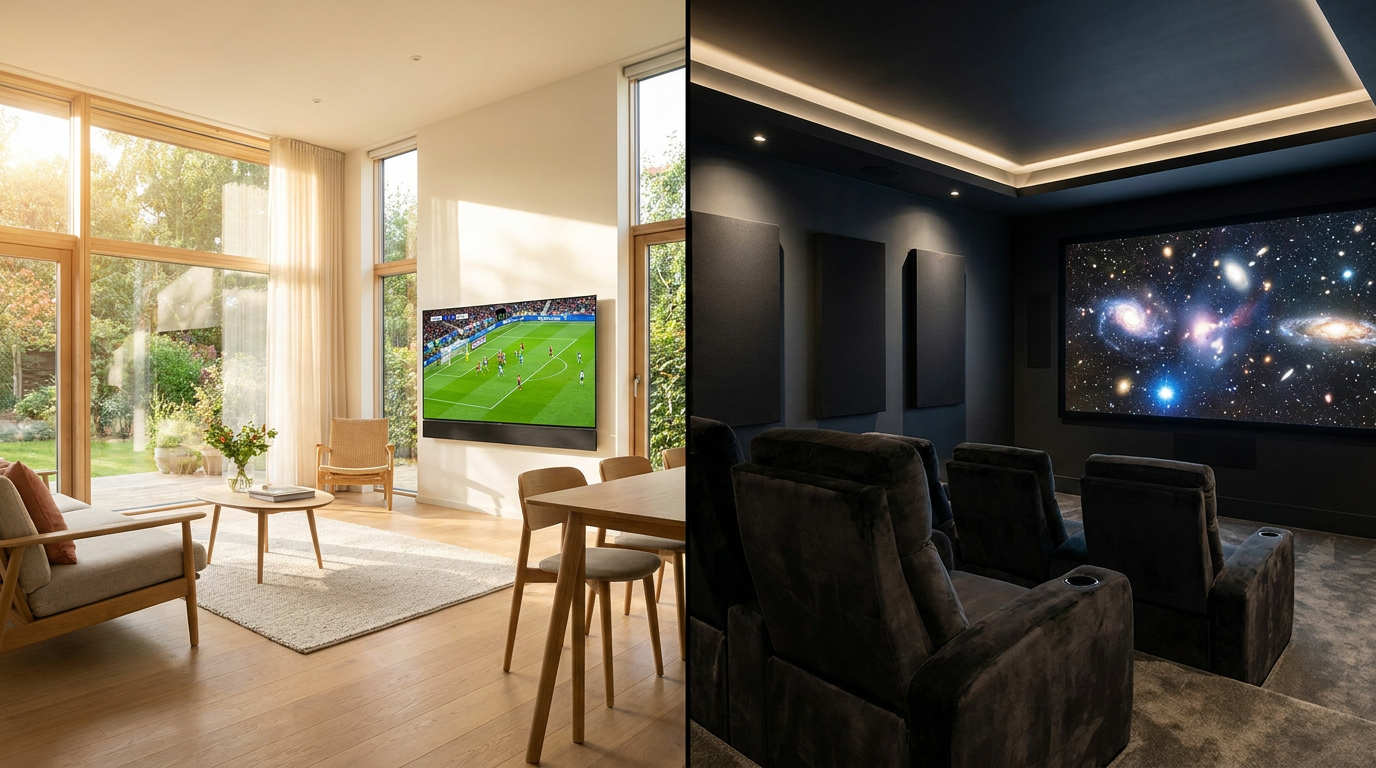
Ultimately, OLED fits perfectly when the primary viewing environment is a light-controlled room or a dedicated home theater. It is the definitive choice for cinephiles who demand perfect shadow detail, competitive gamers who require instantaneous pixel response, and anyone who prioritizes absolute color accuracy and contrast over sheer blinding brightness. If the television is primarily used for evening movie watching or high-end console gaming in a dim room, OLED remains the undisputed champion of picture quality.[1][8]

Conversely, Mini-LED fits perfectly when the television will live in a bright, open-plan living room with large windows and daytime glare. It is the ideal solution for sports enthusiasts hosting daytime watch parties, budget-conscious buyers looking to maximize screen size without sacrificing HDR impact, and households where the TV doubles as an always-on background display. If the room cannot be darkened, or if the display will be used for marathon sessions of static content, Mini-LED is the smarter, more resilient choice.[1][5]
There is no single winner in the 2026 television market without applying specific conditions. Buyers who honestly assess their room lighting, viewing habits, and budget will find that both OLED and Mini-LED have reached a level of technological maturity that guarantees a spectacular viewing experience. The decision is no longer about which technology is objectively better, but rather which set of compromises best aligns with the reality of the viewer's living space.[3][8]
How we got here
Early 2010s
OLED technology enters the consumer market, establishing a new benchmark for perfect black levels.
2019
The first consumer Mini-LED TVs are introduced, offering a massive leap in LCD backlight control and brightness.
2022
QD-OLED panels debut, combining OLED's perfect blacks with quantum dot technology for significantly brighter colors.
2026
Tandem OLED and 5,000-nit RGB Mini-LEDs hit the mainstream market, pushing both technologies to their physical limits.
Viewpoints in depth
The Cinematic Purist View
Prioritizes absolute contrast, perfect black levels, and creator intent above all else.
For home theater enthusiasts and professional colorists, the conversation begins and ends with OLED. This camp argues that sheer brightness is a secondary metric compared to infinite contrast and pixel-level light control. They point out that in a light-controlled room, an OLED's ability to render a starfield without any blooming around the stars creates a sense of depth that no LCD can match. To these purists, the minor risk of image retention is a small price to pay for a display that perfectly preserves the director's original vision without the algorithmic guesswork required by Mini-LED local dimming zones.
The Bright-Room Pragmatist View
Values sheer luminance, large-screen affordability, and absolute durability for mixed-use spaces.
This perspective reflects the reality of how most people actually watch television: in open-plan living rooms with sunlight pouring in, often with the TV left on for hours as background noise. Pragmatists argue that OLED's perfect blacks are entirely wasted if the screen is obscured by daytime glare. By championing Mini-LED, this camp prioritizes the raw HDR punch needed to overpower ambient light, alongside the peace of mind that comes from zero burn-in risk. They also emphasize the economic reality that buyers can secure a massive 85-inch Mini-LED for the price of a standard 65-inch OLED, making it the undeniable champion of value.
What we don't know
- How the long-term durability of the new 2026 Tandem OLED structures will hold up after years of heavy, real-world use.
- Whether emerging MicroLED technology will become affordable enough in the next few years to render both OLED and Mini-LED obsolete.
Key terms
- Blooming (Halo Effect)
- A visual artifact on LED/LCD TVs where light bleeds from a bright object into the surrounding dark areas of the screen.
- Local Dimming Zones
- Specific areas of a TV's backlight that can be independently dimmed or turned off to improve contrast and black levels.
- Tandem OLED
- A new panel architecture that stacks multiple light-emitting layers to significantly increase brightness and lifespan compared to older OLEDs.
- Nits
- A unit of measurement for brightness. A higher number of nits means the TV can produce a brighter image.
- Variable Refresh Rate (VRR)
- A gaming feature that allows the TV to adjust its refresh rate on the fly to match the console or PC, eliminating screen tearing.
Frequently asked
Will an OLED TV get burn-in from playing video games?
While the risk exists, 2026 OLEDs use aggressive pixel-shifting and localized dimming algorithms to prevent image retention. However, if you play the exact same game with static HUDs for 8+ hours daily, Mini-LED remains the safer choice.
Is Mini-LED the same as MicroLED?
No. Mini-LED uses tiny LEDs as a backlight for a traditional LCD panel. MicroLED is a completely different, ultra-expensive technology where each microscopic LED is its own pixel, combining the brightness of LED with the perfect blacks of OLED.
Do I need to worry about viewing angles on a Mini-LED?
Yes, to an extent. Many Mini-LED TVs use VA (Vertical Alignment) panels, which can lose color accuracy and contrast when viewed from the side. OLED TVs maintain perfect picture quality from almost any angle.
Which technology is better for a bright living room?
Mini-LED is the clear winner for bright rooms. With peak brightness levels hitting up to 5,000 nits, Mini-LED panels can easily overpower sunlight and glare, whereas OLEDs may look dim in direct daylight.
Sources
Source coverage
8 outlets
3 viewpoints surfaced








[1]CNETCinematic Purists
Mini-LED vs. OLED: Which TV Tech Should You Get?
Read on CNET →[2]RTINGSCinematic Purists
Mini LED vs. OLED TVs: Which One Is The Best?
Read on RTINGS →[3]What Hi-Fi?Balanced Reviewers
Best TV 2026: flagship OLEDs and budget Mini LED sets tried and tested
Read on What Hi-Fi? →[4]AVForumsBalanced Reviewers
The BEST TVs of CES 2026: OLED, RGB MicroLED, RGB MiniLED and MicroLED
Read on AVForums →[5]EcoPicksGoBalanced Reviewers
OLED vs Mini LED TVs (2026): LG G5 vs LG QNED9M
Read on EcoPicksGo →[6]TCLBright-Room Pragmatists
SQD Mini LED vs RGB Mini LED vs QD Mini LED vs OLED: TV Technology Guide 2026
Read on TCL →[7]RedditBalanced Reviewers
Any unbiased example and comparison of Mini LED and OLED monitors in 2026
Read on Reddit →[8]Pixel PrimeBright-Room Pragmatists
Mini LED vs OLED 2026 – Don't Buy Before This!
Read on Pixel Prime →

More in shopping
See all 5 stories →


Every angle. Every day.
Get shopping stories with full source coverage and perspective breakdowns delivered to your inbox.