
OLED vs. Mini-LED in 2026: How to Choose the Right TV for Your Room
The battle between OLED and Mini-LED display technologies has reached a new peak, forcing buyers to choose between perfect cinematic contrast and daylight-piercing brightness.
By Factlen Editorial Team
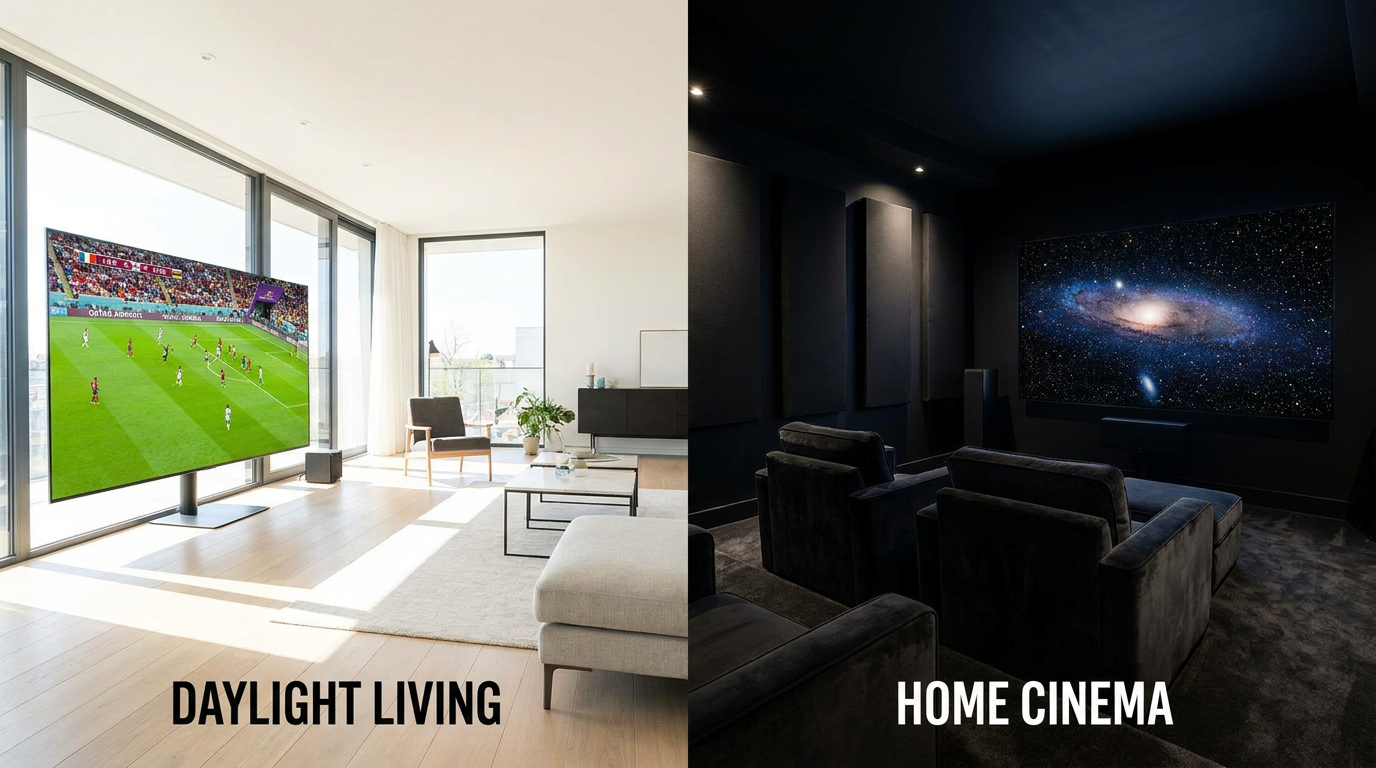
- Cinematic Purists
- Prioritizing perfect black levels and infinite contrast for a theater-like experience.
- Daylight Viewers
- Prioritizing peak brightness and glare reduction for everyday living spaces.
- Balanced Analysts
- Focusing on the environmental trade-offs and use-case matching.
What's not represented
- · Environmental impact analysts
- · Long-term e-waste researchers
Why this matters
A premium television is a multi-year investment that anchors a living space. Choosing the wrong panel technology for your room's lighting can lead to daily frustration, while the right choice delivers a transformative, theater-quality experience.
Key points
- OLED TVs use self-emissive pixels to achieve perfect black levels and infinite contrast, making them ideal for dark rooms.
- Mini-LED TVs use thousands of tiny backlights to reach massive peak brightness, easily cutting through sunlit living rooms.
- OLED panels carry a slight risk of permanent burn-in from static images, while Mini-LEDs are immune to the issue.
- Mini-LED technology is significantly more cost-effective at massive screen sizes of 85 inches and above.
- The 'best' TV depends entirely on the lighting conditions of the room and the viewing habits of the household.
The 2026 television market has distilled its highest-end offerings into a two-horse race that forces every buyer to make a fundamental choice. On one side stands OLED, the reigning champion of cinematic contrast and perfect black levels. On the other side is Mini-LED, a rapidly evolving LCD technology that uses thousands of microscopic backlights to deliver blinding brightness and massive screen sizes. As both technologies mature, they are actively stealing tricks from each other, making the decision less about finding an objective winner and more about diagnosing the specific environment where the screen will live.[2][4]
The stakes for this decision are unusually high for consumer electronics. A premium television is a multi-year investment that anchors a living space, and choosing the wrong panel technology for a specific room can lead to daily friction. Placing a dim screen in a sun-drenched room results in washed-out sports broadcasts, while putting a blooming backlight in a pitch-black home theater shatters the immersion of moody films. Understanding the underlying mechanics of these two display types is the only way to avoid buyer's remorse.[1][6]
To understand the case for OLED, one must first look at exactly how it generates an image on the screen. OLED stands for Organic Light-Emitting Diode, a display technology where the screen lacks a traditional backlight entirely. Instead, every single pixel is self-emissive, meaning it produces its own light and color independently. In a standard 4K OLED television, there are over eight million individual pixels that operate completely autonomously, allowing for an unprecedented level of granular light control across the image.[1][3]
The primary argument for OLED centers on its unique ability to achieve absolute, perfect black levels. When an OLED pixel needs to display black, it simply turns off completely, emitting zero light. This creates an infinite contrast ratio, allowing a brilliantly bright star to sit directly next to the pitch-black vacuum of space without a single photon of light bleeding over. For dark-room viewing, this pixel-level precision creates a three-dimensional depth and richness that traditional backlights simply cannot replicate, making it the gold standard for cinematic viewing.[1][5]

Evidence for OLED's visual supremacy is consistently documented in laboratory testing across the industry. Reviewers note that OLED panels maintain perfect black uniformity and offer flawlessly wide viewing angles. Because the light is generated at the very surface of the screen rather than being pushed through a liquid crystal layer, the color and contrast remain perfectly accurate even if viewers are sitting far off-center. This makes OLED highly forgiving for wide seating arrangements, ensuring everyone on a large sectional sofa sees the exact same vibrant picture.[1][2]
However, the case against OLED is rooted in its physical and chemical limitations. Organic compounds can only be driven so hard with electrical current before they degrade, which places a hard ceiling on how bright an OLED panel can safely get. While 2026 models utilizing Micro Lens Array and QD-OLED technologies have pushed peak brightness past 1,500 nits, they still aggressively dim the screen when displaying full-field white images, such as a hockey rink or a snow-covered documentary landscape, to protect the panel from overheating.[3][4]
Furthermore, the evidence against OLED includes the lingering, albeit significantly reduced, risk of permanent image retention, commonly known as burn-in. If static elements—like a rolling news ticker, a video game heads-up display, or a desktop taskbar—are displayed for thousands of hours, the organic pixels in those specific areas can age faster than the rest of the screen, leaving a permanent ghost image. While modern pixel-shifting algorithms and automatic logo dimming have mitigated this issue for average viewers, it remains a stress factor for heavy, static-content users.[1][6]
Conversely, the case for Mini-LED is built on raw, unadulterated power and long-term durability. Mini-LED is a highly advanced evolution of traditional LCD technology, but instead of using a few dozen standard LEDs to light the screen, it packs thousands of microscopic diodes directly behind the panel. These tiny diodes are grouped into thousands of local dimming zones that can brighten or darken independently, attempting to mimic OLED's granular contrast control while retaining the robust, burn-in-proof durability of a traditional LCD screen.[2][3]
Conversely, the case for Mini-LED is built on raw, unadulterated power and long-term durability.
The primary argument for Mini-LED is its sheer daylight resilience. Flagship 2026 Mini-LED televisions can easily sustain peak brightness levels between 2,000 and 5,000 nits, with some experimental models pushing even higher. This massive brightness headroom allows the screen to effortlessly punch through ambient room light and heavy window glare. It ensures that daytime sports broadcasts and bright HDR highlights remain incredibly vivid and easily readable, even in sun-drenched living rooms where an OLED might look dim or washed out by reflections.[3][4]

Evidence for Mini-LED's practical advantages also extends to its stress-free ownership and sizing economics. Because the technology relies on inorganic LED backlights, it is entirely immune to permanent burn-in, making it the superior choice for users who leave news channels running all day or use their television as a giant PC monitor. Additionally, Mini-LED scales much more cost-effectively in manufacturing; buyers looking for massive 85-inch, 98-inch, or even 115-inch screens will find Mini-LED models priced thousands of dollars cheaper than their massive OLED equivalents.[1][3]
The case against Mini-LED, however, lies in the physical limitations of its backlight zones. Even with tens of thousands of independent dimming zones, a single zone is still responsible for illuminating hundreds or thousands of pixels at once. When a bright object moves across a dark background—such as white subtitles on a black letterbox bar, or a flashlight in a dark video game corridor—the backlight must illuminate the entire zone, causing a faint halo of light to spill into the surrounding dark areas.[1][2]
Evidence against Mini-LED is highly visible in these high-contrast scenes, where this 'blooming' effect can distract from the cinematic experience and raise the black floor of the image. Furthermore, because Mini-LED relies on an LCD layer to filter the light, the image naturally degrades when viewed from an angle. Colors can shift and contrast can wash out for anyone not sitting directly in the center seat, making it less ideal for wide, crowded viewing arrangements where off-axis performance is a critical requirement.[1][5]
When comparing the two technologies for gaming, the trade-offs become highly specific to the player's habits. OLED offers near-instantaneous pixel response times, resulting in absolute zero motion blur during fast-paced action, which competitive esports players and fast-twitch gamers highly prize. Mini-LED, while slightly slower in pixel response, offers the ultimate peace of mind that static health bars, minimaps, and inventory screens will never permanently scar the display during marathon, multi-hour gaming sessions, allowing players to leave games paused without anxiety.[1][3]
Ultimately, synthesizing the data reveals clear environmental mandates rather than a universal winner. OLED fits well when the television is placed in a light-controlled room or a dedicated home theater. It is the definitive, uncompromising choice for movie enthusiasts who prioritize cinematic accuracy, perfect shadow detail, and wide viewing angles for group movie nights. In a dark room, the infinite contrast of an OLED panel creates a level of visual depth and immersion that no backlit television can currently match.[2][5]

Conversely, OLED does not fit well when the room features unshaded, direct sunlight, or when the primary use case involves leaving static content on the screen for eight hours a day. In these bright scenarios, the panel's automatic brightness limiters will aggressively dim the picture to protect the organic compounds, and the ambient glare will wash out the perfect blacks, entirely neutralizing the panel's primary advantage and leaving the viewer with a screen that feels underpowered for the space.[1][3]
Mini-LED fits well when the television lives in a bright, open-concept living room with large windows. It is the optimal choice for daytime sports viewing, casual background television, and buyers who want to maximize their screen size without spending a massive premium. Its immunity to burn-in makes it a bulletproof family television that can handle paused video games, news tickers, and bright afternoon viewing without requiring the user to constantly manage the room's lighting or worry about panel degradation.[3][4]
Mini-LED does not fit well when the primary viewing happens in pitch-black rooms with subtitle-heavy or high-contrast content. In a fully dark environment, the human eye becomes highly sensitive to the blooming and halo effects around bright objects, and the sheer, unbridled brightness of the panel can sometimes become physically fatiguing without ambient room light to balance it. For critical, dark-room viewing, the mechanical limitations of a backlight will always be visible to a discerning eye, pulling the viewer out of the intended cinematic experience.[1][2]
The 2026 television landscape proves that display technology has successfully bifurcated into two highly specialized, premium tools. By ignoring the marketing hyperbole and honestly assessing the lighting conditions of the room and the daily habits of the household, buyers can confidently select the panel that will elevate their specific viewing experience. The best television is no longer an objective benchmark, but rather a personalized match between the screen's engineering strengths and the reality of the living room it will inhabit.[2][6]
How we got here
2013
The first consumer OLED televisions launch, revolutionizing the market with perfect black levels and infinite contrast.
2019
Mini-LED technology enters the consumer market, massively increasing the brightness and zone count of traditional LCD televisions.
2022
QD-OLED panels are introduced, combining quantum dots with OLED technology to boost color volume and peak brightness.
2026
RGB Mini-LEDs launch, pushing backlight precision and color accuracy to new heights, further narrowing the gap with OLED.
Viewpoints in depth
Cinematic Purists
Prioritizing perfect black levels and infinite contrast for a theater-like experience.
For movie enthusiasts and home theater builders, the conversation begins and ends with OLED. This camp argues that the foundation of a good image is its black level, as perfect blacks make every other color pop with three-dimensional depth. They point to laboratory testing showing that even the most advanced Mini-LED local dimming algorithms cannot completely eliminate the halo effect around bright objects on dark backgrounds, arguing that any light bleed shatters cinematic immersion.
Daylight Viewers
Prioritizing peak brightness and glare reduction for everyday living spaces.
This perspective argues that perfect black levels are irrelevant if the screen cannot be seen through afternoon window glare. Advocates for Mini-LED emphasize that most people do not watch television in pitch-black caves; they watch in open-concept living rooms with the lights on. By pushing peak brightness past 2,000 nits, Mini-LEDs maintain a vibrant, punchy image regardless of ambient light, while also eliminating the anxiety of burn-in from news tickers or sports scorebugs.
Size & Value Maximizers
Focusing on the cost-per-inch ratio and the immersive impact of massive screens.
For buyers looking to replicate a theater scale rather than just theater contrast, this camp highlights the economic realities of panel manufacturing. While OLED prices scale exponentially at sizes above 77 inches, Mini-LED panels can reach 85, 98, and even 115 inches at a fraction of the cost. This viewpoint argues that the sheer immersive impact of a 100-inch Mini-LED screen outweighs the nuanced contrast advantages of a smaller OLED.
What we don't know
- How long the newest generation of RGB Mini-LED backlights will last before experiencing color degradation.
- Whether upcoming Micro-LED technology will eventually drop in price enough to replace both OLED and Mini-LED entirely.
Key terms
- OLED
- Organic Light-Emitting Diode; a display technology where each pixel produces its own light, allowing for perfect black levels.
- Mini-LED
- An advanced LCD technology that uses thousands of microscopic LED backlights grouped into zones to improve brightness and contrast.
- Nits
- A standard unit of measurement for screen brightness; higher numbers indicate a brighter display capable of fighting room glare.
- Local Dimming
- A feature in LED TVs that dims specific zones of the backlight behind dark parts of the image to improve contrast.
- Blooming
- A visual artifact on backlit TVs where light spills from a bright object into surrounding dark areas, creating a faint halo.
- Burn-in
- Permanent image retention caused by displaying static elements for thousands of hours, primarily a risk for OLED panels.
Frequently asked
Is OLED or Mini-LED better for a bright living room?
Mini-LED is significantly better for bright rooms. Its high peak brightness can punch through window glare, whereas OLED panels may look washed out in direct sunlight.
Do Mini-LED TVs suffer from permanent burn-in?
No. Because Mini-LEDs use inorganic backlights rather than organic compounds, they are entirely immune to the permanent image retention that can occasionally affect OLED screens.
Which TV technology is better for competitive gaming?
OLED is generally preferred for competitive gaming due to its near-instantaneous pixel response time, which eliminates motion blur. However, Mini-LED is safer for marathon sessions with static HUDs.
Why are OLED TVs so much more expensive at larger sizes?
Manufacturing large sheets of organic self-emissive pixels without defects is incredibly difficult and expensive. Mini-LED scales much more efficiently, making it the value king at 85 inches and above.
Sources
Source coverage
6 outlets
3 viewpoints surfaced






[1]RTINGSCinematic Purists
OLED vs Mini LED: Which Panel Technology Is Better?
Read on RTINGS →[2]TechRadarBalanced Analysts
OLED vs Mini-LED: which TV type is best?
Read on TechRadar →[3]Tom's GuideDaylight Viewers
OLED vs Mini-LED: What's the difference?
Read on Tom's Guide →[4]CNETDaylight Viewers
The Best TVs of CES 2026: RGB Mini-LED and Glare-Free OLED
Read on CNET →[5]What Hi-Fi?Cinematic Purists
OLED vs Mini LED: which TV technology is better?
Read on What Hi-Fi? →[6]ASUSBalanced Analysts
OLED vs Mini LED: Which Display Technology is Better?
Read on ASUS →

More in shopping
See all 5 stories →

Every angle. Every day.
Get shopping stories with full source coverage and perspective breakdowns delivered to your inbox.