
Office-to-Apartment Conversions Hit Record Highs as Cities Reimagine Empty Downtowns
Driven by remote work and housing shortages, a record 90,300 office-to-apartment conversions are underway in 2026, transforming single-use commercial districts into vibrant residential neighborhoods.
By Factlen Editorial Team
- Commercial Real Estate Developers
- Focus on financial feasibility, loan maturities, and the structural challenges of converting deep floor plates.
- Urban Planners and Municipalities
- Focus on revitalizing downtowns, updating zoning codes, and offering tax incentives to spur housing creation.
- Housing Affordability Advocates
- Focus on ensuring that public tax incentives result in mandated affordable units rather than exclusively luxury apartments.
What's not represented
- · Small Business Owners in Downtown Districts
- · Suburban Commuters
Why this matters
The transformation of empty office buildings into apartments is simultaneously solving the crisis of hollowed-out downtowns and the severe national housing shortage. For residents, this shift promises more affordable, walkable, and vibrant urban neighborhoods in the coming decade.
Key points
- A record 90,300 office-to-apartment conversion units are in the pipeline for 2026, a 290% increase since 2022.
- Office buildings now account for 47% of all adaptive reuse projects nationwide.
- Roughly $213 billion in maturing office loans is forcing property owners to repurpose underperforming assets.
- Cities like New York, Boston, and Los Angeles have introduced sweeping tax incentives and zoning reforms to accelerate conversions.
- Structural challenges, such as deep floor plates and centralized plumbing, mean only about 24% of offices are suitable for residential use.
For decades, the American downtown was defined by a simple, rigid rhythm: millions of workers commuted in at dawn and evacuated at dusk, leaving behind canyons of glass and steel. But the permanent shift toward hybrid work has permanently shattered that model. By early 2025, national office vacancy rates hovered near 20 percent, with physical occupancy in many commercial buildings stalled at just 50 to 55 percent. The traditional central business district, built exclusively for the nine-to-five economy, suddenly found itself functionally obsolete, leaving millions of square feet of prime real estate sitting idle.[1][2]
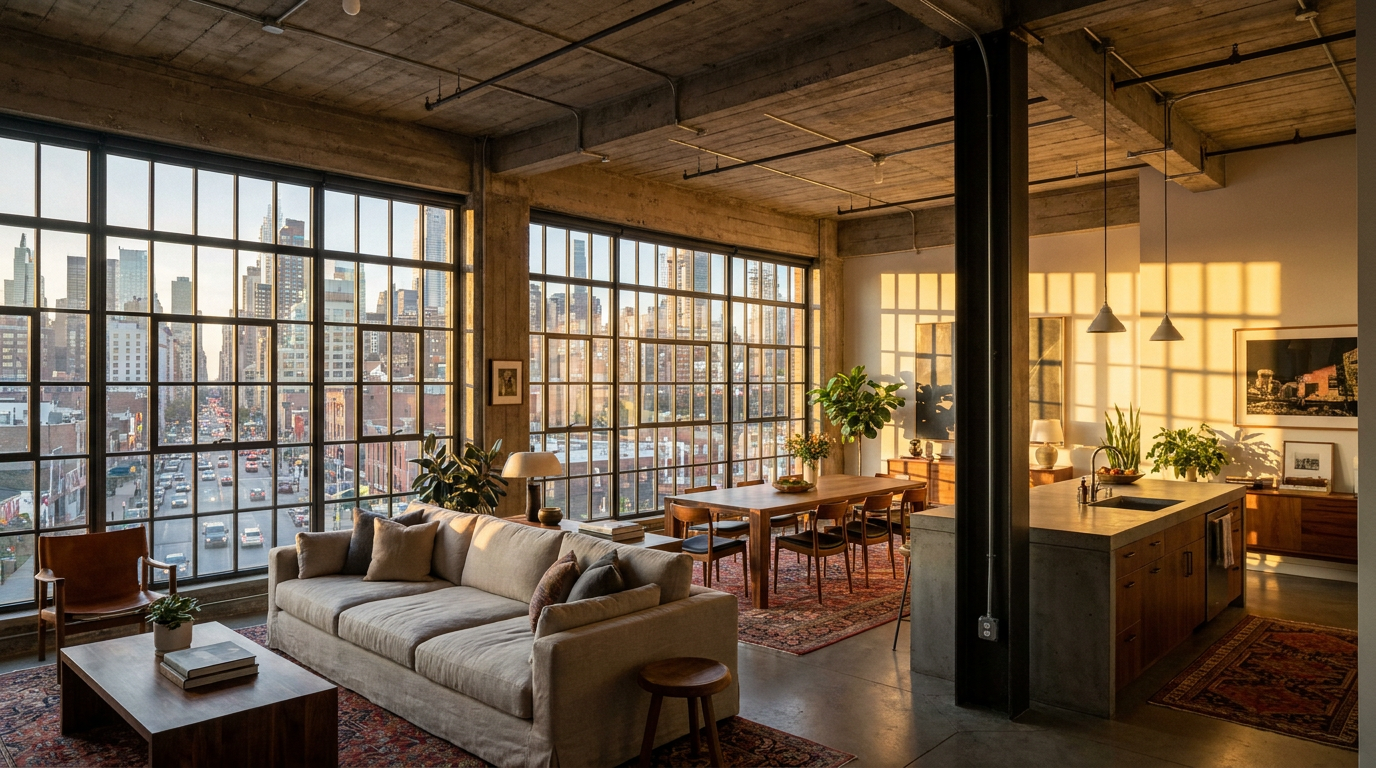
This hollowing out of commercial districts collided with a second, equally severe crisis: a historic shortage of residential housing across the United States. Now, in 2026, a massive structural shift is bridging the gap between these two seemingly intractable problems. Across the country, developers and city planners are undertaking "adaptive reuse"—the complex process of gutting obsolete office towers and transforming them into vibrant, full-time residential communities. What began as a niche architectural experiment has rapidly evolved into a mainstream real estate strategy.[1]
The scale of this transformation has reached unprecedented levels. At the start of 2026, there were 90,300 apartment units in the office-to-residential conversion pipeline across the United States. That figure represents a 28 percent jump from the previous year and a staggering 290 percent increase since 2022. The sheer volume of these projects indicates that developers are no longer waiting for a miraculous return to the office; instead, they are actively dismantling the old commercial infrastructure to build the housing that modern cities desperately need.[1][3]

Office buildings now account for nearly half—47 percent—of all planned adaptive reuse projects nationwide, officially surpassing hotels and industrial warehouses as the primary target for redevelopment. This movement is fundamentally rewriting the zoning maps and skylines of major metropolitan areas, turning single-use business districts into 24-hour neighborhoods. The shift is not merely aesthetic; it represents a profound reallocation of urban space, moving away from corporate exclusivity and toward residential density.[1][4]
The catalyst for this sudden acceleration is largely financial, driven by a ticking clock in the commercial real estate market. Roughly a third of all U.S. office loans, totaling more than $213 billion, are scheduled to mature by 2027. Owners of older, underperforming office properties are facing a stark and immediate choice: attempt to refinance at significantly higher interest rates, sell the empty building at a steep loss, or adapt the property for a completely new use.[2]
For many property owners, residential conversion has emerged as the most viable lifeline. However, turning a 1980s corporate headquarters into a modern apartment complex is an engineering marvel that requires overcoming significant structural hurdles. The most notorious challenge is the "floor plate"—the total square footage and physical layout of a single floor. Office buildings were designed to maximize interior space, resulting in deep, cavernous floors that are fundamentally at odds with residential living.[3]
Traditional office buildings were designed with massive floor plates to accommodate sprawling cubicle farms, relying heavily on artificial fluorescent lighting for the deep interior spaces. Residential building codes, by contrast, strictly require every legal bedroom to have an operable window that provides natural light and ventilation. When developers attempt to map apartment floor plans onto a deep office floor, they are often left with a massive, windowless core in the center of the building that cannot be legally used for bedrooms or living spaces.[8]
Residential building codes, by contrast, strictly require every legal bedroom to have an operable window that provides natural light and ventilation.
To solve this architectural puzzle, developers are employing drastic structural interventions. A common, albeit expensive, technique involves carving a massive "light well" straight down the center of the building, effectively turning a solid block of concrete into a hollow donut. This surgical removal of the building's core reduces the overall leasable square footage, but it maximizes the valuable perimeter space where sunlit apartments can legally be built, transforming an unlivable cavern into a functional residential floor.[8]

Plumbing presents another formidable and costly obstacle. Commercial office buildings typically feature centralized utility cores, with just one or two sets of communal restrooms per floor. Apartments, however, require highly decentralized plumbing, meaning construction crews must painstakingly drill through decades-old, post-tensioned concrete slabs to run new water and waste lines to dozens of individual kitchens, bathrooms, and laundry closets on every single level of the tower.[3]
Because of these harsh structural realities, not every vacant office is a candidate for a second life. Real estate analysts and architectural firms estimate that only about 24 percent of the total U.S. office inventory—roughly 1.9 billion square feet—is physically and economically suitable for residential conversion. Buildings with narrow footprints, operable windows, and locations near public transit are highly coveted, while massive, block-sized monoliths from the late 20th century are often deemed too expensive to retrofit.[4][8]
To bridge the financial gap and incentivize developers to take on these highly complex projects, local governments have aggressively stepped in with sweeping policy reforms in 2025 and 2026. New York City, which currently leads the nation with over 16,300 conversion units underway, recently implemented the 467-m tax incentive program. This initiative recognizes that without public assistance, the math on many of these conversions simply does not pencil out for private developers.[1][6]

The 467-m policy grants developers significant, multi-decade property tax abatements in exchange for a crucial public benefit: dedicating 25 percent of the newly created apartments as permanently affordable housing. Alongside this tax incentive, the city passed broad zoning reforms under the "City of Yes" initiative, expanding the geographic areas where commercial-to-residential conversions are legally permitted, effectively cutting through years of bureaucratic red tape.[6][7]
Other major municipalities have followed suit with their own tailored incentives. Boston introduced a highly successful program offering up to 29 years of property tax abatements for developers who convert vacant offices, prioritizing the preservation of historic neighborhoods. On the West Coast, Los Angeles updated its Citywide Adaptive Reuse Ordinance, expanding eligibility to any commercial building over 15 years old, a significant shift from previous rules that only applied to much older historic structures.[5][9]
The tangible results of these public-private partnerships are already transforming city streets. In Manhattan's Financial District, the former 22-story office building at 160 Water Street has been successfully reborn as "Pearl House," a 588-unit residential complex featuring modern amenities and ground-floor retail. Nearby, a monumental adaptive reuse project at 111 Wall Street is currently transforming 1.1 million square feet of empty commercial space into more than 1,500 apartments, marking one of the largest conversions in history.[2][7][8]

While the coastal hubs dominate the raw numbers, the conversion trend is rapidly spreading inward across the country. Cities like Philadelphia, Denver, and St. Louis have all seen their conversion pipelines more than double over the past year. Even mid-sized markets are realizing that adaptive reuse is a powerful, scalable tool for downtown revitalization, proving that the desire for walkable, mixed-use urban living extends far beyond the traditional gateway cities.[4]
Despite the undeniable momentum, the movement is not without its friction points. High interest rates and the sheer cost of construction materials continue to challenge the economic feasibility of many proposed projects. Furthermore, some housing advocates caution that without strict inclusionary zoning requirements attached to public subsidies, these expensive conversions risk producing exclusively luxury units, doing little to alleviate the severe affordability crisis for middle- and low-income urban residents.[5]
Yet, the long-term trajectory of the American city is clear. As aging commercial portfolios face stricter carbon regulations and shifting market demands, the era of the single-use office monolith is definitively ending. The buildings that survive the 2020s will be those capable of adapting to the people who actually live in them, proving that the most sustainable, resilient, and valuable building is often the one that already exists.[8]
How we got here
Pre-2020
Downtowns operate as single-use commercial districts with rigid zoning separating office and residential spaces.
2020–2022
The pandemic normalizes remote work, emptying office towers and causing physical occupancy to plummet.
2023–2024
Office values drop and interest rates rise, leaving property owners with distressed assets and few options.
2025
Major cities like New York and Los Angeles pass sweeping zoning reforms and tax incentives to encourage adaptive reuse.
Early 2026
The conversion pipeline hits a record 90,300 units nationwide, a 290% increase from four years prior.
Viewpoints in depth
Commercial Real Estate Developers
Developers view adaptive reuse as a necessary but financially perilous lifeline for distressed assets.
Faced with $213 billion in maturing office loans by 2027, developers are highly motivated to repurpose empty buildings. However, they emphasize that conversions are not a cheap alternative to new construction. The costs of drilling through concrete for decentralized plumbing, carving out light wells, and navigating complex building codes often rival ground-up development. Consequently, developers argue that without significant municipal tax abatements, most conversion projects simply cannot secure the necessary financing to break ground.
Urban Planners and Municipalities
City officials see conversions as a dual solution to hollowed-out downtowns and severe housing shortages.
For municipal leaders, the permanent shift to hybrid work poses an existential threat to downtown tax bases and local businesses that rely on foot traffic. Planners are aggressively rewriting decades-old zoning laws to remove red tape, viewing adaptive reuse as the fastest way to inject 24/7 life back into commercial districts. By offering long-term property tax exemptions, cities aim to transform single-use neighborhoods into vibrant, mixed-use communities that are more resilient to future economic shocks.
Housing Affordability Advocates
Advocates argue that public subsidies for conversions must guarantee housing for middle- and low-income residents.
While supportive of adding housing supply, affordability advocates warn against subsidizing luxury apartments with taxpayer dollars. They point out that the high costs of conversion naturally push developers toward premium price points. To counter this, advocates champion policies like New York's 467-m program, which mandates that a percentage of units remain permanently affordable in exchange for tax breaks, ensuring that the revitalization of downtowns benefits a diverse cross-section of the city's population.
What we don't know
- Whether the influx of new downtown apartments will significantly lower overall urban rent prices or primarily cater to the luxury market.
- How the permanent loss of commercial office space will impact long-term municipal tax revenues once temporary abatements expire.
- If mid-sized cities can sustain the high construction costs of adaptive reuse without the massive capital available in coastal hubs.
Key terms
- Adaptive Reuse
- The process of taking an old building or site and repurposing it for a use other than what it was originally designed for.
- Floor Plate
- The total leasable square footage and physical layout of a single floor within a commercial building.
- Light Well
- An unroofed external space provided within the volume of a large building to allow light and air to reach what would otherwise be a dark interior.
- Inclusionary Zoning
- Municipal policies that require a given share of new construction to be affordable by people with low to moderate incomes.
- Mixed-Use Development
- A type of urban development that blends residential, commercial, cultural, or institutional uses into one space.
Frequently asked
Can any empty office building be turned into apartments?
No. Only about 24 percent of the U.S. office inventory is considered structurally and economically suitable for conversion. Buildings with massive, deep floor plates often lack the necessary perimeter window space required for residential bedrooms.
Are these converted apartments affordable?
It depends on the city. Because conversion costs are extremely high, developers often target luxury price points to recoup their investment. However, cities like New York offer tax incentives only if developers reserve a percentage of the units for affordable housing.
Why is there a sudden surge in conversions in 2026?
The surge is driven by a 'perfect storm' of high office vacancy rates, severe housing shortages, and a looming wall of $213 billion in commercial office loans maturing by 2027, forcing owners to either repurpose or default.
Sources
Source coverage
9 outlets
3 viewpoints surfaced








[1]Construction DiveUrban Planners and Municipalities
Office-to-housing conversions grew 28% last year
Read on Construction Dive →[2]GlobeStHousing Affordability Advocates
Office-to-Apartment Conversions Hit Record Levels
Read on GlobeSt →[3]The Real DealCommercial Real Estate Developers
U.S. office-to-apartment conversions hits new high
Read on The Real Deal →[4]CRE DailyCommercial Real Estate Developers
Office Conversions Hit 90K, Boosting Adaptive Reuse
Read on CRE Daily →[5]Los Angeles Business JournalHousing Affordability Advocates
Adaptive Reuse Is a Slow Burn
Read on Los Angeles Business Journal →[6]Commercial Property ExecutiveHousing Affordability Advocates
Yellowstone Secures $203M for Manhattan Office-to-Residential Conversion
Read on Commercial Property Executive →[7]BrookfieldCommercial Real Estate Developers
From empty offices to needed homes, a credit opportunity emerges
Read on Brookfield →[8]GenslerUrban Planners and Municipalities
Conversions+™ by Gensler Turns Stranded Offices Into Valuable Real Estate
Read on Gensler →[9]Epsilon AssociatesUrban Planners and Municipalities
Boston's Office-to-Residential Conversion Program: A Historic Preservation Success Story
Read on Epsilon Associates →
Every angle. Every day.
Get real estate stories with full source coverage and perspective breakdowns delivered to your inbox.