
Nvidia Secures $500 Billion in GPU-Backed Financing to Fund Global AI Data Center Buildout
Nvidia has partnered with six major Wall Street firms to mobilize over $500 billion in third-party capital, allowing cloud providers to use AI chips as collateral for infrastructure loans. The move aims to lower financing costs for data centers, but raises questions about the rapid depreciation of GPU hardware.

For anyone relying on artificial intelligence—from enterprise developers building custom models to consumers using next-generation applications—the bottleneck has rarely been the software. The true constraint is the sheer physical infrastructure required to run it, and more specifically, the massive capital needed to build that infrastructure. If the cost of borrowing money to buy servers drops, the cost of computing drops, expanding who can afford to build and deploy AI at scale.[1]
That financial bottleneck is the target of a massive new initiative led by Nvidia. On August 10, the chipmaker signed memorandums of understanding with six of Wall Street's largest investment firms—Apollo Global Management, BlackRock, Blackstone, Brookfield Asset Management, Goldman Sachs, and KKR—to mobilize more than $500 billion in third-party capital. The goal is to establish independent financing platforms that treat AI computing hardware as an investable asset class, much like real estate or toll roads.[1][2]
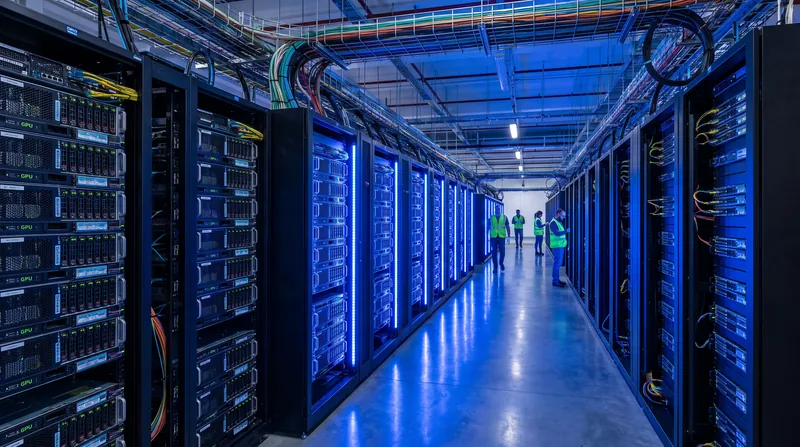
The mechanism fundamentally changes how data centers are funded. Historically, cloud providers and data center operators had to finance their infrastructure by borrowing against traditional hard assets like land, buildings, and grid connections. Under the new platforms, the lenders will accept the graphics processing units (GPUs) themselves as collateral. This allows borrowers—particularly specialized "neocloud" providers who buy Nvidia GPUs onto their own balance sheets—to secure dedicated pools of capital at significant scale and attractive rates.[2][3]
The scale of this financing is unprecedented in the technology sector. For context, during the telecom boom of the late 1990s, equipment suppliers extended roughly $25.6 billion in vendor financing to their customers. Nvidia's target is nearly 20 times that figure. The company itself could backstop as much as $125 billion, representing 25% of potential deals, signaling a deep commitment to ensuring its customers can afford its hardware.[1][2]
There is already evidence that GPU-backed financing can achieve favorable terms in the credit markets. In June 2026, data center operator IREN closed $3.65 billion in GPU financing at a blended 6.00% cost of debt, earning an investment-grade Fitch A rating. Goldman Sachs, one of the six partners in Nvidia's new coalition, worked on that specific financing, indicating that Wall Street is already actively testing and validating this asset class.[3]
However, the evidence supporting GPUs as long-term collateral remains contested, primarily due to the rapid pace of technological obsolescence. Unlike a toll road or a building, which can generate steady cash flow for decades, AI hardware evolves at a blistering pace. The core question underpinning the plan is how quickly these chips will depreciate. If newer GPU architectures render older models obsolete too quickly, the collateral coverage of the loans could collapse.
The viability of the collateral is also constrained by geopolitical factors. Analysts note that China's evolving market dynamics and US export restrictions pose a meaningful risk to the sustained resale value of older chips. If the secondary market for used GPUs is restricted or if domestic Chinese alternatives suppress global demand, the residual value of the collateral could fall short of lenders' models.
The memorandums of understanding do not specify who ultimately bears the credit loss if a compute-backed borrower defaults. While Nvidia is supplying the platform and potentially backstopping a portion of the deals, the six investment firms are expected to carry the primary credit risk, assessing opportunities based on customer demand, utilization, and residual value. How these firms will model that residual value over a five-to-ten-year loan term remains the largest unknown in the arrangement.[2][3]
For Nvidia, the financing push is a strategic necessity to maintain its hyper-growth. With trailing-12-month revenue reaching $253 billion and net income doubling to $160 billion, the sheer cost of Nvidia's hardware is starting to outgrow the balance sheets of its buyers. Rating agencies have warned that record capital spending is squeezing the free cash flow of major AI spenders. By shifting the financing risk to outside investors, Nvidia ensures that capital availability does not become the ceiling on its sales.[1][2]
If successful, this $500 billion pool of third-party capital will widen the market for AI infrastructure, allowing a broader range of developers to access high-performance computing without requiring trillion-dollar balance sheets. It marks a transition for Nvidia from a pure hardware supplier to a central architect of the financial ecosystem that sustains the artificial intelligence boom.[1]
Perspectives explored
The Infrastructure Lenders' View
Treating AI compute as a financeable asset class similar to real estate or toll roads.
Wall Street firms argue that the cash-flow generation of AI data centers justifies treating GPUs as core infrastructure. By establishing dedicated pools of capital, they aim to earn attractive yields while facilitating the next wave of technological expansion, relying on the high utilization rates of modern neoclouds to ensure steady repayment.
The Hardware Supplier's View
Lowering financing costs to sustain demand and remove balance-sheet bottlenecks.
Nvidia views the financing platforms as a strategic necessity to ensure its customers can continue purchasing hardware at scale. By shifting the capital burden to third-party lenders and potentially backstopping a portion of the deals, the company aims to transition from a pure chipmaker to the foundational architect of the AI economy, ensuring that capital availability does not cap its growth.
The Risk Analysts' View
Highlighting the dangers of rapid depreciation and secondary market instability.
Financial analysts caution that unlike physical infrastructure, AI chips face aggressive technological obsolescence. If newer architectures render older GPUs obsolete faster than expected, the collateral backing these massive loans could evaporate. Furthermore, geopolitical tensions and export curbs add unpredictability to the secondary market value of the hardware, complicating long-term risk models.
Key points
- Nvidia signed MOUs with six major Wall Street firms to mobilize over $500 billion for AI infrastructure.
- The financing platforms will allow borrowers to use AI compute hardware as collateral for loans.
- The initiative aims to lower borrowing costs and expand market access for cloud providers.
- The primary risk for lenders is the rapid depreciation and technological obsolescence of GPUs.
Open questions
- Who ultimately bears the credit loss if a compute-backed borrower defaults.
- How lenders will accurately model the residual value of GPUs given the rapid pace of technological obsolescence.
- The impact of US export restrictions on the secondary market for used AI chips.
Timeline
Late 1990s
Telecom equipment makers extend $25.6 billion in vendor financing, a historical precursor to the current model.
Jun 2026
Data center operator IREN closes $3.65 billion of GPU financing at a 6.00% cost of debt, earning an investment-grade rating.
Aug 2026
Nvidia signs memorandums of understanding with six Wall Street firms to build the $500 billion financing platform.
- Infrastructure Lenders
- Treating AI compute as a financeable asset class similar to real estate or toll roads.
- AI Hardware Suppliers
- Lowering financing costs to sustain demand and remove balance-sheet bottlenecks.
- Risk Analysts
- Highlighting the dangers of rapid depreciation and secondary market instability for GPUs.
Perspectives this story doesn't cover
- Smaller AI startups who may be priced out if financing heavily favors large neoclouds
- Environmental groups concerned about the energy footprint of a $500B data center buildout
Sources
Source coverage
3 outlets
3 viewpoints surfaced



- [1]ForbesAI Hardware Suppliers
Nvidia AI Financing Changes The Quality Of Demand
Read on Forbes → - [2]The Motley FoolAI Hardware Suppliers
Nvidia Teams With Wall Street on $500 Billion AI Financing Push
Read on The Motley Fool → - [3]Certified StrategicInfrastructure Lenders
NVIDIA lines up US$500 billion to finance its own customers
Read on Certified Strategic →
More in Artificial Intelligence
See all →Neural Architectures
How Convolutional Filters and Pooling Layers Extract Hierarchical Features in Computer Vision
6 sources

Neural Network Architecture
How Residual Connections and ReLU Activation Prevent Vanishing Gradients in Deep Neural Networks
6 sources

Reinforcement Learning
The Core Mechanics of Reinforcement Learning: Comparing Value-Based, Policy-Based, and Model-Based Algorithms
4 sources

AI Copyright
MIT Research Finds AI Output Untraceable to Training Data as Models Scale, Complicating Copyright Lawsuits
6 sources

Comments
Every angle. Every day.
Get Artificial Intelligence stories with full source coverage and perspective breakdowns, free every day.