
New AI Model Accelerates Molecular Simulations 10,000x, Speeding Up Early Drug Discovery
Researchers in Sweden have developed a generative AI model that predicts molecular motion 10,000 times faster than traditional methods. The breakthrough promises to drastically reduce the time and cost required to identify new pharmaceutical candidates.
By Factlen Editorial Team
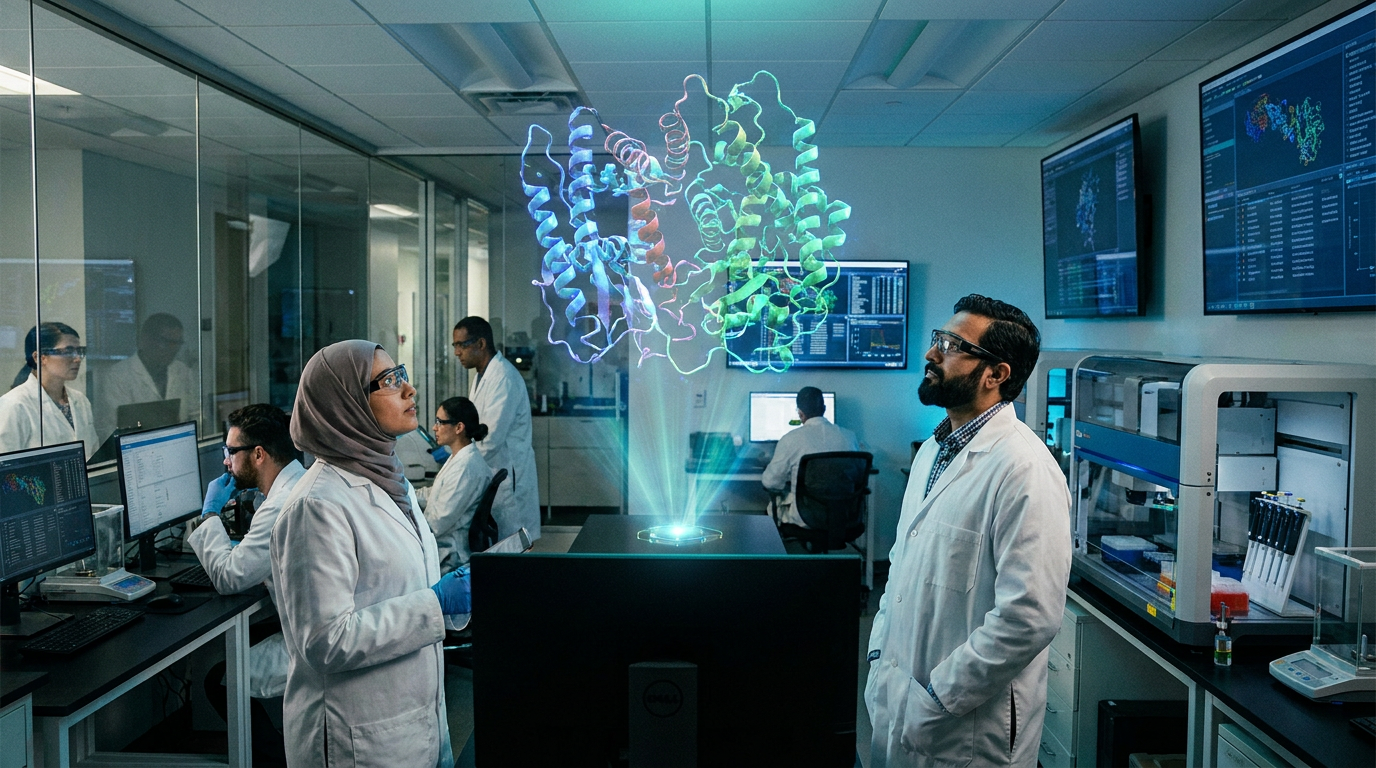
- Computational Biologists
- Focused on the methodological leap from numerical calculation to statistical prediction.
- Pharmaceutical Industry
- Focused on the economic impact of faster, cheaper virtual prototyping.
- Clinical & Public Health Experts
- Focused on the enduring necessity of real-world human testing and care delivery.
What's not represented
- · Patient advocacy groups awaiting treatments for rare diseases
- · Regulatory bodies overseeing AI-generated drug candidates
Why this matters
By compressing months of computational research into mere minutes, this AI breakthrough drastically lowers the cost and time required to discover new medicines. This efficiency means pharmaceutical companies can develop treatments for complex or rare diseases faster, ultimately accelerating the pipeline of life-saving drugs reaching patients.
Key points
- A new AI model developed in Sweden accelerates molecular simulations by a factor of 10,000.
- The system uses generative AI to predict molecular motion, bypassing slow, step-by-step numerical calculations.
- The breakthrough allows researchers to virtually test thousands of drug candidates in minutes rather than months.
- While currently tested on simple molecular systems, developers aim to scale it to complex biological environments.
- The advancement promises to lower early-stage R&D costs, though rigorous human clinical trials remain necessary.
A joint team from Chalmers University of Technology and the University of Gothenburg has unveiled an artificial intelligence model capable of accelerating molecular simulations by a factor of 10,000. Published this week in the journal Science Advances, the deep generative modeling framework represents a fundamental shift in how scientists observe atomic interactions. By bypassing traditional, computationally exhausting numerical calculations, the system allows researchers to predict molecular behavior at unprecedented speeds.[1][2][3]
Bringing a new pharmaceutical to market is notoriously slow and expensive, typically demanding over a decade of research and development before a single patient receives treatment. A massive portion of that timeline—and the associated financial risk—is concentrated in the earliest stages. Scientists must screen countless molecular permutations to identify a handful of promising candidates that might successfully bind to a target protein or pass through a cellular membrane.[2][3]
Historically, this screening process relied heavily on physical wet-lab experimentation and conventional molecular dynamics simulations. These traditional computer simulations calculate the movement of atoms step-by-step, capturing changes on the scale of femtoseconds, which is one quadrillionth of a second. While highly accurate, this brute-force numerical approach requires immense computational power and weeks of processing time just to simulate a fraction of a nanosecond of biological activity.[1][2]

The Swedish research team approached the problem differently, deploying a generative AI framework that learns the underlying statistical rules governing molecular motion directly from existing simulation data. Instead of calculating every microscopic movement sequentially, the model predicts the molecule's future state based on learned patterns. Simon Olsson, a lead researcher on the project, likened the advancement to jumping between key scenes in a "molecular movie" rather than being forced to watch every single frame in real time.[1][2]
The resulting 10,000-fold acceleration transforms tasks that once took months into processes that can be completed in minutes. This leap in efficiency allows computational biologists to explore vastly larger chemical landscapes, testing thousands of potential drug candidates virtually before ever synthesizing a compound in a physical laboratory. The model effectively bridges the gap between femtosecond-scale atomic vibrations and nanosecond-scale structural shifts.[1][3]
The resulting 10,000-fold acceleration transforms tasks that once took months into processes that can be completed in minutes.
For the biopharmaceutical sector, this operational efficiency translates directly into a more sustainable business model. Industry analysts note that accelerating the candidate identification phase lowers the research and development expenditure per successful drug. By relying on data-driven virtual prototyping, pharmaceutical companies can improve the quality of the molecules that eventually enter expensive preclinical and clinical development phases, ensuring a faster return on investment and a more robust pipeline of novel therapies.[3]

The push for computational speed is an industry-wide mandate. Earlier in 2026, pharmaceutical giant Eli Lilly inaugurated "LillyPod," an AI supercomputer designed to simulate billions of molecular hypotheses in parallel to cut the typical 10-year drug development timeline in half. The Swedish generative model complements this hardware arms race by providing a software framework that makes every unit of computing power exponentially more efficient.[4]
This development reflects a broader trend in the 2026 artificial intelligence landscape. Experts at Johns Hopkins University and Stanford University have noted that the era of general-purpose AI hype is giving way to an era of rigorous, highly specialized applications. Tools are being custom-built for specific, high-value scientific tasks, moving away from an "AI-for-everything" approach toward precision instruments that solve distinct bottlenecks in fields like genomics and molecular biology.[6][7]
Despite the enthusiasm, the researchers acknowledge that the technology is still in its foundational stages. The current iteration of the generative model has been successfully tested primarily on small molecular systems suspended in simplified solvent environments at specific temperatures. The physics of complex, real-world biological systems—such as large protein complexes interacting within the chaotic environment of a living human cell—introduce variables that the model has not yet fully mastered.[1][2]

The immediate next step for the Chalmers and Gothenburg teams is to scale the framework to handle these more realistic biological environments. Researchers are actively working to train the model on data involving complex cellular membranes and larger macromolecules. As the training datasets grow more sophisticated, the AI's predictive accuracy is expected to match its unprecedented speed, making it a standard tool in academic and corporate laboratories alike.[1][2]
However, public health experts caution that while AI can revolutionize the discovery phase, it cannot entirely eliminate the decade-long drug development timeline. Identifying a perfect molecular candidate in a simulation does not guarantee its safety or efficacy in a human body. Furthermore, leaders at the New York Academy of Sciences argue that AI's ultimate success in healthcare should not only be measured by what it helps invent, but by its ability to help deliver proven care to patients who are currently missed by the medical system.[5]
Ultimately, the 10,000-fold acceleration in molecular simulation represents a critical victory in the fight against complex diseases. By drastically reducing the time and cost required to find viable therapeutic candidates, this AI framework ensures that the pharmaceutical industry can respond more swiftly to emerging health crises and tackle rare conditions that were previously considered too expensive to research.[2][3]
How we got here
Pre-2020s
Drug discovery relies heavily on physical wet-lab testing and slow, computationally expensive numerical simulations.
2023-2025
Generative AI models prove their capability in predicting static protein structures, such as AlphaFold's breakthroughs.
June 2026
Researchers in Sweden publish a generative model in Science Advances that predicts dynamic molecular motion 10,000 times faster than previous methods.
Next Steps
Scientists aim to scale the AI framework to simulate complex biological environments like living cellular membranes.
Viewpoints in depth
Computational Biologists
Focused on the methodological leap from numerical calculation to statistical prediction.
For researchers in the trenches of computational chemistry, the breakthrough is fundamentally about bypassing the limits of brute-force computing. Traditional models required calculating the physics of every atom at every femtosecond, creating an insurmountable computational bottleneck. By proving that a generative model can learn the statistical rules of molecular motion and accurately 'skip ahead' in time, this camp sees a paradigm shift that will redefine how biological simulations are conducted across all scientific disciplines.
Pharmaceutical Industry
Focused on the economic impact of faster, cheaper virtual prototyping.
Industry leaders and biotech analysts view this development through the lens of pipeline efficiency and return on investment. The earliest stages of drug discovery are characterized by high failure rates and massive sunk costs. By enabling researchers to virtually screen thousands of molecular permutations in the time it previously took to test one, the industry anticipates a dramatic reduction in R&D expenditure per successful candidate, allowing companies to pursue a wider array of therapeutic targets.
Clinical & Public Health Experts
Focused on the enduring necessity of real-world human testing and care delivery.
While celebrating the acceleration of the discovery phase, medical professionals and public health advocates emphasize that simulation is only the first step. A molecule that performs perfectly in a digital environment must still navigate the unpredictable complexities of the human body. This camp reminds stakeholders that the rigorous, multi-year clinical trials required to prove safety and efficacy remain the ultimate bottleneck, and that AI's true value will also depend on its ability to improve patient access to the drugs it helps invent.
What we don't know
- Whether the model's accuracy will hold up when scaled to highly complex, chaotic cellular environments.
- Exactly how much time this will shave off the total 10-year drug development lifecycle in practice.
Key terms
- Molecular dynamics simulation
- A computer simulation method for analyzing the physical movements of atoms and molecules over a set period of time.
- Generative AI
- Artificial intelligence capable of generating new data, structures, or predictions based on the patterns it learned during training.
- Femtosecond
- One quadrillionth of a second, the incredibly brief time scale at which traditional molecular simulations calculate atomic movements.
- Wet-lab experimentation
- Traditional scientific research involving physical chemicals, biological matter, and liquids, as opposed to computer-based virtual testing.
Frequently asked
What exactly does this new AI model do?
It predicts how molecules move and interact over time by learning statistical patterns, bypassing the need for slow, step-by-step mathematical calculations.
Will this make medicines cheaper?
By reducing the time and computational cost required to identify promising drug candidates, it lowers early R&D expenses, which could eventually translate to more affordable therapies.
Does this mean new drugs will be available immediately?
No. While the AI drastically speeds up the initial discovery phase, new drugs must still pass through years of rigorous human clinical trials to ensure safety and efficacy.
Sources
Source coverage
7 outlets
3 viewpoints surfaced







[1]Science AdvancesComputational Biologists
Transferable generative models bridge femtosecond to nanosecond time-step molecular dynamics
Read on Science Advances →[2]News-MedicalComputational Biologists
AI breakthrough accelerates molecular simulations for drug discovery
Read on News-Medical →[3]Biology DigitalComputational Biologists
AI Breakthrough Accelerates Molecular Simulations for Drug Discovery
Read on Biology Digital →[4]Crescendo AIPharmaceutical Industry
Explore What Latest Development Happened in AI World in 2026
Read on Crescendo AI →[5]New York Academy of SciencesClinical & Public Health Experts
Healthcare's Real AI Breakthrough May Be Getting Proven Care to More Patients
Read on New York Academy of Sciences →[6]Stanford University HAIPharmaceutical Industry
From Hype to Dashboards: Measuring AI in Real Time
Read on Stanford University HAI →[7]Johns Hopkins UniversityClinical & Public Health Experts
What to expect in AI in 2026
Read on Johns Hopkins University →

More in ai
See all 5 stories →On-Device AI
How Local AI Replaced the Cloud: Running Frontier Models on Your Laptop
0 sources

Enterprise AI
The Rise of Small Language Models: How Enterprises Are Running AI Locally in 2026
0 sources

Drug Discovery
New AI Model Accelerates Molecular Simulations 10,000-Fold, Slashing Drug Discovery Timelines
0 sources

Every angle. Every day.
Get ai stories with full source coverage and perspective breakdowns delivered to your inbox.