
New AI Model Accelerates Drug Discovery Simulations by 10,000 Times
Researchers in Sweden have developed a generative AI model that predicts molecular movement 10,000 times faster than traditional methods. The breakthrough could drastically reduce the decade-long timeline and massive costs associated with bringing new medicines to patients.
By Factlen Editorial Team
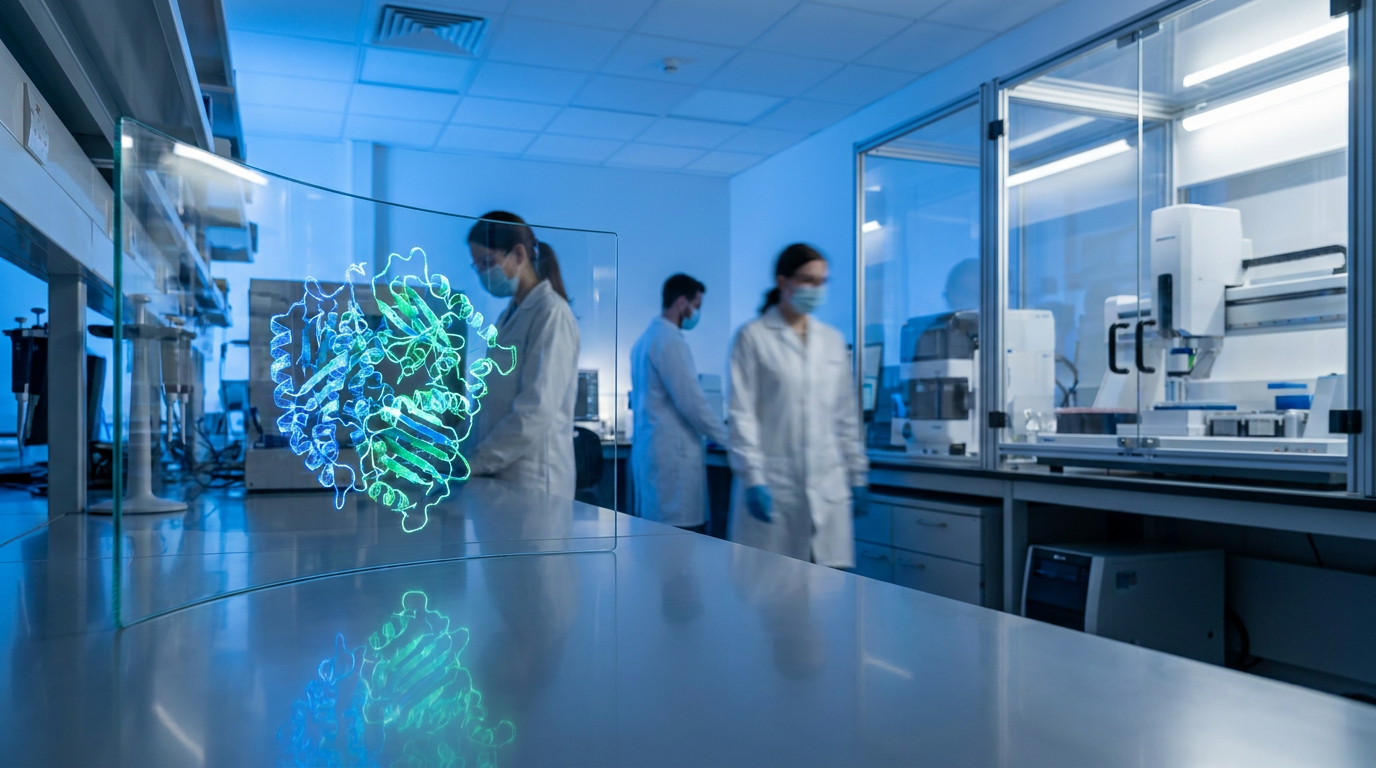
- Bioscience Researchers
- Focus on the unprecedented computational speed and the paradigm shift from numerical calculation to generative prediction.
- Public Health Advocates
- Emphasize that discovering new drugs is only half the battle; AI must also be used to close the delivery gap and reach underserved patients.
- Pharmaceutical Industry
- View AI acceleration as a critical tool to reduce billion-dollar R&D costs and mitigate the high failure rates of early-stage pipelines.
What's not represented
- · Patient Advocacy Groups
- · Regulatory Agencies (FDA/EMA)
Why this matters
The earliest stages of drug discovery are currently a massive bottleneck, costing billions and taking years just to identify viable chemical candidates. By simulating molecular dynamics in seconds rather than weeks, this technology could drastically accelerate the development of cures for rare diseases, cancers, and emerging viruses.
Key points
- A new AI model named TITO can predict molecular motion 10,000 times faster than traditional supercomputer simulations.
- The breakthrough bypasses brute-force physics calculations by using generative AI to learn the statistical rules of molecular movement.
- This technology targets the most expensive and time-consuming phase of drug discovery, potentially shaving years off R&D timelines.
- Public health experts warn that while AI accelerates discovery, it must also be deployed to ensure new treatments actually reach patients.
The timeline for developing a new life-saving medication is notoriously punishing, often stretching beyond a decade from the initial spark of an idea to a finished pill on a pharmacy shelf. A massive portion of that time and capital is burned in the very first phase: simulating how potential chemical compounds interact at the atomic level. Now, researchers at Sweden’s Chalmers University of Technology and the University of Gothenburg have developed an artificial intelligence model that could shatter this bottleneck. The new framework, detailed in a June 2026 study, predicts how molecules evolve over time up to 10,000 times faster than conventional numerical simulations.[1][2]
The model, named TITO (Transferable Implicit Transfer Operators), represents a fundamental shift in computational chemistry. Traditional molecular dynamics rely on brute-force physics, calculating the movement and spatial relationship of every single atom step-by-step across femtosecond time scales. It is a process so computationally heavy that simulating a fraction of a second of biological activity can take weeks on a supercomputer. TITO bypasses this entirely. By utilizing a deep generative modeling framework, it learns the statistical rules governing molecular motion directly from existing simulation data, allowing it to predict future states without performing the exhaustive numerical calculations.[1][2]
"What sets our AI model apart is that it learns the underlying dynamics over longer time scales," explained Juan Viguera Diez, a lead researcher on the project. The system does not merely generate static images of what a molecule might look like; it provides dynamic insights into the specific pathways and speeds at which molecular transitions occur. This capability allows researchers to rapidly identify which drug candidates are most likely to bind successfully to a target protein, filtering out dead ends years before they reach costly clinical trials.[1]

This breakthrough arrives at a massive inflection point for artificial intelligence in the biosciences. Throughout 2025 and early 2026, generative AI has transitioned from a theoretical tool to a core component of pharmaceutical research. Industry analysts note that AI algorithms are now routinely used to simulate biological systems, analyze protein folding, and generate synthetic data for complex experiments. The successful proof-of-concept demonstrated by models like TITO is expected to open the floodgates for researchers seeking to speed up candidate analysis and simulate human body interactions with unprecedented accuracy.[3][6]
The implications for specific medical fields, particularly oncology, are profound. Cancer treatments are already being reshaped by AI models trained on diverse clinical and imaging data, which can predict a patient's response to immunotherapy with 70 to 80 percent accuracy. Advanced multimodal systems are currently used to forecast cancer prognosis and the likelihood of recurrence. By pairing these predictive diagnostic tools with TITO’s rapid drug-candidate generation, the oncology pipeline could shift toward highly personalized, anticipatory treatments developed in a fraction of the historical timeframe.[5][6]
The implications for specific medical fields, particularly oncology, are profound.
The rapid acceleration of these biological models is deeply intertwined with the broader explosion of AI compute power in 2026. As major tech companies and open-source communities release increasingly massive models—some boasting over a trillion parameters and context windows capable of processing entire genomic sequences—the underlying infrastructure for scientific AI has become cheaper, more reliable, and vastly more capable. The same agentic workflows and multimodal reasoning engines driving enterprise software are now being adapted to parse complex biochemical data.[3]

However, as the frontier of medical discovery expands, public health experts are urging the industry to maintain focus on the "delivery gap." Dr. Dave Chokshi, former New York City Health Commissioner, recently argued at a Mount Sinai health conference that healthcare should not measure AI's success solely by what it helps invent. He highlighted the stubborn distance between what science makes possible and what patients actually receive, noting that medicine already possesses curative treatments that fail to reach the most vulnerable populations.[4]
From this perspective, the ultimate promise of AI in healthcare lies in a dual approach: accelerating the discovery of new miracle cures while simultaneously deploying predictive analytics to find undiagnosed patients. AI systems are increasingly being used to augment case-finding, identifying individuals who qualify for proven interventions but have fallen out of the care system. For the breakthroughs generated by models like TITO to have maximum impact, they must be paired with AI-driven delivery systems that ensure the resulting drugs reach the clinic door.[4][6]
For the pharmaceutical industry, the economic incentives to adopt these generative models are undeniable. The traditional R&D pipeline is fraught with high failure rates, with billions of dollars routinely lost on drug candidates that show promise in early stages but fail in late-stage clinical trials. By utilizing AI to streamline the identification of suitable patient cohorts, predict success rates, and filter out unviable molecules instantly, pharmaceutical companies can drastically reduce their overhead. This efficiency could, in theory, translate to more affordable cures for patients.[3][6]

The Chalmers University team acknowledges that their work is currently a foundational proof-of-concept. TITO has been successfully tested on small molecular systems in simplified solvent models at specific temperatures. The immediate next step for the research team is scaling the framework to handle more complex, realistic biological systems—introducing the chaotic variables of human biology into the simulation.[1][2]
If this scaling is successful, the long-term trajectory of medicine will fundamentally change. The ability to generate plausible molecular structures and simulate their motion in seconds rather than months paves the way for a new era of precision medicine. Diseases that are currently considered too rare or complex to warrant a decade-long, billion-dollar R&D investment may soon become solvable puzzles, addressed by bespoke molecules designed and tested in the digital realm before ever entering a physical lab.[1][3]
How we got here
2022–2024
AI models prove highly capable of predicting static protein structures, revolutionizing structural biology.
2025
Generative AI begins actively assisting in bringing new medicines to the clinical trial phase.
June 2026
Chalmers University researchers publish the TITO model, successfully predicting dynamic molecular motion 10,000 times faster than traditional methods.
Viewpoints in depth
Bioscience Researchers
Focus on the unprecedented computational speed and the paradigm shift from numerical calculation to generative prediction.
For computational chemists and bioscience researchers, the TITO model represents an escape from the limitations of brute-force physics. Traditional molecular dynamics require calculating the position of every atom at every femtosecond, a process that chokes even the world's fastest supercomputers. By shifting to a generative model that predicts outcomes based on learned statistical rules, researchers can test thousands of drug candidates in the time it previously took to test one, fundamentally changing the pace of laboratory science.
Public Health Advocates
Emphasize that discovering new drugs is only half the battle; AI must also be used to close the delivery gap.
Public health officials and medical ethicists argue that a faster drug pipeline is meaningless if the resulting cures do not reach the people who need them. They point out that medicine already possesses highly effective treatments for diseases like Hepatitis C that fail to reach vulnerable populations. This camp advocates for equal investment in AI systems designed to identify undiagnosed patients, streamline hospital administration, and ensure equitable healthcare delivery, rather than focusing solely on the invention of new molecules.
Pharmaceutical Industry
View AI acceleration as a critical tool to reduce billion-dollar R&D costs and mitigate the high failure rates of early-stage pipelines.
The pharmaceutical sector views generative AI as a necessary evolution to sustain the economics of drug development. Currently, companies spend billions of dollars on drug candidates that ultimately fail in late-stage clinical trials because their molecular interactions were not fully understood early on. By using AI to rapidly simulate how a molecule will behave in the human body, companies can filter out unviable options immediately, drastically reducing overhead and potentially lowering the cost of bringing a successful drug to market.
What we don't know
- How seamlessly the TITO model will scale from simplified solvent tests to the chaotic, complex variables of actual human biology.
- Whether the massive reduction in early-stage R&D costs will actually translate to lower prescription drug prices for consumers.
Key terms
- Molecular Dynamics
- Computer simulations that analyze the physical movements and interactions of atoms and molecules over time.
- Generative AI
- Artificial intelligence capable of generating new data, structures, or predictions based on the statistical patterns it learned during training.
- Computational Chemistry
- A branch of chemistry that uses computer simulation to assist in solving complex chemical problems, such as drug design.
Frequently asked
What is the TITO AI model?
TITO (Transferable Implicit Transfer Operators) is a deep generative AI framework developed in Sweden that predicts how molecular structures evolve and move over time.
Why is molecular simulation currently so slow?
Traditional methods calculate the movement of every single atom step-by-step using brute-force physics, requiring massive computing power just to simulate a fraction of a second.
Will this technology make medicines cheaper?
By drastically reducing the time and cost of the early discovery phase, it has the potential to lower R&D overhead, though final drug pricing depends on many market factors.
Is TITO being used to manufacture drugs right now?
Not yet. It has been successfully tested on small molecular systems and is currently being scaled to handle more complex, realistic biological environments.
Sources
Source coverage
6 outlets
3 viewpoints surfaced






[1]News-MedicalBioscience Researchers
AI breakthrough accelerates molecular simulations for drug discovery
Read on News-Medical →[2]Science AdvancesBioscience Researchers
Transferable generative models bridge femtosecond to nanosecond time-step molecular dynamics
Read on Science Advances →[3]ForbesPharmaceutical Industry
The Top 5 Healthcare AI Trends For 2026
Read on Forbes →[4]The New York Academy of SciencesPublic Health Advocates
The Breakthrough Healthcare Needs Most
Read on The New York Academy of Sciences →[5]H-OncologyPharmaceutical Industry
AI-driven drug discovery accelerating new therapies
Read on H-Oncology →[6]Vertu HealthPharmaceutical Industry
Top 10 AI Medical Breakthroughs 2026: Revolutionizing Healthcare
Read on Vertu Health →

More in ai
See all 5 stories →On-Device AI
How Local AI Replaced the Cloud: Running Frontier Models on Your Laptop
0 sources

Enterprise AI
The Rise of Small Language Models: How Enterprises Are Running AI Locally in 2026
0 sources

Drug Discovery
New AI Model Accelerates Molecular Simulations 10,000-Fold, Slashing Drug Discovery Timelines
0 sources

Every angle. Every day.
Get ai stories with full source coverage and perspective breakdowns delivered to your inbox.