
Moesha Johnson Eyes Historic Sweep as Four Men Battle for Open Water World Cup Crown
Australia's Moesha Johnson looks to complete a perfect season at the Open Water Swimming World Cup finale in Portugal, while a razor-thin 70-point margin separates the top four men.
By Omar Haddad
The stage is set for a dramatic conclusion to the 2026 World Aquatics Open Water Swimming World Cup. On June 20 and 21, the world’s elite endurance swimmers will descend upon the chilly Atlantic waters of Setubal, Portugal, for the fourth and final stop of the global circuit. With overall championships and substantial prize purses on the line, the weekend promises a stark contrast between a dominant coronation on the women’s side and a razor-thin, four-way battle for the men’s crown.[1][5]
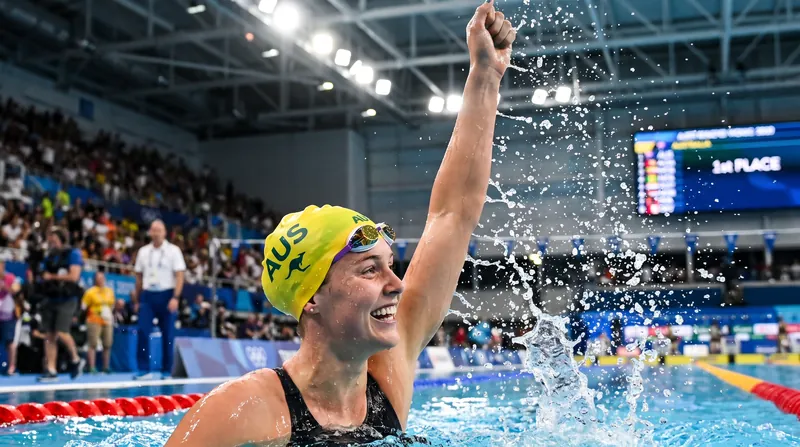
For the women, the narrative belongs entirely to Australia’s Moesha Johnson. The 28-year-old has been an unstoppable force throughout the 2026 campaign, sweeping the 10-kilometer marathon events at the first three stops in Somabay, Ibiza, and Golfo Aranci. She arrives in Portugal with a perfect 2,400 points, holding a commanding 650-point lead over Spain’s Angela Martinez Guillen, who sits in second with 1,750 points.[2][3]
If Johnson secures victory in Setubal, she will complete a historic clean sweep of the season, cementing her status as the undisputed queen of the open water. Her dominance has been characterized by her ability to dictate the pace from the front, regardless of the conditions. In the warm waters of the Red Sea and the frigid chop of the Mediterranean, she has consistently broken away from the pack to avoid the physical chaos of group swimming.[2]
While the women’s title appears to be a formality, the men’s standings are a chaotic, thrilling dead heat. After three grueling races across three countries, France’s Marc-Antoine Olivier and Italy’s Andrea Filadelli share the overall lead with exactly 1,700 points each. The veteran Olivier has relied on his vast experience and tactical drafting to secure consistent podium finishes, while Filadelli has leveraged his raw speed to stay at the front of the pack.[4][5]
Breathing down their necks is 21-year-old French sensation Sacha Velly. Velly sits just 40 points behind the co-leaders at 1,660 points, having catapulted himself into title contention with a stunning maiden 10km victory at the previous stop in Golfo Aranci. Velly’s strategy in Italy—biding his time in the middle of the pack before unleashing a devastating sprint in the final kilometer—proved that he has the tactical maturity to challenge the veterans.[3][4]
Rounding out the four-way men's battle is Hungary’s David Betlehem, who sits in fourth place with 1,630 points. Betlehem showcased his lethal closing speed by winning the Ibiza stop with a courageous final lap, proving he can never be counted out when the finish funnel comes into view. With only 70 points separating first from fourth, the men's championship will likely be decided by a sprint to the final touch pad.[4]
The battleground for this final showdown, Setubal, is one of the most iconic and challenging venues in the sport. Located on the Portuguese coast, the open Atlantic Ocean waters are notoriously cold and unpredictable, testing the athletes' physical endurance and mental fortitude. Setubal has a rich history in open water swimming, having hosted the World Cup 16 times since 2007, as well as serving as the Olympic Marathon Swim Qualifier in 2012, 2016, and 2021.[1]
The weekend will feature the traditional 10km marathon on Saturday, which will primarily determine the overall World Cup champions. Swimmers will navigate a 1.66-kilometer looped course, completing six laps while battling the Atlantic currents. On Sunday, the athletes will switch gears for the 3km Knockout Sprint, a relatively new, high-octane format consisting of successive heats that demand explosive speed and rapid recovery.[1]
Beyond the prestige of the overall title, there are significant financial stakes. The World Aquatics points system rewards consistency, with the overall annual winners earning a substantial payout from the prize pool. For the younger competitors, there is also the World Cup Junior Winner award, which grants a $5,000 bonus to the top male and female swimmers aged 19 or younger.[1]
As the athletes finalize their preparations and acclimate to the Portuguese waters, the contrasting storylines offer a perfect showcase for the sport. Fans will witness either the crowning of an undefeated champion in Moesha Johnson or a dramatic, down-to-the-wire sprint finish to separate four of the world's best men. When the starting horn sounds on Saturday morning, every stroke, every buoy turn, and every tactical decision will carry the weight of an entire season.[4]
Key points
- Australia's Moesha Johnson aims for a perfect season after winning the first three World Cup stops.
- France's Marc-Antoine Olivier and Italy's Andrea Filadelli are tied for the men's overall lead.
- Only 70 points separate the top four men in the championship standings.
- The final races will take place in the notoriously challenging Atlantic waters of Setubal, Portugal.
- Athletes are competing for the overall World Cup title and substantial prize money payouts.
How we got here
March 2026
Somabay, Egypt hosts the opening stop, with Moesha Johnson and Florian Wellbrock taking early leads.
April 2026
Johnson makes it two-for-two in Ibiza, Spain, while David Betlehem surges to win the men's race.
May 2026
Johnson completes a three-peat in Golfo Aranci, Italy, as Sacha Velly claims his maiden 10km title.
June 20-21, 2026
Setubal, Portugal hosts the fourth and final stop to crown the overall World Cup champions.
- The European Contenders
- Focused on the razor-thin men's points race, tactical drafting, and the explosive sprint finishes that will decide the title.
- The Undefeated Frontrunner
- Focused on completing a historic clean sweep and managing the unpredictable Atlantic conditions.
- The Organizers
- Focused on the prestige of the Setubal venue, athlete safety, and the global growth of the knockout sprint format.
Perspectives this story doesn't cover
- Local Portuguese swimmers competing in their home waters
- Coaches detailing the specific nutritional challenges of cold-water marathons
Sources
Source coverage
5 outlets
3 viewpoints surfaced




- [1]World AquaticsThe Organizers
World Aquatics Open Water Swimming World Cup 2026 - Portugal
Read on World Aquatics → - [2]SwimSwamThe Undefeated Frontrunner
Moesha Johnson Wins First 2026 Open Water World Cup Stop By 48 Seconds
Read on SwimSwam → - [3]Swimming WorldThe Undefeated Frontrunner
Sacha Velly Clinches Maiden Solo Victory As Moesha Johnson Continues Domination at Open Water World Cup
Read on Swimming World → - [4]European AquaticsThe European Contenders
Velly's historic gold headlines dominant European display at Golfo Aranci Open Water Swimming World Cup
Read on European Aquatics → - [5]European AquaticsThe European Contenders
2026 in prospect: open water swimming
Read on European Aquatics →
More in Sports
See all →Preview
Katie Ledecky and Léon Marchand Headline UVA's Unscored 'Pro Elite' SCM Prep Meet
3 sources

Storyline
Egor Kornev Matches World Record as Silk Road Tour Opens in Baku
7 sources
Standings
College Swimming League Standings: Virginia Holds the Summit as Stanford and Cal Enter the Championship Hunt
5 sources
Standings
Lani Pallister Dethrones Katie Ledecky Atop 2026 World Rankings in Historic 800m Freestyle Shift
6 sources
Comments
Every angle. Every day.
Get Sports stories with full source coverage and perspective breakdowns, free every day.