
Miles-Per-Hour vs. Peak kW: The 2026 EV Charging Speed Trade-Off After the NACS Standardization
As the NACS plug unifies North American EV charging, a new debate has emerged over whether to measure charging speed by raw electrical power or actual driving range added.
By Factlen Editorial Team
- Utility Pragmatists
- Focuses on miles-per-hour as the ultimate measure of value, prioritizing the actual driving range added over raw electrical power.
- Hardware Purists
- Argues that peak kW is the only objective, reliable metric because it isolates charger capability from vehicle efficiency.
- Consumer Advocates
- Warns that both metrics can be manipulated by automakers and emphasizes the need for transparency around charging curves and real-world conditions.
What's not represented
- · Utility Companies managing grid load
- · Apartment dwellers relying solely on public infrastructure
Why this matters
With the NACS plug standardizing the physical connection, the confusion has shifted to the dashboard metrics. Understanding the difference between raw power (kW) and actual driving range (miles per hour) prevents buyers from overspending on unnecessary home hardware or miscalculating road trip wait times.
Key points
- The NACS standardization has shifted consumer focus from plug compatibility to understanding charging speed metrics.
- Peak kW measures the raw electrical power delivered by the charger, offering an objective benchmark for hardware.
- Miles-per-hour measures the actual driving range added, factoring in the specific efficiency and weight of the vehicle.
- A high-kW charger will add significantly fewer miles per hour to a heavy electric truck than to an aerodynamic sedan.
- Most EVs have an onboard AC charging limit of 11.5 kW, making expensive 19.2 kW home chargers unnecessary for many drivers.
- Both metrics can be misleading, as battery management systems throttle charging speeds significantly once the battery reaches 80 percent.
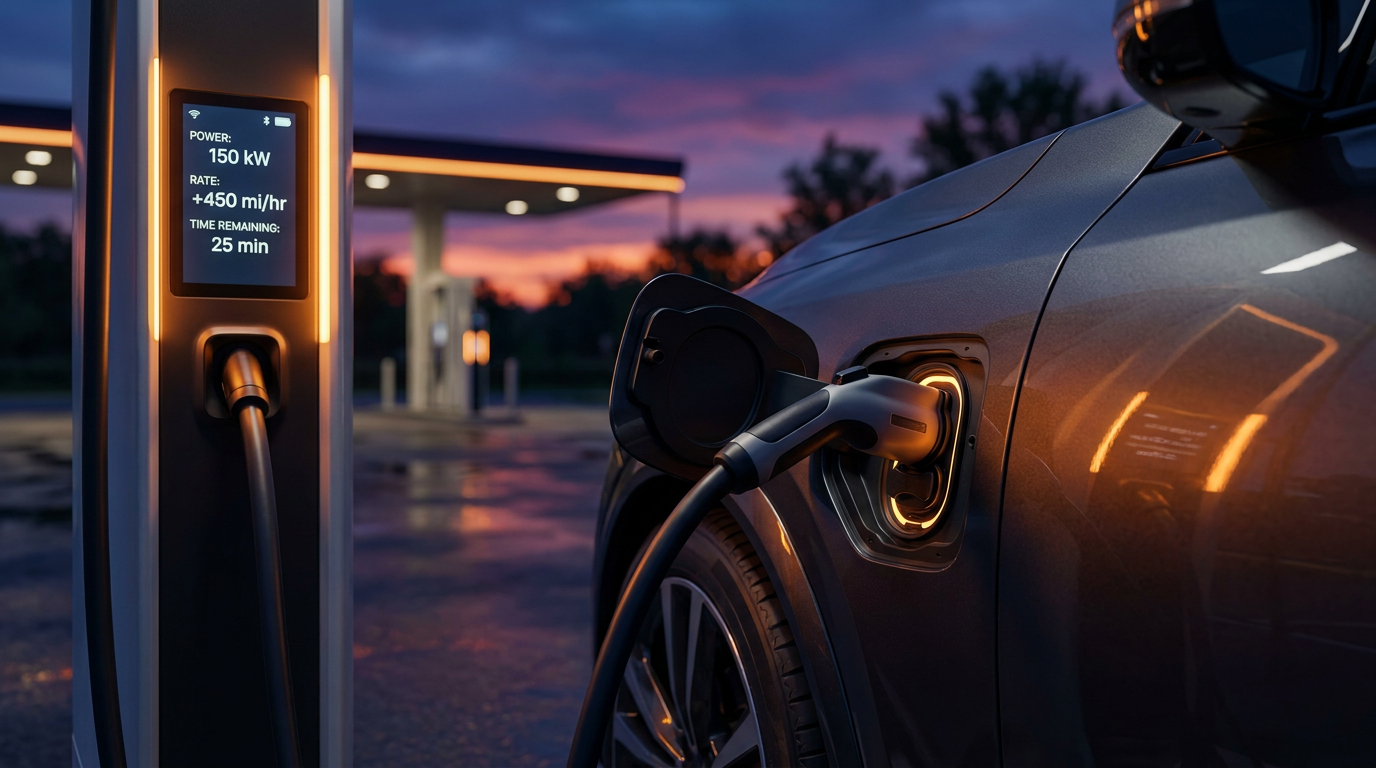
The plug war is officially over. By 2026, the North American Charging Standard (NACS) has achieved near-total market dominance, with virtually every major automaker abandoning the bulky Combined Charging System (CCS) in favor of Tesla’s sleek, unified connector. Drivers no longer need to filter charging maps by plug type or carry cumbersome adapters for daily use. Yet, while the physical connection has been standardized, a new battleground has emerged on dealership floors and dashboard displays. Consumers are now forced to navigate a confusing metric trade-off when evaluating charging speeds: evaluating a system by its peak kilowatt (kW) output versus its miles-per-hour (MPH) of range added.[6]
This distinction is not merely academic; it fundamentally alters how buyers shop for both vehicles and home charging equipment. Peak kW measures the raw electrical power flowing from the grid into the battery, representing the absolute capability of the hardware. Conversely, the miles-per-hour metric translates that raw power into actual driving utility, factoring in the vehicle's aerodynamic efficiency and weight. As the electric vehicle market matures beyond early adopters, understanding the explicit arguments for and against each metric is essential for avoiding expensive miscalculations.[1][2]
The primary argument for using peak kW as the gold standard is its unyielding objectivity. A kilowatt is a fixed unit of power; a 350 kW ultra-rapid public charger or an 11.5 kW Level 2 home wallbox delivers exactly what it promises, regardless of the vehicle attached to it. Hardware purists and infrastructure developers favor this metric because it isolates the charger's performance from the car's efficiency. When a consumer purchases a 19.2 kW home charger, they are buying a specific, measurable electrical capacity. The evidence supporting this approach is rooted in electrical engineering: power delivery is a constant, making kW the only reliable way to compare the hardware capabilities of different charging networks or home installations side-by-side.[4]
However, the argument against relying solely on peak kW is that it creates a massive blind spot regarding real-world utility. Raw power delivery ignores the vehicle's efficiency, which is measured in miles per kilowatt-hour (mi/kWh). The evidence of this flaw becomes glaringly obvious when comparing different vehicle classes. If a massive electric pickup truck and a highly aerodynamic electric sedan both plug into a 150 kW fast charger, they are receiving the exact same amount of energy. Yet, because the truck requires significantly more energy to move its mass, that 150 kW might only translate to 100 miles of range added in thirty minutes, while the sedan might gain over 200 miles in the same timeframe. Evaluating the charging experience purely by kW leaves the driver guessing about their actual time spent waiting.[2][5]

This discrepancy forms the core argument for the miles-per-hour (or miles-per-minute) metric. Pragmatists argue that drivers do not consume kilowatts; they consume miles. The case for this metric is that it directly answers the only question a driver actually cares about: how long until I can reach my destination? By synthesizing the charger's power output with the vehicle's specific efficiency, the miles-per-hour metric provides a highly practical, user-centric number. Evidence from consumer behavior studies shows that drivers planning road trips or calculating overnight home charging needs rely almost exclusively on mileage estimates. A dashboard displaying "adding 40 miles per hour" is immediately actionable, whereas "receiving 9.6 kW" requires mental gymnastics to interpret.[1]
The case against the miles-per-hour metric, however, is its inherent instability and susceptibility to marketing manipulation. Unlike a kilowatt, a "mile of range" is a moving target. The evidence against this metric lies in the variables that affect vehicle efficiency: ambient temperature, highway speeds, tire pressure, and cabin climate control all drastically alter how far a kilowatt-hour will take a car. Consumer advocates warn that automakers often advertise "up to 100 miles added in 10 minutes" based on ideal, laboratory-grade conditions that are rarely replicated in a freezing winter commute. Relying on miles-per-hour can set false expectations, as the metric fluctuates wildly depending on external factors that the charging hardware cannot control.[5][7]
The case against the miles-per-hour metric, however, is its inherent instability and susceptibility to marketing manipulation.
The tension between these two metrics is particularly evident in the 2026 home charging market. Following the NACS standardization, the market has seen a surge in high-capacity Level 2 chargers, specifically 80-amp units capable of delivering 19.2 kW. The peak kW metric suggests this is a massive upgrade over the standard 48-amp, 11.5 kW chargers. However, the miles-per-hour reality often tells a different story. Many compact and mid-sized electric vehicles feature onboard chargers capped at 11.5 kW. If a consumer installs a 19.2 kW wallbox for a vehicle with an 11.5 kW bottleneck, the extra capacity is entirely wasted. The peak kW metric sells an illusion of speed that the miles-per-hour reality quickly shatters.[3]

Furthermore, the charging curve of lithium-ion batteries complicates both metrics. Neither peak kW nor miles-per-hour remains constant throughout a charging session. As a battery approaches 80 percent capacity, the vehicle's battery management system intentionally throttles the incoming power to prevent overheating and degradation. A charger advertised with a peak of 250 kW might only deliver that speed for a few minutes when the battery is nearly empty, before dropping significantly. Consequently, an advertised "miles per hour" rate is usually an average or a peak snapshot, not a sustained reality. This evidence underscores why neither metric can be trusted as an absolute constant during a fast-charging session.[5]
Beyond the vehicle's aerodynamic efficiency, the physical size of the battery pack also heavily influences this trade-off. A larger battery pack can sustain a higher peak kW for a longer duration because the incoming thermal load is distributed across a greater number of individual cells. Consequently, a massive electric truck might hold a 150 kW charge rate deep into its charging cycle, whereas a smaller commuter car might have to throttle down to 50 kW much earlier to protect its smaller pack. This dynamic means that while the truck is less efficient per mile, its ability to absorb raw power longer complicates the miles-per-hour calculation during extended charging sessions.[1]
The ongoing transition to 800-volt vehicle architectures further muddies the waters. Vehicles equipped with 800-volt systems can theoretically accept ultra-rapid speeds of up to 350 kW, drastically reducing charging times. However, if an 800-volt vehicle plugs into a standard 400-volt fast charger, it must use an onboard converter to step up the voltage, which inherently results in energy loss and slower speeds. In this scenario, the peak kW advertised on the station's marquee is entirely disconnected from the reality of what the vehicle can actually process, making the miles-per-hour metric the only reliable indicator of progress.[5]

Recognizing this widespread consumer confusion, automakers are beginning to overhaul their software interfaces in 2026. Modern infotainment systems and companion smartphone apps increasingly allow drivers to toggle seamlessly between peak kW and miles-per-hour displays, or view them side-by-side. This software evolution acknowledges that neither metric is universally superior; rather, they serve different cognitive functions. Raw power satisfies the technical curiosity of ensuring the hardware is functioning correctly, while mileage satisfies the practical anxiety of reaching the next destination.[7]
Synthesizing these arguments reveals clear guidelines for when each metric fits well. The peak kW metric fits perfectly when a consumer is evaluating electrical infrastructure. It is the correct standard to use when hiring an electrician for a panel upgrade, comparing the specifications of two competing home wallboxes, or choosing between a 50 kW and a 150 kW public fast charger. It provides the objective baseline of what the grid can deliver. It does not fit well, however, when a driver is sitting in the cabin trying to determine if they have enough energy to reach the next city.[4][6]
Conversely, the miles-per-hour metric fits well when a consumer is cross-shopping different electric vehicles. By comparing the miles added per minute across different models plugged into the same kW charger, a buyer can accurately assess which vehicle is more aerodynamically and electrically efficient. It is also the ideal metric for daily route planning and understanding overnight charging needs. It does not fit well when evaluating the charging hardware itself, as a low miles-per-hour reading might be the fault of a heavy, inefficient vehicle rather than a defective or slow charging station.[1][2]
The 2026 NACS era has simplified the physical act of plugging in, but it demands a more sophisticated understanding of energy transfer. Ultimately, the trade-off between peak kW and miles-per-hour is a lesson in distinguishing between supply and demand. The charger supplies kilowatts; the driver demands miles. Recognizing that a high-kW charger cannot overcome the physics of an inefficient vehicle is the key to navigating the modern electric landscape. By applying the kW metric to hardware and the mileage metric to the vehicle, consumers can cut through the marketing noise and build a charging strategy that actually fits their daily lives.[7]
How we got here
Nov 2022
Tesla open-sources its proprietary connector, renaming it the North American Charging Standard (NACS).
May 2023
Ford becomes the first major legacy automaker to announce a transition to the NACS port.
2024 - 2025
Automakers begin rolling out NACS adapters to existing CCS vehicles, granting access to the Supercharger network.
2026
NACS becomes the native, factory-installed port on the vast majority of new electric vehicles in North America.
Viewpoints in depth
Hardware Purists
Evaluating charging strictly by electrical capacity.
This camp, heavily populated by electricians, infrastructure developers, and hardware reviewers, argues that peak kW is the only metric that doesn't lie. Because vehicle efficiency varies wildly based on temperature, speed, and payload, they maintain that rating a charger by 'miles per hour' is fundamentally deceptive. To them, a 19.2 kW wallbox is objectively superior to an 11.5 kW unit because it delivers more raw energy, regardless of whether the specific car plugged into it can utilize that full capacity.
Utility Pragmatists
Evaluating charging by actual driving range gained.
Pragmatists argue that raw electrical power is meaningless to the average driver. They point out that a massive electric truck pulling 150 kW might only gain 100 miles of range in a session, while an aerodynamic sedan pulling the same 150 kW could gain over 200 miles. Therefore, they advocate for miles-per-hour as the ultimate equalizer. This perspective emphasizes that the true speed of a charging session is dictated by the vehicle's efficiency (mi/kWh), making mileage the only metric that accurately reflects the user's wait time.
Consumer Advocates
Focusing on transparency and the reality of the charging curve.
Consumer protection groups and industry watchdogs warn that both metrics are routinely weaponized in marketing. They highlight that 'peak kW' is often only achieved for a few minutes when the battery is nearly empty, while 'miles per hour' claims are frequently based on laboratory conditions that ignore winter weather or highway speeds. This camp pushes for standardized, real-world charging curves to be displayed on window stickers, arguing that single-number metrics fail to capture the nuance of battery management systems throttling power past 80 percent state-of-charge.
What we don't know
- Whether regulators will eventually mandate a standardized 'real-world' charging speed metric on vehicle window stickers.
- How the widespread deployment of 800-volt architectures will shift the baseline expectations for peak kW across budget EV models.
- To what extent public charging networks will upgrade their legacy hardware to consistently deliver the peak kW speeds advertised on their apps.
Key terms
- NACS (North American Charging Standard)
- The unified charging connector originally developed by Tesla, now adopted by nearly all major automakers for North American EVs.
- Peak kW (Kilowatt)
- The maximum amount of raw electrical power a charging station can deliver or a vehicle can accept at any given moment.
- Miles per Kilowatt-Hour (mi/kWh)
- The standard measure of an electric vehicle's efficiency, similar to miles per gallon (MPG) in a gas car.
- Onboard Charger
- The internal hardware in an EV that converts AC power from a home wallbox into DC power to store in the battery, which often acts as a speed bottleneck.
- Charging Curve
- The graph showing how a vehicle's charging speed fluctuates over time, typically peaking when the battery is low and slowing down as it fills.
Frequently asked
Why is my car charging slower than the charger's peak kW?
Your vehicle's battery management system controls the flow of power. It will throttle the speed based on the battery's current state of charge (slowing down significantly after 80%), the ambient temperature, or the maximum limit of your car's onboard charger.
Is it worth paying more for a 19.2 kW home charger?
Only if your specific vehicle has an onboard charger capable of accepting 19.2 kW (like certain heavy electric trucks). Most standard EVs are capped at 11.5 kW for AC home charging, meaning the extra capacity of a 19.2 kW unit would go unused.
Does the NACS plug itself make charging faster?
No. The NACS plug is simply the physical connector. The actual charging speed is determined by the electrical output of the station and the maximum acceptance rate of the vehicle's battery.
How does cold weather affect the miles-per-hour metric?
Cold weather reduces the chemical efficiency of the battery and requires energy to heat the cabin, which lowers your miles per kilowatt-hour (mi/kWh). Consequently, the same kW of power will result in fewer miles of range added per hour.
Sources
Source coverage
7 outlets
3 viewpoints surfaced







[1]ev.guideUtility Pragmatists
EV Charging Speeds Explained: kW vs. Miles Per Hour
Read on ev.guide →[2]AAAUtility Pragmatists
Understanding EV charging speeds and metrics
Read on AAA →[3]MotorWattHardware Purists
The Fastest Home EV Chargers in 2026, Ranked
Read on MotorWatt →[4]ElectricpointHardware Purists
How does kW rating relate to EV charging speed?
Read on Electricpoint →[5]Green Energy ConsumersConsumer Advocates
Comparing EV Charging Speeds: What You Need to Know
Read on Green Energy Consumers →[6]QmeritHardware Purists
The Transition to NACS and the Future of EV Charging
Read on Qmerit →[7]Factlen Editorial TeamConsumer Advocates
Synthesis by Factlen editorial team
Read on Factlen Editorial Team →

Every angle. Every day.
Get shopping stories with full source coverage and perspective breakdowns delivered to your inbox.