
Meta Quest 3 vs. Apple Vision Pro: The Complete 2026 Buyer's Guide
A comprehensive trade-off analysis of the mixed reality landscape, comparing Apple's premium spatial computing vision against Meta's accessible, gaming-first ecosystem.
By Factlen Editorial Team
- Mainstream VR Enthusiasts
- Prioritizes accessible pricing, massive gaming libraries, and wireless freedom for active movement.
- Spatial Computing Professionals
- Values absolute visual fidelity, seamless ecosystem integration, and advanced eye-tracking for productivity.
- Enterprise Deployers
- Focuses on the return on investment, device management, and specific use cases like architectural visualization or employee training.
What's not represented
- · Budget-constrained students
- · Accessibility advocates for motor-impaired users
Why this matters
Choosing the right mixed reality headset dictates whether you are investing in a high-end productivity tool or an accessible entertainment console. Understanding the stark trade-offs between Apple and Meta's approaches ensures you don't waste thousands of dollars on hardware that doesn't fit your daily needs.
Key points
- The $3,499 Apple Vision Pro targets professionals with unmatched 4K micro-OLED visual fidelity and seamless macOS integration.
- The $499 Meta Quest 3 dominates the consumer market with a massive gaming library, wireless freedom, and tactile controllers.
- Apple's controller-free eye and hand tracking feels futuristic but lacks the haptic feedback necessary for fast-paced gaming.
- Both headsets struggle with out-of-the-box comfort; Apple is front-heavy with an external battery, while Meta's default strap lacks support.
- Enterprise buyers are splitting: Vision Pro for high-end architectural visualization, and Quest 3 for scalable employee training.
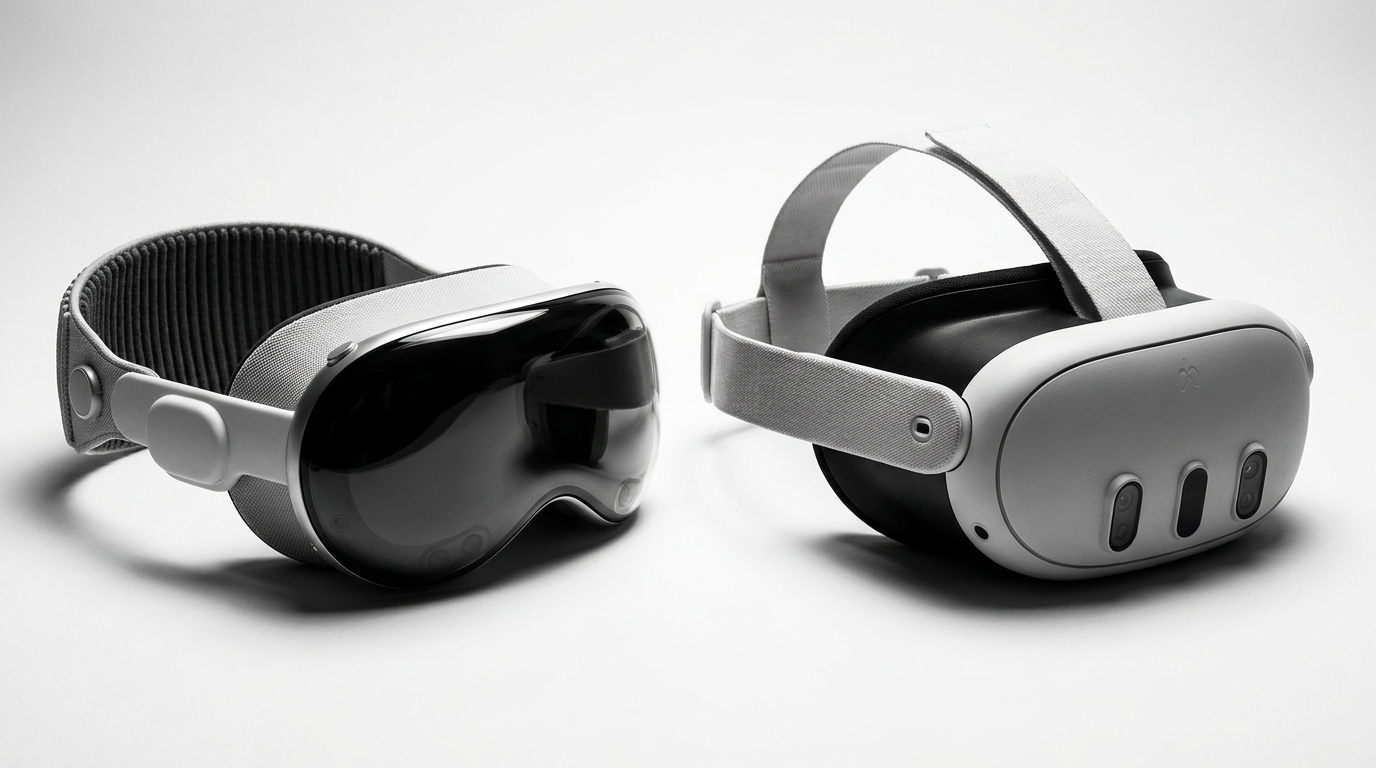
The mixed reality landscape of 2026 is defined by a stark divergence in philosophy, perfectly encapsulated by the industry's two dominant headsets: the Apple Vision Pro and the Meta Quest 3. Rather than competing directly on identical features, these devices represent entirely different visions for the future of spatial computing. Apple has engineered a premium, tethered powerhouse aimed at professionals and early adopters, while Meta has refined its standalone, wireless architecture to capture the mass market. For buyers navigating this space, the decision is rarely about which headset is objectively superior, but rather which set of compromises aligns with their specific daily workflows, entertainment habits, and budget constraints.[1][2]
When evaluating the Apple Vision Pro, the trade-offs are stark. **For:** The device delivers an unparalleled spatial computing experience, driven by seamless integration with the broader Apple ecosystem and groundbreaking eye-tracking interfaces. **Against:** The prohibitive $3,499 entry price and a front-heavy 650-gram design make it inaccessible and occasionally uncomfortable for extended daily use. **Evidence:** Hardware teardowns and technical specifications confirm the inclusion of dual micro-OLED displays pushing 23 million pixels, alongside the M2 and R1 dual-chip architecture, which justifies the premium cost but fundamentally limits its mass-market viability.[2][8]
Conversely, the Meta Quest 3 presents a radically different value proposition. **For:** It offers exceptional wireless freedom, a massive library of standalone applications, and highly capable full-color mixed reality at an accessible $499 price point. **Against:** The LCD panels cannot match the absolute black levels or text clarity of micro-OLEDs, and the default fabric head strap often requires a third-party upgrade for long-term comfort. **Evidence:** The headset utilizes a single Snapdragon XR2 Gen 2 chip and pancake lenses to deliver a 2064 by 2208 pixel-per-eye resolution, keeping the overall weight to a balanced 515 grams with an internal battery.[1][3]

The most immediate differentiator between the two platforms is visual fidelity. The Vision Pro’s micro-OLED screens provide roughly 4K resolution per eye, effectively eliminating the screen door effect that has long plagued virtual reality. This pixel density allows professionals to read fine text in virtual multi-monitor setups without eye strain, making it a genuine laptop replacement for specific tasks. The Quest 3, while a massive leap over its predecessor, relies on LCD technology. It delivers bright, colorful images that are more than sufficient for gaming and casual media consumption, but it falls short of the razor-sharp clarity required for intensive, text-heavy productivity.[4][5]
Mixed reality passthrough—the ability to see the physical world through the headset's cameras—is a core feature of both devices, yet they handle it differently. Apple achieves a remarkably low 6.5-millisecond latency, creating a passthrough experience that feels nearly instantaneous and highly realistic, though it can struggle slightly with motion blur in low light. Meta’s passthrough is fully colorized and depth-correct, allowing users to confidently walk around their homes or interact with physical objects. While the Quest 3's camera feed is noticeably grainier than Apple's, it is highly functional for fitness apps and augmented reality games that blend digital elements with the user's living room.[6][8]
Mixed reality passthrough—the ability to see the physical world through the headset's cameras—is a core feature of both devices, yet they handle it differently.
Interaction paradigms further separate the two ecosystems. Apple has entirely discarded physical controllers, relying instead on a sophisticated array of internal and external cameras to track the user's eyes and hands. Navigating visionOS simply requires looking at an icon and pinching two fingers together—a magical, intuitive interface that feels like the future of computing. Meta, while continuously improving its own hand-tracking capabilities, still relies heavily on its Touch Plus controllers. These controllers provide crucial haptic feedback and sub-millimeter precision, which remains absolutely essential for fast-paced gaming, virtual sports, and complex 3D modeling.[4][7]
Ergonomics and physical comfort remain the most significant hurdles for extended reality adoption. Apple opted for premium materials—custom aluminum alloys and laminated glass—which look spectacular but result in a front-heavy device. Even with the external battery pack moving weight off the head, many users find the Vision Pro fatiguing after an hour of use. Meta’s approach utilizes lightweight plastics and houses the battery within the visor itself. While the Quest 3 is lighter at 515 grams, its default strap places pressure on the temples, leading many buyers to invest in rigid aftermarket straps to achieve the comfort necessary for two-hour movie viewings or prolonged gaming sessions.[2][6]

Software ecosystems ultimately dictate the long-term utility of these headsets. visionOS was built from the ground up for spatial computing, offering native integration with iOS and macOS apps, persistent 3D windows, and a growing library of high-end productivity tools. However, its gaming library remains sparse, relying mostly on flat Apple Arcade titles. Meta’s Horizon OS benefits from years of dedicated virtual reality development, boasting thousands of immersive games, fitness applications, and social platforms. For pure entertainment value, the Quest ecosystem is currently unmatched, while Apple dominates the productivity and media consumption categories.[5][6]
Audio delivery and connectivity options also highlight the differing priorities of the two tech giants. Apple utilizes personalized spatial audio pods integrated directly into the headband, utilizing head tracking and ear scanning to create a deeply immersive, customized soundscape that rivals high-end headphones. The Vision Pro, however, lacks physical ports, relying entirely on wireless connections and a proprietary magnetic power cable. The Quest 3 features improved near-field speakers built into its side straps, which deliver surprisingly robust sound for gaming, though audiophiles will appreciate the inclusion of Bluetooth 5.2 and a versatile USB-C port that allows for wired PC connections and third-party audio accessories.[3][7]
In the enterprise sector, the divide is equally clear. Architecture firms, high-end real estate developers, and medical training facilities are increasingly adopting the Vision Pro. The ability to showcase a luxury pre-construction condo with photorealistic textures and perfect lighting justifies the $3,499 investment for a sales gallery. Meanwhile, the Quest 3 is becoming the standard for scalable corporate deployments. When a logistics company needs to train five hundred warehouse employees simultaneously, the $499 price point and robust mobile device management tools make Meta's hardware the only logical choice.[5][8]

Ultimately, choosing between these platforms requires matching the hardware to the specific use case. **Apple Vision Pro fits well when:** The user is a creative professional, software developer, or enterprise client who requires absolute visual fidelity, pixel-perfect text rendering for virtual multi-monitor setups, and native integration with macOS workflows. **It does not fit when:** The primary goal is high-movement fitness, extensive virtual reality gaming, or deploying dozens of headsets across a budget-conscious classroom or training facility.[2][5]
**Meta Quest 3 fits well when:** The buyer wants a highly versatile, wire-free headset for interactive gaming, social virtual reality, and casual mixed reality experiences without a massive financial commitment. **It does not fit when:** The user needs to read fine text for eight hours a day, requires advanced eye-tracking for accessibility, or demands the premium aluminum-and-glass aesthetic that defines high-end enterprise deployments. By understanding these boundaries, buyers can invest in the platform that actually serves their daily reality.[1][6]
How we got here
June 2023
Apple unveils the Vision Pro at WWDC, introducing the concept of spatial computing to the public.
October 2023
Meta Quest 3 launches globally at $499, quickly dominating the consumer VR market.
February 2024
Apple Vision Pro officially launches in the United States at $3,499, targeting early adopters and professionals.
Early 2026
Both ecosystems see significant software maturity, with visionOS expanding its enterprise apps and Horizon OS dominating gaming.
Viewpoints in depth
Apple's Spatial Computing Vision
The argument that headsets should be premium, tethered extensions of traditional computing.
Proponents of Apple's approach argue that the industry has been held back by underpowered, low-resolution hardware. By prioritizing micro-OLED displays and eye-tracking over battery life and price, Apple aims to create a device that can legitimately replace a laptop for knowledge workers. This camp believes that once developers build out the visionOS ecosystem, the high entry price will be justified by the sheer productivity gains of infinite virtual workspaces.
Meta's Accessible Reality
The argument that mixed reality must be affordable, wireless, and gaming-first to reach mass adoption.
Advocates for Meta's strategy emphasize that virtual reality is inherently an active, physical medium. They argue that tethering a user to a battery pack and eliminating tactile controllers fundamentally misunderstands how people want to use headsets. By subsidizing the hardware to hit a $499 price point, Meta ensures a massive install base, which in turn attracts game developers and creates a sustainable, profitable ecosystem that premium devices struggle to match.
What we don't know
- Whether Apple will release a cheaper, non-Pro Vision headset to compete more directly with Meta's pricing.
- How quickly third-party developers will port complex, controller-based VR games to Apple's hand-tracking ecosystem.
- The long-term health effects of wearing heavy mixed-reality headsets for full eight-hour workdays.
Key terms
- Passthrough
- The ability to see the real physical world through a VR headset using exterior cameras.
- Micro-OLED
- An advanced display technology that packs millions of pixels into a tiny screen, offering perfect black levels and extreme clarity.
- Pancake Lenses
- A type of optical lens that folds light multiple times, allowing VR headsets to be significantly thinner and lighter than older models.
- Spatial Computing
- Apple's preferred term for mixed reality, emphasizing the integration of digital interfaces into physical space rather than just gaming.
- Screen Door Effect
- A visual artifact in older VR headsets where the unlit spaces between pixels are visible, looking like a mesh screen.
Frequently asked
Can I use the Meta Quest 3 for work and productivity?
Yes, the Quest 3 supports virtual desktop applications and basic web browsing. However, its LCD screens are not sharp enough for comfortable, all-day text reading compared to the Vision Pro.
Does the Apple Vision Pro come with controllers?
No, the Vision Pro relies entirely on eye-tracking, hand gestures, and voice commands for navigation, though it supports standard Bluetooth gamepads for traditional gaming.
Which headset is better for wearing glasses?
The Vision Pro requires custom Zeiss optical inserts that magnetically attach to the lenses. The Quest 3 has an adjustable depth spacer that allows most standard glasses to fit comfortably inside the headset.
Is the Vision Pro's battery built into the headset?
No, the Vision Pro uses an external aluminum battery pack connected via a braided cable, which users typically keep in a pocket to reduce the weight on their head.
Sources
Source coverage
8 outlets
3 viewpoints surfaced








[1]Laptop MagMainstream VR Enthusiasts
Meta Quest 3 vs Apple Vision Pro: Mismatch or close fight?
Read on Laptop Mag →[2]Pocket-lintSpatial Computing Professionals
Apple Vision Pro vs. Meta Quest 3: What's the difference?
Read on Pocket-lint →[3]VRcompareMainstream VR Enthusiasts
Meta Quest 3 vs Apple Vision Pro (Comparison)
Read on VRcompare →[4]AutoVRseMainstream VR Enthusiasts
Meta Quest 3 vs Apple Vision Pro: Which is Better in 2025?
Read on AutoVRse →[5]Rice UniversitySpatial Computing Professionals
Apple Vision Pro Vs Meta Quest 3: What U.S. Users Need to Know
Read on Rice University →[6]NomtekEnterprise Deployers
Giants of the Virtual Frontier: Apple Vision Pro vs. Meta Quest 3
Read on Nomtek →[7]Prelaunch BlogSpatial Computing Professionals
Apple Vision Pro vs Meta Quest 3: My Verdict After Extensive Research
Read on Prelaunch Blog →[8]R2UEnterprise Deployers
Apple Vision Pro vs Meta Quest for Real Estate (2026)
Read on R2U →

Every angle. Every day.
Get meta stories with full source coverage and perspective breakdowns delivered to your inbox.