
Meta Quest 3 vs. Apple Vision Pro: The 2026 Spatial Computing Comparison
A comprehensive breakdown of the $499 Meta Quest 3 and the $3,499 Apple Vision Pro, comparing display fidelity, productivity features, and gaming ecosystems to determine which headset fits your needs.
By Factlen Editorial Team
- Spatial Computing Advocates
- Argues that the Vision Pro's micro-OLED displays and seamless Mac integration justify the premium price, viewing it as the future of professional workspaces.
- VR Gaming Enthusiasts
- Maintains that physical controllers and a massive standalone game library are non-negotiable for immersive virtual reality, making the Quest 3 the superior entertainment device.
- Value-Conscious Consumers
- Emphasizes that the Quest 3 delivers 80-90% of the core mixed-reality experience for 15% of the cost, rendering the Vision Pro an impractical luxury for the average buyer.
What's not represented
- · Enterprise IT Managers deploying headsets at scale
- · Developers building cross-platform mixed reality apps
Why this matters
Choosing the right mixed-reality headset dictates whether you are buying a dedicated gaming console or a high-end productivity workstation. Understanding the massive price and feature gap prevents consumers from wasting thousands of dollars on hardware that doesn't fit their actual daily needs.
Key points
- The Meta Quest 3 offers 80-90% of the core mixed-reality experience for a fraction of the Vision Pro's cost.
- Apple's Vision Pro features unparalleled Micro-OLED displays, making it the superior choice for media consumption and Mac-based productivity.
- The Quest 3 dominates the gaming and fitness sectors due to its massive standalone library and physical Touch Plus controllers.
- Vision Pro relies entirely on eye and hand tracking, while the Quest 3 utilizes both physical controllers and hand tracking.
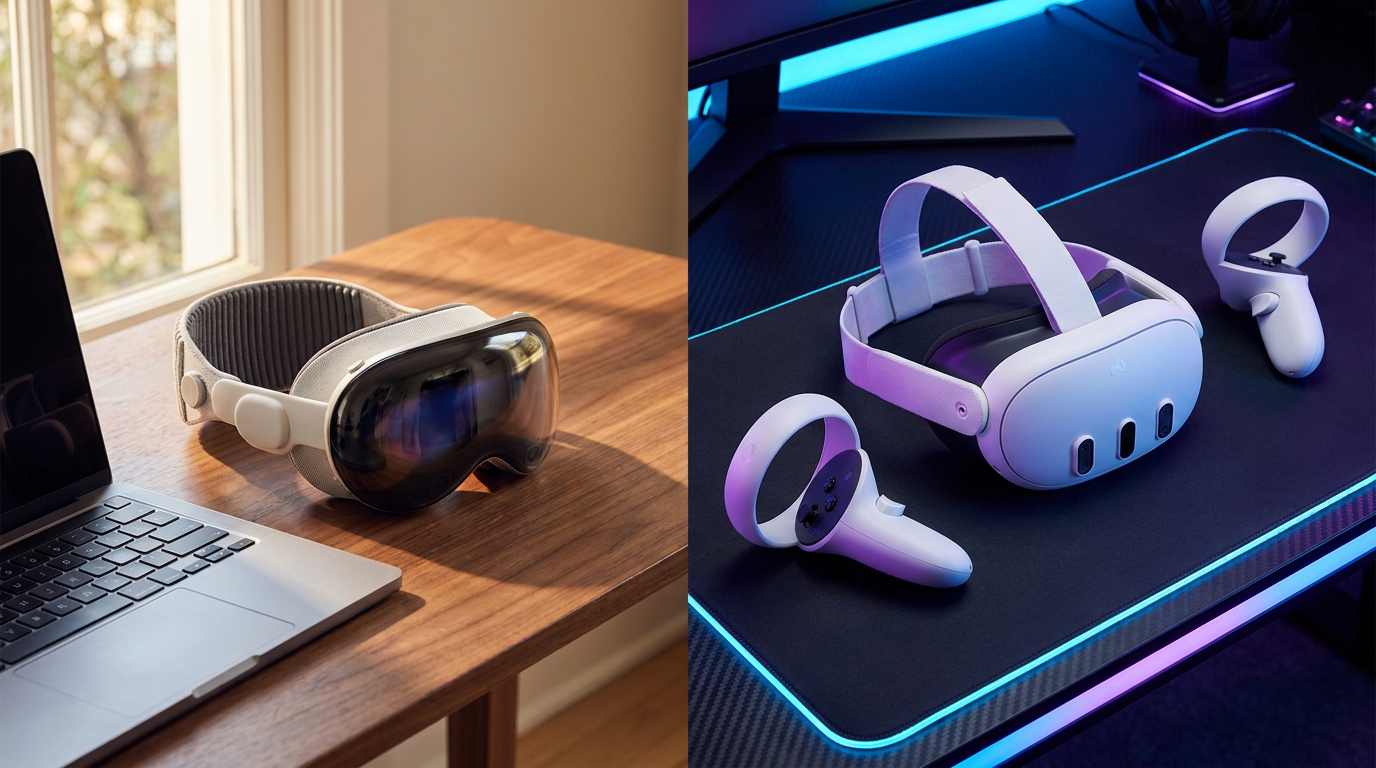
The spatial computing landscape of 2026 is defined by a massive philosophical and financial divide. On one end sits the Meta Quest 3, a $499 standalone headset that has cemented its status as the undisputed king of accessible virtual reality. On the other end is the Apple Vision Pro, a $3,499 spatial computer engineered to blend digital workspaces with the physical world. While both devices utilize high-quality color passthrough to overlay virtual content onto reality, they target entirely different user bases. The decision between the two is no longer just about budget; it is a fundamental choice between a gaming-first ecosystem and a premium productivity platform.[1][3]
The most immediate point of contrast is the staggering price gap. At $3,499, the Vision Pro demands a 700 percent premium over the base 128GB Meta Quest 3. Industry analysts point out that for the cost of a single Apple headset, a consumer could outfit an entire family with Quest 3 units and premium accessories. This pricing places the Vision Pro firmly in the category of professional equipment or luxury tech, competing more with high-end MacBooks than with traditional gaming consoles. Conversely, the Quest 3 provides roughly 80 to 90 percent of the core mixed-reality experience for a fraction of the cost, making it the default entry point for the mainstream market.[1][4]

When evaluating visual fidelity, the evidence heavily favors Apple's engineering. The Vision Pro utilizes dual Micro-OLED displays pushing approximately 3,600 by 3,200 pixels per eye, totaling 23 million pixels across both panels. This translates to an incredibly dense pixel structure that eliminates the screen door effect entirely, allowing users to read physical smartphone screens or fine text with crystal clarity. The Quest 3 relies on LCD panels with pancake lenses, delivering 2,064 by 2,208 pixels per eye. While the Quest 3 represents a massive leap over its predecessors, its black levels appear slightly gray in dark scenes, and the visual sharpness cannot compete with Apple's Micro-OLED technology.[2][4][5][6]
This display disparity directly impacts the quality of mixed reality passthrough. The Vision Pro achieves roughly 34 pixels per degree in passthrough mode, creating an illusion that is remarkably close to looking through clear glass, albeit with slight motion blur in low light. The Quest 3 operates at about 18 pixels per degree. While Meta's color passthrough is highly functional for navigating a room or playing mixed-reality games, it exhibits noticeable grain and minor warping around moving objects. For users demanding true-to-life visual replication and private-cinema movie viewing, the Vision Pro stands uncontested.[1][2][4]

Processing power and multitasking capabilities further separate the two devices. Apple equips the Vision Pro with laptop-class silicon—pairing the M-series processor with a dedicated R1 chip to handle real-time sensor data with virtually zero latency. This dual-chip architecture allows for seamless spatial productivity, enabling users to anchor multiple floating 4K monitors in their physical space without stuttering. The Quest 3 utilizes the Snapdragon XR2 Gen 2 chip, which delivers exceptional performance for a mobile VR headset but cannot match Apple's silicon for heavy, concurrent multitasking.[2][4][5][6]
Processing power and multitasking capabilities further separate the two devices.
In practical productivity workflows, the Vision Pro acts as a genuine workstation multiplier. Users can wirelessly mirror their Mac displays, expanding a single laptop screen into a massive, color-accurate virtual canvas while simultaneously running native visionOS applications alongside it. The Quest 3 offers productivity solutions through apps like Immersed and Meta Horizon Workrooms, allowing for virtual desktop streaming. However, the lower display resolution and less robust multitasking OS make the Quest 3 better suited for secondary, short-term tasks rather than replacing a primary full-time workstation.[1][4]
The control paradigms reveal a stark contrast in design philosophy. Apple famously discarded traditional controllers in favor of a revolutionary eye-and-hand tracking system. Users navigate the visionOS interface simply by looking at elements and pinching their fingers, a method that feels distinctly futuristic and intuitive for media consumption, web browsing, and spatial UI navigation. However, this controller-free approach struggles with applications requiring rapid, tactile precision. Meta retained physical Touch Plus controllers for the Quest 3, supplemented by its own continuously improving hand-tracking software.[2][4]

For serious gaming, fitness applications, and tasks requiring haptic feedback, physical controllers remain vastly superior, giving the Quest 3 a definitive edge in interactive entertainment. Meta has spent years cultivating a massive library of standalone VR games, fitness applications like Supernatural, and social experiences like VRChat. Furthermore, the Quest 3 can connect wirelessly to a PC via Air Link or Steam Link to play high-end PC VR titles like Half-Life: Alyx. Apple's visionOS, while growing, still lacks a robust gaming library, focusing instead on spatial media, immersive video, and seamless integration with the broader Apple ecosystem.[1][3][4]
Comfort and ergonomics present a complex trade-off for both headsets. The Vision Pro's premium aluminum and glass construction looks spectacular but results in a front-heavy device weighing roughly 650 grams. Many users report neck fatigue after extended use, and the device relies on a tethered external battery pack that provides about two hours of runtime. The Quest 3 opts for a lighter, 515-gram plastic chassis with a built-in battery lasting two to three hours. While the Quest 3 is more balanced for active, standing sessions, serious users often find it necessary to purchase aftermarket head straps with counter-weights to achieve optimal long-term comfort.[2][4]
The onboarding and ecosystem requirements also differ significantly. The Quest 3 requires a Meta account, tying the user into Meta's social and data ecosystem, which remains a point of friction for privacy-conscious consumers. The Vision Pro integrates seamlessly into the Apple ecosystem, requiring an Apple ID and utilizing Optic ID for biometric security. For users already invested in iPhones, iPads, and Macs, the Vision Pro acts as a natural, albeit expensive, extension of their existing digital life, allowing for shared clipboards, AirDrop, and native FaceTime integration.[1][2]

Ultimately, the Meta Quest 3 fits well when a user wants a versatile, entertainment-focused device for gaming, virtual fitness, and casual mixed reality without breaking the bank. It is the definitive choice for anyone looking to play VR games, enter social VR spaces, or experience wireless PC VR. It does not fit well for users seeking a full laptop replacement, those who demand the absolute highest visual fidelity for professional design work, or users who want to seamlessly extend their Mac workflow into a spatial environment.[1][3][4]
Conversely, the Apple Vision Pro fits well when a user is deeply embedded in the Apple ecosystem, requires a portable spatial computing workstation with multiple massive virtual monitors, and has the budget to support early-adopter premium hardware. It excels as a private, high-resolution theater and a productivity multiplier for remote workers and creatives. It does not fit well when the primary goal is active gaming, when the user is on a strict budget, or when tethered external batteries and front-heavy ergonomics are dealbreakers for daily use.[1][2][4]
How we got here
June 2023
Apple officially announces the Vision Pro, introducing the term 'spatial computing' to the mainstream.
October 2023
Meta releases the Quest 3, bringing high-quality color passthrough to the consumer market at $499.
February 2024
Apple Vision Pro launches in the United States, establishing a new premium tier for mixed reality headsets.
Mid 2026
The market solidifies into two distinct camps: affordable gaming VR versus premium spatial productivity.
Viewpoints in depth
Spatial Computing Advocates
Argues that the Vision Pro's micro-OLED displays and seamless Mac integration justify the premium price.
This camp views the Vision Pro not as an expensive gaming console, but as the inevitable future of professional workspaces. They point out that a multi-monitor setup with color-accurate 4K displays can easily cost thousands of dollars, making the Vision Pro a legitimate, portable alternative for creatives and remote workers. For these users, the true black levels of the Micro-OLED screens and the seamless integration with the broader Apple ecosystem make the $3,499 price tag a worthwhile investment in productivity.
VR Gaming Enthusiasts
Maintains that physical controllers and a massive standalone game library are non-negotiable for immersive virtual reality.
Gaming purists argue that Apple's controller-free approach fundamentally misunderstands how users interact with virtual environments. They emphasize that without tactile haptic feedback and sub-millimeter tracking precision, serious gaming is impossible. This camp champions the Quest 3 as the ultimate entertainment device, pointing to its massive library of native titles, its ability to connect to high-end PC VR rigs, and its active modding community as evidence that Meta truly understands the VR consumer.
Value-Conscious Consumers
Emphasizes that the Quest 3 delivers the vast majority of the mixed-reality experience for a fraction of the cost.
This perspective focuses purely on the price-to-performance ratio. They argue that while the Vision Pro's displays are undeniably superior, they are not seven times better than the Quest 3's LCD panels. For the average consumer looking to watch a movie on a virtual screen, play a quick fitness game, or try out mixed reality, the Quest 3 provides 80 to 90 percent of the utility for just 15 percent of the cost, rendering the Vision Pro an impractical luxury.
What we don't know
- How quickly Apple will be able to reduce the weight and cost of future Vision models to appeal to a broader consumer base.
- Whether Meta's upcoming software updates can bridge the multitasking and productivity gap with visionOS.
Key terms
- Spatial Computing
- A paradigm where digital content is blended with the physical world, allowing users to interact with virtual interfaces while remaining aware of their surroundings.
- Passthrough
- A feature that uses external cameras on a headset to display the real world on the internal screens, enabling mixed reality experiences.
- Micro-OLED
- An advanced display technology used in the Vision Pro that provides extremely high pixel density and true black levels by turning off individual pixels.
- Inside-out Tracking
- A system where the headset uses its own built-in cameras to track the user's head and hand movements without needing external sensors placed around the room.
- Pancake Lenses
- A type of optical lens used in modern headsets like the Quest 3 that folds light to allow for a thinner, lighter headset design compared to older Fresnel lenses.
Frequently asked
Can the Meta Quest 3 connect to a Mac or PC for work?
Yes, the Quest 3 supports virtual desktop applications for both Mac and PC, though the text clarity and seamlessness do not match the Vision Pro's native Mac mirroring.
Does the Apple Vision Pro have VR games?
While it supports some spatial games and Apple Arcade titles, it lacks the dedicated VR gaming library and physical controllers that make the Quest 3 a gaming powerhouse.
Which headset is better for watching movies?
The Apple Vision Pro is significantly better for media consumption due to its micro-OLED displays, which provide true blacks and a private-cinema experience.
Do I need external sensors for either headset?
No, both the Meta Quest 3 and Apple Vision Pro use inside-out tracking, meaning all cameras and sensors are built directly into the headsets.
Sources
Source coverage
6 outlets
3 viewpoints surfaced






[1]Reality AtlasValue-Conscious Consumers
Meta Quest 3 vs Apple Vision Pro: 2026 Comparison
Read on Reality Atlas →[2]VR EddieValue-Conscious Consumers
Apple Vision Pro (M5) vs Meta Quest 3 (2026): Specs, Price & Verdict
Read on VR Eddie →[3]VR.orgVR Gaming Enthusiasts
Best VR Headsets 2026: Buyer's Guide & Comparison
Read on VR.org →[4]Tech VibesSpatial Computing Advocates
Apple Vision Pro vs Meta Quest 3 | Full Comparison, Price, Features & Performance
Read on Tech Vibes →[5]Apple NewsroomSpatial Computing Advocates
Apple Vision Pro available in the U.S.
Read on Apple Newsroom →[6]Meta Quest BlogVR Gaming Enthusiasts
Meta Quest 3: The New Standard for Mixed Reality
Read on Meta Quest Blog →

Every angle. Every day.
Get meta stories with full source coverage and perspective breakdowns delivered to your inbox.