
Meta Quest 3 vs. Apple Vision Pro: The 2026 Mixed Reality Buyer's Guide
As mixed reality matures in 2026, the choice between Meta's accessible Quest 3 and Apple's premium Vision Pro comes down to a stark divide between gaming value and spatial computing power.
By Factlen Editorial Team
- Mainstream VR Gamers
- Users who prioritize affordability, tactile feedback, and a vast library of interactive content.
- Spatial Computing Purists
- Users who prioritize display fidelity, ecosystem integration, and productivity over gaming.
- Commercial Integrators
- Enterprise buyers deploying headsets for client presentations, training, and sales.
What's not represented
- · Educators deploying VR in underfunded public school systems
- · Independent VR game developers struggling to optimize for both controller and hand-tracking inputs
Why this matters
Choosing the right mixed reality headset dictates whether you are buying into a gaming console or a spatial computer. With a $3,000 price gap between the leading options, understanding these trade-offs prevents costly buyer's remorse and ensures the hardware actually matches your daily workflow.
Key points
- The Meta Quest 3 offers the best value for gaming and fitness at $499.
- The Apple Vision Pro excels in display clarity and Mac integration, starting at $3,499.
- Apple's micro-OLED displays eliminate the screen door effect and render crisp text.
- Meta's inclusion of motion controllers makes it the only viable choice for traditional VR gaming.
- The newly released $299 Quest 3S provides a budget entry point with the same processor as the Quest 3.
- Enterprise users favor the Vision Pro for its low-latency, high-fidelity passthrough.
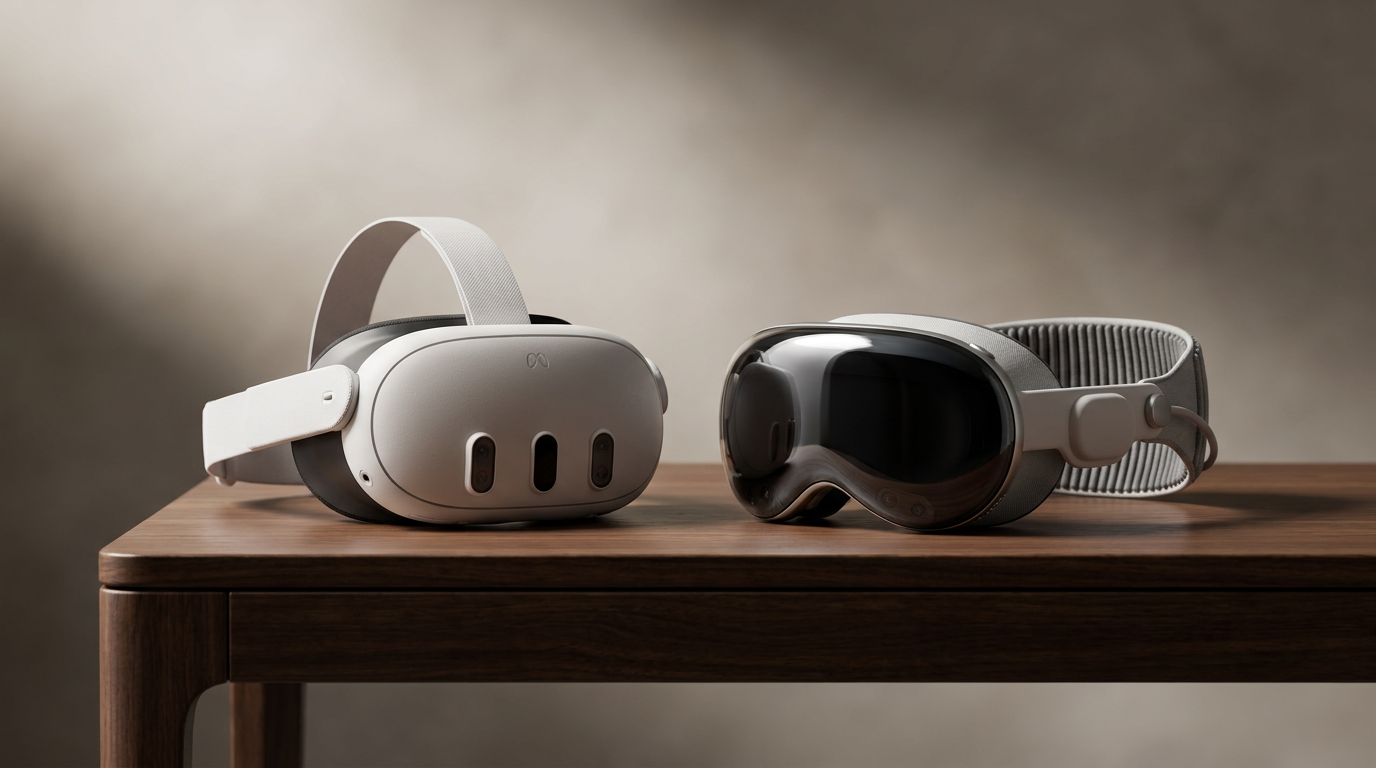
The era of isolating virtual reality has given way to mixed reality, where digital interfaces seamlessly blend with the physical world. At the forefront of this shift are two devices that represent fundamentally different philosophies: the Meta Quest 3 and the Apple Vision Pro. While both headsets utilize external cameras to pass the real world through to the user's eyes, they target entirely different demographics. Meta has doubled down on accessible, controller-based gaming and fitness, while Apple has pioneered what it calls spatial computing—a premium, controller-free extension of the Mac and iOS ecosystems.[1][4]
The most immediate point of comparison is the staggering price disparity. The Meta Quest 3 starts at an accessible $499 for the 128GB model, positioning it as a mass-market consumer electronics device. In stark contrast, the Apple Vision Pro commands a starting price of $3,499, placing it firmly in the realm of professional workstations and luxury early-adopter tech. This seven-fold price difference is not merely an Apple tax; it reflects a massive divergence in component costs, build materials, and intended use cases. For buyers in 2026, the decision rarely comes down to which headset is objectively better, but rather which device's compromises align with their specific needs and budget.[4][6]
When evaluating the arguments for the Apple Vision Pro, the most compelling evidence lies in its visual fidelity. Apple equipped the headset with micro-OLED displays that pack 23 million pixels across both eyes, effectively delivering a 4K-plus resolution per eye. The result is a visual experience where text appears as sharp as it does on a physical monitor, and the dreaded screen door effect—the visible grid of pixels common in older VR—is entirely eliminated. Furthermore, the Vision Pro's passthrough cameras operate with a remarkably low latency of just 6.5 milliseconds, rendering the physical world with near-photographic accuracy.[3][5]

Against the Vision Pro, the primary arguments center on comfort and input limitations. The headset's premium aluminum and glass construction pushes its weight to between 600 and 650 grams, making it noticeably front-heavy. Even with the external battery pack moving some weight off the head, many users report neck fatigue during extended sessions. Additionally, Apple's reliance on eye-tracking and hand gestures—while magical for navigating menus and browsing the web—proves inadequate for the precise, tactile feedback required by high-end gaming. The lack of dedicated motion controllers effectively locks the Vision Pro out of the traditional virtual reality gaming ecosystem.[4][6]
Turning to the Meta Quest 3, the arguments for the device highlight its unparalleled value and versatility. Powered by the Snapdragon XR2 Gen 2 chipset, the Quest 3 delivers robust standalone performance that rivals high-end PC VR from just a few years ago. It features pancake lenses that keep the headset relatively slim, and its built-in battery design weighs in at a more manageable 515 grams. Most importantly, the Quest 3 includes highly accurate motion controllers, granting users access to a massive library of immersive games, fitness applications, and interactive experiences that simply do not exist on Apple's platform.[2][3]
Turning to the Meta Quest 3, the arguments for the device highlight its unparalleled value and versatility.
The evidence against the Quest 3 becomes apparent when examining its display and passthrough technology side-by-side with Apple's offering. Meta opted for LCD panels with a resolution of 2064 by 2208 pixels per eye. While a significant upgrade over its predecessors, the Quest 3's displays still exhibit a slight pixel structure, and its black levels appear somewhat gray compared to the true blacks of Apple's OLEDs. The color passthrough, while functional for mixed reality gaming and basic spatial awareness, suffers from visible noise and depth distortion in lower light conditions, making it less suitable for reading fine text on a physical smartphone screen.[4][5]

Ecosystem integration serves as another major dividing line. The Vision Pro operates on visionOS, seamlessly integrating with iCloud, iMessage, and FaceTime. Its standout feature is the Mac Virtual Display, which allows users to wirelessly project their Mac's screen into their physical space as a massive, crisp 4K monitor. This makes the Vision Pro an incredibly potent tool for remote workers, developers, and creatives already entrenched in the Apple ecosystem. Conversely, the Quest 3 requires a Meta account and leans heavily into Meta's Horizon social platform, though it excels at wireless PC VR streaming via Air Link or Virtual Desktop for PC gamers.[4][6]
In the commercial and enterprise sectors, the technical gap between the two headsets dictates their deployment. Architecture firms and high-end real estate sales galleries increasingly favor the Apple Vision Pro for client presentations. When a buyer is evaluating the finish of cabinetry or the veining of marble in a $2 million pre-construction apartment, Apple's photographic passthrough and high-resolution rendering justify the hardware cost. The Quest 3, while cost-effective for deploying training modules to hundreds of employees, signals a less premium brand experience and introduces passthrough distortion that can break immersion in high-stakes sales environments.[5]

For buyers on a strict budget, the 2026 landscape offers an even more accessible entry point: the Meta Quest 3S. Priced at just $299, the 3S packs the same powerful Snapdragon processor and color passthrough capabilities as the standard Quest 3, but cuts costs by utilizing older fresnel lenses and a lower-resolution display. While it sacrifices visual clarity and edge-to-edge sharpness, the Quest 3S effectively democratizes mixed reality, allowing budget-conscious consumers to access the exact same software library and mixed reality features as those spending twice as much.[1][7]
Battery life and modularity also present distinct trade-offs. Both headsets natively offer roughly two to three hours of continuous use, but they manage power delivery differently. Apple's tethered aluminum battery pack keeps heat and weight away from the face, but requires users to manage a cable that can snag on armrests. Meta's all-in-one design is entirely wireless out of the box, but places the battery's weight directly on the user's temples. Consequently, the Quest 3 almost necessitates third-party accessories—such as aftermarket head straps with integrated counter-weight batteries—to achieve long-term ergonomic comfort, slightly increasing its true cost of ownership.[5][6]
Ultimately, the Apple Vision Pro fits well when a buyer requires uncompromising display clarity, seamless integration with Apple's productivity ecosystem, and a device tailored for spatial computing, media consumption, and professional design work. It is the definitive choice for early adopters and enterprise users who view the headset as a wearable external monitor and communication tool. However, it does not fit when the user's primary goal is interactive gaming, high-intensity fitness, or when budget constraints make a $3,499 purchase impractical.[4][6]

Conversely, the Meta Quest 3 fits well when a buyer wants the best all-around mixed reality experience, prioritizing a vast library of interactive content, reliable motion controllers, and the flexibility to play both standalone and PC-tethered virtual reality games. It represents the sweet spot of price-to-performance in the 2026 market. It does not fit when a user requires the absolute highest visual fidelity for reading fine text all day, or when they need a device that natively integrates with professional macOS workflows without compromise.[2][4]
How we got here
Oct 2023
Meta releases the Quest 3, introducing high-quality color passthrough to the mainstream market.
Feb 2024
Apple launches the Vision Pro, establishing a new ultra-premium tier of spatial computing devices.
Early 2025
Apple introduces the M5 chip refresh for the Vision Pro, improving boot times and app switching.
Spring 2026
Meta releases the budget-friendly Quest 3S, replacing the aging Quest 2 as the entry-level standard.
Viewpoints in depth
Spatial Computing Professionals
Users who prioritize display fidelity and ecosystem integration over interactive gaming.
This camp views the headset as a wearable workstation rather than a console. They emphasize that the Vision Pro's micro-OLED displays and seamless Mac Virtual Display capabilities justify the exorbitant price tag. For these users, the lack of controllers is a feature, not a bug, as it allows for a more natural, gesture-based interaction model while working in traditional 2D applications or reviewing high-fidelity 3D models.
Mainstream Gamers & Enthusiasts
Users who prioritize affordability, tactile feedback, and a vast library of interactive content.
This perspective argues that a headset without dedicated motion controllers cannot deliver true virtual reality. They point to the Quest 3's massive library of standalone games and its ability to stream high-end PC VR titles as the definitive mixed reality experience. From this viewpoint, the Vision Pro is an overpriced developer kit, while the Quest 3 represents the actual realization of consumer-ready spatial computing.
Commercial Integrators
Enterprise buyers deploying headsets for client presentations, training, and sales.
Commercial users evaluate headsets based on return on investment and client perception. In high-end real estate and luxury retail, the Vision Pro is favored because its near-zero latency passthrough prevents motion sickness, and its premium build aligns with luxury branding. Conversely, for scalable employee training or educational deployments, this camp heavily favors the Quest 3 due to its low unit cost and ease of fleet management.
What we don't know
- Whether Apple will release a cheaper, non-Pro version of the Vision headset to compete directly with Meta's pricing.
- How Meta's long-term software ecosystem will evolve to support true desktop-class productivity apps.
- If upcoming competitors from Google and Samsung will disrupt the current duopoly in the mixed reality space.
Key terms
- Passthrough
- The ability to see the real physical world through the headset's external cameras in real-time.
- Micro-OLED
- An advanced display technology used in the Vision Pro that offers extremely high pixel density and true black levels.
- Pancake Lenses
- Slim optical lenses used in the Quest 3 that significantly reduce the physical bulk of the headset compared to older designs.
- Spatial Computing
- Apple's preferred term for mixed reality, emphasizing productivity and the seamless integration of digital apps into the physical environment.
- PC VR
- Virtual reality experiences powered by a separate gaming computer rather than the headset's internal processor, allowing for higher-end graphics.
Frequently asked
Can the Apple Vision Pro play VR games?
Yes, but it lacks dedicated motion controllers, meaning it relies on hand-tracking. It primarily supports iPad games and a limited selection of spatial titles, rather than traditional VR blockbusters.
Does the Meta Quest 3 require a gaming PC?
No, the Quest 3 is a fully standalone device with its own processor and battery. However, it can connect wirelessly to a PC to play high-end SteamVR games.
Which headset is better for working with a Mac?
The Apple Vision Pro is vastly superior for Mac users, offering a native Mac Virtual Display feature that seamlessly projects your computer screen into your physical space.
Is the cheaper Quest 3S worth buying over the Quest 3?
If you are on a strict budget, yes. The $299 Quest 3S plays all the same games, but it uses older lenses and a lower-resolution display, making it less ideal for reading text or watching movies.
Sources
Source coverage
7 outlets
3 viewpoints surfaced







[1]CNETMainstream VR Gamers
Best VR Headsets for 2026
Read on CNET →[2]Tom's GuideCommercial Integrators
Best VR headsets to buy today
Read on Tom's Guide →[3]VR.orgMainstream VR Gamers
Which VR headset should you buy in 2026?
Read on VR.org →[4]Reality AtlasSpatial Computing Purists
Meta Quest 3 and Apple Vision Pro compared
Read on Reality Atlas →[5]R2UCommercial Integrators
Hardware comparison: what matters for a sales gallery
Read on R2U →[6]NordLabs GamingSpatial Computing Purists
Apple Vision Pro vs Meta Quest 3/3S: The Ultimate VR Headset Comparison Guide
Read on NordLabs Gaming →[7]GamesRadarMainstream VR Gamers
Best mixed reality headsets 2026 buyer guide
Read on GamesRadar →


Every angle. Every day.
Get meta stories with full source coverage and perspective breakdowns delivered to your inbox.