
Major Retailers Shift Summer Sales to June in Unprecedented Discount Clash
Amazon, Walmart, Target, and Best Buy have all moved their massive annual summer savings events to late June, creating a concentrated week of deep discounts aimed at inflation-weary shoppers.
By Factlen Editorial Team
- Budget-Conscious Consumers
- Welcoming the relief on everyday essentials and groceries amidst ongoing inflation.
- Retail Industry Analysts
- Viewing the synchronized schedule as a strategic battle to capture early market share.
- Tech Enthusiasts
- Strategizing to leverage the overlapping sales for the best hardware upgrades.
What's not represented
- · Small business owners competing against retail giants
- · Supply chain workers handling the concentrated surge in orders
Why this matters
With inflation continuing to stretch household budgets, this synchronized shift offers consumers a rare, highly competitive window to save on everything from daily groceries and back-to-school essentials to major electronics.
Key points
- Amazon, Walmart, Target, and Best Buy have all scheduled their major summer sales for the week of June 22, 2026.
- The synchronized shift from July to June is designed to capture consumer spending early amidst ongoing inflation concerns.
- Retailers are placing a heavier emphasis on discounting everyday essentials, groceries, and household basics this year.
- Shoppers can expect aggressive price-matching across platforms, making it a prime window for securing deep discounts.
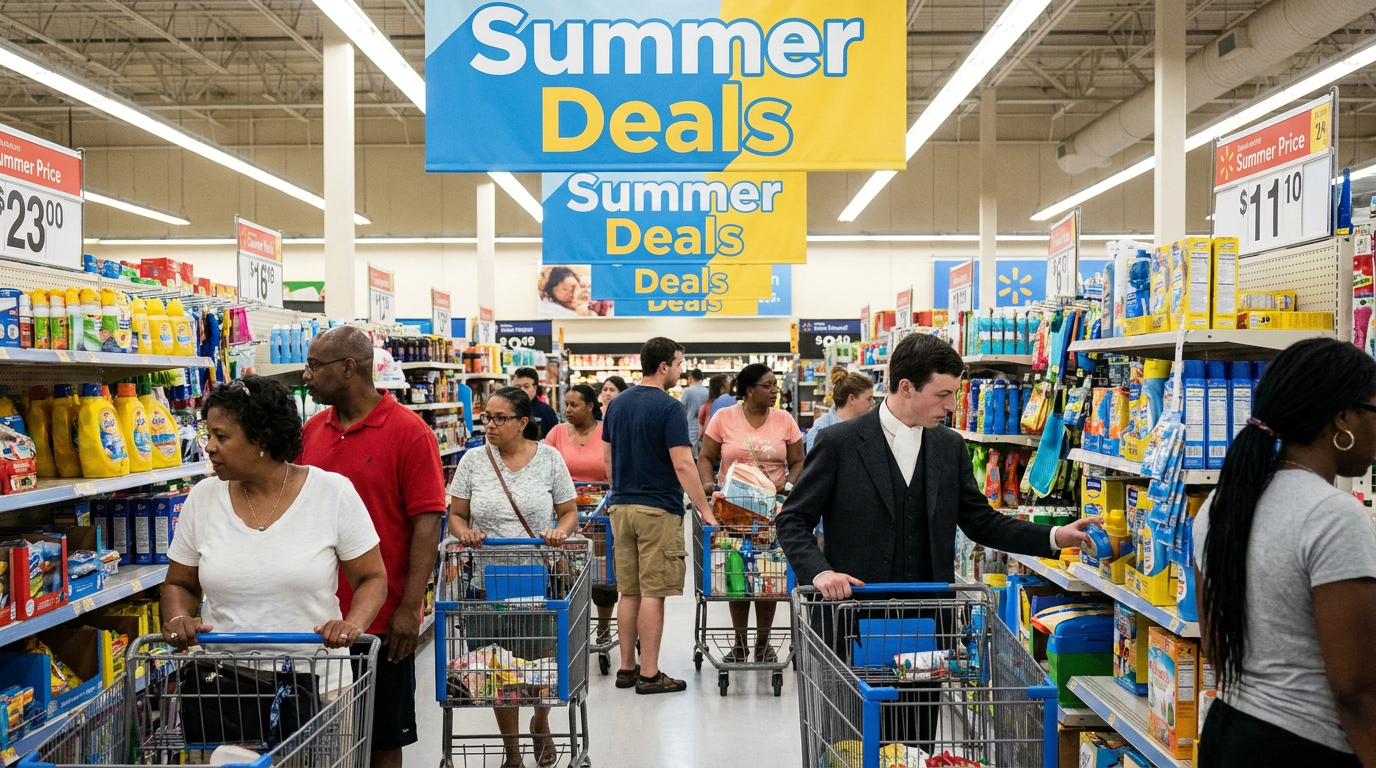
The traditional July retail showdown has been abruptly pulled forward, setting the stage for an unprecedented clash of mega-sales. In a rare synchronized move, Amazon, Walmart, Target, and Best Buy have all announced that their massive annual summer savings events will take place in the final week of June 2026. This aggressive scheduling shift transforms what is usually a mid-summer spending lull into the most concentrated deal competition in recent retail history. For consumers, the sudden alignment of these retail giants means an early opportunity to score significant discounts across virtually every product category.[4][8]
Historically anchored around mid-July, Amazon's Prime Day has long dictated the tempo for the industry's summer promotional calendar. This year, however, the e-commerce giant announced that its four-day Prime Day event will run from June 23 to June 26. In immediate response, primary competitors adjusted their own calendars to match or actively front-run Amazon's dates. The result is a high-stakes game of retail leapfrog, with each company vying to be the first to capture the attention—and wallets—of American shoppers before the traditional back-to-school rush begins.[1][2][7]
The resulting lineup creates a relentless week of overlapping promotions. Walmart confirmed its "Walmart Deals" event will run from June 22 through June 28, deliberately giving it a full 24-hour head start over Amazon. Target's "Circle Deal Days" will align exactly with Amazon's window, running from June 23 to June 26. Meanwhile, Best Buy has entered the fray with its week-long "Summer Tech Fest," which also spans June 22 to June 28. This deliberate competitive overlap ensures that shoppers will have multiple avenues to cross-reference prices and secure the best possible bargains.[4][5][6]

Retail analysts note that this aggressive scheduling is a direct response to shifting consumer spending habits. With inflation and elevated everyday prices continuing to impact household finances, shoppers have become increasingly price-sensitive. Many consumers have been trading down to cheaper brands or delaying discretionary purchases entirely. Retailers recognize that in a tighter economic environment, whoever captures the shopper's budget first is likely to win the season. Moving the sales up to June is a calculated strategy to stimulate spending early and prevent competitors from monopolizing the market.[4][5]
Retail analysts note that this aggressive scheduling is a direct response to shifting consumer spending habits.
Unlike previous years that heavily emphasized luxury electronics and high-end home goods, the 2026 marketing campaigns feature a distinct pivot toward everyday essentials. Recognizing the strain on household budgets, retailers are slashing prices on basics. Amazon is offering a sweepstakes for a year of free groceries, while Target is heavily promoting price cuts on thousands of pantry staples, cleaning supplies, and baby items. This shift acknowledges that for many families, the most valuable deals this summer will be found in the grocery and household aisles rather than the electronics department.[3][4]
Despite the new focus on essentials, traditional big-ticket items remain a central draw for these mega-sales. Best Buy is pitching its Summer Tech Fest as one of the biggest shopping events of the season, promising up to 50 percent off laptops, televisions, gaming gear, and small appliances. Amazon's early deals already feature significant price cuts on flagship Apple devices, premium headphones, and smart home technology. For tech enthusiasts and those looking to upgrade major home appliances, the overlapping sales create an ideal environment for aggressive price-matching.[1][6]

The battle for consumer loyalty is also driving new, complex membership mechanics designed to lock in shoppers. Walmart is introducing "hot deal drops"—a curated assortment of highly sought-after items that will be locked exclusively to Walmart+ subscribers for the first 24 hours of its sale. Similarly, Target Circle 360 members will receive early access to specific promotions, and Amazon's core event remains strictly gated behind its Prime subscription. These tiered access systems force consumers to carefully evaluate which retail subscriptions offer the best return on investment for their specific shopping needs.[2][8]
For consumers, the week of June 22 is shaping up to be the single best buying window of the year outside of the traditional Black Friday and Cyber Monday period. Shopping experts advise consumers to begin tracking prices immediately and to prepare to cross-shop across multiple platforms. Because the competition is so fierce, retailers are expected to aggressively price-match one another throughout the week. By preparing carts in advance and leveraging free trial memberships, savvy shoppers can maximize their savings during this unprecedented summer discount clash.[1][6][8]
How we got here
May 2026
Retailers report consumer pullback due to inflation, prompting internal strategy shifts.
June 3, 2026
Amazon officially announces Prime Day will move up to June 23-26.
June 10, 2026
Walmart confirms its competing 'Walmart Deals' event will begin June 22.
June 11, 2026
Target and Best Buy finalize their respective late-June sale dates to match competitors.
Viewpoints in depth
Budget-Conscious Consumers
Welcoming the relief on everyday essentials.
For households feeling the pinch of sustained inflation, the shift toward discounting groceries and basic household items is a welcome change. Shoppers are increasingly relying on these mega-sales not just for luxury electronics, but to stock up on pantry staples, cleaning supplies, and early back-to-school gear. The inclusion of sweepstakes for free groceries and deep cuts on baby items signals that retailers are finally meeting consumers where their budgets hurt the most.
Retail Industry Analysts
Viewing the shift as a battle for early market share.
Industry experts see the synchronized June schedule as a strategic land grab. With consumers tightening their belts, retailers know that whoever captures the shopper's budget first wins. Moving the sales up to June prevents competitors from monopolizing the mid-summer spending lull, forcing a direct head-to-head confrontation that benefits the consumer but squeezes retail profit margins.
Tech Enthusiasts
Strategizing for the best hardware upgrades.
For gadget hunters, the overlapping sales create an ideal environment for price-matching. With Best Buy, Amazon, and Walmart simultaneously dropping prices on laptops, headphones, and smart home devices, tech buyers are preparing to cross-reference deals to secure the lowest possible prices. Enthusiast communities are already building spreadsheets to track historical lows and identify which retailer's 'exclusive' drops actually offer the best value.
What we don't know
- Whether this June scheduling will become the permanent new standard for summer retail sales in future years.
- Exactly how much inventory retailers have allocated for their exclusive 'early access' member drops.
Key terms
- Prime Day
- Amazon's annual multi-day shopping event featuring exclusive discounts for its subscription members.
- Price-matching
- A retail practice where a store guarantees to match a lower price offered by a competitor for the identical product.
- Loss leader
- A pricing strategy where a product is sold at a price below its market cost to stimulate other sales of more profitable goods or services.
Frequently asked
Do I need a membership to shop these sales?
Amazon Prime Day requires a Prime membership. Walmart and Target offer early access to their paid members, but their main sales are open to everyone. Best Buy's sale is open to all shoppers.
Are these sales better than Black Friday?
For summer apparel, outdoor gear, and mid-year tech releases, these June events often match or beat Black Friday pricing. However, Black Friday typically remains superior for holiday-specific items.
Will groceries be on sale?
Yes. Unlike previous years, retailers are heavily discounting everyday essentials, including pantry staples, cleaning supplies, and personal care items.
Sources
Source coverage
8 outlets
3 viewpoints surfaced








[1]CNETTech Enthusiasts
Amazon Prime Day 2026: June Dates And The Best Early Deals
Read on CNET →[2]ForbesTech Enthusiasts
Amazon Prime Day 2026: June Dates And The Best Early Deals
Read on Forbes →[3]TODAYBudget-Conscious Consumers
Amazon Prime Day 2026 dates announced
Read on TODAY →[4]NewsweekBudget-Conscious Consumers
Walmart, Amazon and Target Launch Deals to Compete for Struggling Consumers
Read on Newsweek →[5]Retail DiveRetail Industry Analysts
Walmart's fictional boy band 'Alwayz' promotes its summer sale
Read on Retail Dive →[6]MashableTech Enthusiasts
Best Buy announces Summer Tech Fest dates
Read on Mashable →[7]The IndependentRetail Industry Analysts
Walmart will hold its summer savings event in late June this year
Read on The Independent →[8]Tech TimesRetail Industry Analysts
Walmart Deals June 22 vs. Amazon Prime Day 2026: How the Week Stacks Up
Read on Tech Times →

More in shopping
See all 5 stories →


Every angle. Every day.
Get shopping stories with full source coverage and perspective breakdowns delivered to your inbox.