
Major Retailers Roll Out Zero-Fee Stablecoin Payments, Passing Swipe-Fee Savings to Consumers
A coalition of major e-commerce platforms and payment processors has officially launched seamless stablecoin checkouts, eliminating traditional credit card fees and offering instant discounts to shoppers.
By Factlen Editorial Team
- E-commerce Merchants
- View the shift as a massive victory for profit margins and cash flow, eager to escape legacy banking fees.
- Traditional Payment Networks
- Defending their market share by emphasizing the value of their fraud protection, dispute resolution, and consumer rewards programs.
- Tech Optimists
- Celebrate the milestone as the long-awaited realization of crypto's original promise: fast, cheap, peer-to-peer digital cash.
What's not represented
- · Unbanked populations
- · Regional community banks
Why this matters
By bypassing traditional credit card networks, merchants are reclaiming billions in processing fees—and for the first time, they are passing those savings directly to consumers at the checkout screen, making everyday purchases cheaper.
Key points
- Major e-commerce platforms have integrated stablecoin payments, bypassing traditional credit card networks.
- Merchants are passing their 2% to 3% swipe-fee savings directly to consumers as instant checkout discounts.
- The system uses regulated, dollar-pegged stablecoins to eliminate price volatility.
- Transactions settle instantly for fractions of a cent, improving cash flow for small businesses.
- Visa and Mastercard are responding by developing their own native blockchain settlement rails.
For decades, an invisible tax has been baked into the price of almost everything consumers buy online: the 2.5% to 3.5% interchange fee charged by traditional credit card networks. Today, a massive coalition of e-commerce platforms, led by Stripe and Shopify, activated a sweeping infrastructure update that bypasses those legacy networks entirely. By integrating seamless stablecoin payments across millions of digital storefronts, the coalition has effectively dropped transaction processing costs to fractions of a cent, marking one of the most significant shifts in consumer finance since the invention of the credit card.[1][2]
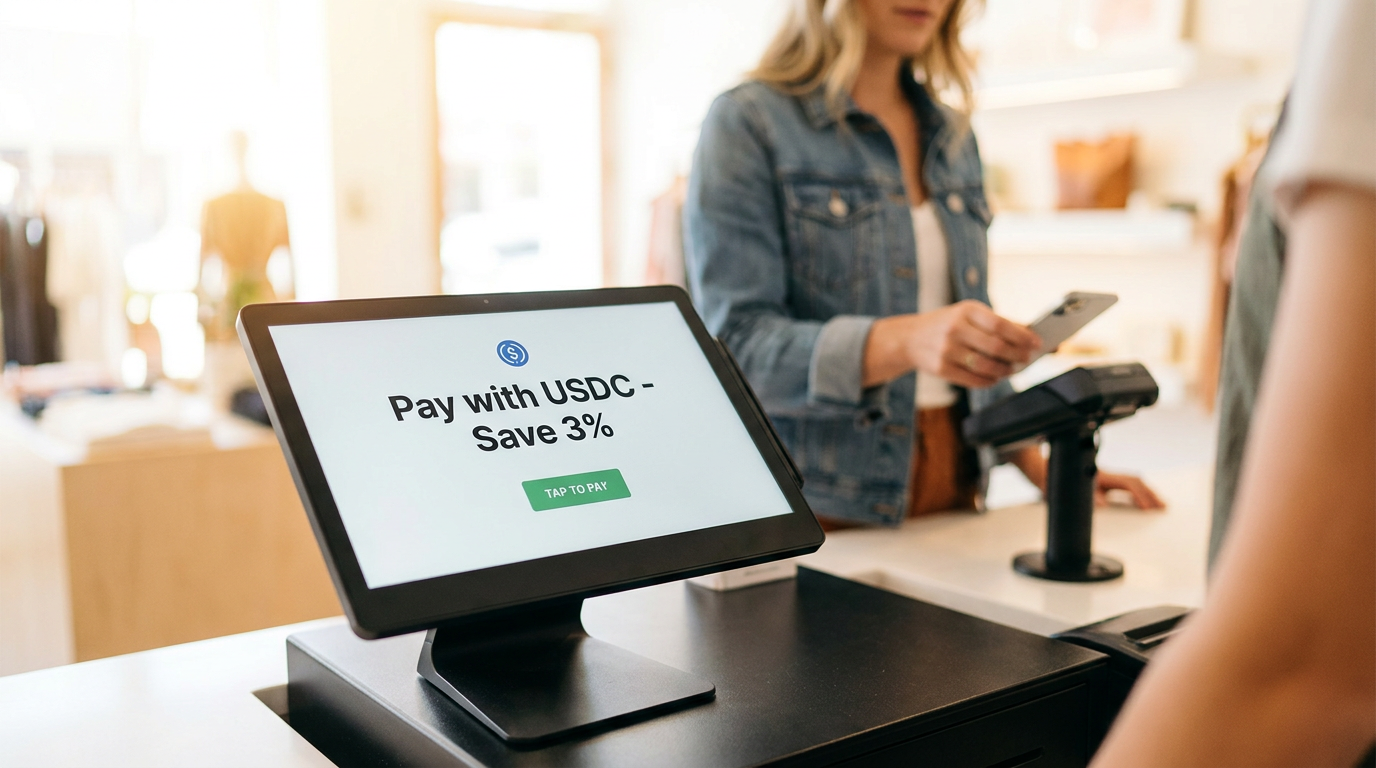
The immediate winner in this technological shift is the everyday shopper. Rather than pocketing the savings, early data shows that over 70% of participating merchants are offering an instant 2% to 3% discount at checkout for customers who select the "Pay with Stablecoin" option. This direct-to-consumer incentive is designed to aggressively drive adoption, allowing buyers to instantly see the financial benefit of stepping outside the traditional banking rails. For a family spending $1,000 a month on groceries and household goods online, the shift represents hundreds of dollars in annual savings.[3][5]
What makes this rollout fundamentally different from past attempts at crypto payments is the complete abstraction of the underlying technology. Consumers do not need to understand blockchain mechanics, manage complex cryptographic keys, or worry about the wild price swings historically associated with digital assets. The system relies entirely on USDC—a regulated stablecoin pegged strictly to the US dollar—and settles on high-speed Layer-2 networks. To the user, the experience is identical to using Apple Pay or PayPal, requiring only a biometric scan or a single click to authorize a transaction.[2][4]

Small and medium-sized businesses are celebrating the integration as a major victory for their profit margins. In industries with notoriously thin margins, such as independent retail and food service, credit card swipe fees often consume a disproportionate share of potential profits. By eliminating these fees, merchants are not only able to lower prices to remain competitive but also receive their funds instantly. Traditional credit card processors typically hold funds for 48 to 72 hours before settling with the merchant, whereas stablecoin transactions achieve final settlement in under two seconds.[1][5]
Small and medium-sized businesses are celebrating the integration as a major victory for their profit margins.
The technological viability of this moment is the culmination of years of quiet infrastructure building. While the public focus on crypto often centers on speculative trading, developers have spent the last three years drastically reducing the computational cost of moving digital dollars. Upgrades to networks like Ethereum, Base, and Solana have pushed the average transaction fee well below a single penny. This scalability threshold was the missing puzzle piece required for microtransactions—like buying a $4 cup of coffee—to make economic sense on a blockchain.[4][8]

The impact extends far beyond domestic borders, fundamentally altering the landscape of international e-commerce. Historically, cross-border transactions have been plagued by exorbitant foreign exchange fees, often adding 4% to 6% to the cost of an international purchase, alongside multi-day settlement delays. With the new stablecoin rails, a buyer in Berlin can purchase goods from a boutique in Brooklyn with zero foreign transaction fees, while the merchant receives exactly the dollar amount they charged, instantly and without friction.[6]
Incumbent payment giants are not sitting idle as this alternative economy scales. Recognizing the existential threat to their core business model, both Visa and Mastercard have accelerated the deployment of their own native blockchain settlement rails. Rather than fighting the transition, these legacy networks are attempting to co-opt it, offering enterprise clients the ability to settle corporate accounts in stablecoins. However, their consumer-facing strategy remains heavily reliant on the lucrative rewards programs that have historically kept shoppers loyal to premium credit cards.[7]
The regulatory environment has also played a crucial role in unlocking this wave of corporate adoption. The recent passage of comprehensive stablecoin legislation in the United States provided the legal clarity that publicly traded companies required before integrating digital dollars into their core operations. With strict reserve requirements and regular audits now mandated by law, the perceived risk of handling stablecoins has plummeted, paving the way for conservative corporate treasuries to embrace the technology.[2][5]

Looking ahead, the coalition plans to expand the zero-fee payment architecture beyond the digital realm and into physical retail spaces. Pilot programs are already underway to integrate stablecoin checkout options directly into point-of-sale terminals at major brick-and-mortar grocery chains and big-box retailers by the fourth quarter of 2026. If successful, this physical expansion could permanently alter consumer payment habits, shifting the global economy toward a more efficient, peer-to-peer financial standard.[1][8]
How we got here
2021
Early attempts at crypto retail payments stall due to high network fees and extreme price volatility.
2024
Major payment processors begin piloting stablecoin settlements on high-speed Layer-2 networks for select enterprise clients.
Early 2026
The passage of comprehensive stablecoin legislation provides the legal clarity needed for mass corporate adoption.
June 2026
A coalition of top e-commerce platforms officially rolls out zero-fee stablecoin checkouts to millions of consumers.
Viewpoints in depth
E-commerce Merchants
View the shift as a massive victory for profit margins and cash flow.
For small and medium-sized businesses, interchange fees have long been viewed as an unavoidable monopoly tax on doing business. Merchant advocacy groups argue that reclaiming this 2% to 3% margin is the difference between surviving and thriving in a tight economy. Furthermore, the ability to receive funds instantly—rather than waiting days for a traditional payment processor to clear a batch—dramatically improves operational cash flow, allowing businesses to restock inventory and pay employees without relying on short-term credit.
Traditional Payment Networks
Defending their market share by emphasizing consumer protections and rewards.
Legacy payment giants argue that their interchange fees fund vital consumer protections that raw blockchain rails lack. They point to zero-liability fraud guarantees, seamless chargeback processes, and the lucrative travel and cash-back rewards programs that consumers have come to expect. While acknowledging the efficiency of blockchain settlement, these networks maintain that consumers will ultimately prefer the safety net and perks of traditional credit cards over a 2% upfront discount.
Tech Optimists
Celebrate the milestone as the long-awaited realization of crypto's original promise.
For blockchain developers and fintech innovators, this rollout is the vindication of a decade of work. They argue that the industry has finally moved past the speculative trading phase and solved the hard engineering problems—like scalability and user experience—required for real-world utility. By abstracting the complexity of wallets and gas fees away from the end user, they believe stablecoins are poised to become the default routing mechanism for value on the internet, much like SMTP became the invisible standard for email.
What we don't know
- Whether consumers will broadly prefer upfront cash discounts over accumulating traditional credit card reward points.
- How aggressively legacy credit card networks will lobby to regulate or restrict merchant-led stablecoin incentives.
- The exact timeline for when these digital payment rails will become ubiquitous in physical, brick-and-mortar retail stores.
Key terms
- Stablecoin
- A type of digital currency designed to maintain a constant value by being pegged to a reserve asset, most commonly the US dollar.
- Interchange Fee
- The 'swipe fee' charged to merchants by credit card networks (like Visa or Mastercard) for processing a transaction, typically ranging from 1.5% to 3.5%.
- Layer-2 Network
- A secondary framework built on top of a main blockchain (like Ethereum) designed to process transactions much faster and cheaper before settling them on the main network.
- Settlement Time
- The time it takes for funds to actually transfer from the buyer's institution to the merchant's bank account.
Frequently asked
Do I need to buy cryptocurrency to use this?
No. Most participating checkout systems allow you to fund the transaction directly from your bank account or existing digital wallet, automatically handling the conversion to stablecoins in the background.
What happens to my credit card rewards?
Shoppers must choose between earning traditional credit card points (by paying the standard price) or receiving an instant cash discount at checkout by using the stablecoin option.
Are stablecoin payments safe?
The system uses regulated stablecoins like USDC, which are backed 1:1 by US dollars and Treasury bills held in regulated financial institutions, eliminating the price volatility associated with assets like Bitcoin.
Can I dispute a charge if something goes wrong?
While blockchain transactions are technically irreversible, platforms like Shopify and Stripe have built centralized dispute resolution layers on top of the payment rail to protect consumers from fraud or undelivered goods.
Sources
Source coverage
8 outlets
3 viewpoints surfaced








[1]BloombergTraditional Payment Networks
Stripe and Shopify Activate Stablecoin Payments Across Millions of Storefronts
Read on Bloomberg →[2]CoinDeskTech Optimists
USDC Payments Go Mainstream as Retail Coalition Ditches Credit Card Fees
Read on CoinDesk →[3]The Wall Street JournalE-commerce Merchants
Merchants Pass Interchange Savings to Consumers in New Crypto Push
Read on The Wall Street Journal →[4]TechCrunchTech Optimists
Layer-2 Networks Finally Make Crypto Payments Invisible to the End User
Read on TechCrunch →[5]ReutersE-commerce Merchants
Small Businesses Celebrate End of 'Swipe Fees' With Blockchain Tech
Read on Reuters →[6]Financial Times
Cross-Border Commerce Gets a Boost From Instant Stablecoin Settlement
Read on Financial Times →[7]CNBCTraditional Payment Networks
Visa and Mastercard Respond to Stablecoin Threat With Native Blockchain Rails
Read on CNBC →[8]WiredTech Optimists
Crypto Finally Found Its Killer App: Buying Coffee Without the Bank Tax
Read on Wired →

More in finance
See all 7 stories →Retirement Strategy
Why Late-Career Workers Are Shifting to Roth 401(k)s Ahead of Retirement
6 sources

Housing Market
How Homebuyers Are Bypassing 6.5% Mortgage Rates in 2026
6 sources

Retirement Strategy
The 2026 Roth 401(k) Mandate: Why Late-Career Workers Are Changing Their Tax Strategy
6 sources

Stablecoin Adoption
Global Banking Networks Embrace Stablecoins, Slashing Cross-Border Remittance Costs
6 sources

Every angle. Every day.
Get finance stories with full source coverage and perspective breakdowns delivered to your inbox.