
Major Retailers Move Summer Sales to June, Slashing Prices to Combat Consumer Fatigue
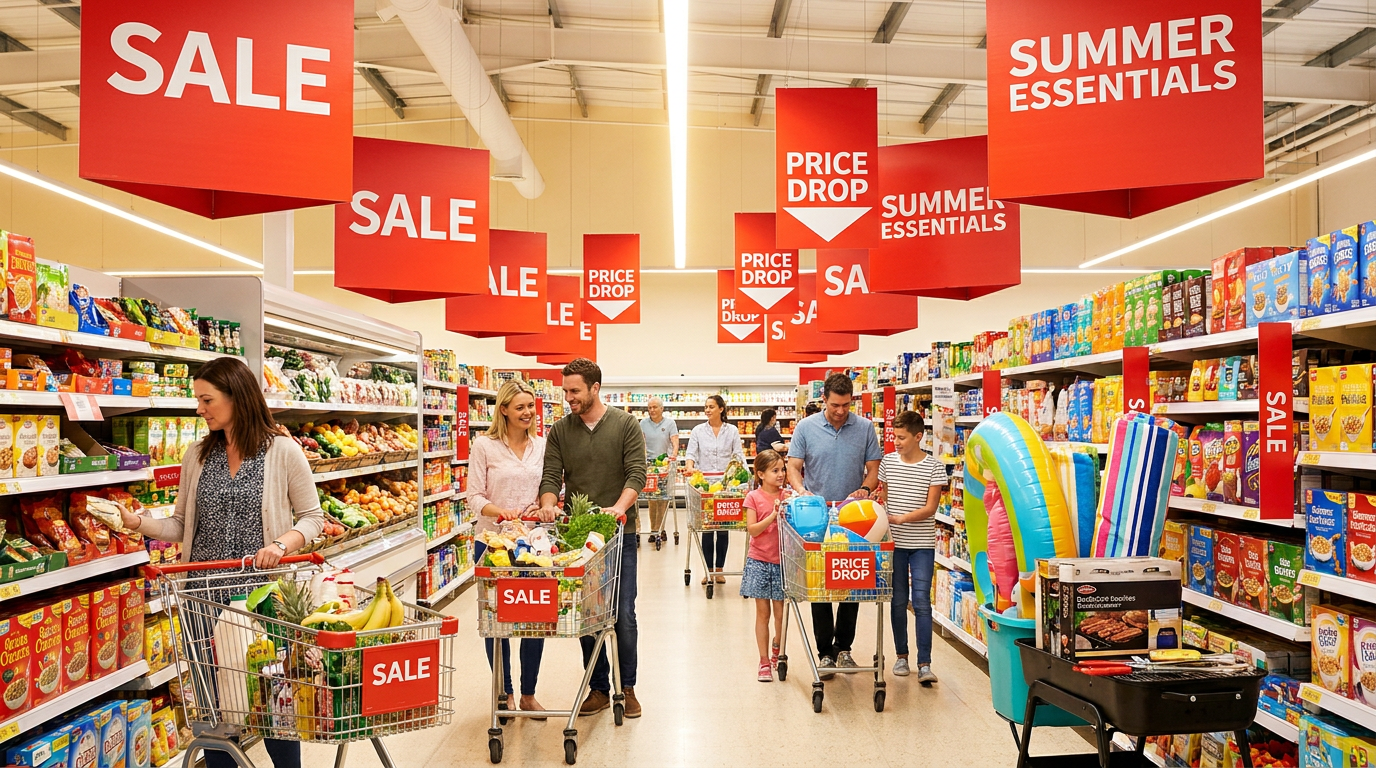
Amazon, Walmart, and Target have pulled their massive summer sales events forward into June, launching a fierce price war. Alongside tech discounts, grocers are slashing prices on thousands of everyday essentials to relieve inflation-weary shoppers.
By Factlen Editorial Team
- Big-Box Retailers
- Focused on driving volume and winning back foot traffic by moving sales events earlier and overlapping with competitors.
- Consumer Deal Experts
- Advising shoppers to leverage the overlapping sales events by cross-checking prices and utilizing early access deals.
- Value Grocers
- Prioritizing sustained, summer-long price cuts on everyday essentials to relieve inflation pressure and retain customer loyalty.
What's not represented
- · Small Business Owners
- · Supply Chain and Logistics Workers
Why this matters
With inflation stretching household budgets, this aggressive retail competition offers consumers a rare opportunity to secure deep discounts on both big-ticket electronics and daily groceries. By strategically timing purchases during these overlapping June events, shoppers can significantly reduce their summer expenses.
Key points
- Amazon has moved its annual Prime Day event to June 23-26, prompting competitors to follow suit.
- Walmart is front-running Amazon with a weeklong 'Walmart Deals' event starting June 22.
- Target and Aldi have implemented sweeping, season-long price cuts on thousands of everyday grocery and household items.
- Retailers are using these aggressive discounts to combat consumer 'price fatigue' and stimulate summer spending.
- Experts advise shoppers to cross-check prices across platforms, as retailers are actively matching each other's deals.
The traditional summer retail lull has been completely upended in 2026, replaced by a fierce, multi-front price war that is arriving weeks earlier than usual. Facing a consumer base exhausted by years of inflation, the nation's largest retailers are sacrificing profit margins to drive volume and win back foot traffic. Instead of waiting for the typical mid-July promotional window, retail giants have pulled their massive sales events forward into June, creating an unprecedented overlap of discounts on everything from high-end electronics to everyday groceries. This aggressive shift signals a broader acknowledgment across the industry that deep, sustained discounts are now required to stimulate spending among cautious, value-conscious shoppers.[1][7]
The catalyst for this calendar shift was Amazon's surprise announcement that its massive annual Prime Day event would move up to June 23 through June 26. Mirroring the expanded four-day format introduced in recent years, the e-commerce giant is promising millions of deals across more than 35 categories, with discounts reaching up to 80% on premium beauty brands, summer fashion, and Amazon's own hardware ecosystem. Early deals have already gone live, offering steep markdowns on smart home devices and early back-to-school essentials to capture consumer dollars before the official event even begins.[3][5][6]
The response from brick-and-mortar competitors was swift and calculated. Walmart immediately announced its own weeklong savings event, dubbed "Walmart Deals," scheduled to run from June 22 through June 28. By launching at 12:01 a.m. Eastern Time on a Monday, Walmart is intentionally front-running Amazon's event by a full 24 hours. The retailer is also leveraging its Walmart+ membership program, offering subscribers exclusive early access to highly coveted "Deal Drops" before they become available to the general public. This overlapping schedule forces consumers to actively compare prices between the two retail behemoths in real-time.[2][4]

While flashy discounts on televisions and headphones dominate the headlines, the most significant shift in 2026 is the aggressive discounting of everyday essentials. Retailers recognize that consumers are suffering from profound "price fatigue" at the checkout counter. In response, Target made waves by announcing sweeping price cuts on 1,500 everyday items—ranging from paper towels to milk—with plans to expand those reductions to roughly 5,000 items over the course of the summer. This strategy aims to provide immediate relief to household budgets and rebuild customer loyalty that may have frayed during periods of high inflation.[7]
The grocery sector has fully entered the fray, recognizing that food prices remain a primary pain point for American families. Aldi, the German discount chain known for its aggressive pricing, announced it is cutting prices on nearly 25% of its entire U.S. store selection through Labor Day. This initiative covers more than 400 items, primarily within its private-label assortment, and is projected to save consumers an estimated $100 million over the summer months. Unlike flash sales, these are sustained price reductions designed to offer predictable affordability week after week.[9]
The grocery sector has fully entered the fray, recognizing that food prices remain a primary pain point for American families.
Traditional supermarkets and warehouse clubs are also feeling the pressure to adapt. Stop & Shop recently lowered prices by 5% to 35% on thousands of products across hundreds of its locations in the Northeast, explicitly citing the need to remain competitive as consumers migrate toward deep-discount stores. Similarly, Costco has implemented price cuts on staple items like eggs and beef, as well as on its popular Kirkland Signature store-brand products, ensuring its members continue to see tangible value from their annual subscription fees despite rising operational costs.[8]

Consumer deal experts emphasize that this highly competitive environment is uniquely favorable for shoppers. With retailers fighting tooth and nail for market share, the discounts are not only deeper but also more widespread than in previous years. Deal-hunting platforms and tech reviewers are already tracking significant early markdowns on premium items, including Apple AirPods, Sony noise-canceling headphones, and high-end robot vacuums. Because the major sales events overlap so heavily, experts advise consumers to utilize price-tracking browser extensions and cross-check items across multiple platforms before completing a purchase.[1][5][6]
The battle for consumer electronics and smart home dominance is particularly fierce this season. Tech reviewers and deal hunters note that flagship products, which typically see only modest discounts, are hitting record-low prices weeks ahead of the main events. Items like the Oura Ring, high-end espresso machines, premium OLED televisions, and Apple AirPods are seeing price cuts ranging from 20% to 40%. To maintain momentum, retailers are utilizing "Deal Drops"—limited-time, high-value discounts released at specific hours. This strategy keeps shoppers repeatedly checking their apps and websites, effectively turning the shopping experience into an engaging, gamified event that drives continuous traffic.[2][4][5]
Beyond electronics, the June price war is heavily targeting seasonal and outdoor goods. Retailers are aggressively clearing out their inventory of patio furniture, grills, and summer apparel to make room for early fall merchandise. Shoppers are finding substantial discounts on major appliances and outdoor dining sets, often bundled with free delivery or installation offers. This timing aligns perfectly with consumers looking to upgrade their living spaces for summer entertaining, providing a rare opportunity to secure off-season pricing during peak usage months. Deal experts note that these bulky items rarely see such steep discounts outside of major holiday weekends.[1][2][6]

The long-term implications of this shift could permanently alter the retail landscape. If the June 2026 sales events prove successful in driving sustained volume, the traditional mid-July promotional window may be permanently retired. Retailers are discovering that offering genuine, transparent value—rather than relying solely on artificial scarcity or confusing multi-buy promotions—is the most effective way to engage a weary consumer base. As the summer progresses, the true winners of this price war will be the shoppers who navigate the overlapping sales to secure meaningful savings on both discretionary upgrades and daily necessities.[4][7]
How we got here
May 2026
Target announces sweeping price cuts on 1,500 everyday items to combat consumer 'price fatigue'.
June 3, 2026
Amazon surprises the retail industry by announcing Prime Day will move from July to June 23-26.
June 5, 2026
Aldi commits to summer-long price reductions on more than 400 private-label items.
June 9, 2026
Walmart announces 'Walmart Deals' for June 22-28, intentionally front-running Amazon's event.
Viewpoints in depth
Big-Box Retailers' Strategy
Sacrificing short-term margins to drive massive volume and capture market share early in the season.
For giants like Amazon, Walmart, and Target, the shift to June is a calculated offensive maneuver. By moving their flagship sales events forward, they aim to capture consumer discretionary spending before shoppers finalize their summer travel budgets. Retail executives acknowledge that while deep discounts on electronics and home goods compress profit margins, the resulting surge in foot traffic and online engagement is critical. Walmart's decision to launch its event 24 hours before Amazon's Prime Day highlights a fierce battle for 'first-mover' advantage, ensuring that shoppers spend their allocated budgets on their platform before competitors even open their digital doors.
Value Grocers' Approach
Focusing on sustained, everyday affordability to build long-term loyalty among inflation-weary families.
While the tech and apparel sectors rely on flash sales, the grocery industry is taking a fundamentally different approach. Chains like Aldi, Costco, and Stop & Shop recognize that consumers are exhausted by the volatility of food prices. Instead of limited-time offers, these retailers are implementing permanent or season-long price cuts on staple items like dairy, meat, and private-label pantry goods. This strategy is designed to provide predictable relief, proving to shoppers that they can rely on these stores for consistent affordability week after week. Industry analysts note that this approach builds deeper customer loyalty than sporadic promotional events.
Consumer Deal Experts' Advice
Encouraging shoppers to exploit the overlapping sales events through rigorous price comparison.
With multiple retail behemoths competing simultaneously, consumer advocates and deal-tracking experts view June 2026 as an unprecedented buyer's market. However, they caution against blind loyalty to a single platform. Because Amazon, Walmart, and Target are actively price-matching each other's 'doorbuster' deals, experts strongly recommend utilizing browser extensions and price-history trackers to verify that a discount is genuine. Furthermore, they advise shoppers to take advantage of 'early access' windows—often granted to loyalty program members—to secure high-demand items like premium headphones and smart home devices before inventory is depleted during the main events.
What we don't know
- Whether the deep discounts will successfully offset the profit margin compression for major retailers.
- If the shift to June sales events will permanently replace the traditional mid-July promotional window in future years.
- How smaller, independent retailers will adapt to the aggressive pricing strategies of industry giants.
Key terms
- Price Fatigue
- Consumer exhaustion and reduced spending caused by prolonged periods of inflation and rising costs.
- Loss Leader
- A product sold at a loss to attract customers into a store or onto a website, with the expectation that they will buy other, profitable items.
- Private-Label Assortment
- Products manufactured or packaged for sale under the name of the retailer rather than that of the manufacturer (e.g., Costco's Kirkland Signature).
- Dynamic Pricing
- The practice of adjusting prices in real-time based on market demand, competitor pricing, and inventory levels.
Frequently asked
When is Amazon Prime Day 2026?
Amazon Prime Day will run for four days, from Tuesday, June 23 through Friday, June 26, 2026.
Do I need a membership to shop the Walmart Deals event?
No, the main Walmart Deals event is open to all shoppers. However, Walmart+ members receive early access to select 'Deal Drops' starting at 12:01 a.m. on June 22.
Are grocery prices actually going down?
Yes, major chains like Aldi, Target, Stop & Shop, and Costco have implemented specific price cuts on thousands of everyday essentials, including dairy, meat, and pantry staples, to provide relief from inflation.
Should I wait for the official sale dates to buy?
Not necessarily. Retailers have already launched 'early access' deals that offer significant discounts on tech, home goods, and apparel, and popular items may sell out before the main events begin.
Sources
Source coverage
9 outlets
3 viewpoints surfaced









[1]NBC NewsConsumer Deal Experts
31+ deals from Walmart, Target, and other stores that rival Amazon Prime Day prices
Read on NBC News →[2]MashableConsumer Deal Experts
The best Walmart Summer Deals to shop before Prime Day
Read on Mashable →[3]AmazonBig-Box Retailers
When is Amazon Prime Day 2026? Shop deals June 23-26
Read on Amazon →[4]WalmartBig-Box Retailers
Walmart Announces the Return of 'Walmart Deals'
Read on Walmart →[5]ForbesConsumer Deal Experts
Best Early Amazon Prime Day Deals 2026
Read on Forbes →[6]CNETConsumer Deal Experts
Best Early Prime Day Deals 2026: Save on Apple, Sony and More
Read on CNET →[7]CheapismBig-Box Retailers
7 Retailers Slashing Prices to Entice Customers With Inflation 'Price Fatigue'
Read on Cheapism →[8]NewsdayValue Grocers
Deal-seeking shoppers spur Costco, Stop & Shop to cut grocery prices
Read on Newsday →[9]Grocery DiveValue Grocers
Aldi cuts prices on more than 400 items for the summer
Read on Grocery Dive →

More in shopping
See all 5 stories →


Every angle. Every day.
Get shopping stories with full source coverage and perspective breakdowns delivered to your inbox.