
Major Gaming Publishers Unite to Standardize Accessibility Features and Adaptive Hardware
Led by the ESA's Accessible Games Initiative, major gaming companies including Xbox, PlayStation, and Ubisoft are rolling out standardized storefront tags and new adaptive hardware to make video games playable for millions of disabled users.
By Factlen Editorial Team
- Industry Publishers
- Major gaming companies view standardized accessibility as a core design pillar that expands their audience.
- Accessibility Advocates
- Disabled gamers and advocates celebrate the progress but stress that critical gaps remain in complex game mechanics.
- Regulatory Observers
- Legal analysts note that global regulations are increasingly forcing digital storefronts to comply with inclusivity standards.
What's not represented
- · Independent game developers who may lack the budget to implement comprehensive accessibility suites.
- · Third-party hardware manufacturers adapting to the new adaptive controller schematics.
Why this matters
For decades, disabled players have had to guess whether a newly purchased game would actually be playable for them. The standardization of accessibility tags and adaptive hardware means millions of gamers can now confidently participate in the world's most popular form of entertainment without facing unintended barriers.
Key points
- The ESA has launched the Accessible Games Initiative, introducing 24 standardized accessibility tags to digital storefronts.
- Ubisoft, Xbox, and PlayStation are integrating these tags so players can verify a game's inclusivity features before purchasing.
- Xbox released seven new 3D-printable thumbstick toppers for its Adaptive Controller to allow for greater at-home customization.
- Sony formed the PlayStation Studios Accessibility Community Council, embedding 15 disabled consultants into its early development cycles.
- Advocates warn that despite hardware advances, software barriers like auto-generated subtitles and complex button inputs still hinder true accessibility.
June 2026 is shaping up to be a watershed month for inclusivity in digital entertainment, as the video game industry's largest publishers and console manufacturers unite to tear down barriers for disabled players. Following years of fragmented, game-by-game approaches to accessibility, a coordinated push is now standardizing how players find, buy, and interact with video games.[7][8]
The cornerstone of this shift is the progressive rollout of the Accessible Games Initiative (AGI), a cross-industry project spearheaded by the Entertainment Software Association (ESA). Originally unveiled at the Game Developers Conference, the initiative has now officially gone live across major digital storefronts.[1][7]
The AGI introduces a standardized set of 24 accessibility tags designed to give consumers clear, upfront information about a game's features before they make a purchase. These tags cover crucial functionalities such as "Narrated Menus," "Full Input Remapping," "Large and Clear Subtitles," and "Save Anytime."[1][2]

Ubisoft became one of the first major publishers to integrate the tags directly into its product pages, starting with titles like Rayman 30th Anniversary Edition and Valiant Hearts: Coming Home. According to the company, the shared language of the AGI ensures that players no longer have to guess whether a newly released title will accommodate their specific motor, visual, or cognitive needs.[2]
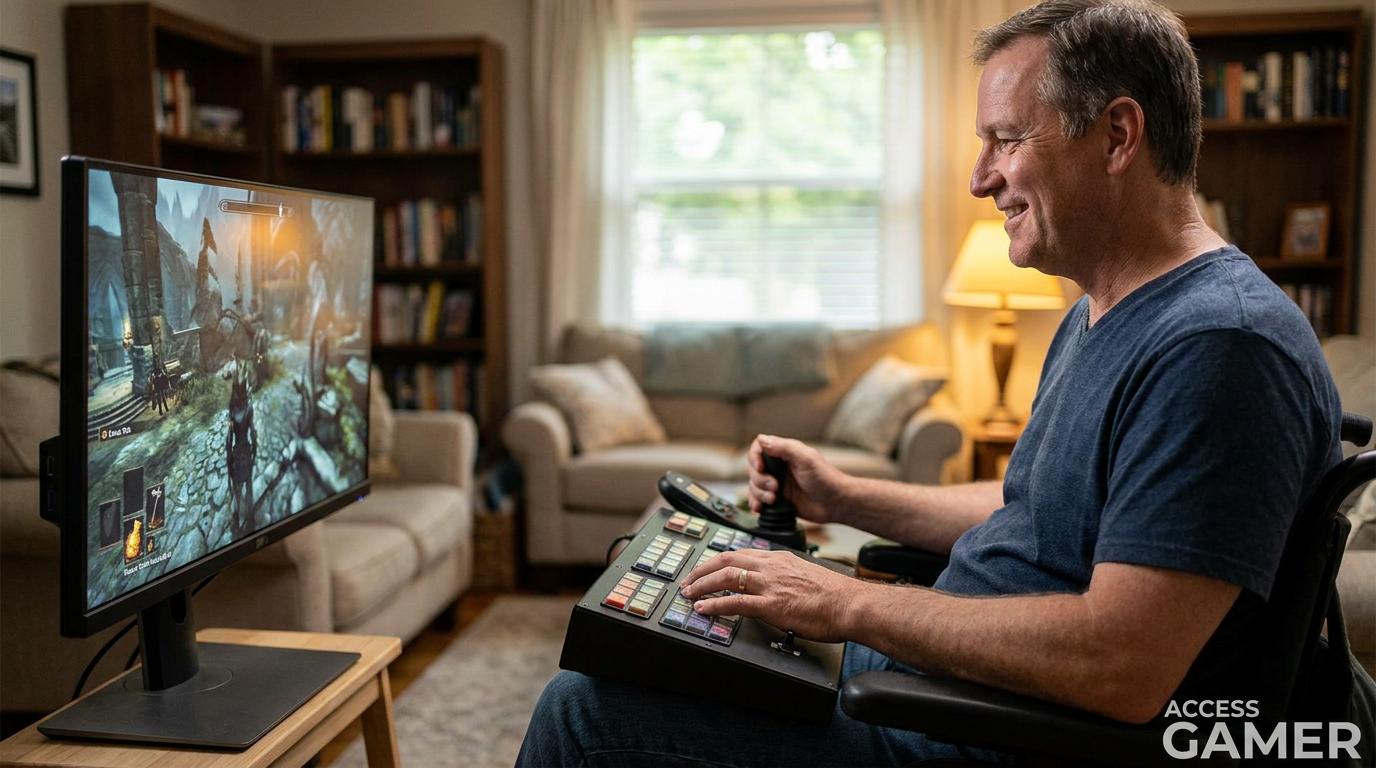
Hardware is also evolving rapidly alongside software. To coincide with Global Accessibility Awareness Day, Xbox expanded its suite of inclusive hardware by releasing new configurations for the Xbox Adaptive Controller. Microsoft's Inclusive Tech Lab introduced seven new adaptive thumbstick toppers, which players can either order through Xbox Design Lab or download as free schematics to 3D-print at home.[3][5]

Xbox has also completely overhauled its Accessible Gaming storefront page, improving navigation and content discoverability so players can easily filter the ecosystem for titles that meet the Xbox Accessibility Guidelines.[3][5]
Meanwhile, Sony Interactive Entertainment has formalized its approach to inclusive design by launching the PlayStation Studios Accessibility Community Council. The council consists of 15 third-party accessibility consultants—each bringing lived experience with various disabilities—who will partner directly with PlayStation's first-party developers.[4]
Meanwhile, Sony Interactive Entertainment has formalized its approach to inclusive design by launching the PlayStation Studios Accessibility Community Council.
By integrating these consultants early in the development cycle, PlayStation aims to move beyond assumptions and build features like sightless navigation and fall-protection systems into the core architecture of its blockbuster titles, rather than patching them in post-launch.[4][8]
This industry-wide acceleration is not driven solely by goodwill; it is also a response to shifting global regulations. The European Accessibility Act (EAA), which took full effect across the EU in June 2025, mandates strict accessibility standards for digital storefronts and e-commerce platforms, effectively forcing gaming ecosystems to comply with baseline inclusivity rules.[9]
Despite the undeniable momentum, accessibility advocates caution that the industry still has significant blind spots. While the corporatization of the internet has made digital entertainment more available, true accessibility is still too often treated as a marketing bullet point rather than a core design requirement.[6]
For example, many major titles and streaming platforms still rely heavily on auto-generated subtitles powered by speech recognition, which frequently fail to differentiate between multiple speakers or describe critical environmental audio cues. For hearing-impaired players, the omission of directional sound indicators can render a game unplayable.[6]
Furthermore, while adaptive controllers provide a vital bridge for mobility-impaired gamers, their effectiveness is inherently limited if the game's software relies on rapid button combinations or sustained physical interactions that cannot be bypassed or remapped.[6][8]

Ultimately, the push for accessibility represents a massive, largely untapped commercial opportunity. With an estimated 250 million gamers worldwide identifying as visually impaired alone, studios that prioritize inclusive design are opening their worlds to a vast demographic that has historically been sidelined.[6]
As the standardized tags of the Accessible Games Initiative become ubiquitous across Xbox, PlayStation, and PC storefronts, the baseline for what constitutes a "finished" game has permanently shifted. For millions of players, the question is no longer whether they are allowed to play, but simply what they want to play next.[1][2][8]
How we got here
2018
Microsoft launches the Xbox Adaptive Controller, bringing mainstream attention to hardware accessibility.
March 2025
The Entertainment Software Association first unveils the Accessible Games Initiative at the Game Developers Conference.
June 2025
The European Accessibility Act takes effect, mandating strict accessibility standards for digital storefronts across the EU.
May 2026
Xbox and PlayStation announce major new accessibility councils and hardware updates for Global Accessibility Awareness Day.
June 2026
Major publishers begin the progressive rollout of standardized AGI tags across their digital storefronts.
Viewpoints in depth
Industry Publishers
Major gaming companies view standardized accessibility as a core design pillar that expands their audience.
For console manufacturers and software publishers, accessibility has evolved from a niche post-launch patch into a fundamental architectural requirement. By adopting the ESA's 24 standardized tags and forming dedicated advisory councils, companies like Sony, Microsoft, and Ubisoft are attempting to remove the friction of game discovery. They argue that building inclusive features—such as full input remapping and sightless navigation—directly into a game's engine from day one not only fulfills a moral imperative but drives significant commercial engagement by welcoming millions of previously excluded players.
Accessibility Advocates
Disabled gamers and advocates celebrate the progress but stress that critical gaps remain in complex game mechanics.
While advocacy groups applaud the rollout of standardized tags and 3D-printable adaptive hardware, they caution against declaring victory too soon. Organizations point out that many high-budget titles still rely on cost-saving measures like auto-generated subtitles, which fail to differentiate speakers or describe vital environmental audio cues. Furthermore, advocates argue that hardware solutions like the Xbox Adaptive Controller can only do so much if the underlying game design still demands rapid button-mashing or sustained physical holds that cannot be bypassed in the software.
What we don't know
- It remains unclear how strictly third-party and independent developers will adopt the voluntary AGI tags on major storefronts.
- The industry has not yet standardized how accessibility features will be communicated on physical video game box art.
- It is unknown how regulatory bodies will enforce the European Accessibility Act's requirements on smaller, legacy gaming platforms.
Key terms
- Accessible Games Initiative (AGI)
- A standardized tagging system developed by the ESA to clearly label accessibility features on video game digital storefronts.
- Xbox Adaptive Controller
- A highly customizable gaming hub designed for players with limited mobility, allowing them to connect external switches, buttons, and joysticks.
- European Accessibility Act (EAA)
- An EU directive that sets mandatory accessibility requirements for a wide range of digital products and services, including e-commerce platforms.
- Haptic Feedback
- Technology that uses advanced vibrations to simulate the feeling of in-game actions, providing crucial sensory input for players.
- Auto-generated Subtitles
- Captions created by speech-recognition software rather than human professionals, which advocates note often lack crucial context like speaker differentiation and environmental cues.
Frequently asked
What is the Accessible Games Initiative?
It is a cross-industry project led by the ESA that introduces 24 standardized tags to digital storefronts, helping players identify a game's accessibility features before purchasing.
How is Xbox improving its adaptive controllers?
Xbox has released seven new adaptive thumbstick toppers that players can either order through Xbox Design Lab or download as free schematics to 3D-print at home.
What is the PlayStation Studios Accessibility Community Council?
It is a newly formed group of 15 third-party accessibility consultants with lived experiences who will partner directly with PlayStation developers to build inclusive features into games early in development.
Does the European Accessibility Act affect video games?
Yes. The EAA, which took effect in 2025, requires digital storefronts and e-commerce platforms in the EU to meet strict accessibility standards, accelerating the gaming industry's adoption of inclusive design.
Sources
Source coverage
9 outlets
3 viewpoints surfaced









[1]Entertainment Software AssociationIndustry Publishers
Entertainment Software Association Introduces the Accessible Games Initiative
Read on Entertainment Software Association →[2]Ubisoft NewsIndustry Publishers
Ubisoft Launches Accessible Games Initiative Tags for Global Accessibility Awareness Day
Read on Ubisoft News →[3]Xbox WireIndustry Publishers
XBOX Celebrates Global Accessibility Awareness Day with Improved Adaptive Thumbstick Toppers and More
Read on Xbox Wire →[4]PlayStation BlogIndustry Publishers
Introducing the PlayStation Studios Accessibility Community Council
Read on PlayStation Blog →[5]Console CreaturesAccessibility Advocates
For GAAD 2026, Xbox Releases Fresh Accessibility Updates
Read on Console Creatures →[6]Direct AccessAccessibility Advocates
Still Not Playing Fair: Accessibility Gaps in Gaming and Digital Entertainment
Read on Direct Access →[7]MashableAccessibility Advocates
New video game initiative is a boost for players with disabilities
Read on Mashable →[8]PlayStation UniverseIndustry Publishers
How Game Accessibility Pillars Are Reshaping PS5 Titles
Read on PlayStation Universe →[9]LexologyRegulatory Observers
The impact of the European Accessibility Act on Online Gaming and Gaming Devices
Read on Lexology →

More in entertainment
See all 6 stories →Pixar Animation
'Toy Story 5' Premieres to Critical Acclaim as Pixar Tackles the Screen-Time Era
0 sources

Toy Story 5
Toy Story 5 Premieres With Taylor Swift Original Song, Tackling the Modern Dilemma of Screen Time
0 sources
Awards History
The EGOT Explained: How Entertainment's Ultimate Crown is Actually Won
0 sources

Game Accessibility
Gaming Giants Unite to Launch Universal Accessibility Standard Across All Consoles
0 sources

Every angle. Every day.
Get entertainment stories with full source coverage and perspective breakdowns delivered to your inbox.