
Major Console Makers Unveil 'Universal Adaptive Standard' to Make Gaming Hardware Cross-Platform for Disabled Players
Microsoft, Sony, and Nintendo have jointly announced a breakthrough hardware treaty allowing accessibility controllers to work natively across all three major consoles. The move eliminates the need for disabled gamers to purchase expensive, separate setups for different platforms.
By Factlen Editorial Team
- Accessibility Advocates
- Celebrate the move as a historic dismantling of the 'disability tax' that has long gatekept the gaming community.
- Industry Analysts
- View the treaty as a logical expansion of the total addressable market that doesn't cannibalize standard hardware sales.
- Hardware Developers
- Focus on the technical achievement of unifying the APIs and the new economies of scale for third-party peripheral makers.
What's not represented
- · Disabled PC gamers who rely on keyboard-and-mouse adaptations rather than console controllers.
- · Indie developers concerned about the resource cost of implementing the mandatory UAS certification by 2027.
Why this matters
Adaptive gaming setups can cost hundreds of dollars, forcing disabled players to choose a single console ecosystem or pay a massive 'disability tax' to play with all their friends. By making accessibility hardware universally compatible, the industry is removing the largest financial and technical barrier to inclusive play.
Key points
- Microsoft, Sony, and Nintendo announced the Universal Adaptive Standard (UAS) at Summer Game Fest 2026.
- The standard allows adaptive controllers to work natively across Xbox, PlayStation, and Nintendo Switch.
- The move eliminates the need for disabled gamers to buy multiple expensive setups for different consoles.
- A unified developer API will make it easier for studios to implement deep accessibility features.
- By 2027, all new games must support the UAS software hooks to pass console certification.
- Standard controllers (like the DualSense) remain locked to their respective ecosystems.
At Summer Game Fest 2026, amidst the barrage of blockbuster trailers and long-awaited sequel announcements, the weekend's most significant standing ovation was reserved not for a video game, but for a hardware treaty. In an unprecedented display of industry cooperation, Microsoft, Sony, and Nintendo took the stage together to unveil the Universal Adaptive Standard (UAS). The joint initiative effectively tears down the hardware walled gardens that have long segregated disabled gamers, establishing a unified protocol for accessibility controllers across all three major console ecosystems.[1][3][4]
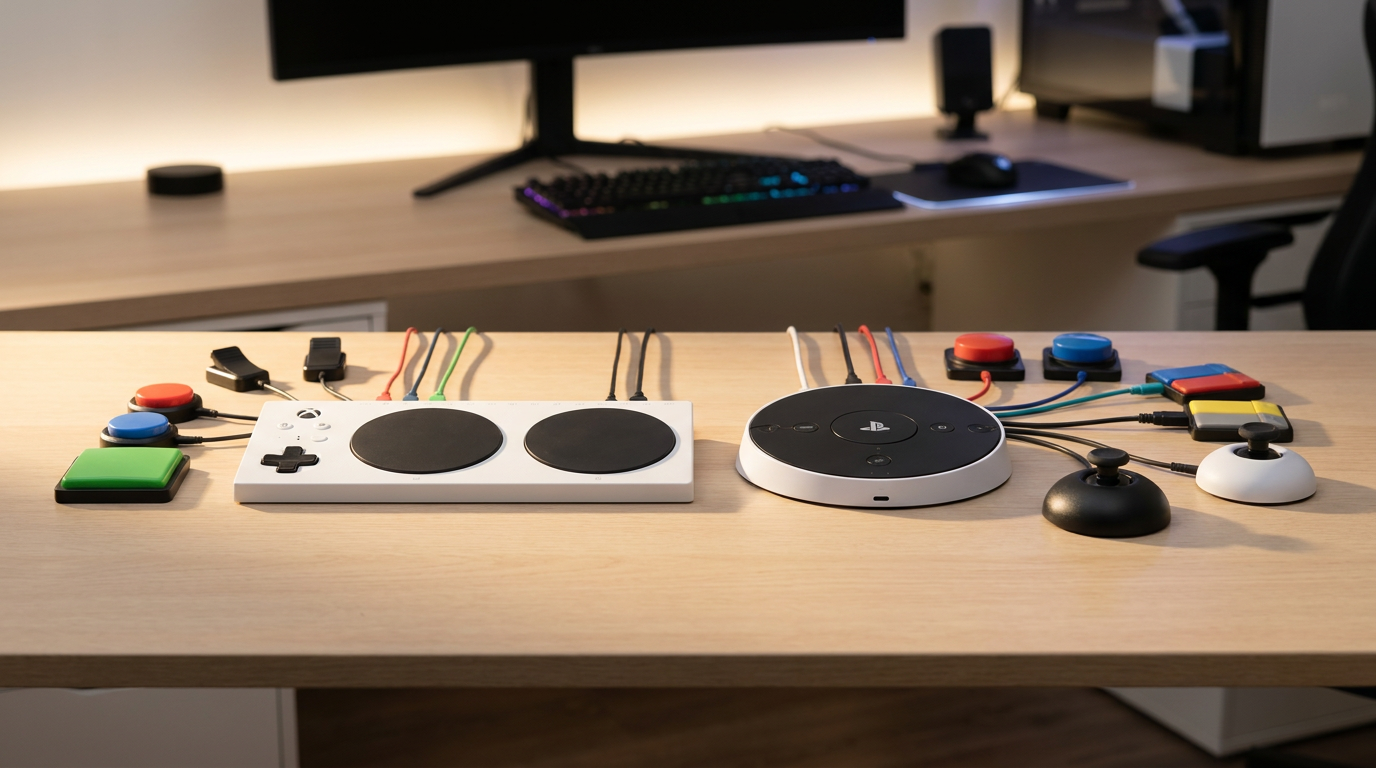
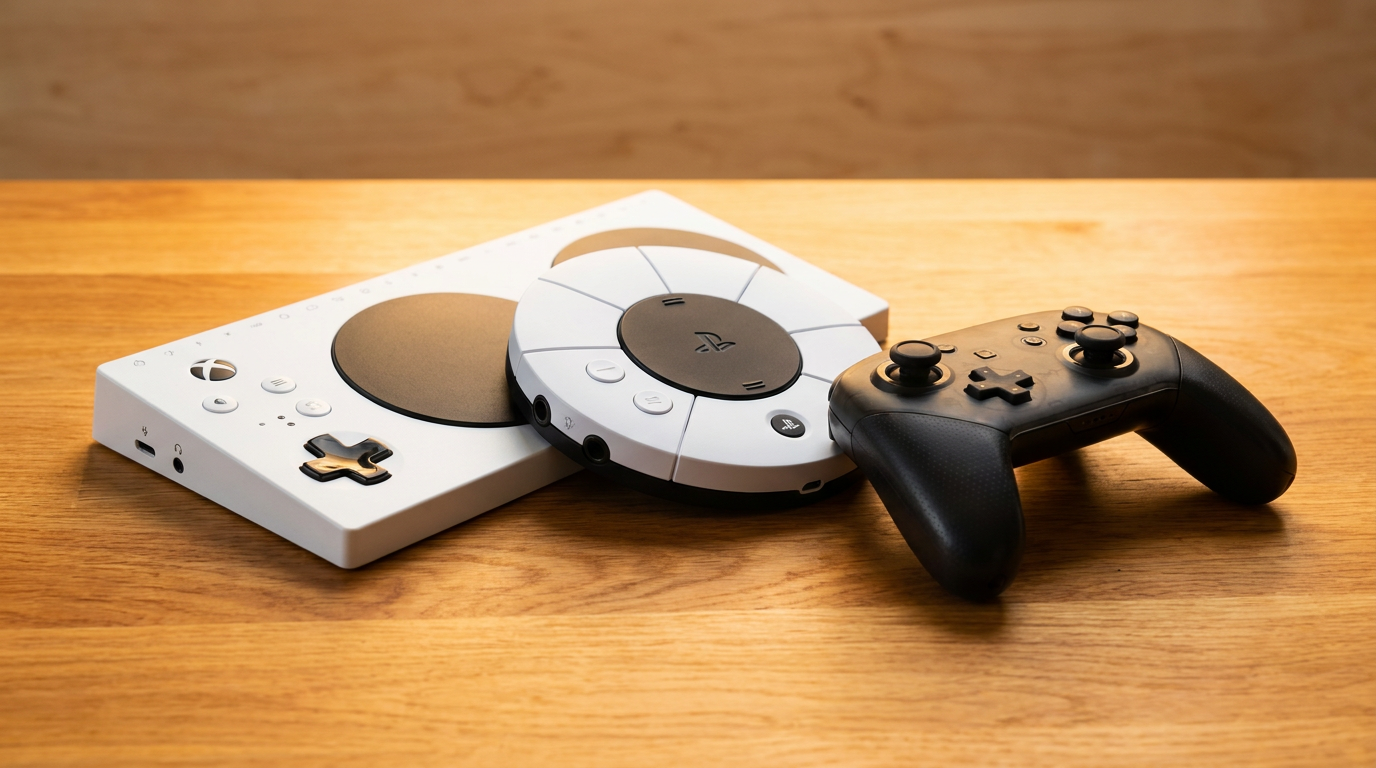
The core of the Universal Adaptive Standard is a native firmware handshake that allows officially licensed accessibility hardware to function seamlessly across rival platforms. When the firmware updates roll out this fall, a player will be able to plug a PlayStation Access Controller into an Xbox Series X, or connect an Xbox Adaptive Controller to a PlayStation 5 or Nintendo Switch, and have the console recognize it immediately. The system will automatically translate the inputs to match the host console's native architecture, preserving custom button maps and switch configurations without triggering security flags.[1][4][6]
For the disabled gaming community, this cross-platform compatibility resolves one of the most persistent and expensive barriers to entry: the "disability tax." Adaptive gaming setups are highly individualized and notoriously costly. A base controller hub typically runs between $90 and $100, but the specialized external switches, joysticks, and mounting rigs required to accommodate specific mobility needs can push the total cost well past $300.[5]
Previously, a disabled player who wanted to enjoy a PlayStation exclusive like Marvel's Wolverine and an Xbox exclusive like Fable had to purchase and configure two entirely separate adaptive setups. The alternative was relying on unauthorized third-party adapter dongles, which were frequently—and sometimes permanently—disabled by routine console security updates aimed at thwarting multiplayer cheaters. The UAS eliminates this friction entirely, allowing players to invest in a single, high-quality adaptive rig that travels with them across the entire gaming landscape.[3][5][6]

The hardware breakthrough is paired with a robust software framework that builds directly upon the Entertainment Software Association's 2025 Accessible Games Initiative. That earlier initiative successfully standardized 24 accessibility tags across digital storefronts, allowing players to filter games by features like "Full Input Remapping," "Narrated Menus," and "Color Alternatives." The UAS takes this taxonomy and bakes it into a unified developer API.[2][4]
By standardizing the software hooks for these features, the UAS dramatically reduces the development overhead required to implement deep accessibility options. Instead of building bespoke control-remapping logic for PlayStation's operating system and a completely different set of logic for Xbox, developers can utilize the UAS API to ensure their game interfaces correctly with any certified adaptive hardware on any platform.[1][6]
By standardizing the software hooks for these features, the UAS dramatically reduces the development overhead required to implement deep accessibility options.
Industry analysts view the collaboration as a rare but highly logical moment of synergy between fierce competitors. While Microsoft, Sony, and Nintendo fiercely guard their standard controller ecosystems—you still cannot use a standard DualSense on an Xbox—they recognized that accessibility hardware represents a fundamentally different market dynamic. By unifying the adaptive standard, they are not cannibalizing their own hardware sales; rather, they are expanding the total addressable market for their software.[3][6]
The demographic imperative behind the move is undeniable. According to data highlighted by the ESA, over 44 million residents in the United States alone live with a disability, and nearly half of them play video games. As gaming has solidified its position as the dominant form of modern entertainment and a crucial social outlet, ensuring that this massive demographic can actually play the games their friends are playing has become both a moral and commercial priority.[2][5]

The ripple effects of the UAS are expected to invigorate the third-party peripheral market. Companies like Logitech, Hori, and 8BitDo, which manufacture the specialized switches and joysticks that plug into these adaptive hubs, now have a single, massive unified market to target. Hardware developers anticipate that this economy of scale will drive down the manufacturing costs of specialized inputs, making accessible gaming more affordable across the board.[1][4]
The initiative also standardizes "Co-Pilot Mode" across all participating platforms. Originally pioneered by Xbox, this feature allows two separate controllers to be registered by the console as a single player. It enables a disabled gamer to handle the inputs they are comfortable with—such as using their feet to operate pedals for acceleration in a racing game—while a friend or family member uses a standard controller to handle steering. Under the UAS, this collaborative approach to input will become a system-level requirement for all consoles.[1][3][5]
Accessibility advocates, who have spent years campaigning for exactly this kind of interoperability, are celebrating the announcement as a historic milestone. For years, the burden of accessibility has been placed squarely on the shoulders of disabled players, who had to become amateur engineers just to wire together a functional setup. The UAS shifts that burden back onto the platform holders, where it belongs.[5][6]

The rollout of the Universal Adaptive Standard will begin in September 2026, with synchronized system updates pushed to the PlayStation 5, Xbox Series X/S, and Nintendo Switch. The update will include a new, unified accessibility dashboard on each console, allowing players to manage their cross-platform hardware profiles in one place.[1][4]
Looking further ahead, the ESA has confirmed that starting in late 2027, full compliance with the UAS software API will become a mandatory requirement for any new game seeking certification on these major consoles. Games that fail to support the universal input remapping standards will simply not be allowed on the digital storefronts, ensuring that the baseline for accessibility continues to rise.[2]
Ultimately, the Universal Adaptive Standard represents a maturation of the medium. Video games are fundamentally about interactive connection, and the industry has collectively decided that the physical hardware required to make that connection should no longer serve as a barrier to entry. By tearing down the walls between their consoles, the industry's biggest rivals have ensured that the future of play is genuinely open to everyone.[3][5][6]
How we got here
September 2018
Microsoft launches the Xbox Adaptive Controller, pioneering first-party accessible hardware.
December 2023
Sony releases the PlayStation Access Controller, expanding first-party options to the PS5 ecosystem.
March 2025
The ESA unveils the Accessible Games Initiative, standardizing 24 accessibility tags on digital storefronts.
January 2026
CES 2026 highlights 'Gaming for All' as a major industry trend, setting the stage for hardware unification.
June 2026
Microsoft, Sony, and Nintendo announce the Universal Adaptive Standard at Summer Game Fest.
Viewpoints in depth
Accessibility Advocates
Celebrate the move as a historic dismantling of the 'disability tax' that has long gatekept the gaming community.
For years, advocacy groups have pointed out that gaming is uniquely expensive for disabled players. Because standard controllers require high manual dexterity, players with limited mobility have had to purchase expensive hubs and specialized switches. Buying a $200 setup for an Xbox, and then another $200 setup to play a PlayStation exclusive, priced many out of the medium entirely. Advocates view the UAS as a monumental victory that shifts the technical and financial burden away from the player and onto the multi-billion-dollar platform holders.
Industry Analysts
View the treaty as a logical expansion of the total addressable market that doesn't cannibalize standard hardware sales.
Market analysts note that the console wars are usually defined by strict walled gardens—Sony wants you buying Sony hardware, and Microsoft wants you buying Microsoft hardware. However, accessibility peripherals are a low-margin, niche hardware category that exists primarily to sell high-margin software. By allowing cross-platform compatibility for these specific devices, the console makers aren't losing lucrative standard controller sales. Instead, they are ensuring that a demographic of over 40 million potential players can easily buy and play their games, regardless of which plastic box sits under their TV.
Hardware Developers
Focus on the technical achievement of unifying the APIs and the new economies of scale for third-party peripheral makers.
From an engineering perspective, translating the distinct input languages of the PS5, Xbox Series X, and Nintendo Switch into a single standard is a massive achievement. Third-party manufacturers like Logitech and Hori are particularly thrilled. Previously, they had to design, manufacture, and license different adaptive switches for different consoles, keeping production runs small and prices high. With a unified standard, they can manufacture a single line of accessible peripherals for the entire global console market, which is expected to drive down consumer prices significantly.
What we don't know
- Whether older, legacy games will be patched to support the new UAS software API.
- How PC gaming storefronts like Steam and Epic Games will integrate the console-driven standard.
- The exact pricing impact on third-party peripheral switches once the unified market scales up.
Key terms
- Universal Adaptive Standard (UAS)
- A joint hardware and software agreement allowing certified accessibility controllers to function natively across rival gaming consoles.
- Adaptive Controller
- A highly customizable gaming input device designed for players with limited mobility, often featuring large buttons and ports for external switches.
- Co-Pilot Mode
- A feature that links two separate controllers to act as a single player, allowing a friend or family member to assist with complex inputs.
- API (Application Programming Interface)
- A set of rules that allows different software programs to communicate with each other, in this case allowing games to understand inputs from any adaptive controller.
Frequently asked
What does the Universal Adaptive Standard do?
It allows officially licensed accessibility controllers, like the PlayStation Access or Xbox Adaptive Controller, to work natively on any participating console without requiring third-party adapters.
When will the cross-platform support go live?
Firmware updates enabling the UAS are scheduled to roll out to the PS5, Xbox Series X/S, and Nintendo Switch in Fall 2026.
Will standard controllers work cross-platform too?
No. The agreement strictly applies to certified accessibility hardware, not standard DualSense, Xbox Wireless, or Switch Pro controllers.
Do I need to buy a new adaptive controller?
No. Existing first-party adaptive controllers will be updated via firmware to support the new cross-platform standard.
Sources
Source coverage
6 outlets
3 viewpoints surfaced






[1]IGNIndustry Analysts
Summer Game Fest 2026: Xbox, PlayStation, and Nintendo Announce Universal Adaptive Standard
Read on IGN →[2]GameSpotHardware Developers
The ESA's Accessible Games Initiative Evolves: Cross-Platform Controller Support is Finally Here
Read on GameSpot →[3]EurogamerAccessibility Advocates
Why the Universal Adaptive Standard is the Biggest Announcement of Summer Game Fest 2026
Read on Eurogamer →[4]EngadgetHardware Developers
Sony, Microsoft, and Nintendo tear down the hardware wall for disabled gamers
Read on Engadget →[5]Access-AbilityAccessibility Advocates
A Historic Win: What the Universal Adaptive Standard Means for Disabled Players
Read on Access-Ability →[6]The VergeIndustry Analysts
The console wars pause for a major accessibility breakthrough at SGF 2026
Read on The Verge →

More in entertainment
See all 6 stories →Pixar Animation
'Toy Story 5' Premieres to Critical Acclaim as Pixar Tackles the Screen-Time Era
0 sources

Toy Story 5
Toy Story 5 Premieres With Taylor Swift Original Song, Tackling the Modern Dilemma of Screen Time
0 sources
Awards History
The EGOT Explained: How Entertainment's Ultimate Crown is Actually Won
0 sources

Game Accessibility
Gaming Giants Unite to Launch Universal Accessibility Standard Across All Consoles
0 sources
Every angle. Every day.
Get entertainment stories with full source coverage and perspective breakdowns delivered to your inbox.