
Legal Challenge to Trump's D.C. Arch Threatens to Overturn 127-Year-Old Height of Buildings Act
The Trump administration's push to build a 250-foot triumphal arch in Washington D.C. relies on a novel legal theory that exempts federal projects from the city's historic 130-foot height limit.
By Joao Marques

Share this story
The Washington D.C. skyline is defined by its horizontality, a deliberate design choice that keeps the U.S. Capitol and the Washington Monument as the undisputed focal points of the city. For over a century, this low-slung profile has been fiercely protected by strict federal law, ensuring that no commercial skyscraper or modern monument can overshadow the historic core.
But a massive new commemorative project is now testing the absolute limits of that legislation, threatening to establish a legal precedent that could permanently alter the architectural fabric of the nation's capital. The dispute pits executive ambition against century-old urban planning principles, raising fundamental questions about who controls the visual identity of Washington.[1][3]
At the center of the escalating dispute is a proposed 250-foot triumphal arch, championed by President Donald Trump as a legacy monument for the United States' 250th anniversary in 2026. Slated for Memorial Circle—a highly visible traffic roundabout situated directly between the Lincoln Memorial and Arlington National Cemetery—the concrete and granite structure is designed to be a dominant new feature on the Potomac River.
The architectural plans feature a 166-foot mezzanine, a sprawling public observation deck, and a towering 60-foot statue of Lady Liberty capping the structure. If completed, it would be roughly 30 feet taller than the Plaza de la República in Mexico City, currently the largest triumphal arch in the world, fundamentally shifting the scale of monuments in the American capital.[2]
The sheer scale of the project immediately clashes with one of the most famous urban planning laws in the country: the Height of Buildings Act. Originally enacted by Congress in 1899 and significantly updated in 1910, the law was designed specifically to prevent the proliferation of steel-frame skyscrapers from overwhelming the city's historic, neoclassical character.
It strictly caps most construction in the District of Columbia at 130 feet, or roughly half the height of the proposed arch. The legislation ties maximum building heights to the width of the adjacent street, ensuring that light and air can reach the pavement while preserving the sweeping, unobstructed vistas that define the L'Enfant Plan for the city.[1]
For decades, the National Capital Planning Commission (NCPC)—the central federal agency responsible for reviewing and approving development in the capital region—has consistently applied the Height Act to both private commercial developments and federal construction projects. However, the Trump administration is now advancing a novel and highly controversial legal interpretation to bypass the restriction. Administration lawyers argue that the 127-year-old statute functions merely as a local zoning ordinance intended for private real estate, and therefore does not legally bind the federal government when constructing monuments on federal land.[1]
This aggressive legal theory was formalized in a June 2026 memorandum issued by the Department of the Interior, the cabinet agency that oversees the federal land designated for the arch. The internal memo concluded unequivocally that federal buildings are exempt from the Height Act, a stance that would abruptly reverse a long-held NCPC policy.
Will Scharf, the Trump-appointed chairman of the NCPC and a White House staff secretary, publicly echoed this argument during commission hearings. Scharf stated that applying the local height law to federal projects raises serious issues of sovereign immunity, suggesting that doing so would inappropriately give local D.C. courts jurisdiction over federal commemorative works.[1]
To support their case for an exemption, proponents point to historical anomalies in the capital's architecture. Scharf specifically cited the National Archives Building on Pennsylvania Avenue, which was constructed in 1932 and reaches a height of 166 feet, bypassing the standard limits without receiving an explicit congressional waiver. By framing the Height Act as historically flexible and legally inapplicable to federal land, the administration aims to clear the path for the 250-foot arch without needing to shrink its grand proportions or seek a difficult legislative exemption from a divided Congress.[1]
The administration's legal maneuvering has sparked intense internal friction within the NCPC's own ranks. Ahead of a crucial July 9 meeting, the commission's career staff and general counsel, Meghan Hottel-Cox, authored a comprehensive 185-page report explicitly warning against the administration's new interpretation.
Hottel-Cox cautioned that exempting federal property from the Height Act could fundamentally reshape the city's architectural fabric and severely disrupt the delicate balance of local versus federal planning authority. The staff report emphasized that the act has been a key limiting principle for federal projects since at least 1938, and abandoning it now would invite a wave of oversized federal construction.[3]
In their report, the NCPC career staff initially recommended that the commission require the arch's designers to redistribute its height—shrinking the main structure, the habitable roof, and the statuary—to comply with the strict 130-foot limit.
However, in a highly unusual procedural move during the July hearing, Chairman Scharf successfully moved to strike those legal warnings entirely from the executive director's report. Following the redaction, the commission, which is composed largely of administration appointees, voted 8-1 to grant preliminary approval for the site plan, effectively ignoring the staff's plea for height compliance.[2]
While the preliminary approval allows the architectural planning to advance, the NCPC deliberately deferred a final, binding ruling on whether the Height Act applies to federal projects until its next scheduled meeting in September. This strategic delay sets the stage for a high-stakes legal and political showdown, as opponents of the arch mobilize to block the construction on multiple statutory fronts before ground can be broken. The September vote will serve as the ultimate test of whether the executive branch can unilaterally rewrite the rules of Washington's skyline.[2]
Beyond the constraints of the Height Act, the arch project faces significant legal hurdles under the Commemorative Works Act of 1986. This federal statute mandates that any new monument or memorial placed on federal land in Washington must receive express, prior authorization from Congress.
A coalition of Democratic lawmakers recently sent a scathing letter to Interior Secretary Doug Burgum, warning that proceeding with the monument via executive order blatantly violates this statute. The lawmakers cautioned that any officials or private contractors directing the work without congressional approval proceed at their own peril, threatening personal fines, suspension, or even criminal consequences.
The visual and cultural impact of the massive arch has also drawn fierce opposition from preservationists, urban architects, and military families. At 250 feet, the structure would entirely dwarf the adjacent 99-foot Lincoln Memorial and obstruct the carefully designed, symbolic sightline connecting the memorial to Arlington National Cemetery.
This specific vista was originally intended by city planners to represent the reunification of the North and the South after the Civil War, offering a solemn, unobstructed view from the monument of the Great Emancipator to the rolling hills where the nation's military dead are buried.[2]
During the NCPC's public comment period, which drew nearly 1,700 overwhelmingly negative submissions, witnesses argued that the sheer scale of the arch would clutter a solemn historic landscape. Critics pointed out that the proposed 32 traffic poles and towering 20-foot lighting stanchions would turn a quiet memorial space into a glaring spectacle.
Cynthia Morrison, a Gold Star mother, testified passionately that the open space between the monuments is not merely empty land awaiting development, but a vital, breathing part of the area's commemorative power that would be destroyed by a 25-story concrete structure.
Despite the overwhelming public pushback and the looming legal threats, the administration is pursuing an aggressive, fast-tracked timeline to ensure the monument is ready for the 2026 semiquincentennial. National Park Service documents filed to the federal register indicate plans for a grueling schedule of 20-hour construction days over a two-year period.
If the NCPC ultimately rules in September that the Height Act does not apply, it will not only greenlight the arch but potentially open Washington's famously flat skyline to a new era of towering federal architecture, ending over a century of strict urban preservation.
Key points
- The Trump administration is seeking to build a 250-foot triumphal arch in Washington D.C. for the nation's 250th anniversary.
- The project violates the 1910 Height of Buildings Act, which generally caps construction in the capital at 130 feet.
- The Interior Department and NCPC leadership argue the law functions as a local zoning code that does not apply to federal buildings.
- NCPC career staff warned that exempting federal projects would permanently alter the city's historic horizontal skyline.
What we don’t know
- Whether the National Capital Planning Commission will ultimately vote in September to officially exempt federal projects from the Height Act.
- How federal courts will rule if lawmakers or preservationists sue to enforce the Commemorative Works Act.
- Whether the aggressive two-year construction timeline can be maintained amid mounting legal and bureaucratic challenges.
How we got here
1899 & 1910
Congress passes and amends the Height of Buildings Act, capping D.C. structures to preserve the skyline.
1932
The National Archives Building is constructed at 166 feet, a precedent now cited by the administration.
June 2026
The Interior Department issues a memo arguing the Height Act does not apply to federal buildings.
July 9, 2026
The NCPC votes 8-1 to approve preliminary site plans, striking staff warnings about the Height Act.
September 2026
The NCPC is scheduled to make a final ruling on whether the height limits bind federal projects.
- Preservation & Process Focus
- Highlights the internal agency dissent, the historical precedent of the Height Act, and the visual impact on the capital.
- Executive Authority Focus
- Focuses on the administration's legal maneuvering, sovereign immunity arguments, and the push to bypass the Height Act.
- Congressional Oversight Focus
- Centers on the legislative pushback, the Commemorative Works Act, and threats of legal consequences for officials.
Perspectives this story doesn't cover
- Local D.C. residents and urban planners concerned about traffic and infrastructure impacts at Memorial Circle.
- Private real estate developers who might seek similar height exemptions if the federal government bypasses the law.
Sources
Source coverage
3 outlets
3 viewpoints surfaced



- [1]The Washington PostExecutive Authority Focus
Trump administration argues D.C. Height Act doesn't apply to 250-foot arch
Read on The Washington Post → - [2]The GuardianPreservation & Process Focus
California ‘billionaire tax’ makes ballot despite opposition from tech moguls
Read on The Guardian → - [3]Fast CompanyExecutive Authority Focus
As Trump's D.C. arch gets another review, officials are asking for these design changes
Read on Fast Company →

More in Culture
See all →Urban Planning
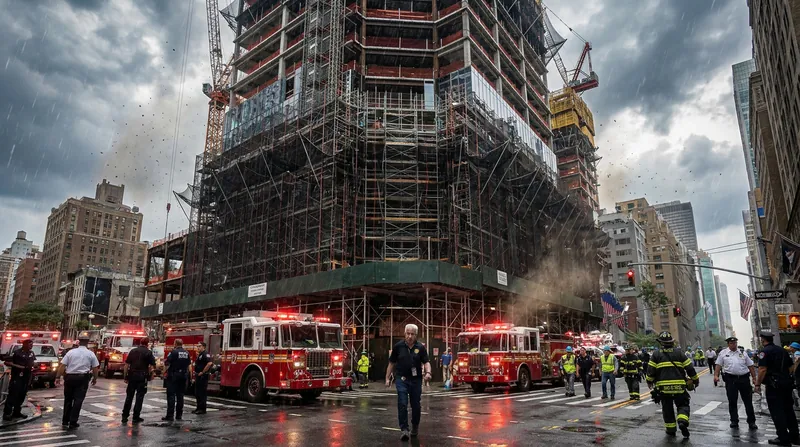
The Engineering Challenge Behind NYC's Near-Collapse of a 37-Story Office Conversion
3 sources
Sustainable Architecture
The Rise of the 'Plyscraper': How Mass Timber is Rewriting the Rules of High-Rise Construction
6 sources
Mass Timber
How 'Plyscrapers' Are Replacing Concrete and Changing the Global Skyline
4 sources

Mass Timber
How Mass Timber is Replacing Concrete to Build the Next Generation of Skyscrapers
5 sources
Comments
Every angle. Every day.
Get Culture stories with full source coverage and perspective breakdowns, free every day.