
La Liga's $875 Million Transfer Window: The Strategy to Avoid Being Priced Out by the Premier League
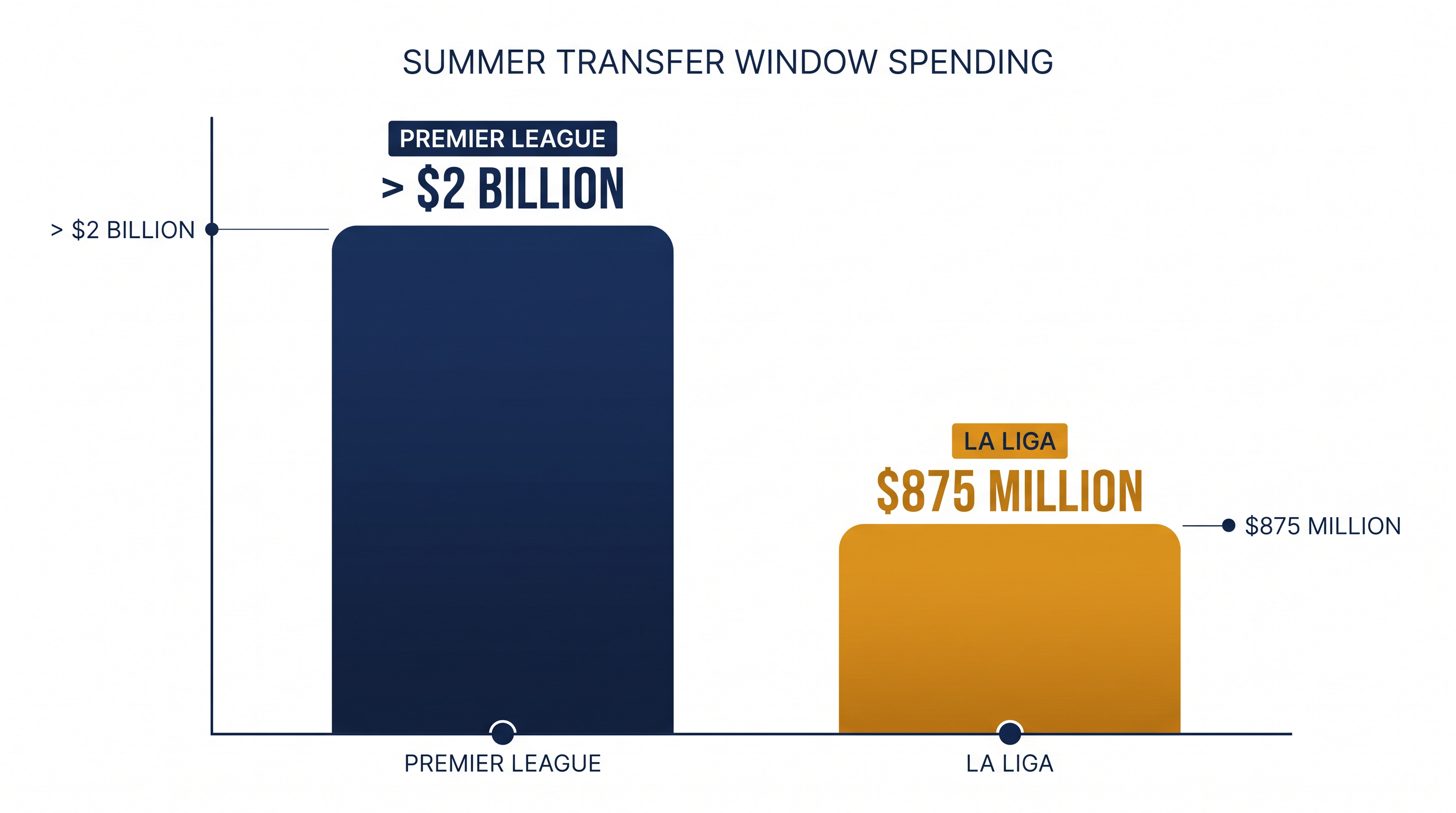
As the Premier League's summer spending eclipses $2 billion, La Liga is countering with a projected $875 million outlay focused on strict financial sustainability and targeted blockbuster signings.
By Omar Haddad


- League Administrators
- Focuses on financial sustainability and preventing a market bubble.
- Mid-Table Supporters
- Frustrated by the inability to compete financially and the strict FFP rules.
- The Elite Giants
- Focused on maintaining Champions League dominance through targeted blockbuster signings.
Why this matters
The widening financial gap between Europe's top football leagues dictates where the world's best talent plays, directly impacting the quality of competition in the Champions League and the long-term survival of historic clubs.
Key points
- La Liga's total summer transfer spending is projected to reach $875 million, compared to the Premier League's $2 billion-plus outlay.
- League executives warn that English spending is creating an inflationary bubble that leads to 'value destruction' in the transfer market.
- Real Madrid, Barcelona, and Atlético Madrid continue to spend heavily on targeted marquee signings, including Real Madrid's €140 million acquisition of Yan Diomande.
- Mid-table Spanish clubs are pivoting to youth development and shrewd scouting to survive the financial disparity.
- La Liga maintains that strict financial fair play rules are essential for the long-term sustainability of Spanish football.
$875 million. That is the projected total outlay for Spain's 20 top-flight clubs before the summer transfer window slams shut. Across the English Channel, Premier League clubs have already blasted past the staggering $2 billion mark with a full month left on the clock. The financial gulf between Europe's two premier footballing institutions has never been wider, forcing La Liga into a high-stakes balancing act. Spanish executives are now tasked with figuring out how to remain competitive on the pitch and relevant in the global broadcasting market without getting sucked into an inflationary bubble that threatens to bankrupt the unwary. The sheer scale of English spending has fundamentally altered the mechanics of the transfer market, leaving continental clubs scrambling to adapt.[1][2]
The strategy emerging from Spanish front offices is distinctly two-pronged, reflecting the growing financial disparity within the league itself. At the summit, heavyweights Real Madrid, Barcelona, and Atlético Madrid are still flexing their financial muscle to secure marquee talent, executing surgical strikes rather than scattergun spending to ensure they remain Champions League contenders. Below them, the remaining 17 clubs are doubling down on youth academies, strict financial sustainability, and shrewd scouting networks. They are attempting to survive an era where English relegation candidates routinely outspend Spanish teams that regularly qualify for European competitions. This dual approach highlights a league attempting to protect its middle class while allowing its giants to continue competing for the sport's most coveted prizes.[1][5]
"In our view, that spending spree by the Premier League isn't investment—it's value destruction," noted Marta Alonso, La Liga's deputy corporate managing director, in a stark assessment of the current landscape. She points to the inflated transfer fees and wages sweeping the market, arguing that English clubs are paying astronomical sums for players who simply aren't worth the price tag. This creates a dangerous market dynamic, forcing continental clubs to either overpay drastically or step away from the negotiating table entirely. By artificially inflating the cost of average players, the Premier League's financial dominance makes it increasingly difficult for Spanish teams to find value in the open market, prompting a strategic retreat toward internal development.[1][2]
Despite the structural warnings and calls for restraint, Spain's traditional giants are not sitting out the summer arms race. Real Madrid shattered their club record by securing 19-year-old Ivorian winger Yan Diomande from RB Leipzig for a staggering €140 million, signaling their intent to build a new dynasty. Los Blancos also added Chelsea's Marc Cucurella for €55 million and Inter's Denzel Dumfries for €20 million. To balance the books, they scooped up Bernardo Silva and Ibrahima Konaté on highly lucrative free transfers, fortifying their squad for a grueling 2026-27 campaign without paying massive fees to rival clubs. It is a calculated gamble that relies on their immense global revenue to absorb the high wage demands of top-tier talent.[3][4]
Despite the structural warnings and calls for restraint, Spain's traditional giants are not sitting out the summer arms race.
Barcelona, still navigating their own well-documented financial tightrope, have managed to restructure enough capital to make significant waves in the market. The Catalan club landed Newcastle United's Anthony Gordon for €80 million and Borussia Dortmund's Karim Adeyemi for €22 million, injecting much-needed pace into their attacking lines. Across town, Atlético Madrid breached the €100 million spending mark by bringing in Sporting CP's Morten Hjulmand, Paris Saint-Germain's Lee Kang-in, and Bayer Leverkusen's Alejandro Grimaldo. For these three clubs, the strategy remains clear: they must continue to acquire world-class talent to maintain their status as global brands, even if it means stretching their budgets to the absolute limit under La Liga's watchful eye.[1][4]
But outside that elite trio, the reality of La Liga's market is starkly different and heavily constrained. Clubs like Real Betis and Getafe have made modest €15 million to €20 million investments following their respective European qualifications, while the vast majority of the league operates on shoestring budgets. For these clubs, the Premier League's financial dominance is a constant, looming threat, turning every transfer window into a defensive battle to shield homegrown stars from deep-pocketed English suitors. When a mid-table Premier League side can casually trigger a €40 million release clause, Spanish clubs are forced to constantly rebuild their squads, relying on their famed academies to produce the next generation of talent before they, too, are poached.[1][2]

The disparity has sparked intense debate among supporters, analysts, and club executives across the Iberian Peninsula. Critics point out that strict domestic financial fair play regulations, championed by La Liga president Javier Tebas, have left mid-table Spanish clubs fighting for scraps while their English counterparts spend with impunity. When a newly promoted Premier League side can offer double the wages of a historic Spanish institution, the competitive balance of European football fundamentally shifts. This dynamic has led some fans to fear a massive talent drain that could render the league entirely top-heavy, reducing the domestic competition to a three-horse race while the rest of the division simply makes up the numbers.[5]
Yet La Liga executives remain steadfast in their belief that strict financial controls are the only viable path to long-term survival in an overheated market. By refusing to match the Premier League's spending euro for euro, Spanish football is betting that sustainable growth, world-class youth development, and the enduring prestige of clubs like Real Madrid and Barcelona will be enough to keep the league at the pinnacle of the global game. They argue that the English bubble will eventually burst, leaving financially prudent clubs in a position of strength. The true test of that philosophy will unfold on the pitch when the Champions League knockout stages arrive next spring, pitting Spain's calculated investments against England's bottomless wallets.[2]
Viewpoints in depth
La Liga Executives
League officials argue that strict financial controls are necessary to prevent a market bubble from destroying clubs.
Administrators like Marta Alonso maintain that the Premier League's spending is unsustainable 'value destruction.' By enforcing strict salary caps and financial fair play rules, La Liga aims to protect its clubs from bankruptcy, arguing that paying inflated transfer fees ultimately harms the sport's ecosystem. They believe that investing in infrastructure and youth academies will yield better long-term results than engaging in bidding wars.
Mid-Table Spanish Clubs
Smaller teams feel squeezed by both the Premier League's wealth and La Liga's strict domestic spending rules.
For the majority of Spain's top flight, the transfer window is an exercise in survival. These clubs argue that while financial responsibility is important, the current regulations make it nearly impossible to compete for talent or retain their best players. When English relegation candidates can easily outbid Spanish teams competing in Europe, mid-table clubs are forced to rely almost entirely on free transfers, loan deals, and unproven academy prospects.
The Elite Giants
Real Madrid, Barcelona, and Atlético Madrid continue to leverage their global brands to attract top-tier talent despite market inflation.
The traditional powerhouses operate in a different financial stratosphere. While they acknowledge the Premier League's overall financial dominance, these clubs rely on their historic prestige and massive global revenue streams to secure marquee signings like Yan Diomande and Anthony Gordon. Their strategy involves making fewer, but more impactful, high-value acquisitions while supplementing the squad with strategic free transfers.
Sources
Source coverage
5 outlets
3 viewpoints surfaced





[1]ASLeague Administrators
LaLiga expects total spending to reach $875 million in a window marked by inflated player prices
Read on AS →[2]DafaNewsLeague Administrators
La Liga raises concern over Premier League's transfers
Read on DafaNews →[3]ForbesThe Elite Giants
The World's Most Valuable Soccer Teams
Read on Forbes →[4]BetinfThe Elite Giants
Major transfers in Spanish Primera Liga
Read on Betinf →[5]RedditMid-Table Supporters
La Liga teams have spent just €13.7M this transfer window. The Premier League has spent more than 25 times that amount.
Read on Reddit →
Comments

More in sports
See all 17 stories →Bundesliga Shift
Wolfsburg Suffers Historic First Relegation as Schalke and Elversberg Join Bundesliga Lineup
3 sources

Transfer Market
Como 1907 Stuns Serie A with €35M Signing of Chelsea Defender Trevoh Chalobah
5 sources

Champions League
Late Ajax Penalty Eliminates Rangers in Champions League Qualifying Third Round
3 sources

Transfer Market
Elliot Anderson's £116M Move to Manchester City Reshapes the Premier League Title Race
7 sources
Every angle. Every day.
Get sports stories with full source coverage and perspective breakdowns delivered to your inbox.