
Japan's Borrowing Costs Hit 30-Year High, Triggering Global Bond Market Sell-Off
The yield on Japan's benchmark 10-year government bond has breached 3% for the first time since 1996, forcing a massive unwinding of the yen carry trade and driving up borrowing costs globally.

Share this story
For the last two decades, global financial markets have relied on a single, seemingly immutable law of physics: borrowing money in Japan is practically free. That era has abruptly ended, and the consequences are poised to ripple through American mortgages, European equities, and global corporate debt.
The unwinding of Japan's ultra-loose monetary policy is no longer a localized economic shift; it is actively draining liquidity from the international financial system. As the cost of capital rises in the world's fourth-largest economy, investors everywhere are being forced to recalibrate their portfolios, preparing for a fundamentally different macroeconomic environment where cheap money can no longer be taken for granted.
On Tuesday, the yield on Japan's benchmark 10-year government bond breached the 3% threshold for the first time since September 1996. This marks a staggering reversal for a nation that maintained negative interest rates as recently as early 2024.
Because bond yields move inversely to prices, the surge reflects a massive, sustained sell-off by bondholders reacting to energy-driven inflation and worsening fiscal conditions. The psychological impact of crossing the 3% barrier has sent shockwaves through trading desks from Tokyo to London, signaling that the Bank of Japan's long-standing grip on its domestic bond market is finally slipping.[1][2][4]
To understand why a domestic Japanese bond metric triggers global anxiety, one must look at the mechanics of the 'yen carry trade.' For years, institutional investors borrowed yen at near-zero interest rates, converted those funds into dollars or euros, and invested in higher-yielding assets abroad, such as U.S. Treasuries or technology stocks. This strategy effectively subsidized global asset prices with cheap Japanese capital, creating a massive, interconnected web of leverage that relied entirely on the Bank of Japan keeping its interest rates pinned to the floor.[1]
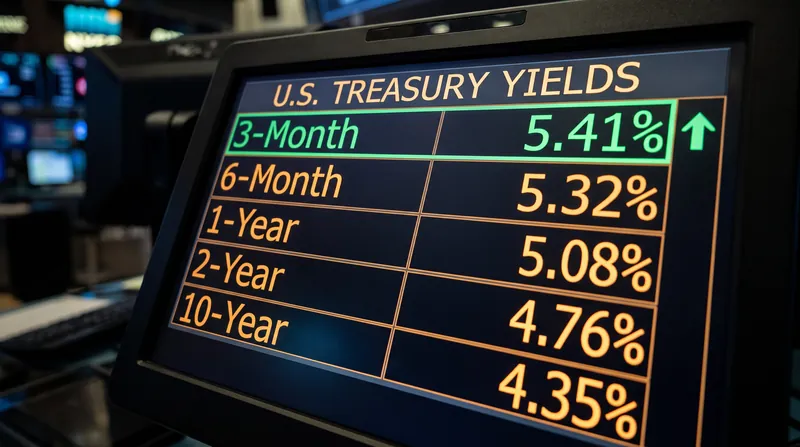
As Japanese yields rise, the mathematical foundation of the carry trade collapses. Investors are forced to sell their global assets to repay their increasingly expensive yen-denominated loans. This mass liquidation drains liquidity from global markets, pushing up borrowing costs everywhere from Wall Street to Frankfurt. The effects are already visible across major economies, with U.S. 10-year Treasury yields pushing toward 4.79% and Eurozone yields hitting fresh multi-year highs as traders scramble to adjust to the new reality of tighter global credit.[2][4]
The global bond rout is exacerbating a market already strained by heavy debt issuance and competing capital demands. Technology companies are aggressively raising money to fund the artificial intelligence boom, while the U.S. national debt load has surpassed an unprecedented $40 trillion. The sudden absence of cheap Japanese capital removes a crucial shock absorber for these massive borrowing needs, leaving government and corporate issuers to compete for a shrinking pool of available funds at significantly higher interest rates.[2][4]
Inside Japan, the 3% yield creates a severe fiscal headache that threatens to paralyze the government's economic agenda. The Japanese government carries a debt-to-gross domestic product ratio of 249%, representing one of the highest debt metrics in the developed world. Debt servicing is projected to cost the government a record 36.6 trillion yen—roughly $230 billion—next year, representing a 17% jump in a single year. This exploding interest burden severely limits the administration's ability to fund public services or stimulate growth.[5][6]
The Bank of Japan finds itself trapped between conflicting economic forces with no easy exit strategy. The country is highly dependent on crude oil imports, and a weak Japanese yen imports inflation directly through energy acquisitions. With domestic inflation climbing to 1.9% and marking three consecutive months on an upward trajectory, the central bank is under immense pressure to raise interest rates to support the currency and prevent the cost of living from spiraling out of control for everyday citizens.[5]
Yet, raising rates threatens to choke off an already fragile domestic economy that has struggled to gain momentum. Over the last four quarters, Japan's gross domestic product has expanded by an average of just 0.1%.
Higher borrowing costs could stifle corporate investment and consumer spending just as Prime Minister Sanae Takaichi's administration plans aggressive new budget outlays and record spending to revitalize the nation's industrial base and support an aging population. If the central bank moves too aggressively, it risks plunging the country back into the deflationary stagnation it spent decades trying to escape.[2][4][5]
The volatility has drawn intense international attention, particularly from Washington, where officials are monitoring the situation closely. U.S. Treasury Secretary Scott Bessent and Japanese Finance Minister Satsuki Katayama recently met during the Group of 20 summit in North Carolina to coordinate potential interventions. The U.S. administration is reportedly concerned that a disorderly unwinding of Japanese debt could destabilize American financial markets, weaken the yen further, and create a cascading liquidity crisis just as the Federal Reserve attempts to manage its own delicate economic soft landing.[3]
Market interventions have already begun in earnest as policymakers attempt to stem the bleeding. In July, the United States supported Japan's massive $100 billion intervention to prop up the yen against speculative attacks. More recently, the U.S. Treasury committed to doubling buybacks of long-dated Treasuries to provide temporary market support, signaling the depth of Washington's concern over rising global borrowing costs and the potential for a broader systemic shock if the Japanese bond market is allowed to spiral out of control.[3][4]
Global energy prices are adding fuel to the inflationary fire, complicating the central bank's calculus. Recent geopolitical tensions, including U.S. military actions targeting Iranian rocket launchers near the Strait of Hormuz, have pushed Brent crude above $92 a barrel.
This energy-driven inflation further pressures central banks worldwide to maintain tight monetary policies, leaving bond markets with little relief in sight and ensuring that the cost of capital will remain elevated for the foreseeable future. For Japan, which imports nearly all of its fossil fuels, the combination of a weak currency and rising oil prices is particularly punishing.[4]
For a generation of traders, Japanese government bonds were considered a stable, low-yield benchmark that anchored global finance. The psychological impact of a 3% yield forces a fundamental repricing of risk across every asset class.
It marks a definitive departure from the deflationary era where massive central bank purchases kept rates artificially suppressed, forcing investors to rethink how they view sovereign debt and demanding higher premiums for lending money to heavily indebted governments. This paradigm shift means that the era of 'free money' is officially over, replaced by a more historically normal, but painful, environment of positive real interest rates.[2][4]
Market participants are now bracing for the Bank of Japan's highly anticipated September policy meeting. Having already raised its policy rate to 1% in June—the highest in 31 years—analysts anticipate the central bank may accelerate the pace of rate increases, potentially moving the cost of borrowing to 1.25%. If that happens, the global bond sell-off could intensify, further tightening financial conditions for consumers and corporations worldwide and testing the resilience of a global economy that has grown addicted to cheap Japanese capital.[5][6]
Key points
- Japan's 10-year government bond yield surpassed 3% for the first time since September 1996.
- The surge threatens to unwind the 'yen carry trade,' draining cheap liquidity from global financial markets.
- U.S. 10-year Treasury yields have climbed toward 4.79% in response to the global bond sell-off.
- Japan's government faces a record 36.6 trillion yen ($230 billion) in debt servicing costs next year.
What we don’t know
- Whether the Bank of Japan will hike rates to 1.25% at its September meeting or hold steady to protect domestic growth.
- Exactly how much global capital is still tied up in the yen carry trade waiting to be unwound.
- If coordinated interventions by the U.S. Treasury and Japanese Finance Ministry can successfully stabilize the bond market without further rate hikes.
How we got here
Early 2024
The Bank of Japan maintains its long-standing policy of negative interest rates to combat deflation.
June 2026
The Bank of Japan raises its policy rate to 1%, marking the highest borrowing cost in 31 years.
July 2026
The United States supports Japan in a massive $100 billion currency intervention to prop up the weakening yen.
August 2026
The U.S. Treasury announces it will double buybacks of long-dated Treasuries to provide temporary support to volatile bond markets.
September 2026
The yield on Japan's 10-year government bond breaches 3% for the first time since September 1996.
- Global Bond Investors
- Focused on the systemic risk of unwinding the yen carry trade and the resulting global liquidity drain.
- Bank of Japan Policymakers
- Trapped between fighting imported inflation and protecting fragile domestic economic growth.
- Fiscal Analysts
- Concerned with the exploding cost of servicing Japan's massive sovereign debt burden.
Perspectives this story doesn't cover
- Japanese retail consumers facing higher domestic borrowing costs
- Emerging market economies vulnerable to capital flight
Sources
Source coverage
6 outlets
3 viewpoints surfaced



- [1]Financial TimesGlobal Bond Investors
Japan's borrowing costs hit 30-year high: what does it mean for global markets?
Read on Financial Times → - [2]The Straits TimesGlobal Bond Investors
Global bond rout deepens as Japan yield breaks key 3% barrier
Read on The Straits Times → - [3]The Japan TimesBank of Japan Policymakers
The 10-year Japanese government bond hit 3%, a 30-year high
Read on The Japan Times → - [4]KitcoGlobal Bond Investors
A sell-off in global bond markets deepened on Tuesday, with Japan's 10-year bond yield hitting 3%
Read on Kitco → - [5]EquitiBank of Japan Policymakers
Japan's bond yields hit the 3% mark, adding to BoJ policy challenges; USD/JPY rises
Read on Equiti → - [6]CryptoNewsFiscal Analysts
'Dear God': Japan's borrowing costs hit 30-year high
Read on CryptoNews →

More in Finance
See all →Market Mechanics
How Market Depth and Price-Time Priority Dictate the Execution Price of a Large Market Order
6 sources

Portfolio Theory
Using Capital Allocation Lines to Maximize Returns Along the Efficient Frontier
4 sources

Risk-Free Rate
The Near-Zero Duration and Minimal Default Risk That Make the 3-Month Treasury Bill the Standard Risk-Free Rate Proxy
7 sources
Derivatives Pricing
How Volatility, Time to Expiration, and the Risk-Free Rate Dictate the Theoretical Value of a European Option in the Black-Scholes Model
3 sources

Comments
Every angle. Every day.
Get Finance stories with full source coverage and perspective breakdowns, free every day.