
Intermittent Fasting vs. Calorie Counting: What the Latest Science Says About Weight Loss
Recent clinical trials and meta-analyses reveal that intermittent fasting and traditional calorie restriction yield nearly identical weight loss results, shifting the focus to behavioral sustainability.
By Factlen Editorial Team
- Clinical Consensus & Meta-Analysts
- Focus on the aggregate data showing physiological equivalence between the two methods.
- Fasting Protocol Researchers
- Highlight specific fasting schedules that may offer behavioral or adherence advantages.
- Lifestyle Synthesis Experts
- Emphasize that the choice between methods should be dictated by individual psychology and lifestyle fit.
What's not represented
- · Individuals with a history of disordered eating, for whom both tracking and fasting can be triggering.
- · Shift workers who struggle to maintain consistent fasting windows or meal schedules.
Why this matters
For years, dieters have agonized over finding the 'perfect' weight loss method. By proving that intermittent fasting and calorie counting are physiologically identical in their results, the latest science frees individuals to choose the approach that causes them the least psychological friction.
Key points
- Gold-standard 2026 reviews confirm intermittent fasting and calorie counting yield identical ~7% weight loss over 12 months.
- Both methods provide similar improvements to blood pressure, cholesterol, and blood sugar levels.
- Intermittent fasting works by naturally creating a calorie deficit, not through a unique fat-burning metabolic state.
- Calorie counting offers more flexibility in meal timing but often leads to tracking fatigue.
- Fasting removes the burden of counting calories but can disrupt social schedules and make protein goals harder to hit.
- Nutritionists now recommend choosing the method that best fits an individual's psychology and daily routine.
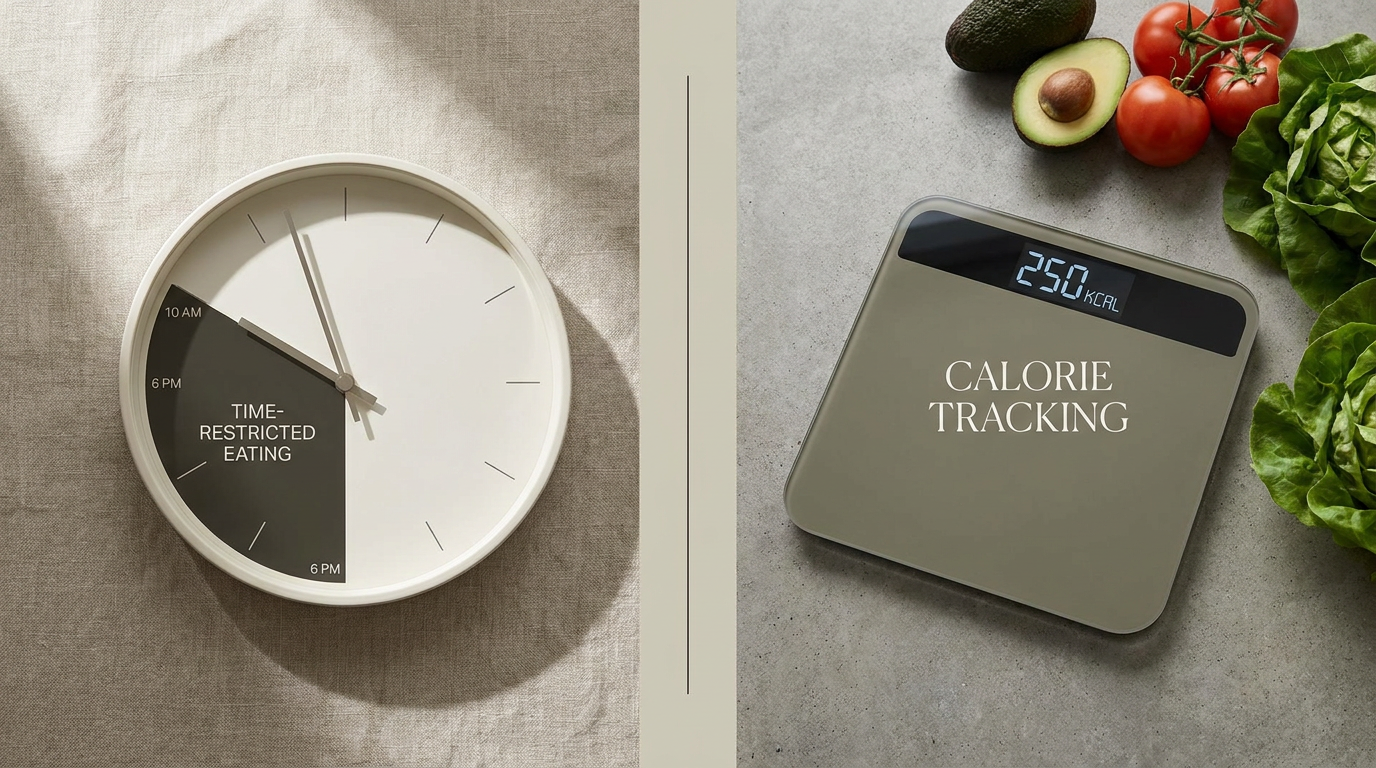
For the better part of a decade, the wellness industry has framed intermittent fasting and traditional calorie counting as rival philosophies. On one side, advocates of time-restricted eating argue that limiting food intake to specific hours unlocks unique metabolic advantages. On the other, traditional dietitians maintain that weight loss is purely a mathematical equation of calories in versus calories out.[5]
Now, a wave of high-quality clinical data published throughout 2025 and 2026 has settled the debate. According to multiple major meta-analyses, neither approach possesses a magical advantage over the other. Instead, they are simply different behavioral tools used to achieve the exact same physiological outcome: a sustained energy deficit.[1][2]
The most definitive verdict arrived in early 2026 via a comprehensive Cochrane review, considered the gold standard in evidence-based medicine. Analyzing 22 randomized controlled trials, researchers found that both intermittent fasting and continuous calorie restriction typically produce an identical 7% reduction in body weight over a six- to twelve-month period when participants receive adequate dietary support.[2]

"This review found absolutely no benefit of intermittent fasting on weight loss beyond simple restriction of calories," noted Dr. Adam Collins, an associate professor of nutrition who reviewed the findings. The data effectively dismantles the popular claim that fasting triggers a unique fat-burning state that outpaces traditional portion control.[2]
A parallel review led by the University of Toronto and published in The BMJ echoed these findings. Researchers tracked cardiometabolic factors—such as blood pressure, waist circumference, and cholesterol levels—and found that both dietary strategies yielded nearly identical health improvements. The primary driver of these benefits was the weight loss itself, rather than the specific timing of the meals.[1]
However, while the physiological outcomes are similar, the behavioral realities of the two diets differ wildly. Continuous calorie restriction requires meticulous tracking, weighing food, and logging macronutrients. For many individuals, this level of daily surveillance leads to "tracking fatigue," causing adherence to plummet after the first few months of a program.[5]
However, while the physiological outcomes are similar, the behavioral realities of the two diets differ wildly.
Intermittent fasting, particularly the popular 16:8 method which involves fasting for 16 hours and eating within an 8-hour window, removes the cognitive burden of counting. By simply watching the clock, many individuals naturally reduce their daily caloric intake by 300 to 500 calories. It operates as a boundary-based rule rather than a math-based rule.[5]
Yet fasting comes with its own set of adherence hurdles. Skipping meals can disrupt social engagements, family dinners, and morning routines. Furthermore, some sports nutrition studies indicate that highly restrictive fasting windows can make it difficult for individuals to consume adequate protein, which is essential for preserving lean muscle mass during a weight loss phase.[5]

There are exceptions where fasting might offer a slight behavioral edge. A 2025 clinical trial from the University of Colorado Anschutz Medical Campus tested a "4:3" fasting model—where participants ate normally for four days and severely restricted calories for three. That specific group achieved a 7.6% weight loss at the one-year mark, compared to 5% for the daily restriction group, largely because participants found it easier to endure intense restriction for a few days rather than moderate restriction every single day.[3]
Similarly, a 2026 meta-analysis presented at the American Association of Clinical Endocrinology annual meeting looked specifically at patients with type 2 diabetes. The researchers found that while HbA1c reductions were equivalent between the two strategies, intermittent fasting offered a simpler alternative for patients who felt overwhelmed by the prospect of daily calorie tracking.[4]
Ultimately, the clinical consensus has shifted away from crowning a universal winner. Clinical nutritionists now emphasize personalization, stressing that the best diet is simply the one an individual can sustain for years, rather than just weeks.[1][5]
For those deciding between the two, the choice comes down to psychological preference. Continuous calorie restriction fits well when an individual desires flexibility in meal timing, prefers grazing throughout the day, or needs to optimize protein intake for athletic performance. It does not fit well for those prone to obsessive tracking or those who experience decision fatigue from logging every bite.[5]

Conversely, intermittent fasting fits well when an individual prefers large, satiating meals, struggles with late-night snacking, or wants a simple, binary rule to follow. It does not fit well for those with a history of eating disorders, pregnant women, or individuals whose social lives revolve around shared meals outside their designated eating window.[5]
How we got here
2010s
Intermittent fasting surges in popularity, often marketed as having unique metabolic advantages over traditional dieting.
May 2022
The New England Journal of Medicine publishes a landmark trial showing time-restricted eating is not more beneficial than daily calorie restriction.
March 2025
A University of Colorado study finds a specific '4:3' fasting schedule slightly outperforms daily restriction in a one-year trial.
July 2025
A major BMJ review by the University of Toronto confirms both methods yield identical cardiometabolic improvements.
February 2026
A gold-standard Cochrane review of 22 trials concludes both methods produce an average 7% weight loss, cementing their clinical equivalence.
Viewpoints in depth
Time-Restricted Eating Advocates
Argue that fasting is superior because it removes the cognitive burden of tracking food.
This camp emphasizes behavioral sustainability. By setting a simple rule—such as 'only eat between noon and 8 PM'—individuals naturally reduce their caloric intake without the psychological exhaustion of weighing ingredients or scanning barcodes. They argue that modern tracking fatigue is the primary reason traditional diets fail long-term.
Traditional Macro Trackers
Believe that continuous calorie restriction offers more flexibility and better nutritional optimization.
Advocates for traditional tracking point out that fasting can lead to poor nutritional choices during the eating window. By tracking macros (protein, fats, carbohydrates), individuals can ensure they are preserving lean muscle mass and getting adequate micronutrients. They also argue that tracking allows for greater social flexibility, as no times of day are strictly off-limits.
Clinical Nutritionists
Focus on individualization, stressing that the best diet is the one a patient can adhere to for years.
The medical consensus has moved away from dogmatic diet prescriptions. Nutritionists emphasize that since both methods yield a ~7% weight loss and identical cardiometabolic benefits, the choice should be based entirely on a patient's lifestyle, psychological relationship with food, and daily schedule.
What we don't know
- Whether intermittent fasting provides unique longevity or cellular autophagy benefits in humans independent of weight loss.
- How the two diets compare over a 5- to 10-year horizon, as most clinical trials stop tracking participants after 12 months.
Key terms
- Time-Restricted Eating (TRE)
- A dietary strategy that limits food consumption to a specific window of hours each day, such as the 16:8 method.
- Continuous Calorie Restriction
- The traditional dieting approach of reducing daily energy intake by a set percentage or number of calories every single day.
- 4:3 Fasting
- A specific intermittent fasting protocol where an individual eats normally for four days a week and severely restricts calories for the other three days.
- Cardiometabolic Factors
- Health markers related to the heart and metabolism, including blood pressure, cholesterol, and blood sugar levels.
- HbA1c
- A blood test that measures average blood sugar levels over the past two to three months, commonly used to monitor diabetes.
Frequently asked
Does intermittent fasting burn more fat than calorie counting?
No. Recent gold-standard reviews show that fasting does not trigger a unique fat-burning state beyond what is achieved through a simple calorie deficit.
Which method is better for preserving muscle?
Continuous calorie restriction often makes it easier to spread protein intake evenly throughout the day, which is optimal for muscle synthesis, though fasting can work if protein is prioritized during the eating window.
Can I combine both methods?
Yes. In fact, all successful intermittent fasting inherently relies on a calorie deficit. Combining a feeding window with mindful portion control is how most people achieve long-term results.
Is intermittent fasting safe for diabetics?
Yes, 2026 data shows it is safe and effective for type 2 diabetes, yielding similar blood sugar improvements to traditional diets, though patients on insulin should consult a doctor to avoid hypoglycemia.
Sources
Source coverage
5 outlets
3 viewpoints surfaced



[1]University of TorontoClinical Consensus & Meta-Analysts
Intermittent fasting as effective for weight loss as traditional dieting: Study
Read on University of Toronto →[2]Science Media CentreClinical Consensus & Meta-Analysts
Expert reaction to review of intermittent fasting for weight loss
Read on Science Media Centre →[3]University of Colorado AnschutzFasting Protocol Researchers
4:3 Intermittent Fasting Outperforms Daily Calorie Restriction in Weight-Loss Study
Read on University of Colorado Anschutz →[4]HCP LiveClinical Consensus & Meta-Analysts
Intermittent Fasting, Calorie Restriction Yield Similar Outcomes in Type 2 Diabetes
Read on HCP Live →[5]Factlen Editorial TeamLifestyle Synthesis Experts
Synthesis by Factlen editorial team
Read on Factlen Editorial Team →

Every angle. Every day.
Get fitness stories with full source coverage and perspective breakdowns delivered to your inbox.