
Inside the SpaceX IPO: How a $1.77 Trillion Debut is Rewiring the Stock Market
SpaceX has executed the largest initial public offering in history, raising $75 billion and testing the mechanical limits of passive index funds.
By Factlen Editorial Team
- Index Modernizers
- Argue that benchmark indices must adapt rapidly to include mega-cap IPOs to accurately reflect the modern economy.
- Fundamental Skeptics
- Warn that the IPO price is detached from underlying financials and driven by speculative hype.
- Passive Capital Allocators
- Focus on the mechanical supply-and-demand imbalances caused by forced index buying of low-float stocks.
- Space Economy Bulls
- View the valuation as justified by SpaceX's total dominance in launch infrastructure and the rapidly expanding commercial space sector.
What's not represented
- · Retail Investors
- · Competitor Aerospace Firms
Why this matters
The mechanics of this IPO will force millions of everyday investors to buy SpaceX shares through their passive index funds, fundamentally altering how mega-cap tech companies enter the public markets.
Key points
- SpaceX raised a record $75 billion at a $1.77 trillion valuation, bypassing traditional IPO pricing.
- Nasdaq changed its rules to allow SpaceX into the Nasdaq 100 in just 15 days, eliminating float requirements.
- Passive index funds will be forced to buy up to $30 billion in SpaceX stock, creating a mechanical liquidity squeeze.
- S&P Global declined to alter its rules, meaning SpaceX will not join the S&P 500 until at least mid-2027.
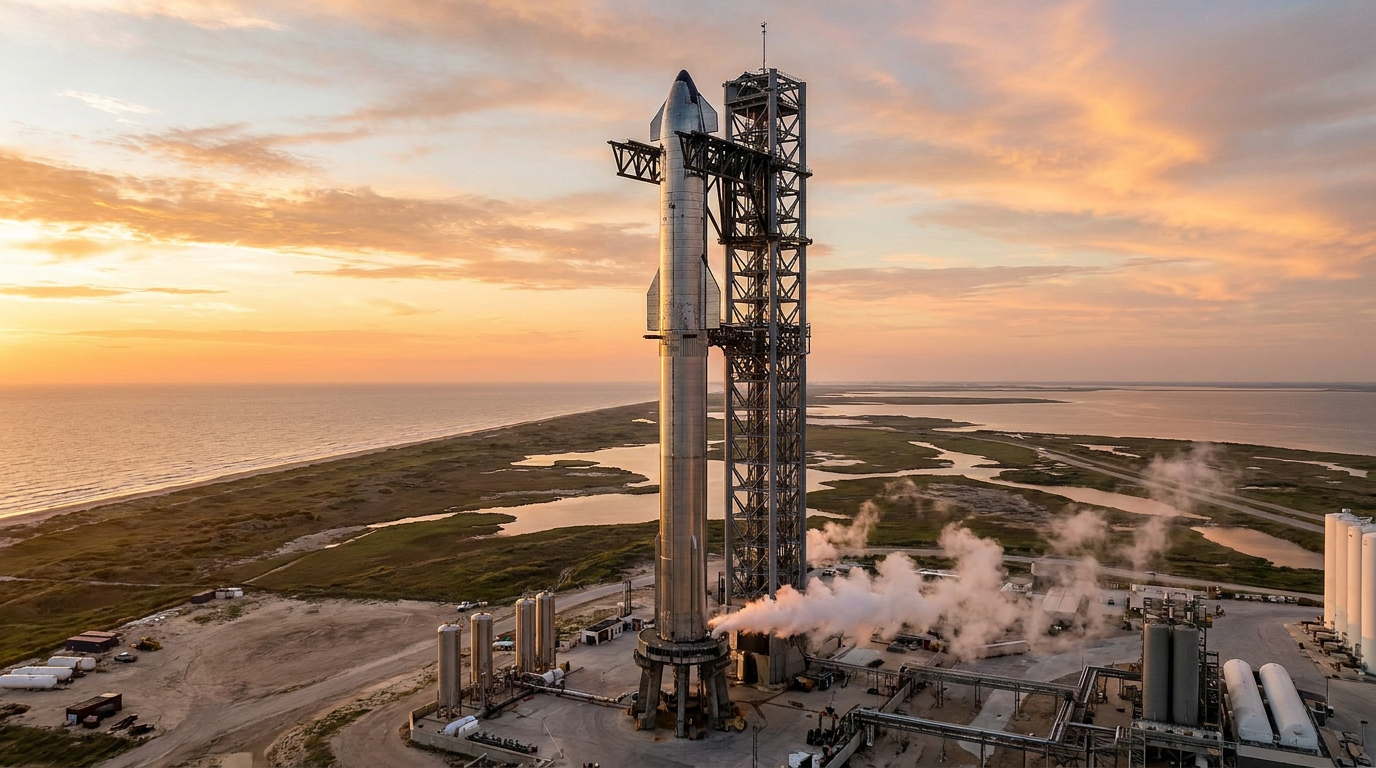
SpaceX has officially executed the largest initial public offering in the history of global finance, debuting on the Nasdaq exchange with a staggering $1.77 trillion valuation. By raising $75 billion, the aerospace and artificial intelligence conglomerate has shattered the previous $29.4 billion record set by Saudi Aramco in 2019. The sheer scale of the capital raised instantly positions the company among the most valuable publicly traded entities on Earth, trailing only a handful of established tech giants like Apple and Microsoft. Executives rang the opening bell as the stock began trading under the ticker SPCX, marking the culmination of nearly two and a half decades of private development that transformed a small warehouse startup into a multi-planetary infrastructure behemoth.[1]
Beyond the sheer scale of the capital raised, the SpaceX IPO is fundamentally rewiring the mechanics of the stock market. The company bypassed the traditional institutional bookbuilding process—where underwriters spend weeks narrowing an indicative price range based on institutional feedback. Instead, SpaceX handed the market a fixed, take-it-or-leave-it price of $135 per share. Demand was never the variable; reports indicate the offering was oversubscribed by three to four times, drawing more than $250 billion in bids from global investors. This historic demand has created an unprecedented liquidity event, proving that for a company of this magnitude, standard Wall Street pricing conventions no longer apply.[1][6]
The intense appetite for the stock extends well beyond domestic borders, with foreign investors driving a significant portion of the historic demand. Analysts at JPMorgan note that the sheer volume of the SpaceX listing, alongside other anticipated mega-IPOs in the artificial intelligence sector, is generating immense trading income for major Wall Street investment banks. This provides an unexpected upside for the financial sector in the second quarter, as brokerages capitalize on the massive execution volumes required to process the global influx of capital. The enthusiasm underscores a broad willingness among international investors to bet heavily on U.S. technological dominance.[2][6]

The most consequential aspect of this IPO, however, lies in the plumbing of passive index funds. In preparation for SpaceX's debut, Nasdaq controversially rewrote its index inclusion rules. The exchange introduced a "Fast Entry" provision that allows mega-cap stocks to join the premier Nasdaq 100 index just 15 trading days after their IPO, a sharp reduction from the historic three-month seasoning period. This regulatory shift ensures that the world's largest index funds will be forced to absorb the aerospace giant almost immediately, fundamentally altering the timeline for how new companies impact broader market benchmarks.[5]
Furthermore, Nasdaq eliminated its requirement that a company must have a minimum 10% public float to join the index. This change is critical because SpaceX is floating only about 4.3% of its total equity to the public—a fraction of the 80% float typical for mature public companies. By removing the float threshold, the exchange paved the way for a massive company with very few tradable shares to exert outsized influence on the index. The combination of fast-track inclusion and a historically low public float creates a perfect storm for a mechanical liquidity squeeze.[3][5]
Furthermore, Nasdaq eliminated its requirement that a company must have a minimum 10% public float to join the index.
Approximately $1.4 trillion in total capital tracks the Nasdaq 100 index through various exchange-traded funds, mutual funds, and structured products. When SpaceX is officially added to the benchmark, funds that replicate the index will be forced to buy the stock to match its weighting, regardless of whether portfolio managers believe the $135 price is fundamentally justified. Analysts estimate this fast entry will trigger between $8 billion and $30 billion in forced passive buying within the first month of trading alone. Because index funds are buyers without discretion, this price discovery process may be driven less by fundamental business metrics and more by sheer supply-and-demand imbalances.[3][5][6]
To fund these mandatory purchases, passive trackers cannot simply print new money; they must mechanically rebalance their portfolios. This means index funds will have to sell pro-rata shares of other mega-cap technology companies to free up capital. Billions of dollars will be systematically redistributed away from stalwarts like Apple, Microsoft, Amazon, and Nvidia to make room for SpaceX in the index. This forced selling highlights how the mechanics of passive investing can cause a single mega-IPO to send ripple effects across the entire technology sector, impacting the share prices of companies that have nothing to do with space exploration.[3]
While Nasdaq and FTSE Russell have accelerated their inclusion timelines to capture this trading volume, S&P Global has taken a starkly different approach. The provider of the world's most tracked benchmark, the S&P 500, declined to alter its methodology to accommodate the aerospace giant. S&P 500 inclusion still requires a 12-month seasoning period, four quarters of cumulative GAAP profitability, and a minimum 10% public float. SpaceX currently fails two of those three tests, meaning the S&P 500 will not hold one of the world's most valuable publicly listed companies until at least mid-2027. This decision protects the index's reputation for standards-based methodology.[3][5]

This divergence in index philosophy highlights a growing tension on Wall Street, but for the broader commercial space economy, the IPO serves as a massive validation regardless of index mechanics. Industry analysts project the global space market will reach $462 billion in 2026, driven by satellite broadband expansion and a 95% reduction in launch costs over the past decade. The sector is expected to nearly double to $850 billion by 2035, transitioning from a government-dominated arena into a thriving commercial ecosystem where private enterprises dictate the pace of innovation and infrastructure development.[4][7]
SpaceX completely dominates this expanding sector, having captured over 50% of global commercial launches. Its reusable Falcon rocket series fundamentally altered the economics of spaceflight, while its Starlink satellite network continues to expand rapidly, providing high-speed internet to underserved regions globally and generating significant recurring revenue. Furthermore, the company's recent integration with the artificial intelligence startup xAI has positioned it as a unique hybrid entity. Investors are no longer just buying a rocket manufacturer; they are purchasing exposure to launch infrastructure, global satellite connectivity, and advanced AI compute in a single instrument.[1][4]

Yet, not everyone is convinced the current valuation is sustainable. Fundamental analysts point out that SpaceX posted a net loss of $4.9 billion in 2025, largely due to heavy capital expenditures in its next-generation Starship program and massive investments in AI infrastructure. Investment research group Morningstar has calculated the company's fundamental value at closer to $63 per share, warning of a major disconnect between market expectations and underlying financials. Skeptics argue that the $1.77 trillion valuation relies heavily on untested technologies and speculative AI integration, suggesting that the current price is inflated by the mechanical index squeeze rather than current cash flow generation.[1][6]
As the lock-up periods for insider shares gradually expire over the next 135 days, the public float will slowly expand. This staggered release of shares is designed to increase the tradable supply, which could eventually ease the constraints that are currently driving the stock's premium. Until then, the market will serve as a real-time stress test for equity market structure. The SpaceX IPO stands as a watershed moment, not just for the commercialization of space, but for the mechanics of modern finance. It has forced the industry to confront the realities of passive index investing, proving that how a stock is traded can be just as influential as what the company builds.[3][7]
How we got here
December 2025
SpaceX tender offer prices shares at approximately $421 (pre-split), implying an $800 billion valuation.
May 2026
Nasdaq eliminates its 10% minimum float requirement and introduces a 15-day 'Fast Entry' rule for mega-cap IPOs.
June 11, 2026
SpaceX prices its IPO at $135 per share, raising a record $75 billion.
June 12, 2026
SpaceX begins trading on the Nasdaq under the ticker SPCX.
Viewpoints in depth
Index Modernizers
Argue that benchmark indices must adapt rapidly to include mega-cap IPOs.
Proponents of accelerated index inclusion, including executives at Nasdaq and FTSE Russell, argue that modern financial markets move too quickly for legacy rules. When a $1.77 trillion company enters the public sphere, it immediately represents a significant portion of the global economy. Forcing passive index funds to wait three to twelve months to hold the stock means those funds are no longer accurately tracking the market's true composition. By eliminating minimum float requirements and fast-tracking entry, they believe indices remain relevant and reflective of current economic realities.
Fundamental Skeptics
Warn that the IPO price is detached from underlying financials and driven by speculative hype.
Value investors and fundamental analysts point to SpaceX's $4.9 billion net loss in 2025 as evidence that the $1.77 trillion valuation is highly speculative. Groups like Morningstar argue that at $135 per share, investors are paying a massive premium for unproven AI integrations and capital-intensive projects like Mars colonization. They contend that the current price is artificially supported by the mechanical forced-buying of index funds rather than actual cash flow, warning that retail investors could be left holding the bag once the initial liquidity squeeze subsides and lock-up periods expire.
Passive Capital Allocators
Focus on the mechanical supply-and-demand imbalances caused by forced index buying.
Managers of exchange-traded funds and mutual funds view the SpaceX IPO primarily as a structural challenge. Because their mandate is strictly to replicate an index, they are forced buyers 'without discretion.' When a company with a massive market cap but a tiny 4.3% public float is added to the Nasdaq 100, these funds must aggressively bid for a very limited supply of shares. This mechanical reality forces them to sell off holdings in other stable tech giants to fund the purchase, creating artificial volatility across the broader market that has nothing to do with fundamental business performance.
What we don't know
- How severely the forced selling of other mega-cap tech stocks will impact the broader Nasdaq 100 index.
- Whether the stock price will face significant downward pressure once insider lock-up periods begin expiring in the coming months.
Key terms
- Public Float
- The portion of a company's shares that are available for trading by the general public, excluding locked-up insider shares.
- Passive Index Fund
- A mutual fund or ETF designed to automatically track the performance of a specific market benchmark, like the Nasdaq 100.
- Seasoning Period
- The required length of time a newly public company must trade before becoming eligible for inclusion in major stock indices.
- Bookbuilding
- The traditional process where underwriters determine the price of an IPO by collecting bids from institutional investors over several weeks.
Frequently asked
When will SpaceX join the S&P 500?
Not until at least mid-2027. S&P Global declined to change its rules, requiring a 12-month seasoning period and four quarters of GAAP profitability.
Why is the stock price fixed at $135?
Unlike traditional IPOs that offer a price range, SpaceX bypassed the standard bookbuilding process and offered a fixed price of $135 per share, relying on overwhelming investor demand.
How does this affect my 401(k)?
If you hold funds tracking the Nasdaq 100, your portfolio will automatically purchase SpaceX shares when the index rebalances, regardless of the stock's current price.
Sources
Source coverage
7 outlets
4 viewpoints surfaced







[1]The GuardianFundamental Skeptics
SpaceX makes largest ever stock market debut at $1.77tn valuation
Read on The Guardian →[2]MarketWatchPassive Capital Allocators
JPMorgan says investors are overlooking the upside to Wall Street banks that comes from SpaceX and other mega IPOs
Read on MarketWatch →[3]CME GroupIndex Modernizers
The SpaceX Mega-IPO: Why Index Choice Matters
Read on CME Group →[4]Global Market InsightsSpace Economy Bulls
Space Economy Market Size, Share, Trends, Analysis 2026-2035
Read on Global Market Insights →[5]ETF StreamIndex Modernizers
SpaceX to IPO on Nasdaq after index rules adjusted
Read on ETF Stream →[6]IR MagazinePassive Capital Allocators
SpaceX IPO shines light on the market structures that shape valuation
Read on IR Magazine →[7]Factlen Editorial Team
Synthesis by Factlen editorial team
Read on Factlen Editorial Team →
Every angle. Every day.
Get finance stories with full source coverage and perspective breakdowns delivered to your inbox.