
Inside the 538-Square-Kilometer Solar Park Rewriting India's Energy Grid
The Khavda Renewable Energy Park in Gujarat has crossed 10 GW of commissioned capacity, deploying massive battery systems to become the world's largest power plant by 2029.
By Factlen Editorial Team
- Renewable Energy Developers
- Focusing on unprecedented scale and technological integration to drive down costs and meet national targets.
- Grid Operators & Planners
- Prioritizing grid stability and the urgent need for battery storage to manage intermittent power.
- Financial Analysts
- Monitoring the immense capital requirements and execution risks of a mega-project.
What's not represented
- · Local Kutch Communities
- · Fossil Fuel Industry Competitors
Why this matters
The Khavda project is a real-world test of whether ultra-large-scale renewable energy, paired with massive battery storage, can reliably replace fossil fuels at a national level. Its success will dictate how quickly developing economies can transition to clean power without sacrificing grid stability.
Key points
- The Khavda Renewable Energy Park in Gujarat is expanding to become the world's largest power plant, aiming for 30 GW by 2029.
- Spanning 538 square kilometers, the hybrid facility utilizes both solar panels and wind turbines to maximize generation.
- Developers recently commissioned over 3 GWh of battery storage to prevent excess clean energy from being wasted during peak sunlight.
- The $18 billion mega-project is expected to power over 16 million Indian homes and create roughly 100,000 jobs.
- Waterless robotic cleaners and bifacial solar modules are being deployed to maintain efficiency in the harsh salt desert environment.
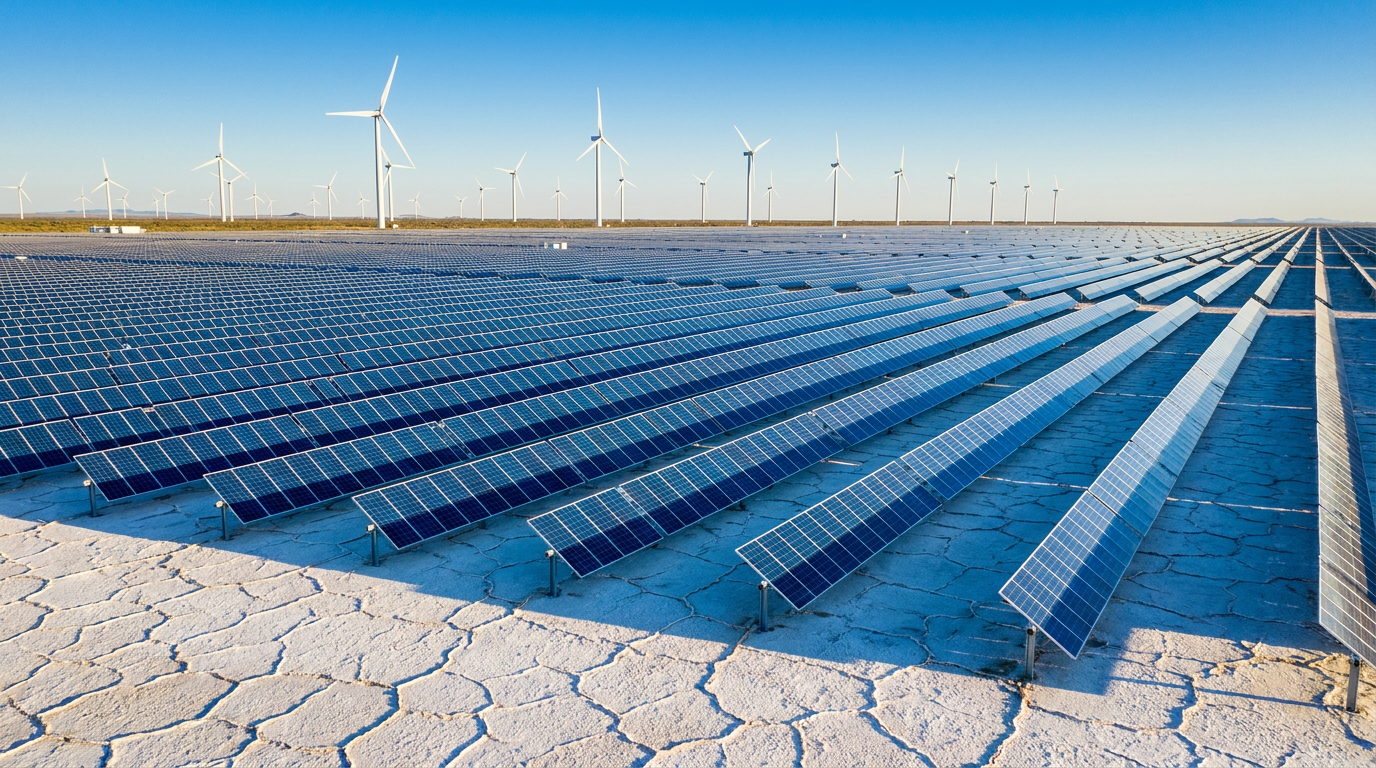
Deep in the salt deserts of Gujarat, near the India-Pakistan border, a barren wasteland is being transformed into a structure visible from space. The Khavda Renewable Energy Park spans 538 square kilometers—an area roughly five times the size of Paris.[1][5]
By 2029, this site is projected to become the largest power plant on Earth across any energy source, with a planned capacity of 30 gigawatts (GW). As of mid-2026, the project has crossed a major threshold, with nearly 10 GW of solar and wind capacity already commissioned and feeding into the national grid.[1][4]
The sheer physics of the site explain its selection. Khavda receives exceptional solar irradiation, averaging 2,060 kilowatt-hours per square meter annually. Simultaneously, winds sweep across the flat plains at an average of eight meters per second. This makes it an ideal location for a hybrid renewable facility, where wind turbines can generate power during the night or overcast days when solar panels are dormant.[1][5]
Building at this scale requires immense logistical coordination. The primary developer, Adani Green Energy Limited (AGEL), alongside state-backed entities like NTPC and Gujarat Industries Power Company, is deploying nearly 60 million solar modules and hundreds of advanced wind turbines. The total investment is estimated at roughly $18 billion (₹1.5 lakh crore).[1][4]

To maximize efficiency in the harsh desert environment, engineers are utilizing bifacial solar modules. These advanced panels capture sunlight on both their front and rear surfaces, utilizing light reflected off the bright, highly reflective salty ground to boost overall energy yields.[5][6]
Water scarcity presents another severe challenge in the arid Kutch district. Traditional solar farms require millions of gallons of water to wash dust off the panels, which otherwise blocks sunlight and degrades efficiency. To solve this, the Khavda facility is deploying fleets of waterless cleaning robots that sweep the panels dry, preserving local water resources and aligning with regional conservation goals.[6]
However, generating massive amounts of electricity is only half the equation; the grid must be able to absorb it. Renewable energy is inherently intermittent. When the sun peaks at midday, the park generates more power than the local grid can immediately consume.[2][4]
However, generating massive amounts of electricity is only half the equation; the grid must be able to absorb it.
This mismatch has tangible consequences. In the first quarter of 2026 alone, India was forced to waste—or "curtail"—roughly 300 gigawatt-hours of clean power nationwide simply because there was nowhere to store the excess generation.[2]

To capture this lost energy, developers at Khavda are constructing what is rapidly becoming one of the world's largest Battery Energy Storage Systems (BESS). By May 2026, Adani Green Energy had commissioned 3.37 gigawatt-hours of lithium-ion battery storage on-site.[2][3]
These massive battery banks act as a buffer. They absorb excess solar generation during peak daylight hours and discharge it back into the grid during the evening peak demand, smoothing out the supply curve and preventing clean energy from being wasted. The company plans to scale this storage to 14 GWh by the end of the fiscal year, and eventually 50 GWh over the next five years.[2][4]
Moving the power out of the remote desert requires equally massive infrastructure. The Power Grid Corporation of India is constructing high-capacity transmission lines—often referred to as a "green corridor"—to evacuate the electricity to the rest of the country without overloading local circuits.[1][3]

The economic and environmental stakes are monumental. Once fully operational, the Khavda park is expected to generate over 80 billion units of clean electricity annually. This output is sufficient to power approximately 16 to 18 million Indian homes, effectively offsetting 58 million tonnes of carbon emissions each year.[1][5]
The project is also reshaping the regional economy, with estimates projecting the creation of up to 100,000 jobs in construction, operations, and maintenance. For a historically isolated and inhospitable region, this represents a massive influx of capital and infrastructure.[1][5]
Despite the rapid progress, financial analysts note the immense execution risks. Developing 30 GW of capacity in a harsh environment requires continuous, massive capital injection. The reliance on vertical integration—where various Adani group companies handle everything from turbine manufacturing to transmission—helps control costs but also concentrates financial risk within a single conglomerate.[4]
Ultimately, the Khavda Renewable Energy Park serves as a critical test case for the global energy transition. If successful, it proves that ultra-large-scale hybrid renewable projects, paired with massive battery storage, can reliably replace fossil fuel generation at a national scale, pushing India closer to its goal of 500 GW of non-fossil fuel capacity by 2030.[1][6]
How we got here
Dec 2020
The foundation stone for the Khavda Renewable Energy Park is officially laid.
April 2023
On-site construction and infrastructure development begin in the Kutch salt desert.
March 2024
The first 1 gigawatt (GW) of solar capacity is officially commissioned and connected to the grid.
May 2026
Over 3 gigawatt-hours of battery storage is commissioned to help manage the nearly 10 GW of active generation.
2029
Target completion date for the full 30 GW capacity across the 538-square-kilometer site.
Viewpoints in depth
The Developers' View
Focusing on unprecedented scale and technological integration to drive down costs.
For developers like Adani Green Energy and NTPC, Khavda represents the ultimate economies of scale. By co-locating wind and solar generation on a massive single site, they can share transmission infrastructure, access roads, and maintenance facilities. They argue that this hyper-centralized model, combined with vertical integration of the supply chain, is the only way to deploy clean energy fast enough to meet India's ambitious 2030 targets.
Grid Operators' View
Prioritizing grid stability and the urgent need for battery storage to manage intermittent power.
Grid managers view massive solar parks with a mix of optimism and anxiety. While the clean energy is welcome, injecting 30 GW of intermittent power into the national grid poses severe stability challenges. Their primary focus is on the rapid deployment of Battery Energy Storage Systems (BESS) and high-capacity 'green corridors.' Without these buffers, they warn that the grid will be forced to curtail (waste) massive amounts of solar power during peak daylight hours.
Financial Analysts' View
Monitoring the immense capital requirements and execution risks of a mega-project.
Market watchers emphasize the sheer financial weight of an $18 billion infrastructure project. While acknowledging the long-term revenue potential of 80 billion units of annual electricity generation, analysts remain cautious about the continuous capital injections required. They note that building in a harsh, corrosive salt desert introduces unpredictable maintenance costs, and the heavy reliance on a single conglomerate's internal supply chain concentrates execution risk.
What we don't know
- Whether the national transmission grid can be upgraded fast enough to handle the full 30 GW of intermittent power without severe curtailment.
- How the harsh, corrosive salt desert environment will affect the long-term maintenance costs of the solar panels and wind turbines.
- The final total cost of the project, as supply chain fluctuations and infrastructure delays could push the budget beyond the estimated $18 billion.
Key terms
- Bifacial Solar Modules
- Solar panels designed to capture sunlight on both their front and rear sides, increasing energy generation by utilizing light reflected off the ground.
- Battery Energy Storage System (BESS)
- Large-scale battery installations that store excess electricity generated during peak production times and release it when demand is high or generation drops.
- Curtailment
- The deliberate reduction of electricity generation below what a power plant is capable of producing, often because the grid cannot absorb or store the excess power.
- Hybrid Renewable Energy
- A power facility that combines two or more renewable generation methods—such as solar and wind—at the same location to provide a more consistent energy output.
Frequently asked
Where is the Khavda Renewable Energy Park located?
It is located in the Kutch district of Gujarat, India, near the border with Pakistan. The site is a barren salt desert known for high solar irradiation and strong winds.
How much power will the park generate?
Once fully completed in 2029, the park is expected to have a capacity of 30 gigawatts (GW), generating roughly 80 billion units of electricity annually.
Why does the park need massive batteries?
Solar and wind power are intermittent. Massive battery systems store excess power generated during sunny or windy periods so it can be fed into the grid during peak evening hours, preventing the clean energy from being wasted.
How are the solar panels cleaned in a desert without water?
Developers are deploying fleets of waterless robotic cleaning systems that sweep dust off the panels, preserving the region's scarce water resources.
Sources
Source coverage
6 outlets
3 viewpoints surfaced






[1]Fortune IndiaRenewable Energy Developers
Inside Khavda: The World's Largest Renewable Energy Park
Read on Fortune India →[2]The Economic TimesGrid Operators & Planners
Adani Green to commission 14 GWh battery storage at Khavda by fiscal year-end to cut clean energy wastage
Read on The Economic Times →[3]Energy-Storage.newsGrid Operators & Planners
Adani Green Energy commissions 3GWh of battery storage at world's largest renewable energy project
Read on Energy-Storage.news →[4]WhalesbookFinancial Analysts
The Financial And Execution Context of Khavda
Read on Whalesbook →[5]Blackridge ResearchGrid Operators & Planners
Khavda Renewable Energy Park: Project Overview
Read on Blackridge Research →[6]Adani Green EnergyRenewable Energy Developers
Adani Green Energy operationalizes 1,000 MW at Khavda
Read on Adani Green Energy →
Every angle. Every day.
Get world stories with full source coverage and perspective breakdowns delivered to your inbox.