
Inside the $1.77 Trillion SpaceX IPO: How Rockets, Satellites, and AI Compute Forged the Largest Public Debut in History
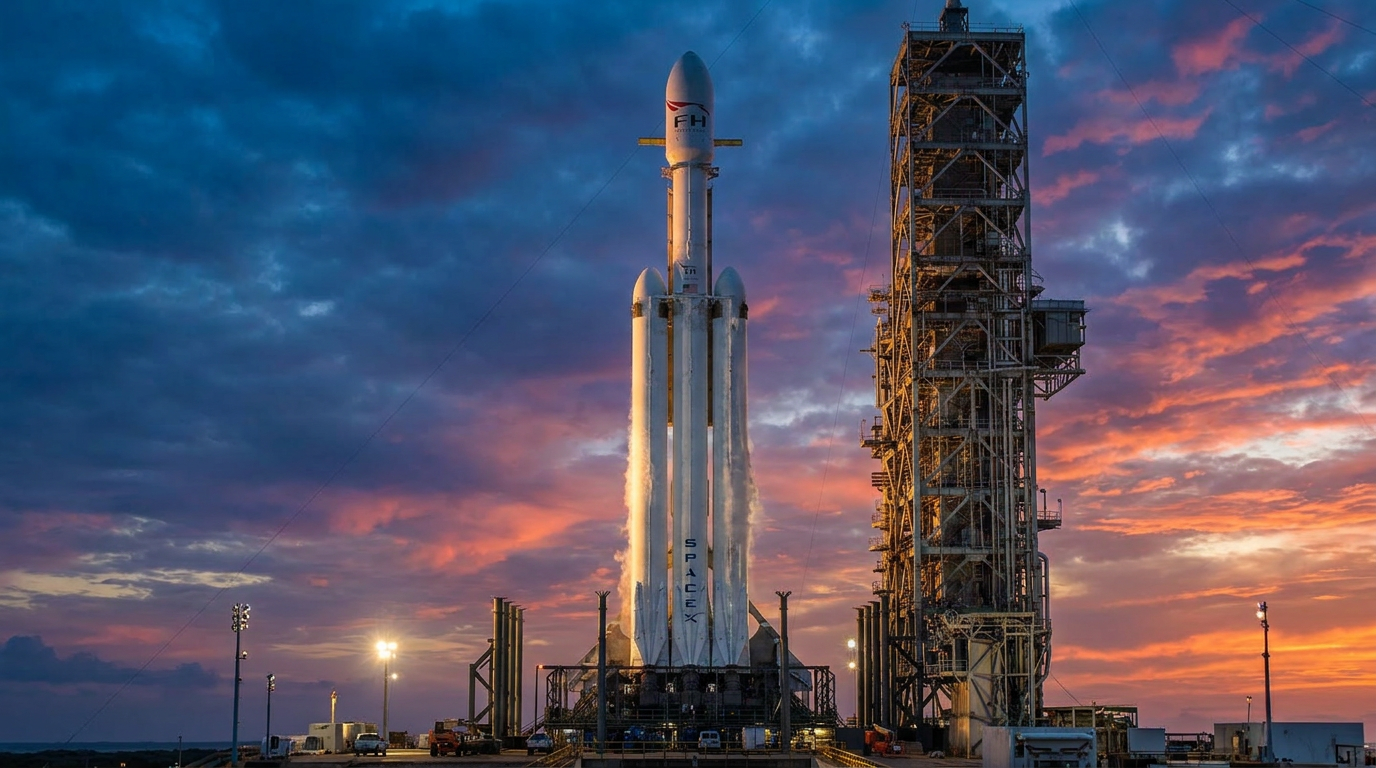
SpaceX has executed the largest initial public offering in history, raising $75 billion at a $1.77 trillion valuation. The unprecedented debut rests on a vertically integrated business model that combines a profitable satellite internet monopoly with massive new artificial intelligence computing leases.
By Factlen Editorial Team
- Infrastructure Growth Bulls
- View SpaceX as an unassailable monopoly in launch and satellite internet, with massive upside from AI compute leasing.
- Fundamental Valuation Skeptics
- Argue that a 94x revenue multiple for an unprofitable company is detached from reality and heavily discounts execution risks.
- Space Economy Strategists
- Focus on the vertical integration model, where Starlink profits and AI leases fund the development of Starship and orbital infrastructure.
What's not represented
- · Traditional aerospace competitors
- · Regulatory bodies overseeing orbital deployment
Why this matters
The SpaceX IPO fundamentally rewrites the rules of public markets, proving that investors are willing to pay unprecedented premiums for vertically integrated infrastructure. By combining global satellite connectivity, orbital launch monopolies, and massive AI computing power into a single stock, SpaceX forces every major technology and defense portfolio to rethink how they allocate capital.
Key points
- SpaceX raised $75 billion at a $1.77 trillion valuation, making it the largest IPO in history.
- The company's Starlink division is highly profitable, generating $11.4 billion in revenue in 2025.
- SpaceX's AI segment recently secured $26 billion in annualized compute leases from Google and Anthropic.
- Retail investors received an unusually high 30% allocation of the available IPO shares.
On June 12, 2026, Space Exploration Technologies Corp. executed the largest initial public offering in the history of financial markets. Listing on the Nasdaq under the ticker SPCX, the aerospace conglomerate raised $75 billion at a fixed price of $135 per share. The offering valued the company at $1.77 trillion, instantly making it the seventh-largest publicly traded enterprise in the United States and crowning founder Elon Musk as the world's first trillionaire.[1][6]
The scale of the offering shattered previous records, raising more than two and a half times the $29.4 billion secured by Saudi Aramco during its 2019 debut. When trading opened, retail and institutional demand drove shares up 19% to close at $160.95, pushing the company's market capitalization past the $2 trillion mark on its first day.[6][8]
Yet beneath the historic headline numbers lies a complex, multi-layered business model that defies traditional categorization. SpaceX is no longer just a rocket manufacturer. Following a massive internal reorganization in early 2026, the public entity now encompasses three distinct businesses: a dominant launch provider, a highly profitable satellite internet constellation, and a cash-burning artificial intelligence infrastructure division.[7][8]
The $1.77 trillion valuation has sparked intense debate among financial analysts, primarily because SpaceX remains fundamentally unprofitable. The company generated $18.67 billion in revenue in 2025, but posted a consolidated net loss of $4.94 billion. At its IPO price, SpaceX trades at a staggering 94 times its trailing annual revenue—a multiple that dwarfs even the most aggressively priced technology stocks.[1][8]

Independent research firm Morningstar initiated coverage with a fair value estimate of just $780 billion, roughly 55% below the IPO target. Lead equity analyst Nicolas Owens cautioned that the company is "significantly overvalued," noting that the current price requires flawless execution across all business lines. Morningstar assigned only a 7% probability to its most optimistic "moonshot" scenario, which assumes the successful commercialization of orbital AI data centers.[2]
To understand how the broader market justifies the premium, one must look at the company's cash engine: Starlink. The satellite broadband division is the only consistently profitable segment within SpaceX. In 2025, Starlink generated $11.4 billion in revenue—accounting for 61% of the company's total sales—and delivered $4.4 billion in operating profit with a 63% EBITDA margin.[7][8]
Starlink's success is rooted in SpaceX's vertical integration. By manufacturing its own satellites and launching them on its own reusable Falcon 9 rockets, the company has built a constellation of over 9,600 active satellites serving 10.3 million subscribers across 164 countries. This recurring subscription revenue provides the predictable cash flow necessary to fund the company's more speculative, capital-intensive projects.[4][8]
Starlink's success is rooted in SpaceX's vertical integration.
The launch division, which forms the historical core of the company, operates as a near-monopoly in the West. SpaceX completed 165 orbital launches in 2025, capturing roughly 90% of the global commercial launch market by mass-to-orbit. The company's pioneering development of reusable first-stage boosters has fundamentally altered the economics of spaceflight, amortizing fixed hardware costs across multiple missions.[1][4]

However, the launch segment remains deliberately loss-making as SpaceX pours billions into the research and development of Starship, its next-generation, fully reusable super-heavy launch vehicle. Starship is designed to reduce the cost of reaching orbit by another order of magnitude, which is a prerequisite for the company's most ambitious future projects, including lunar logistics and Mars colonization.[1]
The most controversial element of the $1.77 trillion valuation is the company's aggressive pivot into artificial intelligence. In February 2026, SpaceX absorbed xAI—Musk's artificial intelligence venture—in an all-stock merger that valued the combined entity at $1.25 trillion. This integration brought the Grok large language model and the massive Colossus data center in Memphis, Tennessee, onto SpaceX's balance sheet.[7][8]
The AI segment is currently a massive financial drain, having recorded an operating loss of $6.36 billion in 2025 while consuming $12.7 billion in capital expenditures. However, the division recently secured two transformative "neocloud" computing leases that alter its near-term revenue trajectory and provide a new pillar for the company's valuation.[4][8]
In May 2026, AI developer Anthropic signed a three-year agreement to lease the entirety of the Colossus 1 data center—housing 220,000 Nvidia GPUs—for $1.25 billion per month. Shortly after, Google agreed to a separate three-year deal worth $920 million per month for access to an additional 110,000 GPUs. Combined, these two contracts represent roughly $26 billion in annualized revenue, exceeding the entire company's total sales from the previous year.[4][8]

Beyond the underlying business model, the structure of the IPO itself was highly unconventional. SpaceX opted for a fixed price of $135 per share rather than utilizing a traditional bookbuilding range, signaling that institutional demand had already vastly exceeded the available supply. Total investor demand reportedly surpassed $250 billion, leaving the offering nearly four times oversubscribed.[5][8]
Furthermore, the company allocated an unprecedented 30% of the offering to retail investors, roughly three times the standard carve-out for a mega-cap IPO. Major brokerages accommodated the surge in public interest; Fidelity, for instance, lowered its minimum account balance requirement for IPO access from $100,000 to just $2,000 to allow broader participation.[5][7]
This heavy retail allocation, combined with a structurally thin public float of just 4.3% of total outstanding shares, creates a dynamic where momentum trading could drive significant short-term volatility. The remaining 95.7% of the company is held by pre-IPO investors and employees, subject to staggered lockup periods that will gradually release millions of shares into the market over the next year.[1][2]

Ultimately, the SpaceX IPO forces capital markets to price the future of infrastructure. Investors paying 94 times revenue are not buying the current iteration of the Falcon 9; they are purchasing a call option on a vertically integrated conglomerate that controls global satellite connectivity, the majority of orbital launch capacity, and a rapidly expanding footprint in AI compute. Whether that combination is worth $1.77 trillion will depend entirely on execution.[8]
How we got here
2002
Elon Musk founds Space Exploration Technologies Corp. (SpaceX) with the goal of reducing space transportation costs.
2015
SpaceX successfully lands a Falcon 9 first-stage booster, proving the economic viability of reusable rockets.
2019
Starlink begins launching its first operational satellite broadband constellation to provide global internet coverage.
February 2026
SpaceX absorbs xAI in an all-stock merger, valuing the combined entity at $1.25 trillion and bringing AI infrastructure in-house.
May 2026
SpaceX secures massive AI computing lease agreements with Anthropic and Google, generating billions in new recurring revenue.
June 12, 2026
SpaceX debuts on the Nasdaq, raising $75 billion in the largest initial public offering in history.
Viewpoints in depth
The Valuation Skeptics
Morningstar and value-focused analysts argue the $1.77 trillion price tag is disconnected from current financial realities.
At 94 times trailing revenue, skeptics point out that SpaceX is priced for absolute perfection. They emphasize that the company posted a nearly $5 billion net loss in 2025, driven by massive capital expenditures in Starship and AI infrastructure. From this perspective, the market is ignoring the severe execution risks associated with building orbital data centers and assumes that Starlink's margins will never face terrestrial or satellite competition.
The Infrastructure Bulls
Growth investors and retail momentum buyers view SpaceX as a multi-industry monopoly.
Bulls argue that backward-looking revenue multiples fail to capture SpaceX's true value. They point to the company's 90% market share in commercial launch, Starlink's 63% EBITDA margins, and the recent $26 billion in annualized AI compute leases from Google and Anthropic. To these investors, SpaceX is not just a rocket company, but the foundational infrastructure layer for the next century of global telecommunications and artificial intelligence.
What we don't know
- Whether the massive AI compute leases from Google and Anthropic will be renewed when they expire in 2029.
- How the structurally thin public float will impact the stock's volatility once initial momentum fades.
- If the Starship program can successfully achieve the cost reductions necessary to make orbital data centers economically viable.
Key terms
- Price-to-sales multiple
- A valuation metric that compares a company's stock price to its revenues, often used for high-growth companies that are not yet profitable.
- Public float
- The portion of a company's shares that are in the hands of public investors and available for trading on the open market.
- Vertical integration
- A business strategy where a company owns and controls multiple stages of its supply chain, such as SpaceX building its own rockets to launch its own satellites.
- Bookbuilding
- The traditional process by which underwriters determine the price of an IPO by collecting indications of interest from institutional investors within a price range.
- EBITDA margin
- A measure of a company's operating profitability as a percentage of its revenue, calculated before interest, taxes, depreciation, and amortization.
Frequently asked
Why is SpaceX valued at $1.77 trillion despite losing money?
Investors are pricing in the company's near-monopoly in commercial space launch, the high profit margins of its Starlink broadband service, and massive new AI computing contracts.
How much of the company is actually trading on the stock market?
Only about 4.3% of SpaceX's total shares were made available in the IPO, creating a structurally thin public float that can amplify price volatility.
What role does artificial intelligence play in SpaceX's business?
In early 2026, SpaceX absorbed Elon Musk's xAI venture, bringing the Colossus data center into the company to lease massive GPU computing power to tech giants like Google and Anthropic.
Can retail investors buy shares?
Yes. SpaceX allocated an unusually high 30% of its IPO shares to retail investors through brokerages like Fidelity and Robinhood, though demand far exceeded supply.
Sources
Source coverage
8 outlets
3 viewpoints surfaced








[1]Investing.comInfrastructure Growth Bulls
SpaceX begins trading on Nasdaq today under the ticker SPCX
Read on Investing.com →[2]MorningstarFundamental Valuation Skeptics
As Morningstar launches research coverage of SpaceX
Read on Morningstar →[3]ForbesInfrastructure Growth Bulls
SpaceX IPO Draws Small Investors Despite Valuation Concerns
Read on Forbes →[4]Constellation ResearchSpace Economy Strategists
SpaceX's initial public offering is ready for liftoff
Read on Constellation Research →[5]XTB
SpaceX Share Price (SPCX): What to Expect After the IPO
Read on XTB →[6]CBS NewsInfrastructure Growth Bulls
SpaceX stock soars 19% on first day of trading following record-breaking $75 billion IPO
Read on CBS News →[7]BitMEX ResearchSpace Economy Strategists
SpaceX IPO Date, Price, and Trading Strategy
Read on BitMEX Research →[8]VenQuest GroupSpace Economy Strategists
The Day That Shifted the Coordinates of Capital
Read on VenQuest Group →
More in business
See all 5 stories →AI Infrastructure
SpaceX Raises Record $85.7 Billion in Historic IPO to Fund Orbital AI Infrastructure
7 sources
AI Economics
The Compute-First Era: How AI is Rewriting the Rules of Venture Capital
6 sources
Fed Watch
Federal Reserve Holds Rates Steady as New Chair Kevin Warsh Signals Hawkish Pivot
8 sources

Every angle. Every day.
Get business stories with full source coverage and perspective breakdowns delivered to your inbox.