
How Women's Wrestling Became America's Fastest-Growing Sport and Secured an NCAA Championship
Driven by explosive grassroots growth and state sanctioning, women's wrestling has transformed from a niche pursuit into a collegiate powerhouse, culminating in the first-ever NCAA Championship in 2026.
By Factlen Editorial Team
- Collegiate Athletes & Coaches
- Viewing the NCAA championship as the ultimate validation of their dedication and a key to unlocking scholarships.
- High School Administrators
- Managing the logistical triumphs and challenges of the sport's explosive growth and sanctioning.
- Grassroots Advocates
- Focusing on the character-building benefits and the cultural shift that has made combat sports accessible to young women.
What's not represented
- · Division I Athletic Directors
- · Pioneer female wrestlers from the pre-sanctioning era
Why this matters
The official NCAA recognition of women's wrestling unlocks millions in athletic scholarships and institutional funding, providing a clear collegiate pathway for the tens of thousands of young women flocking to the sport.
Key points
- The NCAA hosted its first-ever Women's Wrestling Championship in March 2026 in Coralville, Iowa.
- McKendree University won the inaugural team title, defeating the University of Iowa 171 to 166.
- Women's wrestling is the fastest-growing high school sport in the U.S., with participation surging 28.5% in a single year.
- The boom is driven by state athletic associations officially sanctioning the sport and creating dedicated girls' teams.
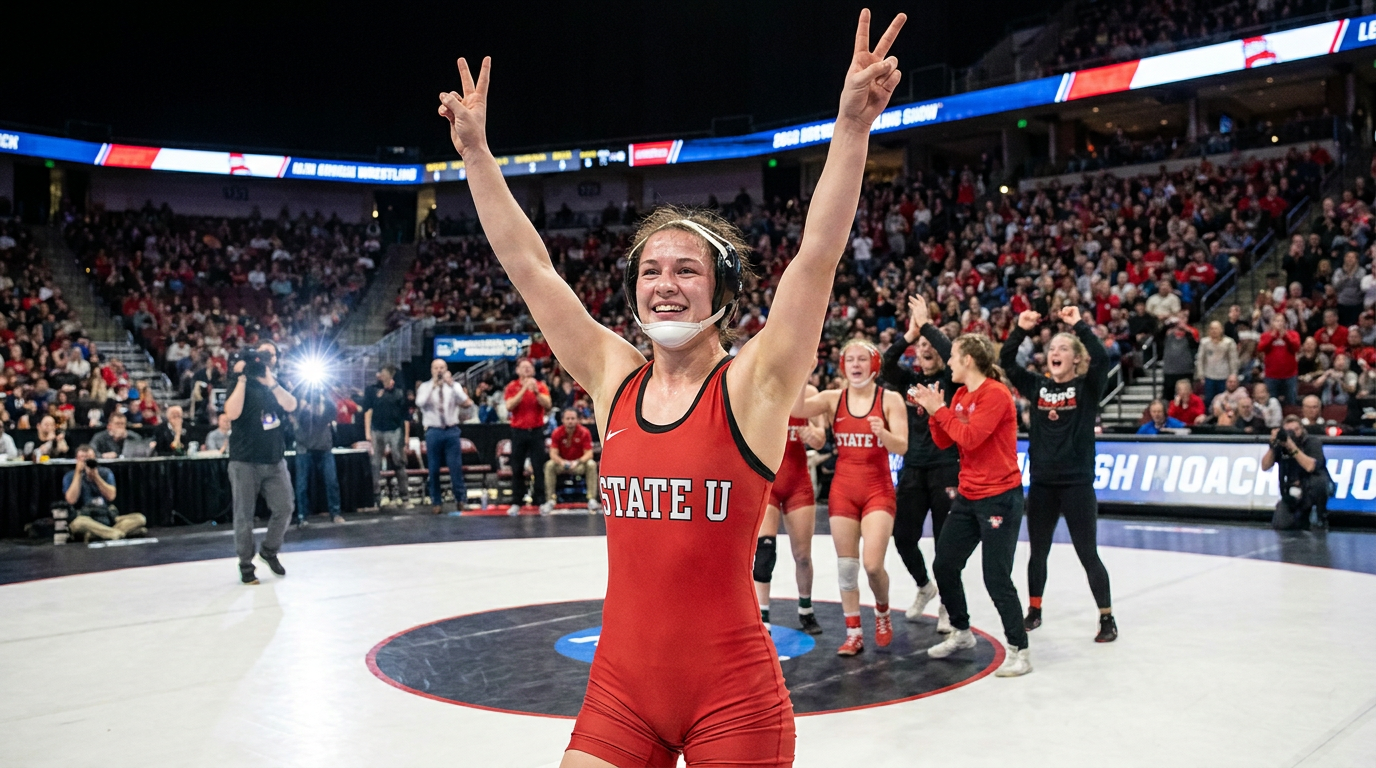
In March 2026, the Xtream Arena in Coralville, Iowa, hosted a milestone event that had been decades in the making: the inaugural NCAA Women's Wrestling Championship. For two days, 180 athletes representing 52 collegiate programs competed in a double-elimination tournament that officially cemented women's wrestling at the pinnacle of college sports. McKendree University captured the first-ever national team title under head coach Alexio Garcia, narrowly edging out the University of Iowa in a fiercely contested 171–166 team race.[4][5]
The arrival of an official NCAA championship is not merely a bureaucratic upgrade; it is the culmination of an explosive, grassroots athletic movement. Over the past decade, women's wrestling has quietly transformed from a niche pursuit into the fastest-growing high school sport in the United States. The numbers reflect a staggering cultural shift. According to the National Federation of State High School Associations (NFHS), high school wrestling participation recently shattered an all-time record set in 1976, driven overwhelmingly by the influx of female athletes.[1][2][3][6]
During the 2024–2025 school year, the number of girls wrestling in high school surpassed 74,000. To put that growth into perspective, in 1990, there were barely 100 girls on high school wrestling rosters nationwide. Last year alone, girls' participation surged by 28.5%, the highest growth rate of any major high school sport. This surge has fundamentally reshaped the landscape of American combat sports, creating a massive new audience of parents, fans, and competitors.[1][2][3][6]

The primary mechanism behind this rapid expansion is the wave of official state sanctioning. Before 2018, only six states officially sanctioned girls' wrestling, meaning female athletes who wanted to compete usually had to join boys' teams and wrestle against male opponents. This structural barrier artificially capped participation. However, as state athletic associations began recognizing girls' wrestling as a standalone sport, the paradigm shifted.[3][6]
By creating dedicated girls' teams and female-only state tournaments, high schools removed the intimidation factor and provided a level playing field. The opportunity to compete for official plaques, medals, and state records against other girls opened the floodgates. Today, nearly every state sanctions the sport, and the transition from co-ed rosters to dedicated female programs is largely complete.[3][6]
By creating dedicated girls' teams and female-only state tournaments, high schools removed the intimidation factor and provided a level playing field.
This high school pipeline directly fueled the collegiate boom. In 2020, the NCAA designated women's wrestling as an "emerging sport," a classification designed to help institutions provide more athletic opportunities for women. To graduate from an emerging sport to a fully sanctioned NCAA championship sport, a discipline must be sponsored by at least 40 varsity programs. Women's wrestling shattered that threshold in record time, leading to the historic 2026 championship in Iowa.[3][4][5][6]

The inaugural championship showcased the depth of talent that this new pipeline has already produced. McKendree and Iowa each crowned three individual national champions, highlighting the intense rivalry between the established powerhouse and the rising Big Ten program. Standout performances included McKendree's Cameron Guerin, who made collegiate history by securing her fifth national title across different collegiate divisions, and North Central's Bella Mir, who captured the 145-pound championship by fall.[4][6]
The growth of the sport is also heavily indebted to the Olympic movement. Women's freestyle wrestling was added to the Olympic Games in 2004, providing the first generation of female wrestlers with visible, elite role models. The subsequent international success of American women—including Olympic champions like Helen Maroulis, Tamyra Mensah-Stock, and Amit Elor—proved that the United States could be a global powerhouse in the discipline. These highly visible victories trickled down to the grassroots level, inspiring thousands of young girls to step onto the mat.[1][6]
Interestingly, the wrestling boom has bypassed a common logistical hurdle that plagues other rapidly growing sports: a shortage of referees. While many high school sports are struggling to staff their contests, the NFHS reported a 12% increase in the number of registered wrestling officials over the past year. This influx of over 9,000 officials has been crucial in supporting the expanded schedule of dual meets and multi-team tournaments required by the addition of girls' programs.[1][6]

The U.S. Wrestling Foundation has actively capitalized on this momentum, launching national campaigns to further drive participation. Their recent initiatives have enlisted professional athletes from the NFL and MLB, as well as prominent business leaders, to advocate for the character-building benefits of the sport. These campaigns frame wrestling not just as a physical contest, but as a foundational tool for teaching resilience, discipline, and overcoming adversity.[2]
Despite the overwhelming success, the sport faces ongoing structural challenges. The primary uncertainty is whether the collegiate infrastructure can expand fast enough to accommodate the massive wave of high school talent. While 52 teams competed in the 2026 NCAA Championship, the vast majority of Division I athletic departments still do not sponsor women's wrestling. Advocates hope that the official NCAA championship status, combined with Title IX compliance pressures, will incentivize major universities to add programs in the coming years.[4][6]
For now, the trajectory remains steeply upward. Women's wrestling is rapidly closing the participation gap with established sports like lacrosse, and the ceiling appears incredibly high. The 2026 NCAA Championship was not just a finish line for the pioneers who fought for sanctioning; it was the starting gun for a new era in the world's oldest sport.[1][6]
How we got here
2004
Women's freestyle wrestling makes its Olympic debut in Athens, providing visible role models.
2018
Only six U.S. states officially sanction girls' high school wrestling.
2020
The NCAA officially designates women's wrestling as an 'emerging sport.'
2024-2025
High school girls' participation surpasses 74,000, becoming the fastest-growing sport in the country.
March 2026
The first-ever NCAA Women's Wrestling Championship is held in Coralville, Iowa.
Viewpoints in depth
Collegiate Athletes & Coaches
Viewing the NCAA championship as the ultimate validation of their dedication.
For athletes and coaches at the collegiate level, the 2026 NCAA Championship represents the dismantling of a massive glass ceiling. Previously, female wrestlers had to rely on alternative governing bodies or club-level competitions to prove their worth. The official NCAA stamp not only brings prestige and national television coverage, but it also unlocks vital funding, athletic scholarships, and institutional support. Coaches argue that this visibility will create a positive feedback loop, drawing even more elite high school athletes into the collegiate pipeline.
High School Administrators
Managing the logistical triumphs and challenges of the sport's explosive growth.
State athletic associations and high school administrators view the wrestling boom as a massive success story for athletic inclusion, but one that requires intense logistical maneuvering. Transitioning from a model where a few girls wrestled on boys' teams to fully funding dedicated girls' programs requires new coaching hires, separate practice times, and expanded travel budgets. However, administrators point to the surprising 12% surge in registered wrestling officials as proof that the broader combat sports community is stepping up to support the infrastructure needed for this expansion.
Grassroots Advocates
Focusing on the character-building and cultural shifts driving the sport.
Organizations like the U.S. Wrestling Foundation emphasize that the rise of women's wrestling is about much more than athletic accolades. They argue that combat sports teach unparalleled lessons in resilience, self-reliance, and discipline. Grassroots advocates celebrate the cultural shift that has normalized combat sports for young women, pointing out that the sport welcomes athletes of all sizes and body types. They view the current boom as a fundamental victory for female empowerment, proving that young women are eager to engage in one of the world's most physically demanding sports.
What we don't know
- How quickly major Division I athletic departments will add women's wrestling programs to their budgets.
- Whether the supply of qualified coaches can keep pace with the explosive rate of new high school teams.
Key terms
- Emerging Sport
- An NCAA designation for sports intended to provide more athletics opportunities for women, requiring 40 varsity programs to reach championship status.
- Sanctioned Sport
- A sport officially recognized and governed by a state's high school athletic association, allowing for official state championships and dedicated teams.
- Double-elimination
- A tournament format where a participant ceases to be eligible to win the championship upon having lost two matches.
- Technical Fall
- A victory condition in wrestling achieved by outscoring the opponent by a specified margin, ending the match early.
Frequently asked
When did the NCAA officially recognize women's wrestling?
The NCAA designated it as an 'emerging sport' in 2020 and hosted the first official NCAA Women's Wrestling Championship in March 2026.
Why is girls' wrestling growing so fast?
The growth is driven by states officially sanctioning the sport, allowing girls to compete on dedicated female teams for state titles rather than wrestling against boys.
Who won the first NCAA women's wrestling team title?
McKendree University won the inaugural 2026 team title, narrowly defeating the University of Iowa 171 to 166.
Sources
Source coverage
6 outlets
3 viewpoints surfaced






[1]National Federation of State High School AssociationsHigh School Administrators
Wrestling Participation Surges to Record Highs
Read on National Federation of State High School Associations →[2]U.S. Wrestling FoundationGrassroots Advocates
Wrestling is America's Fastest Growing Boys and Girls High School Sport
Read on U.S. Wrestling Foundation →[3]FOX 10 PhoenixHigh School Administrators
Girls' wrestling has become the fastest-growing high school sport in the country
Read on FOX 10 Phoenix →[4]The GuillotineCollegiate Athletes & Coaches
2026 NCAA Women's Wrestling Championships results
Read on The Guillotine →[5]NCAACollegiate Athletes & Coaches
National Collegiate Women's Wrestling Championships
Read on NCAA →[6]Factlen Editorial TeamGrassroots Advocates
Synthesis by Factlen editorial team
Read on Factlen Editorial Team →

More in sports
See all 13 stories →Olympic Sustainability
How the LA 2028 Olympics Will Run Entirely on Existing Stadiums
0 sources

NBA Finals
New York Knicks Win 2026 NBA Finals, Ending 53-Year Championship Drought
0 sources
NBA Finals
New York Knicks Capture First NBA Championship Since 1973
0 sources
Hockey Strategy
How the PWHL's 'Jailbreak' and 'No Escape' Rules Are Rewriting Hockey Strategy
0 sources
Every angle. Every day.
Get sports stories with full source coverage and perspective breakdowns delivered to your inbox.