
How to Write an AI-Optimized Resume for 2026's Skills-First Job Market
With 78% of employers now using AI to screen applications, the traditional chronological resume is failing. Here is how to format your experience to beat the algorithms.

In short
- Application volumes have surged, prompting 78% of U.S. employers to use AI for initial resume screening.
- Modern ATS software uses semantic search to infer skills, rather than just matching exact keywords.
- The 'skills-first' resume format, which places core competencies at the top, is now preferred by 63% of employers.
The job search in 2026 has fundamentally changed. Gone are the days when a carefully crafted PDF was guaranteed to be read by human eyes. Application volumes have surged, with the average job posting now attracting nearly 260 candidates—a 24% increase from just two years ago. To manage this deluge, corporate recruiting has handed the first pass over to the machines.[2]
Today, an estimated 87% of organizations utilize artificial intelligence at some stage of their hiring pipeline. For the initial resume screen, that number is similarly staggering: 78% of U.S. employers now rely on AI-driven tools to filter inbound applications before a human recruiter ever gets involved.[1]
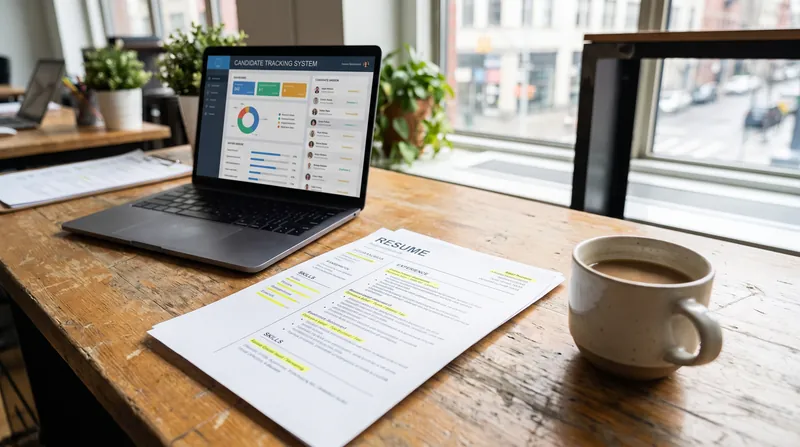
This shift has rendered the traditional, chronological resume obsolete for many roles. Candidates who continue to submit heavily designed, credential-first documents are finding their applications instantly rejected by Applicant Tracking Systems (ATS). Understanding how these algorithms parse, score, and rank candidates is no longer an insider secret—it is a mandatory survival skill for the modern job seeker.[3][4]
To beat the machine, candidates must first understand what the machine is actually doing. Early ATS platforms were simple keyword scanners, looking for exact text matches. But the AI screening tools of 2026 operate on semantic search and natural language processing.[1]
These systems do not just tally keywords; they build a "knowledge graph" of a candidate's capabilities. They extract work history, normalize job titles, and infer skills based on the context of the bullet points. The software then generates a composite fit score, ranking applicants and routing only the highest-scoring profiles to human reviewers.[1]
Because the AI is hunting for specific capabilities rather than prestigious pedigrees, the structure of the winning resume has inverted. Welcome to the era of "skills-based hiring." According to recent data, 70% of U.S. employers now use skills-based screening for entry-level and mid-tier roles, while traditional GPA screening has plummeted.
In response, career strategists are universally recommending the "skills-first" or hybrid resume format. In fact, 63% of employers actively prefer this layout. Unlike a reverse-chronological resume that buries a candidate's actual abilities under long lists of past daily duties, the skills-first format brings core competencies to the very top of the page.
A modern 2026 resume opens with a punchy, keyword-rich professional summary, immediately followed by a dense "Core Competencies" or "Technical Skills" section. This top-heavy structure spoon-feeds the AI parsing tools exactly what they need in the first few lines of text, maximizing the initial relevance score before the algorithm even reaches the work history.
However, claiming a skill is not enough; the AI looks for contextual proof. When detailing past work experience, standard bullet points that simply list responsibilities are heavily penalized. Instead, candidates must quantify their impact using the "X-Y-Z formula"—stating that they accomplished X, as measured by Y, by doing Z.
For example, rather than writing "Responsible for customer support," an optimized bullet reads, "Resolved 80+ customer inquiries daily, maintaining a 95% satisfaction rating and reducing response times by 30%." Numbers catch the algorithmic eye and provide the concrete evidence that semantic scanners require to validate a claimed skill.[4]
Beyond the content, the physical layout of the document is a frequent point of failure. The irony of the 2026 job market is that the most technologically advanced screening systems require the most visually primitive documents. A resume format can look entirely plain to a human and still drastically outperform a stylish template.[3]
ATS software does not admire graphic design; it extracts text. Multi-column layouts, text boxes, tables, custom icons, and infographic-style rating bars confuse the parsers. When an AI encounters these elements, it often scrambles the text, placing a candidate's best experience in the wrong data field or dropping it entirely.[3]
The consensus among technologists is to stick to a single-column layout, standard fonts like Arial or Calibri, and universally recognized section headers such as "Work Experience" and "Education." Creative headers like "My Journey" or "What I Bring" will cause the ATS to miscategorize the section, potentially resulting in an automatic rejection.[3]
While the skills-first, AI-optimized approach is dominant, it is not universally applicable. Career experts note that highly conservative industries—such as law or traditional finance—still lean toward conventional chronological formats. Furthermore, senior executive roles, which rely heavily on network and pedigree, are less likely to be subjected to automated skills screening.[4]
There are also ongoing concerns regarding algorithmic bias. While AI vendors argue that automated screening reduces human prejudice by standardizing evaluations, critics warn that models trained on historical hiring data can inadvertently replicate past biases. As a result, new regulations in 2026 are forcing companies to implement "human-in-the-loop" governance and regular bias audits.[4]
Ultimately, the AI gatekeeper is here to stay. Job seekers who view ATS software as an adversary will continue to face silent rejections. Those who treat it as a predictable system—one that rewards clear formatting, semantic keyword alignment, and quantified skills—will find their resumes consistently landing on the screens of human hiring managers.[4]
Key terms
- Applicant Tracking System (ATS)
- Software used by employers to screen, sort, and rank job applications before human review.
- Semantic Search
- An AI capability that understands the context and intent of words, rather than just looking for exact keyword matches.
- Skills-Based Hiring
- A recruitment strategy that prioritizes a candidate's demonstrated abilities and competencies over their formal education or past job titles.
- X-Y-Z Formula
- A method for writing resume bullet points that quantifies impact: 'Accomplished X, as measured by Y, by doing Z.'
Frequently asked
Should I save my resume as a PDF or a Word document?
Most modern ATS systems parse both well, but a standard .docx or a text-based PDF is safest. Avoid image-only PDFs, which algorithms cannot read.
Can I use a multi-column resume template?
No. Career experts strongly advise against multi-column layouts, as they often confuse ATS parsers and scramble your text.
What is a skills-first resume?
It is a format that places a dense 'Core Competencies' or 'Technical Skills' section at the very top, prioritizing what you can do over chronological job titles.
Will AI reject my resume if I lack a college degree?
Not necessarily. In 2026, skills-based hiring is replacing degree requirements, with AI scanners increasingly looking for proven competencies rather than educational pedigree.
Viewpoints in depth
Talent Acquisition Technologists
Advocates for using AI to manage surging application volumes and find semantic skill matches.
This camp, comprising HR software developers and enterprise recruiters, argues that AI screening is a necessary evolution. With application volumes up 24% year-over-year, manual review is mathematically impossible. They emphasize that modern semantic search actually benefits candidates by looking past exact keyword matches to infer true capabilities, ultimately reducing human bias and standardizing the evaluation process.
Modern Career Strategists
Advisors who teach candidates to adapt via skills-first formats and machine-readable layouts.
Career coaches and resume writers focus on the pragmatic reality of the 2026 job market: the machine reads first. They advocate for the 'skills-first' resume structure, urging job seekers to abandon pretty, multi-column designs in favor of plain text. Their core philosophy is that candidates must spoon-feed their core competencies to the algorithm using quantified bullet points and universally recognized section headers.
Candidate Advocates
Voices focused on transparency, algorithmic fairness, and the applicant experience.
Labor advocates and job seekers often view the ATS landscape as an opaque 'black box.' They raise concerns about algorithmic bias, noting that AI models trained on historical data can inadvertently penalize non-traditional candidates. This group pushes for 'human-in-the-loop' governance, demanding that companies regularly audit their screening tools and provide clearer feedback to applicants who are automatically rejected.
- Modern Career Strategists
- Advisors who teach candidates to adapt via skills-first formats and machine-readable layouts.
- Talent Acquisition Technologists
- Advocates for using AI to manage surging application volumes and find semantic skill matches.
- Candidate Advocates
- Voices focused on transparency, algorithmic fairness, and the applicant experience.
Perspectives this story doesn't cover
- Small Business Owners who still rely entirely on manual resume review
Sources
Source coverage
4 outlets
3 viewpoints surfaced




- [1]HireVoxTalent Acquisition Technologists
How Recruiters Use AI Resume Screening in 2026
Read on HireVox → - [2]Pin HRTalent Acquisition Technologists
7 Best AI Resume Screening Tools Compared for 2026
Read on Pin HR → - [3]MediumModern Career Strategists
How to Write a Resume in 2026 That Beats the Bots
Read on Medium → - [4]Factlen Editorial TeamCandidate Advocates
Synthesis by Factlen editorial team
Read on Factlen Editorial Team →

More in Careers & Work
See all →Resume Optimization
The Six-Second Scan: How Recruiter Eye-Tracking Data Dictates Optimal Resume Length
8 sources

Resume Optimization
The Call-Back Premium: Why Quantified Resume Achievements Outperform Task Descriptions
7 sources
Pay Transparency
The End of the Salary History Trap: How the EU's Pay Transparency Directive Works
4 sources

ATS Optimization
How to Write an AI-Proof Resume: The 2026 Guide to Beating ATS Filters
2 sources
Comments
Every angle. Every day.
Get Careers & Work stories with full source coverage and perspective breakdowns, free every day.