
How the Open Social Web Finally Broke the Walled Garden
In 2026, a new wave of interoperability bridges and multi-protocol clients is allowing users across Mastodon, Bluesky, and Nostr to seamlessly interact, fundamentally changing who owns social media data.
By Factlen Editorial Team
- ActivityPub Purists
- Advocates for community-owned servers and strict chronological feeds.
- Portability Advocates
- Engineers focused on seamless account migration and algorithmic choice.
- Cryptographic Maximalists
- Privacy advocates who rely on cryptographic keys rather than servers.
- Digital Rights Defenders
- Organizations focused on user autonomy and breaking corporate monopolies.
- Industry Analysts
- Observers tracking the broader shift from walled gardens to open protocols.
What's not represented
- · Everyday users who prioritize convenience over data ownership
- · Advertisers struggling to reach audiences on ad-free decentralized networks
Why this matters
For two decades, users have been locked into corporate social networks where leaving meant losing all their friends and content. The maturation of interoperability protocols means you can now choose your app interface without sacrificing your social graph, shifting power from platforms back to people.
Key points
- The open social web has reached critical mass in 2026, breaking the 'walled garden' model of corporate social media.
- Interoperability bridges like Bridgy Fed now allow seamless communication between different decentralized protocols.
- ActivityPub, AT Protocol, and Nostr represent the three major pillars of the new decentralized landscape.
- Multi-protocol clients like Ditto enable users to aggregate multiple networks into a single, highly customizable feed.
- The shift grants users 'credible exit,' allowing them to move their accounts and followers without platform lock-in.
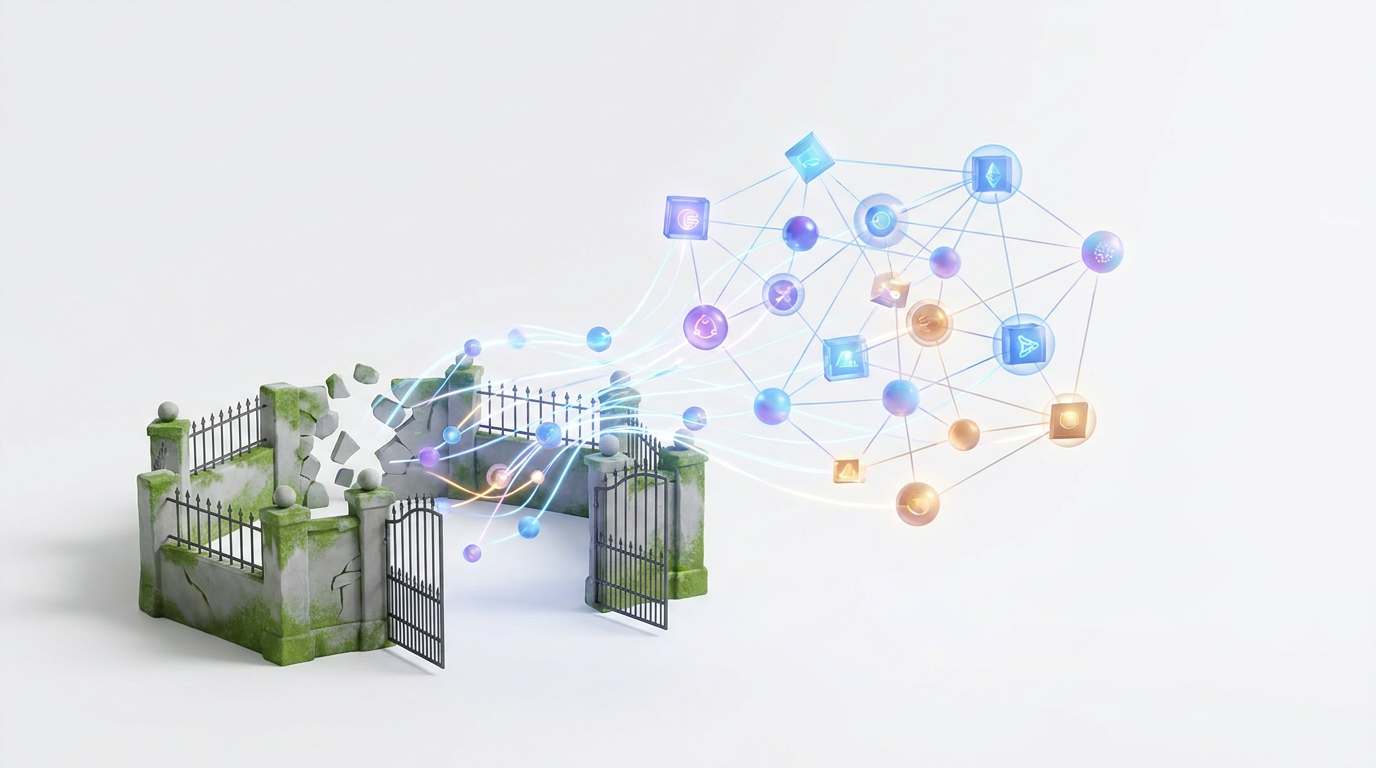
For the better part of two decades, social media has operated under a strict "walled garden" model. If you built an audience on Twitter, you could not take those followers to Instagram; if you posted a photo on Facebook, your friends on Reddit could not comment on it. It was a paradigm that defied the foundational logic of the internet. If email functioned like modern social media, a Gmail user would be entirely unable to message a Yahoo user. But in 2026, a quiet architectural revolution has reached critical mass, fundamentally breaking the walled garden and returning ownership of the social graph to the user.[6]
This shift is being driven by the "open social web," a constellation of decentralized networks that prioritize interoperability over corporate lock-in. Rather than logging into a single monolithic server owned by a tech giant, users connect through open protocols—standardized languages that allow different applications to speak to one another.[6]
By 2026, this ecosystem has evolved from a niche experiment for tech enthusiasts into a robust, interconnected landscape supporting tens of millions of active users. The breakthrough isn't just that these alternative networks exist; it is that the underlying protocols have finally learned how to seamlessly translate and communicate with each other, bridging previously isolated communities into a single, unified internet.[5][6]
The oldest and most established pillar of this new web is ActivityPub, an official web standard published by the World Wide Web Consortium (W3C). ActivityPub powers Mastodon, the decentralized microblogging platform that surged in popularity during the corporate turbulence of the early 2020s. By early 2026, Mastodon had grown to encompass between 10 and 15 million accounts spread across more than 500 independent servers, known as instances.[4]

ActivityPub operates on a model of server-to-server federation. A user joins a specific instance—perhaps one dedicated to a specific hobby, profession, or geographic region—and that server communicates with other servers across the network. This allows communities to set their own moderation rules and governance structures without being subjected to a single, global algorithm.[4]
However, ActivityPub is not the only protocol vying to rebuild the social web. Bluesky, originally incubated within Twitter before spinning out as an independent entity, built its network on an entirely different foundation called the AT Protocol (Authenticated Transfer Protocol).[2]
The developers behind the AT Protocol designed it to solve specific friction points they identified in ActivityPub. Primarily, they focused on "account portability." In the AT Protocol, a user's identity and data are decoupled from the server hosting them. If a user disagrees with their host's policies or the server shuts down, they can seamlessly migrate their entire account—followers, posts, and identity—to a new provider without breaking any links. The AT Protocol also functions more like a search engine, aggregating data across the network to support large-scale algorithmic feeds that users can choose and customize.[2]
The developers behind the AT Protocol designed it to solve specific friction points they identified in ActivityPub.
A third, more radical approach emerged in the form of Nostr (Notes and Other Stuff Transmitted by Relays). Unlike ActivityPub and the AT Protocol, Nostr does not rely on servers or traditional accounts. Instead, user identity is tied to cryptographic keys. Users broadcast their posts to independent "relays," and clients fetch those posts. Because there is no central server to ban an account, Nostr offers a highly censorship-resistant architecture favored by privacy advocates and cryptographic maximalists.[3]
For a time, the open social web faced a paradox: it had successfully escaped the walled gardens of Big Tech, only to accidentally build three new, incompatible walled gardens of its own. A user on Mastodon could not follow a user on Bluesky, and neither could interact with a user on Nostr. The protocols spoke different languages.[1][5]
The defining technical achievement of 2026 has been the deployment of robust "translation bridges" that sit between these protocols, rendering the underlying infrastructure invisible to the average user. The most prominent of these is Bridgy Fed, an open-source service that acts as a real-time interpreter between ActivityPub and the AT Protocol.[1]

Bridgy Fed operates elegantly in the background. If a Mastodon user wants to interact with the Bluesky network, they simply follow a specific bridging bot account. Once activated, the bridge translates their ActivityPub posts into AT Protocol formats, and vice versa. A Bluesky user sees the Mastodon account as if it were native to Bluesky, complete with the ability to like, reply, and repost.[1]
Similar infrastructure has been built to connect the cryptographic world of Nostr. The "Mostr" bridge translates between Nostr relays and ActivityPub servers in real time, allowing the Fediverse to interact with Nostr users seamlessly.[3]
With the translation layers in place, software developers have begun releasing "multi-protocol clients"—applications that aggregate all these networks into a single, unified interface. In the spring of 2026, the open-source development team Soapbox launched a major update to Ditto, a platform that exemplifies this new era.[3]
Built natively on the Nostr protocol, Ditto functions as a universal social hub. Through the Mostr and Bridgy Fed bridges, a user on Ditto can follow a journalist on Mastodon, reply to an artist on Bluesky, and read notes from a Nostr relay, all within the same chronological feed.[3]

Furthermore, Ditto represents a cultural shift back to the creative, highly personalized era of the early internet. Rejecting the standardized, "sad beige" feeds of modern corporate platforms, Ditto allows users to deeply customize their profiles with themes, background images, and custom layouts—evoking the deep personalization of the MySpace era, but powered by decentralized, user-owned infrastructure.[3]
The momentum of open protocols has become so undeniable that even traditional tech giants have been forced to adapt. Meta's microblogging platform, Threads, has steadily rolled out ActivityPub interoperability, allowing its hundreds of millions of users to follow and interact with accounts on Mastodon and other federated servers. While some decentralization purists remain skeptical of Meta's involvement, the integration proves that open standards are no longer a fringe movement.[6]
Ultimately, the maturation of the open social web in 2026 is about leverage. When protocols are interoperable and identities are portable, users possess "credible exit." If a platform introduces intrusive advertising, changes its algorithm, or alters its moderation policies, users can simply pack up their digital lives and move to a different interface without losing their connections. By breaking the walled garden, the internet has finally given the social graph back to the people who actually created it.[2][5][6]
How we got here
2016
Mastodon launches, popularizing the ActivityPub protocol for decentralized microblogging.
2021
Bluesky is announced as an independent initiative to build the AT Protocol.
2024
Bridgy Fed enters beta, offering the first reliable translation layer between Mastodon and Bluesky.
2026
Multi-protocol clients like Ditto launch, unifying ActivityPub, AT Protocol, and Nostr into a single customizable feed.
Viewpoints in depth
ActivityPub Purists
Advocates for community-owned servers and strict chronological feeds.
This camp, largely centered around Mastodon, believes that true decentralization requires community governance. They argue that server-to-server federation allows distinct communities to set their own rules and protect themselves from corporate influence. For purists, the lack of algorithmic feeds is a feature, not a bug, ensuring that attention cannot be manipulated by engagement-optimizing algorithms.
AT Protocol Developers
Engineers focused on account portability and scalable network indexing.
The architects behind Bluesky argue that ActivityPub's reliance on specific servers still leaves users vulnerable to bad administrators. They prioritize 'credible exit'—the ability to seamlessly move an account, identity, and followers to a new host without friction. They also believe that algorithmic feeds are necessary for discovery at scale, provided the user has the power to choose and customize which algorithm they use.
Nostr Maximalists
Privacy advocates who rely on cryptographic keys rather than servers.
This community views both ActivityPub and the AT Protocol as insufficiently decentralized because they still rely on host servers. By tying identity to cryptographic keys and broadcasting to independent relays, Nostr advocates argue they have built the only truly censorship-resistant network. They prioritize absolute user ownership and view multi-protocol clients like Ditto as the best way to interact with the rest of the web without compromising their cryptographic security.
What we don't know
- Whether major corporate platforms like X or TikTok will ever adopt open protocols to allow user portability.
- How decentralized networks will handle large-scale content moderation and spam as their user bases grow into the hundreds of millions.
- If the average consumer will ultimately prefer the convenience of centralized apps over the data ownership offered by open protocols.
Key terms
- Fediverse
- A portmanteau of 'federation' and 'universe,' referring to the collection of decentralized social networks that can communicate with each other.
- ActivityPub
- An open, decentralized social networking protocol established by the W3C, used by platforms like Mastodon and Threads.
- AT Protocol
- The Authenticated Transfer Protocol, a decentralized networking framework built by Bluesky that emphasizes account portability.
- Nostr
- A decentralized network protocol where user identity is based on cryptographic keys rather than accounts on a specific server.
- Instance
- An independent server running decentralized social media software, hosting its own specific community of users.
Frequently asked
Can I move my Twitter or Instagram followers to the Fediverse?
No. Centralized platforms like X and Instagram do not allow users to export their social graph. However, once you build an audience on an open protocol like AT Protocol, you can move it freely between compatible apps.
Do I need multiple accounts to use these different networks?
Not anymore. Thanks to interoperability bridges like Bridgy Fed and multi-protocol clients like Ditto, you can maintain one account on your preferred protocol and interact with users across the others.
Is the open social web free to use?
Yes. Most decentralized platforms are open-source and run by non-profits, community donations, or volunteer administrators, meaning there are no subscription fees or targeted advertisements.
Sources
Source coverage
6 outlets
5 viewpoints surfaced





[1]Electronic Frontier FoundationDigital Rights Defenders
How to Post to Bluesky from Mastodon
Read on Electronic Frontier Foundation →[2]AT ProtocolPortability Advocates
AT Protocol FAQ: Why not use ActivityPub?
Read on AT Protocol →[3]SoapboxCryptographic Maximalists
Ditto: A Bridge to the Open Web
Read on Soapbox →[4]Marketing AgentActivityPub Purists
Mastodon 2026 Statistics and Growth
Read on Marketing Agent →[5]Werd.ioPortability Advocates
The community-first software era
Read on Werd.io →[6]Factlen Editorial TeamIndustry Analysts
Synthesis by Factlen editorial team
Read on Factlen Editorial Team →
Every angle. Every day.
Get technology stories with full source coverage and perspective breakdowns delivered to your inbox.