
How the Middle East is Bottling Sunshine: The Rise of Desert Mega-Solar
Driven by vast deserts and record-low costs, Gulf states are building the world's largest solar parks to transition from petrostates to renewable energy superpowers.
By Factlen Editorial Team
- Economic Diversification Planners
- Viewing solar as a strategic tool to preserve hydrocarbon export revenues and build a post-oil economy.
- Energy Transition Advocates
- Focusing on the rapid decarbonization potential of ultra-large-scale solar.
- Global Energy Importers
- Looking to the Middle East as a future supplier of zero-carbon fuels.
What's not represented
- · Local ecological conservationists
- · Legacy fossil fuel workers
Why this matters
The Gulf's massive investments are driving down the global cost of solar technology and pioneering the green hydrogen supply chains needed to decarbonize heavy industries worldwide.
Key points
- The Gulf states are leveraging their high solar irradiance and vast deserts to build the world's largest single-site solar parks.
- Economies of scale and cheap capital have driven regional solar tariffs to record lows of under 1.5 cents per kilowatt-hour.
- Domestic solar power frees up valuable oil and natural gas reserves for export, funding the region's broader economic diversification.
- The region is investing heavily in green hydrogen, aiming to convert solar power into a liquid fuel that can be shipped globally.
- Autonomous, waterless cleaning robots are being deployed at scale to combat the severe efficiency losses caused by desert dust.
For decades, the Arabian Peninsula has been synonymous with one energy source: crude oil. The vast deserts of the Middle East hold some of the largest proven hydrocarbon reserves on the planet, shaping global geopolitics and fueling a century of industrial growth.[8]
But a profound transformation is rewriting the region's energy narrative. Across the United Arab Emirates, Saudi Arabia, and Oman, a new kind of energy boom is underway—one that harnesses the sky rather than the ground. The Gulf states are rapidly becoming the epicenter of ultra-large-scale solar power.[1][8]
This is not merely a token greening effort. Driven by plummeting technology costs and a strategic imperative to diversify their economies before the oil era ends, these nations are building solar parks of unprecedented scale. They are turning their harshest environments into their most valuable economic assets.[1][2]
The fundamental mechanism driving this boom is geography. The Middle East sits in the heart of the global "Sunbelt," boasting some of the highest levels of Direct Normal Irradiance (DNI) in the world. DNI measures the amount of solar radiation received per unit area by a surface that is always held perpendicular to the incoming rays of the sun.[3][8]
According to data from the World Bank's Global Solar Atlas, the Arabian Peninsula receives over 2,200 kilowatt-hours per square meter annually. This intense, consistent sunlight means that a solar panel placed in the Saudi desert generates significantly more electricity than the exact same panel placed in Germany or the United Kingdom.[3]

Beyond the sheer intensity of the sun, the Gulf states possess another critical advantage: vast expanses of flat, uninhabited, and otherwise unproductive land. In densely populated regions like Europe or East Asia, acquiring land for utility-scale solar is expensive and politically fraught. In the Arabian desert, land is abundant and cheap, allowing for economies of scale that are impossible elsewhere.[7]
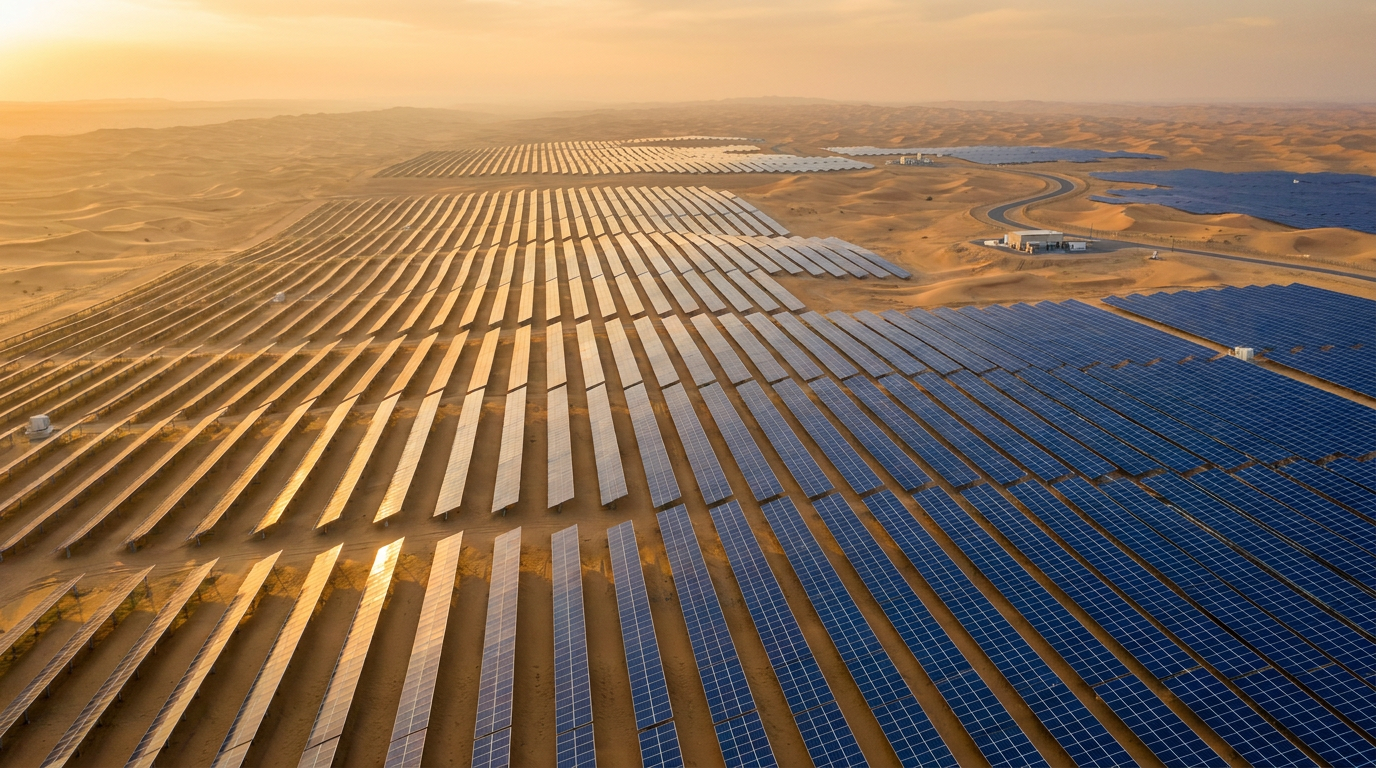
These economies of scale are visible in the sheer size of the region's mega-projects. Take the Al Dhafra Solar PV project in the UAE. Spanning 20 square kilometers of desert outside Abu Dhabi, it features nearly 4 million bifacial solar panels.[4]
Bifacial panels capture sunlight on both their front and back sides. In a desert environment, the highly reflective sand bounces sunlight back up onto the underside of the panels, boosting overall energy yield by up to 20 percent. Al Dhafra alone boasts a capacity of 2 gigawatts, enough to power roughly 160,000 homes.[4][7]
In neighboring Saudi Arabia, the Sudair Solar PV project is similarly massive, designed to generate 1.5 gigawatts of power. Meanwhile, Dubai's Mohammed bin Rashid Al Maktoum Solar Park is expanding in phases with a staggering ultimate target of 5 gigawatts by 2030, making it the largest single-site solar park in the world.[5]
In neighboring Saudi Arabia, the Sudair Solar PV project is similarly massive, designed to generate 1.5 gigawatts of power.
The scale of these projects has fundamentally altered the economics of renewable energy. By purchasing millions of panels at once, securing ultra-low-cost financing backed by sovereign wealth funds, and utilizing cheap state-owned land, Gulf developers have repeatedly shattered world records for the lowest solar tariffs.[7][8]
A decade ago, solar power was heavily subsidized and considered a luxury energy source. Today, power purchase agreements in the Middle East routinely clear at under 1.5 US cents per kilowatt-hour. This makes solar not just competitive with fossil fuels, but significantly cheaper than burning the region's own heavily subsidized natural gas.[1][7]

For the Gulf's economic planners, this presents a compelling arbitrage opportunity. Every barrel of oil or cubic meter of natural gas that is not burned domestically for power generation is a barrel that can be exported to global markets at a premium. Domestic solar power effectively frees up hydrocarbons for export, funding the very economic transition these countries are attempting to navigate.[1][8]
But the ambition extends beyond simply powering domestic air conditioning grids. The ultimate goal is to export this cheap, abundant solar energy to the rest of the world. Because electricity is difficult to transmit across oceans, the region is betting heavily on a chemical carrier: green hydrogen.[2]
Green hydrogen is produced by using renewable electricity to power electrolyzers, which split water into hydrogen and oxygen. The hydrogen can then be converted into green ammonia and shipped globally on specialized tankers, providing a zero-carbon fuel for heavy industries, shipping, and aviation.[2][6]
The centerpiece of this strategy is the NEOM Green Hydrogen Company in northwestern Saudi Arabia. Powered by 4 gigawatts of dedicated solar and wind energy, the facility aims to produce 600 tonnes of carbon-free hydrogen per day by the end of 2026.[6]
If successful, projects like NEOM will allow the Middle East to remain a dominant force in global energy markets long after the internal combustion engine is phased out. They are effectively figuring out how to bottle sunshine and ship it to Europe and Asia.[6][8]
Despite the rapid progress, the desert environment presents unique engineering challenges. The most significant is "soiling"—the accumulation of dust and sand on solar panels, which can rapidly degrade their efficiency. A heavy sandstorm can slash a solar park's output by more than half if the panels are not promptly cleaned.[7]

To solve this, the industry has turned to automation. The region's mega-parks are increasingly maintained by fleets of autonomous, waterless cleaning robots. These machines sweep the panels nightly, using specialized micro-fiber brushes to remove dust without wasting precious water resources.[7][8]
The other major hurdle is grid integration. Solar power is inherently intermittent; it peaks at midday and drops to zero at night. As solar penetration increases, the Gulf states are having to invest heavily in grid modernization and utility-scale battery storage to ensure stability when the sun goes down.[2][8]

Ultimately, the Middle East's solar boom represents one of the most consequential shifts in the global energy landscape. The nations that built their immense wealth by extracting fossilized sunlight from deep underground are now securing their future by harvesting it directly from the sky.[8]
How we got here
2013
Dubai launches the first phase of the Mohammed bin Rashid Al Maktoum Solar Park.
2020
The Al Dhafra project in Abu Dhabi shatters records with a solar tariff below 1.35 cents per kWh.
2023
NEOM Green Hydrogen Company reaches financial close on its massive $8.4 billion facility.
2026
NEOM facility targets full production of 600 tonnes of green hydrogen per day.
Viewpoints in depth
Energy Transition Advocates
Focusing on the rapid decarbonization potential of ultra-large-scale solar.
For climate researchers and international energy agencies, the Gulf's solar boom is a critical proof of concept for rapid decarbonization. They argue that the sheer scale of these mega-projects demonstrates how quickly renewable capacity can be deployed when backed by strong state mandates and sovereign capital. By driving down the global cost curve for solar panels and robotic cleaning technologies, these projects make renewable energy more accessible for developing nations worldwide.
Economic Diversification Planners
Viewing solar as a strategic tool to preserve hydrocarbon export revenues and build a post-oil economy.
State-backed developers and economic ministries view the solar transition through the lens of national survival. Their primary goal is to free up domestic oil and gas for lucrative export markets by substituting them with ultra-cheap solar power at home. Furthermore, by establishing dominance in next-generation energy carriers like green hydrogen, they aim to ensure their nations remain indispensable energy superpowers long after global oil demand peaks.
Global Energy Importers
Looking to the Middle East as a future supplier of zero-carbon fuels.
For energy-hungry regions like Europe and East Asia, the Middle East's solar boom represents a lifeline for their own climate goals. Heavy industries, such as steelmaking and maritime shipping, cannot easily run on electricity and require chemical fuels. Importers are heavily investing in Gulf green hydrogen projects, betting that the region's vast solar resources will make it the most cost-effective supplier of the zero-carbon fuels needed to decarbonize heavy industry.
What we don't know
- How quickly global shipping infrastructure can adapt to handle the massive volumes of green ammonia the Gulf plans to export.
- Whether utility-scale battery storage costs will fall fast enough to fully stabilize grids heavily reliant on intermittent desert solar.
- The long-term ecological impact of covering vast tracts of undisturbed desert habitat with millions of reflective panels.
Key terms
- Direct Normal Irradiance (DNI)
- A measure of the amount of solar radiation received per unit area by a surface held perpendicular to the sun's rays.
- Bifacial panels
- Solar panels designed to capture sunlight on both their front and back sides, utilizing light reflected off the ground.
- Green hydrogen
- Hydrogen fuel produced entirely through renewable energy sources, resulting in zero carbon emissions.
- Soiling
- The accumulation of dust, dirt, or sand on solar panels, which blocks sunlight and reduces energy output.
- Power Purchase Agreement (PPA)
- A long-term contract between an electricity generator and a buyer, securing a fixed price for the power produced.
Frequently asked
Why are oil-rich countries investing in solar power?
To free up their oil and gas for lucrative export markets, and to position themselves as dominant players in future zero-carbon energy markets like green hydrogen.
How do solar panels work in extreme desert heat?
While extreme heat can slightly reduce panel efficiency, the sheer intensity of the sunlight (irradiance) more than compensates for the thermal losses.
How do they clean the panels without wasting water?
Mega-parks utilize fleets of autonomous, waterless robots equipped with specialized microfiber brushes that sweep the panels nightly.
What is green hydrogen?
It is hydrogen fuel produced by using renewable electricity (like solar) to split water into hydrogen and oxygen, creating a zero-carbon fuel for heavy industry.
Sources
Source coverage
8 outlets
3 viewpoints surfaced








[1]International Renewable Energy Agency (IRENA)Energy Transition Advocates
Renewable Energy Market Analysis: Middle East
Read on International Renewable Energy Agency (IRENA) →[2]International Energy Agency (IEA)Energy Transition Advocates
Renewables 2024: Analysis and Forecast to 2030
Read on International Energy Agency (IEA) →[3]World Bank GroupGlobal Energy Importers
Global Photovoltaic Power Potential by Country
Read on World Bank Group →[4]MasdarEconomic Diversification Planners
Al Dhafra Solar PV Project: 2GW Capacity
Read on Masdar →[5]ACWA PowerEconomic Diversification Planners
Sudair Solar PV Independent Power Project
Read on ACWA Power →[6]NEOM Green Hydrogen CompanyGlobal Energy Importers
Building the World's Largest Green Hydrogen Plant
Read on NEOM Green Hydrogen Company →[7]Nature EnergyEnergy Transition Advocates
The economics of ultra-large-scale solar in arid regions
Read on Nature Energy →[8]Factlen Editorial TeamEconomic Diversification Planners
Synthesis by Factlen editorial team
Read on Factlen Editorial Team →
Every angle. Every day.
Get world stories with full source coverage and perspective breakdowns delivered to your inbox.