
How the Cruise Industry is Engineering the Zero-Emission Ships of the Future
Driven by strict new environmental mandates in Norway, maritime engineers are deploying massive battery banks, solar sails, and fuel cells to eliminate the cruise industry's massive carbon footprint.
By Factlen Editorial Team
- Maritime Innovators
- Engineers and shipbuilders focused on proving that zero-emission technologies can scale to massive vessels today.
- Cruise Operators
- Travel companies balancing the demand for luxury amenities with the urgent need to decarbonize their fleets.
- Environmental Regulators
- Government bodies and port authorities enforcing strict emission deadlines to protect local ecosystems.
What's not represented
- · Port City Residents
- · Alternative Fuel Suppliers
Why this matters
The cruise industry has historically been one of the heaviest polluters in the travel sector. The rapid deployment of zero-emission maritime technology not only preserves the world's most fragile marine ecosystems but also pioneers clean-energy solutions that will eventually decarbonize global commercial shipping.
Key points
- Norway will ban greenhouse gas-emitting ships from its World Heritage fjords starting in 2026.
- Cruise lines are using massive battery banks and fuel cells to eliminate emissions while docked in port.
- Hurtigruten's 'Sea Zero' project aims to launch a fully electric, wind-and-solar-assisted ship by 2030.
- Shipbuilders are redesigning vessels without smokestacks, creating quieter ships with more deck space.
- Transatlantic zero-emission voyages remain a challenge due to the immense weight and size of current batteries.
For decades, the cruise industry has been synonymous with heavy fuel oil, towering smokestacks, and a massive carbon footprint. A single large cruise ship can consume hundreds of tons of fuel per day, generating the energy equivalent of a small city to propel thousands of passengers across the ocean while keeping their floating hotel running. But a quiet revolution is taking hold in shipyards across Europe. Driven by tightening environmental regulations and a push for sustainable tourism, maritime engineers are fundamentally redesigning how these massive vessels are powered. The era of the zero-emission cruise ship is no longer a distant concept; it is actively under construction, promising a future where travelers can explore the world's most pristine marine environments without leaving a trail of exhaust in their wake.[6]
The catalyst for this rapid acceleration in green maritime technology is a looming deadline in Scandinavia. Starting in 2026, the Norwegian government will enforce a strict mandate: only zero-emission vessels will be permitted to enter the country's spectacular UNESCO World Heritage fjords, including the Geirangerfjord and Nærøyfjord. For years, these narrow, steep-sided waterways have suffered from trapped air pollution generated by the constant influx of traditional cruise ships. By banning greenhouse gas-emitting vessels from these protected waters, Norway has effectively forced the hand of the global cruise industry. Operators must either innovate or forfeit access to some of the most lucrative and breathtaking destinations on the planet.[1][3]
Meeting this 2026 deadline requires bridging the gap between current capabilities and future technologies. One of the most immediate solutions being deployed is the integration of massive battery packs alongside traditional engines. Norwegian research institute SINTEF has been heavily involved in developing thermal storage and battery solutions that allow large ships to operate emission-free for specific periods. When a hybrid ship approaches a protected fjord, it can shut down its combustion engines and glide silently through the water on stored electrical power. While this does not make the entire voyage zero-emission, it eliminates local air and noise pollution in the most sensitive ecological zones.[1]

Beyond temporary battery power, major cruise lines are turning to fuel cell technology to drastically reduce their overall footprint. Royal Caribbean Group has positioned its new Icon Class ships, as well as Silversea's Silver Nova, as testbeds for advanced environmental systems. These vessels utilize a combination of liquefied natural gas (LNG) and fuel cells. While LNG is a fossil fuel, it burns significantly cleaner than traditional marine diesel, virtually eliminating sulfur dioxides and reducing nitrogen oxides. The fuel cells, meanwhile, use a chemical reaction to generate electricity without combustion.[4]
The primary role of these fuel cells is to handle the ship's "hotel load"—the massive amount of energy required to power lighting, air conditioning, kitchens, elevators, and water parks for thousands of guests. By relying on fuel cells for these functions, a ship can achieve zero local emissions while docked in port, completely shutting down its main engines. Royal Caribbean's strategy views this LNG-and-fuel-cell combination as a transitional step. The ultimate goal is to replace LNG with green hydrogen or other sustainable fuels, paving the way for a fully net-zero cruise ship by 2035.[4]
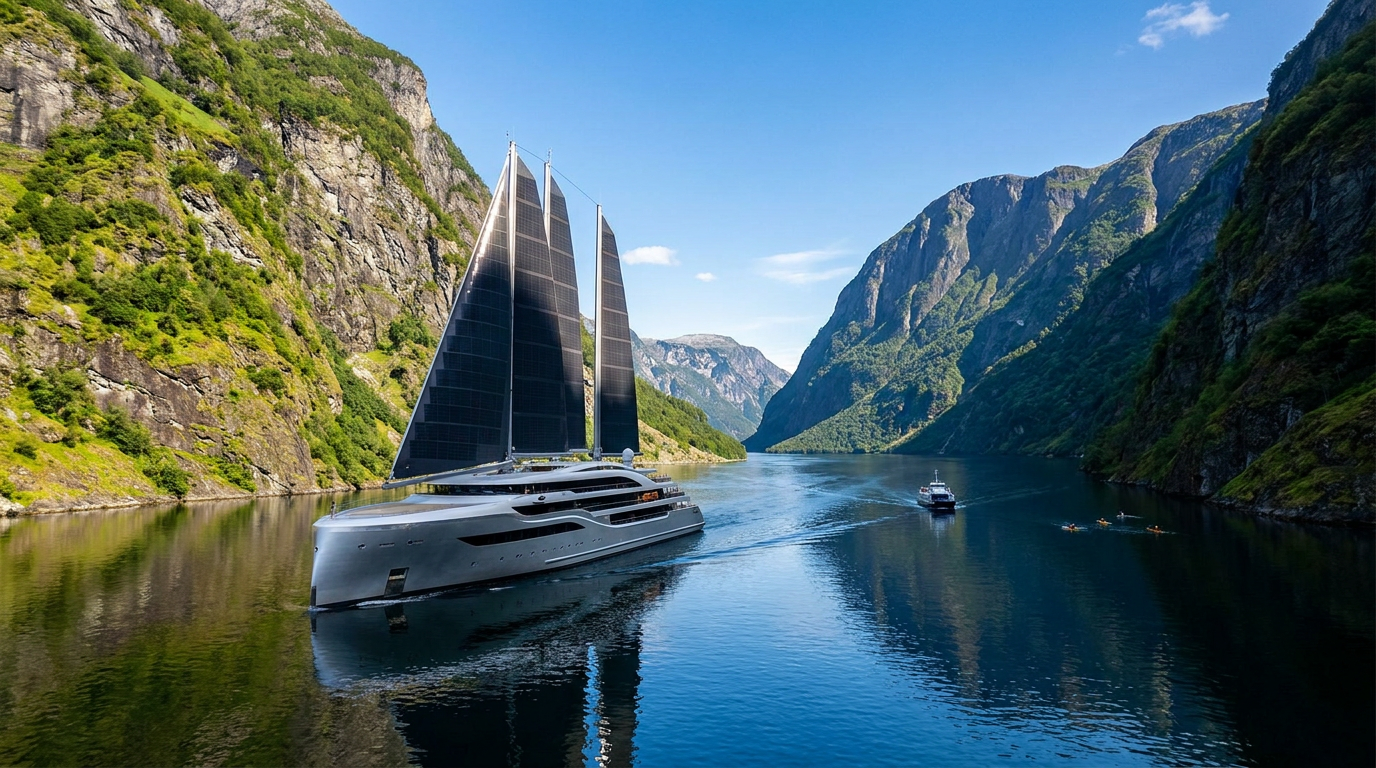
While transitional fuels are moving the needle today, some operators are aiming directly for absolute zero. Hurtigruten, the historic Norwegian coastal ferry and cruise operator, has launched "Sea Zero," an ambitious initiative to build a fully emission-free ship by 2030. Partnering with SINTEF and the shipbuilding company VARD, Hurtigruten has spent years running advanced simulations and physical trials in ocean basins to perfect a radically new vessel design. The resulting concept is a 443-foot ship that relies entirely on electricity, featuring a massive 60-megawatt-hour battery system that charges with renewable energy while docked in port.[2]
While transitional fuels are moving the needle today, some operators are aiming directly for absolute zero.
Because batteries alone cannot push a heavy ship through rough coastal waters for days at a time, the Sea Zero project relies on extreme energy efficiency. The ship will feature three retractable, autonomous wing-rigs—essentially high-tech sails—that pull in air currents up to 164 feet high to provide wind propulsion. These sails will be clad in over 16,000 square feet of solar panels, allowing the ship to harvest energy from the 24-hour Midnight Sun during the Norwegian summer. Combined with air lubrication systems that pump bubbles under the hull to reduce drag, these innovations are expected to cut the ship's total energy consumption by 40 to 50 percent compared to current vessels.[2]

The push for electrification is also reshaping the physical architecture of the ships themselves. At the Seatrade Cruise Global event, German shipbuilder Meyer Werft unveiled "Project Vision," a concept for a 100 percent battery-electric cruise ship capable of carrying nearly 2,000 passengers. Developed in collaboration with Corvus Energy, a leader in maritime battery systems, the design proves that existing battery technology can be scaled up for large-scale electric cruising today, not decades in the future. Meyer Werft estimates that such a vessel could reduce greenhouse gas emissions by up to 95 percent and could be delivered as early as 2031 if ordered now.[5]
Removing the massive combustion engines, exhaust shafts, and funnels required by traditional fuels unlocks entirely new possibilities for passenger spaces. Without a central smokestack dominating the upper decks, Meyer Werft's Project Vision features an expanded, unobstructed sun deck and a glass-enclosed indoor aqua park at the stern. Furthermore, the absence of heavy machinery significantly reduces onboard vibrations and engine noise, creating a smoother, quieter, and more comfortable experience for guests. The ship becomes less of an industrial machine and more of a silent, floating resort.[5]
Despite these rapid advancements, the industry still faces significant engineering hurdles. The energy density of current battery technology remains a major limiting factor. Batteries are incredibly heavy and take up vast amounts of space; a battery bank large enough to power a ship across the Atlantic Ocean would currently leave no room for passengers or cargo. As a result, fully electric ships like Hurtigruten's Sea Zero and Meyer Werft's Project Vision are currently viable only for coastal routes or standard European itineraries where frequent charging is possible. Transatlantic voyages will likely require the development of high-density alternative fuels like green ammonia or liquid hydrogen.[1][2][5]

Another critical piece of the puzzle is port infrastructure. A battery-electric ship is only as clean as the grid that charges it. To support zero-emission cruising, ports around the world are racing to install "shore power" facilities, allowing ships to plug into the local electrical grid and turn off their generators while docked. If the local grid is powered by renewable sources like wind, solar, or hydroelectricity, the ship's port stay becomes truly emission-free. However, upgrading port infrastructure to deliver the massive voltage required by a modern cruise ship is a costly and complex undertaking that requires coordination between governments, utilities, and cruise lines.[1]
Beyond propulsion, sustainable cruising requires rethinking every aspect of a ship's operation, particularly waste and water management. Modern eco-ships are essentially floating recycling plants. Advanced desalination and reverse osmosis systems now produce up to 90 percent of the freshwater used onboard, while heat recovered from the engines is repurposed to warm swimming pools and showers. Some vessels are even pioneering Microwave-Assisted Pyrolysis (MAP) systems, which convert solid waste directly into synthesis gas that the ship can use for fuel, drastically reducing the amount of trash sent to landfills.[4]

The transformation of the cruise industry from a heavy polluter to a pioneer of green maritime technology represents a monumental shift in global travel. While the transition will require billions of dollars in investment and years of rigorous testing, the roadmap is now clearly defined. From the battery-powered hybrid ships navigating the Norwegian fjords today to the solar-sailed electric vessels of the 2030s, the future of cruising is undeniably clean. For travelers, this means the ability to explore the world's oceans with a clear conscience, knowing that the journey itself is no longer harming the destinations they set out to see.[2][6]
This technological shift is also driving a change in the philosophy of cruising itself. Companies are moving toward "experience tourism," focusing on smaller, purpose-built ships that offer immersive, off-the-beaten-path itineraries rather than sheer volume. By prioritizing sustainability, these operators are attracting a new demographic of environmentally conscious travelers who previously avoided cruises. As zero-emission technologies prove their viability on the water, they will inevitably trickle down to commercial shipping and cargo fleets, meaning the innovations funded by luxury travel today could ultimately help decarbonize the entire global supply chain tomorrow.[6]
How we got here
2023
Silversea launches Silver Nova, utilizing fuel cells to power the ship's entire hotel load in port.
2024
Royal Caribbean's Icon of the Seas debuts as a testbed for LNG and fuel cell integration.
2026
Norway's mandate takes effect, banning emitting vessels from World Heritage fjords.
2030
Hurtigruten plans to launch its first fully zero-emission 'Sea Zero' coastal ship.
2035
Major cruise operators target the deployment of fully net-zero cruise ships.
Viewpoints in depth
Maritime Innovators
Engineers and shipbuilders focused on proving that zero-emission technologies can scale to massive vessels today.
For naval architects and battery manufacturers, the challenge is overcoming the sheer physics of moving tens of thousands of tons through water. Innovators argue that the technology already exists—pointing to 60-megawatt-hour battery banks, air lubrication systems, and retractable solar sails. Their focus is on extreme energy efficiency, redesigning the fundamental shape of the hull and eliminating heavy combustion machinery to make room for clean power. They view the 2026 and 2030 regulatory deadlines not as burdens, but as necessary catalysts to force the industry out of its reliance on fossil fuels.
Environmental Regulators
Government bodies and port authorities enforcing strict emission deadlines to protect local ecosystems.
Regulators, particularly in Scandinavia and the European Union, argue that voluntary corporate sustainability pledges are moving too slowly to protect vulnerable environments. By implementing hard deadlines—such as Norway's 2026 ban on emitting vessels in its World Heritage fjords—they are forcing the market to adapt. These authorities emphasize that local air quality, noise pollution, and marine ecosystem health must take precedence over cruise industry profits. They are also heavily investing in shore power infrastructure, ensuring that when clean ships arrive, the local grid can support their massive electrical needs.
Cruise Operators
Travel companies balancing the demand for luxury amenities with the urgent need to decarbonize their fleets.
Major cruise lines face the complex reality of transitioning multi-billion-dollar fleets while maintaining the resort-style experiences their passengers expect. Operators view the path to net-zero as a phased approach. They are currently investing heavily in transitional technologies like Liquefied Natural Gas (LNG) and hybrid fuel cells to immediately reduce sulfur and nitrogen emissions. While they support the ultimate goal of fully electric or hydrogen-powered ships, they caution that global port infrastructure and alternative fuel supply chains must mature before transatlantic, zero-emission cruising becomes a logistical reality.
What we don't know
- Whether global port infrastructure can be upgraded fast enough to provide shore power for entire fleets.
- Which high-density alternative fuel (e.g., green hydrogen, ammonia) will ultimately win out for transatlantic voyages.
Key terms
- Hotel Load
- The electrical power required to run a ship's passenger amenities, such as lighting, air conditioning, and kitchens.
- Shore Power
- The ability for a ship to plug into a port's electrical grid, allowing it to turn off its engines while docked.
- Liquefied Natural Gas (LNG)
- A transitional marine fuel that burns cleaner than traditional heavy fuel oil, though it still emits carbon.
- Fuel Cell
- A device that converts the chemical energy of a fuel directly into electricity without combustion.
- Air Lubrication
- A system that pumps a layer of micro-bubbles under a ship's hull to reduce friction and improve fuel efficiency.
Frequently asked
Can a large cruise ship run entirely on batteries?
Yes, but currently only for shorter coastal routes. Transatlantic voyages require more energy than modern batteries can store, necessitating alternative fuels.
Why is Norway banning traditional cruise ships in 2026?
The Norwegian government is enforcing a zero-emission mandate to protect the air quality and pristine marine environments of its UNESCO World Heritage fjords.
What do fuel cells do on a cruise ship?
Fuel cells generate electricity chemically without combustion. They are primarily used to power the ship's 'hotel load' (lights, AC, pools) so the main engines can be turned off in port.
Sources
Source coverage
6 outlets
3 viewpoints surfaced






[1]SINTEFMaritime Innovators
Zero-emission cruising with batteries
Read on SINTEF →[2]HurtigrutenCruise Operators
Sea Zero – an emission-free future
Read on Hurtigruten →[3]Business NorwayEnvironmental Regulators
Norwegian shipowners are now launching brand-new, zero-emission cruise ships
Read on Business Norway →[4]ESG TodayCruise Operators
Royal Caribbean to Launch Cruise Industry’s First Fuel Cell-Powered Ship
Read on ESG Today →[5]AutoEvolutionMaritime Innovators
Meyer Werft's Vision for a 100% Electric Cruise Ship
Read on AutoEvolution →[6]Factlen Editorial Team
Synthesis by Factlen editorial team
Read on Factlen Editorial Team →

Every angle. Every day.
Get travel stories with full source coverage and perspective breakdowns delivered to your inbox.