
How SpaceX Executed the Largest IPO in History—and What It Means for Investors
SpaceX bypassed traditional Wall Street norms to raise a record-breaking $75 billion in its public debut, reshaping how mega-cap companies approach the market. This explainer breaks down the mechanics of the historic offering, the underlying value of its Starlink network, and the broader implications for the trillion-dollar space economy.
By Factlen Editorial Team
- Tech & Growth Investors
- View SpaceX fundamentally as a telecommunications and data-routing company, pointing to Starlink's recurring revenue as the true driver of valuation.
- Aerospace Traditionalists
- Focus on the insurmountable lead SpaceX has built in orbital launch mechanics and hardware execution.
- Macroeconomists
- See the IPO as a critical milestone in establishing the foundational infrastructure for a projected $1.8 trillion space economy.
What's not represented
- · Legacy aerospace competitors facing margin compression
- · Astronomers concerned about light pollution from mega-constellations
Why this matters
The SpaceX IPO isn't just a milestone for space exploration; it fundamentally alters the landscape of public markets by introducing the largest commercial space pure-play to everyday investors. Understanding how this offering was structured provides a blueprint for future mega-IPOs and offers retail investors a direct stake in the infrastructure of the next technological frontier.
Key points
- SpaceX executed the largest IPO in history, raising $75 billion and bypassing traditional Wall Street roadshow norms.
- The company's Form S-1 revealed massive profitability driven by its near-monopoly on commercial launch services.
- Starlink's recurring subscription revenue is viewed by tech investors as the primary engine justifying the mega-cap valuation.
- The successful debut signals a broadening of market leadership beyond software and artificial intelligence into heavy hardware.
- Balancing quarterly earnings expectations with long-term Mars ambitions will be the primary challenge for the new public board.
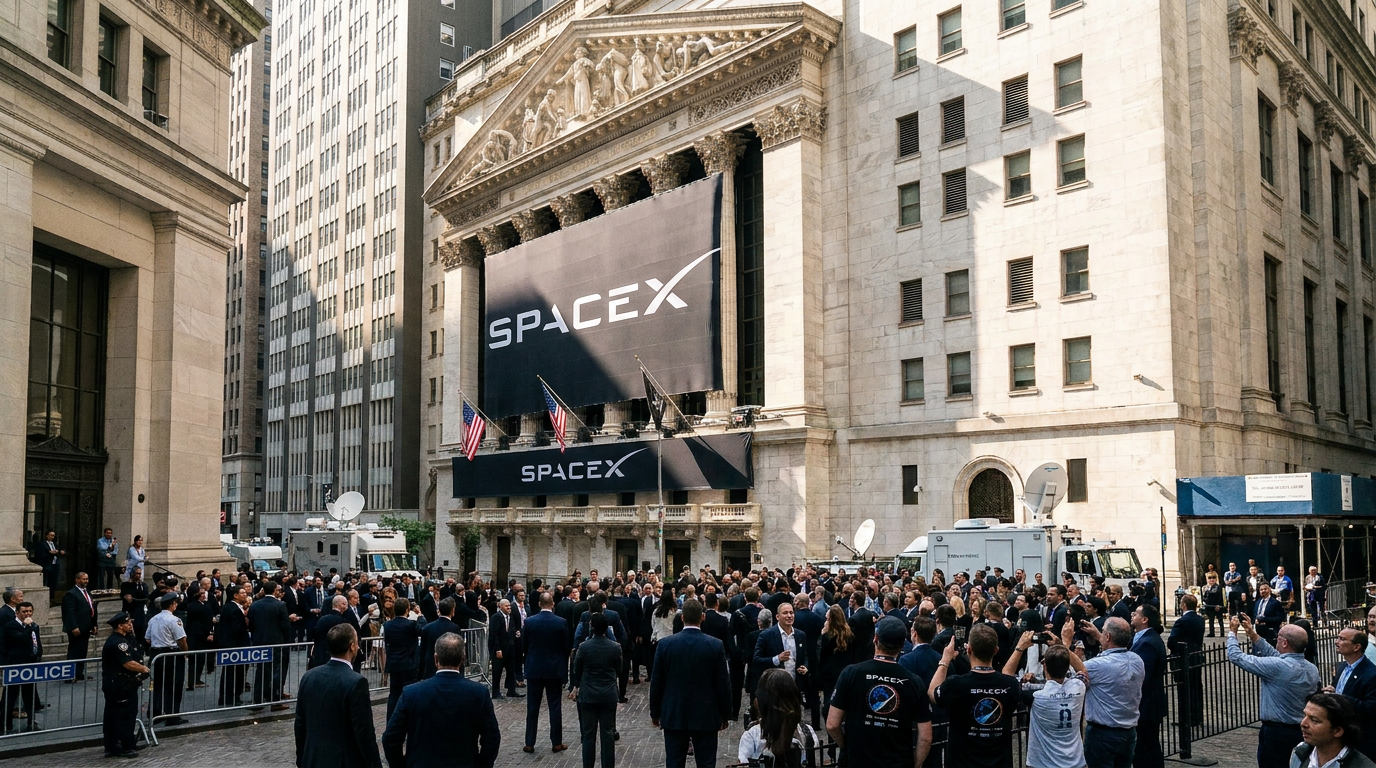
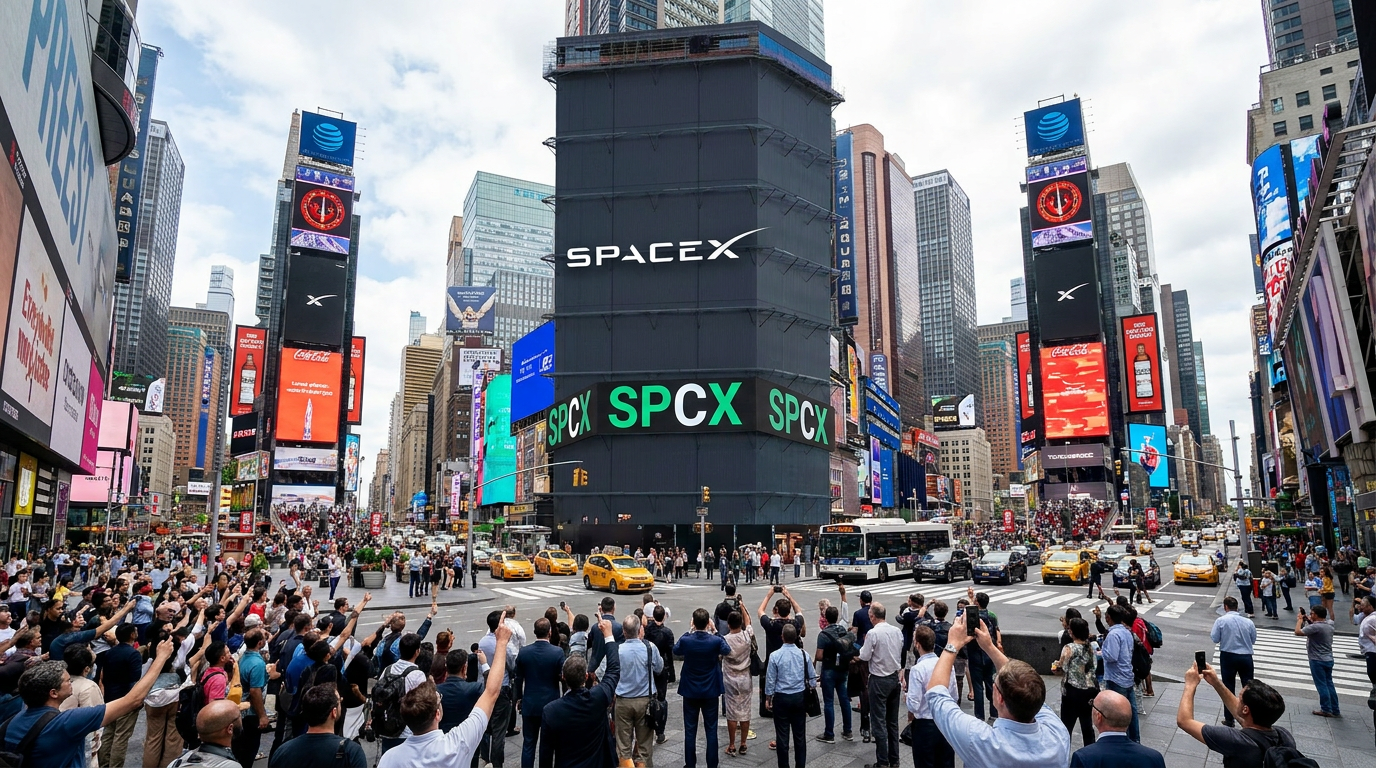
For decades, the public markets have waited for a pure-play space infrastructure company with the scale and financial gravity of a major tech platform. That wait ended this week when Space Exploration Technologies Corp. executed the largest Initial Public Offering in global financial history. Raising a staggering $75 billion, the debut shattered previous records and immediately minted SpaceX as a public mega-cap titan.[1][5]
The sheer magnitude of the offering eclipses the historical benchmarks set by Saudi Aramco’s $29.4 billion debut in 2019 and Alibaba’s $25 billion listing in 2014. According to historical IPO data maintained by the University of Florida, an offering of this size requires an unprecedented level of institutional and retail coordination, effectively absorbing a massive swath of available market liquidity in a single event.[5]
Yet, it was not just the size of the capital raise that captured Wall Street’s attention, but the unorthodox mechanics of the execution. Market analysts noted that the company actively bucked traditional investment banking norms, bypassing the standard, fee-heavy roadshow structure in favor of a streamlined, digitally native allocation process.[1]

By leveraging its massive retail following and utilizing direct-access platforms, SpaceX managed to distribute a significant portion of its shares directly to everyday investors. This approach minimized the traditional first-day pricing pop that typically enriches institutional insiders at the expense of the issuing company, ensuring that the $75 billion raised went directly onto the company's balance sheet rather than into the pockets of intermediaries.[1][6]
The foundation of this historic valuation was laid bare in the company’s Form S-1 registration statement filed with the Securities and Exchange Commission. For years, SpaceX’s internal financials were a closely guarded secret, subject to intense speculation. The public filings revealed a dual-engine business model that is far more diversified and profitable than many traditional aerospace analysts had previously modeled.[3]
The first engine is the company's near-monopoly on commercial launch services. Through the relentless optimization of its reusable Falcon 9 fleet and the rapid development of the super-heavy Starship launch system, SpaceX has driven the cost of reaching Low Earth Orbit down by orders of magnitude. The S-1 data confirmed that the company now handles the vast majority of global commercial payload mass, operating with margins that legacy aerospace contractors cannot replicate.[3][6]
However, the true financial powerhouse driving the $75 billion raise is Starlink, the company's satellite internet constellation. Silicon Valley investors and tech analysts have increasingly pointed to Starlink as the primary upside surprise that justifies the company's astronomical public valuation.[2]
However, the true financial powerhouse driving the $75 billion raise is Starlink, the company's satellite internet constellation.
Rather than viewing SpaceX purely as a transportation or logistics company, forward-looking investors are pricing it as a global telecommunications utility. Starlink provides high-margin, recurring subscription revenue that perfectly balances the capital-intensive, cyclical nature of rocket development. With millions of active terminals deployed globally, Starlink effectively acts as the cash-flow engine funding the company's deep-space ambitions.[2][3]

This telecommunications pivot is crucial for understanding the broader macroeconomic context of the IPO. The World Economic Forum recently projected that the global space economy will reach $1.8 trillion by 2035, driven largely by satellite communications, Earth observation, and space-based data routing.[4]
In this trillion-dollar ecosystem, SpaceX is positioning itself not just as a participant, but as the foundational infrastructure layer. By controlling both the launch vehicles—the delivery mechanism—and the satellite network—the end product—the company has established a vertically integrated moat that is virtually unprecedented in modern industrial history.[3][4]
The implications for the broader stock market are profound. For years, software and artificial intelligence have dominated the growth narratives of public equities. The successful flotation of a heavy-industry, hardware-centric aerospace company signals a potential broadening of market leadership. It demonstrates that public investors are willing to underwrite massive capital expenditures if the long-term technological moat is sufficiently deep.[1][6]

Furthermore, the integration of Starlink into the broader AI and compute ecosystem is just beginning to be understood by public markets. Leading technology investors argue that a low-latency, high-bandwidth global satellite network is the necessary backbone for edge computing, autonomous logistics, and remote AI deployment, effectively making SpaceX an adjacent play on the artificial intelligence boom.[2]
Despite the overwhelming success of the debut, the transition from a closely held private fiefdom to a publicly scrutinized entity introduces new variables. Public market investors demand predictable quarterly earnings, a rhythm that often conflicts with the iterative, explosion-heavy development style that characterized SpaceX's early years of rapid prototyping.[3][6]
The company's S-1 filings transparently acknowledge the immense capital requirements of its ultimate goal: establishing a self-sustaining human presence on Mars. Balancing the fiduciary duty to maximize near-term shareholder value with the founder's multi-decade, interplanetary ambitions will be the defining governance challenge for the newly public board of directors.[3]

Ultimately, the SpaceX IPO represents a watershed moment in financial history. It proves that the public markets can still digest and reward audacious, capital-intensive hardware engineering. By opening its capitalization table to the world, SpaceX has invited everyday investors to directly participate in the commercialization of the cosmos, fundamentally redefining the boundaries of public equity.[6]
How we got here
2002
Elon Musk founds Space Exploration Technologies Corp. with the goal of reducing space transportation costs.
2008
SpaceX becomes the first privately funded company to launch a liquid-fueled rocket into orbit.
2020
The company successfully launches its first crewed mission to the International Space Station.
2024
Starlink achieves profitability, providing a massive recurring revenue stream to fund deep-space projects.
June 2026
SpaceX executes the largest Initial Public Offering in history, raising $75 billion.
Viewpoints in depth
Tech & Growth Investors
Argue that SpaceX is fundamentally a telecommunications and data-routing company disguised as a rocket manufacturer.
This camp points to Starlink's high-margin subscription model as the true driver of the $75 billion valuation, drawing parallels to early internet service providers but with a global, monopolistic moat. They view the low-latency satellite network as the necessary backbone for edge computing and remote AI deployment, effectively making SpaceX an adjacent play on the artificial intelligence boom.
Aerospace Traditionalists
Focus on the insurmountable lead SpaceX has built in orbital launch mechanics and hardware execution.
Traditional industry analysts emphasize that the reusable Falcon 9 and the emerging Starship platform have structurally altered the economics of spaceflight. By driving down the cost-per-kilogram to orbit by orders of magnitude, they argue SpaceX has made it nearly impossible for legacy defense contractors and national space agencies to compete on commercial terms.
Macroeconomists
View the IPO as a critical milestone in the maturation of the commercial space sector.
Economic forecasters argue that by providing reliable, low-cost access to orbit, SpaceX is acting as the foundational infrastructure—the "railroads"—that will enable a projected $1.8 trillion space economy. They see the successful public listing as proof that global capital markets are ready to underwrite the massive expenditures required for zero-gravity manufacturing and deep-space logistics.
What we don't know
- How the public markets will react to the inevitable delays and explosive setbacks inherent in Starship's iterative development program.
- Whether regulatory bodies will impose new restrictions on Starlink's orbital deployment as the constellation grows denser.
- How the company will balance the fiduciary duty to maximize quarterly shareholder returns with Elon Musk's stated goal of colonizing Mars.
Key terms
- Initial Public Offering (IPO)
- The process by which a private company offers shares to the public in a new stock issuance, allowing it to raise capital from public investors.
- Low Earth Orbit (LEO)
- An Earth-centered orbit with an altitude of 2,000 km or less, where SpaceX's Starlink satellites operate to provide high-speed internet.
- Mega-cap
- A company with a market capitalization typically exceeding $200 billion, a status SpaceX achieved immediately upon going public.
- Form S-1
- The initial registration form for new securities required by the SEC for public companies, revealing detailed financial and business information.
Frequently asked
Can retail investors buy SpaceX stock now?
Yes, following the IPO, SpaceX shares are publicly traded on major exchanges and are accessible through standard brokerage accounts.
Does the IPO include Starlink?
Yes, Starlink remains a wholly owned subsidiary of SpaceX, meaning its revenue and growth are fully integrated into the parent company's public valuation.
How does this compare to previous record IPOs?
Raising $75 billion, SpaceX's debut easily surpassed the previous global records set by Saudi Aramco ($29.4 billion) and Alibaba ($25 billion).
Sources
Source coverage
6 outlets
3 viewpoints surfaced





[1]MarketWatchTech & Growth Investors
How Elon Musk nailed the SpaceX IPO: ‘I’m not sure that this could have gone much better’
Read on MarketWatch →Here’s what could be SpaceX’s biggest upside surprise, according to a leading Silicon Valley investor
Read on MarketWatch →[3]U.S. Securities and Exchange CommissionAerospace Traditionalists
Space Exploration Technologies Corp. Form S-1 Registration Statement
Read on U.S. Securities and Exchange Commission →[4]World Economic ForumMacroeconomists
The Future of the Space Economy: Reaching $1.8 Trillion
Read on World Economic Forum →[5]University of Florida Warrington College of BusinessMacroeconomists
Initial Public Offerings: Updated Statistics
Read on University of Florida Warrington College of Business →[6]Factlen Editorial TeamMacroeconomists
Synthesis by Factlen editorial team
Read on Factlen Editorial Team →
Every angle. Every day.
Get finance stories with full source coverage and perspective breakdowns delivered to your inbox.