
How Solid-State Batteries Work: The Science Behind the Next Generation of Energy Storage
By replacing flammable liquid electrolytes with solid ceramics or polymers, solid-state batteries promise to double electric vehicle range, slash charging times, and eliminate fire risks. Here is how the breakthrough technology actually works—and why manufacturing it at scale remains the final hurdle.
By Factlen Editorial Team
- Battery Innovators & Automakers
- Focused on the transformative potential for vehicle range, charging speed, and consumer adoption.
- Manufacturing Realists
- Focused on the immense physical and economic hurdles of scaling the technology.
- Energy Policy & Safety Advocates
- Focused on the systemic benefits of eliminating flammable liquids and improving grid resilience.
What's not represented
- · Lithium Mining Communities
- · Independent Auto Mechanics
Why this matters
Solid-state chemistry is the key to making electric vehicles lighter, cheaper, and capable of driving over 600 miles on a single charge. When this technology reaches mass production, it will fundamentally alter not just the automotive industry, but portable electronics, home grid storage, and even electric aviation.
Key points
- Solid-state batteries replace flammable liquid electrolytes with solid ceramics or polymers, drastically reducing fire risks.
- The solid barrier allows the use of a lithium metal anode, which can store up to ten times more energy than traditional graphite.
- Automakers expect solid-state cells to deliver 400 to 500 Wh/kg, potentially increasing EV range by 50% to 80%.
- Because they lack a liquid core, solid-state batteries maintain their charging speeds and range even in extreme sub-zero temperatures.
- While prototypes are currently on the road, manufacturing challenges and high costs mean mass-market adoption is unlikely before 2030.
For over a decade, the electric vehicle industry has been chasing a holy grail: a battery that can drive 600 miles on a single charge, refill in ten minutes, and never catch fire. Until recently, this sounded like science fiction. Today, the lithium-ion batteries that power our phones, laptops, and cars are marvels of modern engineering, but they are fundamentally limited by their chemistry. Inside every conventional battery is a liquid electrolyte—a chemical soup that shuttles ions back and forth. This liquid is heavy, temperature-sensitive, and highly flammable.
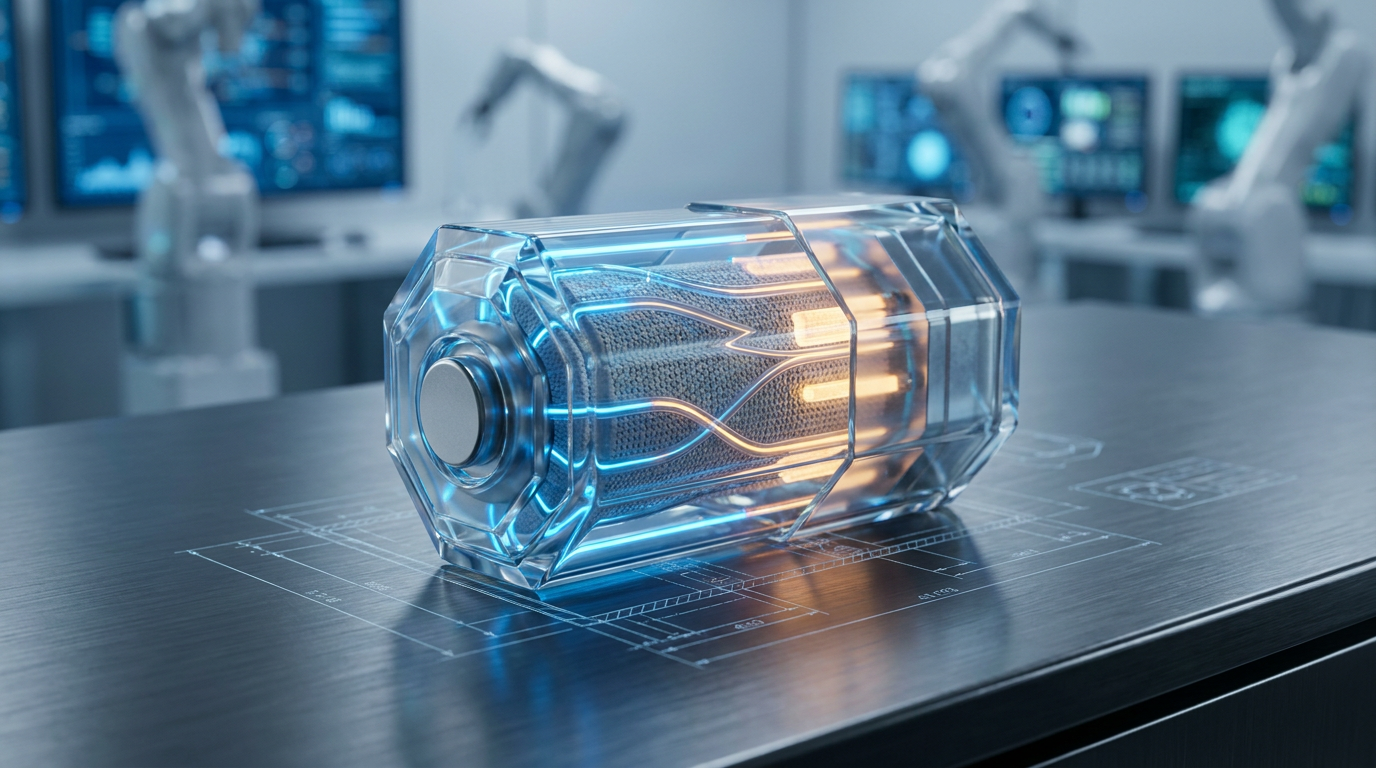
Enter the solid-state battery. As the name suggests, this next-generation technology replaces the liquid electrolyte with a solid material—typically a specialized ceramic, glass, polymer, or sulfide. This single substitution unlocks a cascade of physical and chemical advantages that engineers have theorized about for years. Without a liquid core, the battery is no longer a pressurized, flammable hazard waiting for a puncture or a software glitch to trigger a thermal runaway fire.[1][2]
But safety is only the beginning of the story. The true prize of solid-state technology is a massive leap in energy density. In a traditional battery, the anode (the negative side) is typically made of graphite, a bulky and heavy material. Battery chemists have long wanted to replace graphite with pure lithium metal, which can hold up to ten times more energy by weight.[3]
However, in a liquid battery, lithium metal is notoriously unstable. As the battery charges and discharges, the lithium tends to grow "dendrites"—microscopic, needle-like spikes of metal. In a liquid environment, these dendrites easily pierce the battery's thin internal separator, causing catastrophic short circuits and fires. Because of this, pure lithium metal anodes have been largely unusable in commercial rechargeable batteries.

A solid electrolyte changes the physics entirely. The dense ceramic or sulfide layer acts as a physical fortress, tough enough to suppress dendrite growth and finally making the lithium-metal anode viable. The result is a staggering leap in how much power can be packed into a small space.[1][3]
While today's best lithium-ion cells max out around 200 to 260 watt-hours per kilogram (Wh/kg), solid-state prototypes are consistently hitting targets of 400 to 500 Wh/kg. In practical terms, this means an electric vehicle could travel 50% to 80% further on a battery of the exact same weight. Alternatively, automakers could maintain current driving ranges while shedding hundreds of pounds from the vehicle's chassis, improving handling and efficiency.[4]
Beyond raw range, solid-state batteries rewrite the rules for extreme weather performance. Anyone who has driven an EV in freezing temperatures knows that liquid electrolytes thicken in the cold. This severely throttles charging speeds and can slash driving range by up to 30%, forcing the car to waste precious energy heating its own battery pack.
Solid electrolytes, by contrast, do not freeze or become sluggish in the same way. Testing shows that solid-state cells can retain up to 95% of their charge in -20°C (-4°F) conditions, requiring virtually no pre-conditioning to accept a fast charge. Conversely, they can also operate safely at much higher temperatures without the need for heavy, parasitic liquid-cooling systems that drain power in the summer heat.[5]

If the technology is so revolutionary, why aren't these batteries in every driveway today? The year 2026 marks a critical transition phase: the shift from the laboratory bench to the pilot production line. Building a perfect, coin-sized solid-state cell in a pristine lab is one thing; manufacturing millions of large automotive cells flawlessly is an entirely different challenge.[4]
If the technology is so revolutionary, why aren't these batteries in every driveway today?
Automakers are already proving the concept on public roads. Mercedes-Benz, in partnership with battery startups, has logged thousands of miles on modified EQS test cars equipped with solid-state prototypes, achieving an estimated 620 miles of range—a 25% improvement over the standard model. Meanwhile, companies like Toyota, Nissan, and BMW are targeting 2027 and 2028 for their first low-volume commercial releases.[4]
To bridge the gap between today's technology and tomorrow's promise, the industry is currently deploying "semi-solid" or condensed batteries. Manufacturers like China's CATL and Gotion Hi-Tech are rolling out cells that drastically reduce the liquid content, blending a small amount of gel with solid polymers.[3]
These hybrid packs offer a pragmatic middle ground. They provide a 30% bump in energy density and pass stringent safety tests—such as the infamous "nail penetration" test—without igniting. Crucially, semi-solid batteries can be manufactured using slightly modified versions of existing factory equipment, allowing the supply chain to mature while pure solid-state technology is perfected.

The final hurdle for true, all-solid-state batteries is not chemical discovery, but manufacturing physics. Solid-solid interfaces are notoriously finicky. While a liquid electrolyte easily flows into every microscopic pore of an electrode, ensuring perfect contact, pressing two rigid solids together without leaving microscopic gaps is incredibly difficult.[3]
As a battery charges and discharges, its internal components naturally expand and contract. Over time, this microscopic "breathing" can cause the solid layers to crack, shift, or separate. Even the tiniest gap between the solid electrolyte and the electrode raises electrical resistance, slowing down the flow of power and permanently degrading the battery's lifespan.[3]
Solving this interface problem requires immense mechanical pressure or highly engineered composite layers to keep the internal components tightly bound together. Some early solid-state pack designs require heavy external clamps just to maintain the necessary internal pressure, which eats into the weight savings gained by the new chemistry.
Furthermore, building these batteries at scale requires entirely new manufacturing tools. The lithium-ion industry has spent three decades optimizing its high-speed, roll-to-roll liquid coating processes. Solid-state production must invent its own automated assembly lines and novel quality-control methods to catch microscopic defects before they ruin a cell.[3][5]

Because of these immense engineering challenges, early solid-state batteries are currently estimated to cost two to five times more than traditional lithium-ion cells. When they do arrive in commercial vehicles later this decade, they will almost certainly debut in high-end luxury sedans and premium sports cars, where buyers can absorb the technological premium.
However, the trajectory of the technology is clear. Billions of dollars are pouring into solid-state research from legacy automakers, government energy departments, and specialized startups. This unprecedented wave of capital and scientific focus guarantees that the manufacturing bottlenecks will eventually be solved, driving down costs through economies of scale.[2][5]
When solid-state batteries cross into mainstream affordability—likely in the early 2030s—they will not just transform electric cars. The massive reduction in weight and fire risk will enable entirely new industries. Electric vertical takeoff and landing (eVTOL) aircraft, which desperately need lightweight power, will finally become viable for commercial use.
Ultimately, the transition to solid-state chemistry represents the maturation of the battery industry. Just as the leap from vacuum tubes to solid-state transistors revolutionized computing in the 20th century, moving from volatile liquids to stable solids will fundamentally alter how humanity stores and uses power, making the clean energy transition faster, safer, and more efficient.[1][5]
How we got here
1991
Sony commercializes the first rechargeable lithium-ion battery, revolutionizing portable electronics.
2024
Automakers begin testing early solid-state prototypes on public roads, including a modified Mercedes EQS.
2026
Semi-solid and condensed batteries, which drastically reduce liquid content, begin entering the commercial market.
2027–2028
Major automakers project the first low-volume commercial releases of true solid-state electric vehicles.
2030+
Industry analysts expect solid-state manufacturing to reach mass-market scale, driving down costs.
Viewpoints in depth
Battery Innovators & Automakers
Focused on the transformative potential for vehicle range, charging speed, and consumer adoption.
For automotive engineers, solid-state chemistry is the key to unlocking the next massive wave of EV adoption. By pushing energy densities past 400 Wh/kg, automakers can build vehicles that travel over 600 miles on a single charge while shedding hundreds of pounds of battery weight. This camp argues that eliminating range anxiety and slashing charge times to 15 minutes will finally convince the remaining internal-combustion holdouts to switch to electric, fundamentally altering the transportation landscape.
Manufacturing Realists
Focused on the immense physical and economic hurdles of scaling the technology.
Materials scientists and manufacturing analysts caution that building a perfect solid-state cell in a laboratory is vastly different from producing millions of them affordably. This perspective highlights the 'interface problem'—the microscopic gaps that form between solid layers as the battery naturally expands and contracts during use. Realists argue that until the industry invents entirely new, defect-free manufacturing tools, solid-state batteries will remain a premium luxury feature rather than a mass-market standard.
Energy Policy & Safety Advocates
Focused on the systemic benefits of eliminating flammable liquids and improving grid resilience.
For public health officials and grid operators, the primary appeal of solid-state technology is intrinsic safety. Traditional lithium-ion fires, though relatively rare, are notoriously difficult to extinguish and release toxic gases. By replacing the flammable liquid core with an inert ceramic or polymer, solid-state batteries drastically reduce the risk of thermal runaway. This camp emphasizes that safer batteries will allow for denser energy storage in residential homes and urban centers, accelerating the transition to renewable energy grids.
What we don't know
- Exactly how quickly manufacturing costs can be reduced to match current lithium-ion prices.
- Which specific solid material (sulfides, polymers, or oxides) will ultimately dominate the commercial market.
- How well the solid-solid interfaces will hold up over a decade of real-world daily driving and fast-charging.
Key terms
- Electrolyte
- The medium inside a battery that allows ions to flow between the positive and negative sides during charging and discharging.
- Dendrites
- Microscopic, needle-like metallic growths that can pierce a battery's internal components and cause short circuits.
- Lithium Metal Anode
- A highly efficient negative battery terminal made of pure lithium, capable of storing vastly more energy than traditional graphite.
- Thermal Runaway
- An unstoppable chain reaction inside a damaged battery where rising heat causes further chemical breakdown, often leading to a fire.
Frequently asked
Will solid-state batteries make EVs cheaper?
Not immediately. Early solid-state batteries are estimated to cost two to five times more than current lithium-ion cells, though prices will drop as mass production scales in the 2030s.
Are solid-state batteries completely fireproof?
While they eliminate the highly flammable liquid solvents that cause most battery fires, they still contain reactive lithium metal, meaning they are vastly safer but not entirely immune to extreme thermal events.
When can I buy a car with a solid-state battery?
Automakers like Toyota and Nissan are targeting 2027 and 2028 for low-volume premium vehicle releases, with mass-market availability expected after 2030.
Do solid-state batteries work better in the winter?
Yes. Because they lack a liquid electrolyte that thickens in freezing temperatures, solid-state cells maintain their charging speed and range much better in extreme cold.
Sources
Source coverage
5 outlets
3 viewpoints surfaced




[1]IDTechExManufacturing Realists
Solid-State and Polymer Batteries 2026-2036: Technology, Forecasts, Players
Read on IDTechEx →[2]U.S. Department of EnergyEnergy Policy & Safety Advocates
Breaking It Down: The Anatomy of a Battery
Read on U.S. Department of Energy →[3]Battery Tech OnlineManufacturing Realists
Solid-State Batteries: The Divide Between Promise and Scalable Reality
Read on Battery Tech Online →[4]CarBuzzBattery Innovators & Automakers
Solid-State Battery Breakthroughs: From Lab to Road-Ready
Read on CarBuzz →[5]Factlen Editorial TeamEnergy Policy & Safety Advocates
Synthesis by Factlen editorial team
Read on Factlen Editorial Team →

More in guides
See all 29 stories →Metabolic Health
The Science of Zone 2 Cardio: Why Slowing Down is the Ultimate Longevity Hack
7 sources

Battery Tech
How Solid-State Batteries Work: The Next Generation of Energy Storage
8 sources
Fitness Science
The Cellular Science of Zone 2 Cardio: Why Slowing Down is the Key to Longevity
6 sources

Metabolic Health
The Science of Zone 2 Cardio: Why Slowing Down is the Key to Metabolic Health
7 sources

Every angle. Every day.
Get guides stories with full source coverage and perspective breakdowns delivered to your inbox.