
How Skiing Eliminated Toxic 'Forever Chemicals' From the Mountain
The 2026 Winter Olympics will be the first completely PFAS-free games, marking the culmination of a massive industry shift toward biodegradable, plant-based ski waxes.
By Factlen Editorial Team
- Environmental Advocates
- Focus on protecting alpine watersheds from bioaccumulating forever chemicals and supporting total bans.
- Ski Technicians & Athletes
- Value the health benefits of eliminating toxic fumes while demanding high-performance alternatives for racing.
- Wax Manufacturers
- Navigating the complex transition by investing heavily in plant-based R&D and managing supply chain contamination.
- Sports Regulators
- Tasked with ensuring fair competition by developing and enforcing rigorous testing protocols for fluorine detection.
What's not represented
- · Local watershed conservation boards
- · Recreational backcountry skiers
Why this matters
The elimination of PFAS from winter sports protects alpine watersheds from permanent chemical contamination and shields ski technicians from severe health risks, proving that high-performance sports can successfully transition to sustainable materials.
Key points
- The 2026 Winter Olympics will be the first completely PFAS-free games in history.
- The International Ski Federation (FIS) enforces a strict ban on fluorinated waxes using mandatory equipment testing.
- Multiple US states, including Colorado, Maine, and Vermont, have enacted laws banning the sale of PFAS sports waxes.
- Legacy brands and startups are successfully replacing toxic forever chemicals with biodegradable, plant-based alternatives.
- Take-back programs are actively collecting thousands of pounds of old fluoro wax to prevent environmental contamination.
The 2026 Milan Cortina Winter Olympics are approaching, but a quiet revolution has already transformed the gear tents. For the first time in Olympic history, the games will be completely free of fluorinated ski waxes.[1][8]
For decades, elite skiers and snowboarders chased podiums with the help of high-performance wax made with per- and polyfluoroalkyl substances, widely known as PFAS or "forever chemicals."[1][4]
The wax gave athletes a powerful advantage, especially in wet snow, delivering what technicians described as "ridiculous" speed. But that era is officially over, marking a turning point for athlete safety and environmental protection.[1]
To understand the shift, one must understand the mechanism of PFAS. These highly stable synthetic compounds consist of carbon and fluorine chains that provide extraordinary water- and oil-repellent properties.[2]

When applied to a ski base, fluorinated wax creates a hydrophobic layer that dramatically reduces friction between the ski and the microscopic water layer on the snow.[2]
However, the very stability that makes PFAS so effective also makes them an environmental nightmare. Because they are not biodegradable, they accumulate in ecosystems and can be absorbed by living organisms.[2][6]
Every time a skier carves down a mountain, microscopic shavings of wax are left behind in the snowpack. When spring arrives, that snow melts, carrying the forever chemicals directly into alpine streams, lakes, and local watersheds.[6][7]
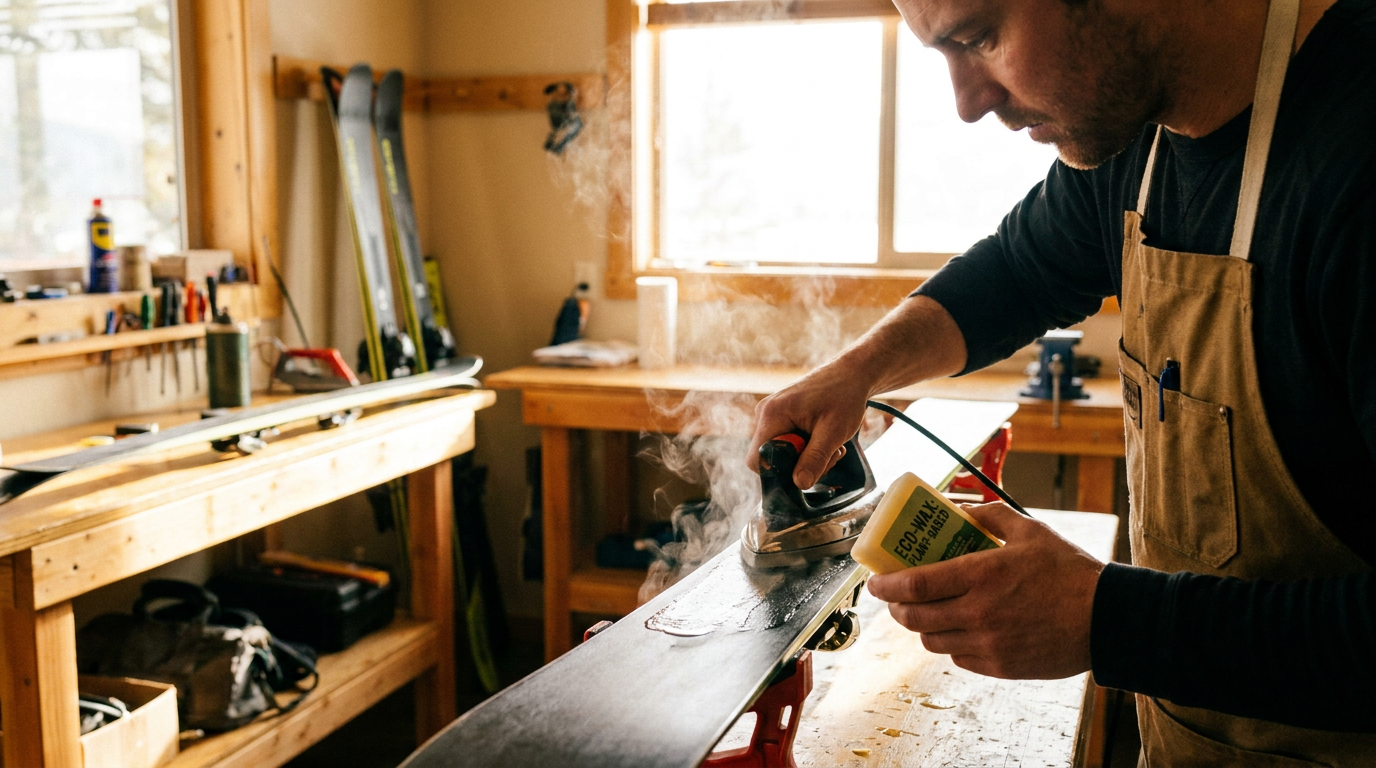
The health risks are equally alarming. Ski technicians, who spend hours in poorly ventilated waxing rooms ironing and scraping these compounds, have historically faced severe exposure, leading to respiratory issues and elevated health risks.[1][6]
Recognizing the crisis, the International Ski and Snowboard Federation (FIS) and the International Biathlon Union (IBU) implemented a total ban on fluorinated waxes that took full effect during the 2023-2024 season.[1][2]

Enforcement was initially the primary hurdle. The federation spent several seasons perfecting reliable ways to detect fluorine on race skis before making the ban mandatory across top-tier events like the World Cup.[1]
The federation spent several seasons perfecting reliable ways to detect fluorine on race skis before making the ban mandatory across top-tier events like the World Cup.
Today, officials enforce the rule with strict testing protocols. Every pair of skis competing at the Olympics will be tested, and random checks are conducted at lower-level competitions to ensure a level playing field.[1][4]
The consequences are real. At recent events, athletes have faced immediate disqualification when random checks detected fluorinated compounds on their equipment, including South Korean Olympic skiers Han Dasom and Lee Eui-jin.[1]
The regulatory wave has also reached the consumer market. In the absence of a federal rule in the United States, individual states have stepped in to ban the sale of PFAS-containing sports waxes entirely.[3][4]
Vermont led the charge by banning the sale of PFAS ski wax in 2023. Minnesota's ban takes effect in 2025, while Colorado, Maine, and New Hampshire have enacted similar bans taking effect between 2026 and 2027.[3][4]

This regulatory pressure has forced the ski industry to innovate rapidly. Major legacy brands like Swix stopped selling PFAS-containing waxes to the mass market by the 2021-2022 season, though they acknowledge that eliminating trace cross-contamination in global supply chains remains an ongoing challenge.[5]
Meanwhile, agile startups have seized the moment to redefine high-performance wax. Colorado-based mountainFLOW emerged with a proprietary plant-based wax blend that uses zero petroleum and is 100-percent biodegradable.[6][7]
To bridge the performance gap for elite racers, companies are experimenting with new additives. MountainFLOW, for instance, employs a proprietary "Ceramic Nanotechnology" to match the glide of traditional fluoro waxes without the ecological toll.[6]
European researchers are also in the race. At the Institute of Mechanical Engineering and Materials Technology (MEMTi) in Switzerland, scientists are developing hydrophobic, fluorine-free nanocoatings that adapt flexibly to varying snow conditions and humidity levels.[2]

The transition isn't just about new products; it's about cleaning up the past. Initiatives like the "Fluoro Wax Take-Back Program" are working with retail shops to collect thousands of pounds of old carcinogenic wax before it ends up on the mountain.[6]
As recreational skiers and Olympic champions alike click into their bindings this season, they are participating in one of the most successful environmental pivots in modern sports history—proving that speed on the mountain doesn't have to come at the cost of the mountain itself.[8]
How we got here
2019
The International Ski Federation (FIS) announces plans to ban fluorinated waxes, pending reliable testing methods.
2021-2022
Major legacy brands like Swix stop selling PFAS-containing waxes to the mass consumer market.
2023-2024
The FIS and International Biathlon Union total ban on fluorinated waxes takes full effect at the professional level.
2025
Minnesota's state-level ban on the sale of PFAS-containing sports waxes goes into effect.
2026
The Milan Cortina Winter Games become the first fully PFAS-free Olympics in history.
Viewpoints in depth
Environmental Advocates
Focus on protecting alpine watersheds from bioaccumulating forever chemicals.
Environmental groups emphasize that the ski industry's reliance on PFAS was quietly poisoning fragile alpine ecosystems. Because forever chemicals do not break down, every application of fluorinated wax eventually washed into local streams during the spring melt. Advocates argue that while the FIS racing ban was a crucial first step, state-level retail bans are necessary to stop recreational skiers from unknowingly contaminating the snowpack with stockpiled or imported toxic waxes.
Ski Technicians & Athletes
Value the health benefits of eliminating toxic fumes while demanding high-performance alternatives.
For decades, ski technicians bore the brunt of the industry's chemical reliance, spending hours in poorly ventilated tuning rooms inhaling toxic vapors as they ironed fluorinated wax onto skis. While athletes and techs initially expressed skepticism that plant-based alternatives could match the 'ridiculous' speed of fluoro waxes in wet snow, the rapid advancement of ceramic nanotechnology and hydrophobic coatings has largely closed the performance gap, allowing them to embrace the health benefits without sacrificing podium finishes.
Wax Manufacturers
Navigating the complex transition by investing heavily in plant-based R&D.
The regulatory shift forced a massive pivot in chemical engineering. Legacy brands faced the daunting task of purging PFAS from their entire global supply chains, often battling trace cross-contamination from overseas apparel factories. Conversely, agile startups capitalized on the disruption by building entirely new supply chains based on agricultural products rather than petroleum, proving that high-performance winter sports gear could be both profitable and 100-percent biodegradable.
What we don't know
- Whether plant-based waxes can consistently match the extreme wet-snow performance of fluorinated waxes at the absolute highest levels of Olympic downhill racing.
- How legacy manufacturers will completely eliminate trace PFAS cross-contamination from their Asian apparel and gear supply chains.
- Whether recreational skiers will voluntarily surrender their stockpiled fluorinated waxes before they are used on the mountain.
Key terms
- PFAS
- Per- and polyfluoroalkyl substances, highly stable synthetic chemicals known as 'forever chemicals' because they do not break down in the environment.
- Hydrophobic
- The physical property of a molecule that repels water, crucial for reducing friction between a ski and the snow.
- Fluorinated wax
- Traditional high-performance ski wax containing fluorine compounds that provided exceptional speed but caused severe environmental contamination.
- Ceramic Nanotechnology
- An emerging additive used in eco-friendly waxes to replicate the water-repellent performance of banned forever chemicals.
Frequently asked
Why was PFAS used in ski wax?
PFAS compounds created a highly water- and dirt-repellent layer on the ski base, drastically reducing friction and providing unmatched speed, especially in wet snow conditions.
Can recreational skiers still buy fluorinated wax?
It is becoming increasingly difficult. Several US states have banned its sale, and major manufacturers have phased it out of their consumer lines in favor of plant-based or hydrocarbon alternatives.
How do officials test for banned wax at races?
Ski federation officials use specialized testing devices that detect the presence of fluorine on the ski base. Skis are tested before races, and athletes can be disqualified if fluorine is found.
Sources
Source coverage
8 outlets
4 viewpoints surfaced








[1]Environmental Working GroupEnvironmental Advocates
The 2026 Olympics will be the first completely PFAS-free winter games
Read on Environmental Working Group →[2]MyScienceSports Regulators
Racing towards fluorine-free ski waxes
Read on MyScience →[3]CIRS GroupEnvironmental Advocates
US New Hampshire Expands PFAS Ban to Include Ski, Boat, and Surfboard Waxes
Read on CIRS Group →[4]Headwaters LawSports Regulators
Ecology Proposes Restrictions on PFAS in Outdoors Apparel and Ski Wax
Read on Headwaters Law →[5]SwixWax Manufacturers
Leaving PFAS Behind: Swix's journey to 100% PFAS-free production
Read on Swix →[6]Ski MagazineSki Technicians & Athletes
mountainFLOW's Fluoro Wax Take-Back Program
Read on Ski Magazine →[7]FreeskierSki Technicians & Athletes
mountainFLOW is North America's only plant-based ski wax
Read on Freeskier →[8]Factlen Editorial Team
Synthesis by Factlen editorial team
Read on Factlen Editorial Team →

More in sports
See all 13 stories →Olympic Sustainability
How the LA 2028 Olympics Will Run Entirely on Existing Stadiums
0 sources

NBA Finals
New York Knicks Win 2026 NBA Finals, Ending 53-Year Championship Drought
0 sources

NBA Finals
New York Knicks Capture First NBA Championship Since 1973
0 sources

Hockey Strategy
How the PWHL's 'Jailbreak' and 'No Escape' Rules Are Rewriting Hockey Strategy
0 sources

Every angle. Every day.
Get sports stories with full source coverage and perspective breakdowns delivered to your inbox.