
How Repair Cafes and Tool Libraries Are Rebuilding the Modern 'Third Place'
As traditional community gathering spots disappear, neighborhoods are combating loneliness and waste by organizing collaborative spaces to share tools and fix broken goods.
By Factlen Editorial Team
- Community Organizers
- Focus on skill-sharing, reducing waste, and building local resilience through hands-on collaboration.
- Public Health & Urban Planners
- View these spaces as critical infrastructure for combating social isolation and improving mental health outcomes.
- Sustainability Advocates
- Emphasize the diversion of usable goods from landfills and the shift away from disposable consumerism.
- Equity Researchers
- Highlight the uneven distribution of these spaces, noting that low-income areas often lack access.
What's not represented
- · Commercial repair shop owners
- · Manufacturers of consumer goods
Why this matters
Strong social infrastructure is critical for mental health and economic resilience. The rise of non-commercial gathering spaces offers a scalable blueprint for reducing both household expenses and chronic isolation.
Key points
- Traditional commercial gathering spots are becoming less accessible due to rising costs and changing business models.
- Repair Cafes and Tool Libraries are emerging as non-commercial alternatives that foster deep community connection.
- Research links regular participation in these 'third places' to significantly improved mental health outcomes.
- Local governments are beginning to offer grants to help sustain these volunteer-run initiatives.
The modern era presents a profound paradox: society has never been more digitally connected, yet communities are experiencing unprecedented levels of social isolation. By 2026, public health officials continue to grapple with what has been widely classified as a loneliness epidemic. Young adults and the elderly are particularly vulnerable, with studies showing that chronic isolation can carry health risks comparable to smoking. As digital platforms increasingly replace physical interactions, the natural friction of everyday community life—bumping into a neighbor, chatting with a barista, or sharing a park bench—has steadily eroded, leaving a void in the social fabric.[4]
Sociologists trace much of this isolation to the decline of the "third place." Coined by urban sociologist Ray Oldenburg in 1989, the term describes the informal public spaces that exist outside of the home, which is considered the first place, and the workplace or school, which serves as the second place. A healthy third place is accessible, welcoming, and requires little to no financial barrier to entry. Historically, these spaces included neighborhood diners, local barbershops, public libraries, and corner pubs—environments where people could gather voluntarily and interact with a diverse cross-section of their community.[3][4]
However, traditional commercial third places are disappearing or fundamentally changing their operating models. Many cafes have optimized for rapid turnover and mobile orders, removing seating to discourage lingering. Furthermore, the rising cost of living has transformed spaces that were once accessible into luxury experiences; a six-dollar coffee is a significant barrier to entry for many residents seeking a place to sit and socialize. As these commercial avenues narrow, the burden of fostering community connection has shifted, prompting neighborhoods to innovate and build their own non-commercial gathering spaces.[4][5]
In response to this spatial deficit, a grassroots movement of alternative third places is rapidly gaining momentum. Leading this charge are Repair Cafes and Tool Libraries—community-run initiatives that combine practical, hands-on utility with deep social engagement. Rather than relying on consumption to drive interaction, these spaces use shared resources and collective problem-solving as the engine for community building. They offer a compelling blueprint for how neighborhoods can self-organize to combat both household economic strain and chronic social isolation simultaneously.[8]

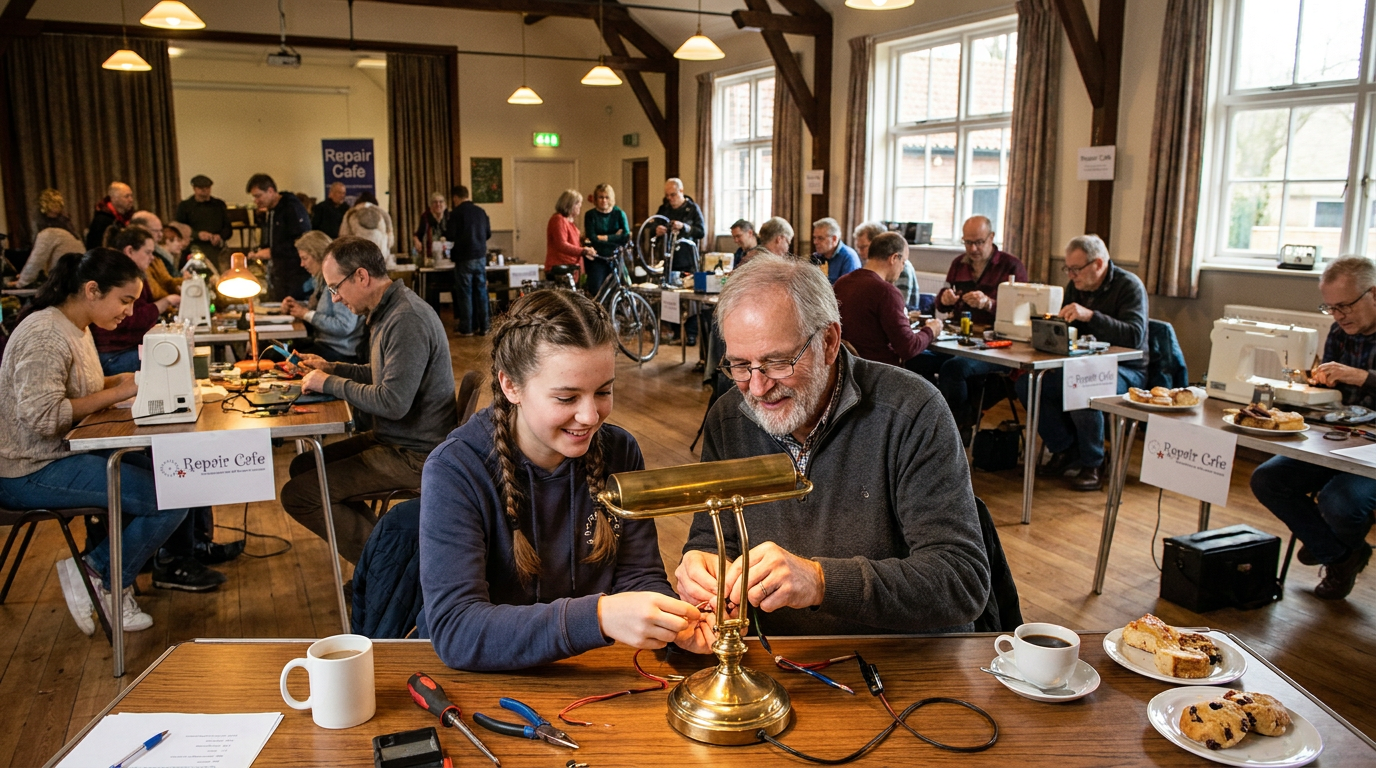
A Repair Cafe is fundamentally different from a traditional repair shop or a drop-off service. It operates as a collaborative, pop-up event where volunteers with technical expertise help their neighbors fix broken household items. Visitors bring in malfunctioning electronics, torn clothing, wobbly furniture, or broken toys, and sit down alongside a volunteer "fixer." The goal is not merely to return a working item to the owner, but to demystify the repair process, transferring skills and confidence to the community member so they might tackle future fixes themselves.[1][7]
The atmosphere inside a Repair Cafe is intentionally social and highly interactive. A teenager might sit next to a retired electrician to learn how to rewire an antique fan, while at the next table, someone is learning how to replace a finicky zipper on a winter coat. Coffee and tea are usually provided, encouraging attendees to linger, chat, and watch others work even after their own items have been mended. This environment naturally dissolves social barriers, creating a shared sense of purpose that transcends age, background, and technical ability.[1]
What began as a localized experiment has scaled into a massive international movement. The first Repair Cafe was organized in the Netherlands in 2009 by Martine Postma, who wanted to challenge the culture of disposable goods. Today, the network has expanded to encompass more than 4,000 registered cafes worldwide. This global infrastructure is powered by an estimated 59,000 volunteers who collectively repair nearly 850,000 items every single year, proving that the desire to fix rather than discard is a universally shared value.[1]
Operating alongside these repair events, Tool Libraries are fundamentally changing how neighborhoods approach consumption and ownership. Instead of every household on a block purchasing a power washer, a specialized drill, or a heavy-duty carpet cleaner that they might only use once a year, the community shares a central inventory. These libraries function exactly like traditional book libraries, allowing members to check out expensive or bulky equipment for a few days at a time before returning it for the next person to use.[2][7]

Operating alongside these repair events, Tool Libraries are fundamentally changing how neighborhoods approach consumption and ownership.
The economic relief provided by Tool Libraries is substantial, particularly during periods of high inflation or economic uncertainty. By removing the need to purchase rarely used tools, families can maintain their homes, cultivate gardens, and take on do-it-yourself projects without taking on financial strain. Many of these libraries operate on a sliding-scale annual membership fee or rely entirely on community donations, ensuring that access to necessary equipment is not restricted by a resident's income level.[2][7]
Beyond the immediate economic and environmental benefits, public health experts are increasingly studying these spaces as direct interventions for the loneliness epidemic. Because they are structured around a shared activity rather than forced conversation, Repair Cafes and Tool Libraries lower the social anxiety often associated with meeting new people. The focus on a tangible task—like diagnosing a broken toaster or learning how to operate a circular saw—provides a comfortable, low-stakes avenue for interaction that naturally evolves into deeper community bonds.[3][4]
The mental health impacts of these interactions are highly measurable. Research conducted by South Dakota State University indicates that engaging in conversations for over 30 minutes in a third place is directly associated with better mental health outcomes. This buffering effect against stress and depression is particularly pronounced among rural and isolated adults, who often face significant geographic barriers to regular social engagement. The casual connections formed in these environments provide emotional support and a vital sense of belonging.[3]
Sociologists refer to the type of relationships forged in these spaces as "bridging social capital." Unlike bonding social capital, which occurs between people who are already similar, bridging capital connects individuals across different socioeconomic, racial, and generational lines. When a community relies on a shared Tool Library or gathers at a Repair Cafe, residents are forced to interact with neighbors they might never cross paths with otherwise, strengthening the overall resilience and empathy of the neighborhood.[8]

Environmentally, the impact of these initiatives is a critical component of local climate action plans. By extending the life of items already in circulation, communities actively divert usable goods from overflowing landfills. More importantly, repairing and sharing reduces the demand for newly manufactured products, thereby cutting down on the significant greenhouse gas emissions associated with resource extraction, factory production, and global shipping. For many municipalities, supporting these circular economy models is one of the most effective steps toward becoming a certified climate-smart community.[7]
This represents a growing anti-consumerist shift in public consciousness. Advocates argue that mass-produced, disposable goods have dominated the global economy for the last half-century, creating a culture where it is often cheaper to replace an item than to fix it. The popularity of Repair Cafes, alongside legislative pushes for "right to repair" laws, signals a deep public frustration with planned obsolescence. People are actively seeking alternatives to the buy-and-throw-away cycle, reclaiming agency over the objects they own and demanding better manufacturing standards.[1]
Despite their success, these community models face significant structural hurdles. Tool libraries, in particular, require complex logistical oversight that goes far beyond a simple weekend event. They demand rigorous inventory management, regular equipment maintenance, secure storage space, and clear liability policies for damaged or lost items. Sustaining this level of operational complexity on volunteer energy alone is notoriously difficult, and many grassroots initiatives struggle with severe volunteer burnout, sometimes forcing them to close their doors when their founding members eventually step down.[8]

Furthermore, access to these spaces remains deeply unequal across different demographics. Research examining the distribution of third places across the United States reveals significant disparities, showing that higher poverty rates strongly correlate with fewer available community hubs. Low-income neighborhoods often lack the initial capital and free time required to launch volunteer-led initiatives. Additionally, when new third places do open in historically under-resourced areas, they can sometimes inadvertently accelerate gentrification, raising local property values and alienating the very residents they were originally intended to serve.[6]
To address these vulnerabilities, local governments are beginning to step in with formal support. Regional bodies, such as Metro in the Portland area, have started issuing dedicated "Reuse Impact Grants" to help volunteer-run organizations stabilize their operations. This critical funding allows tool libraries and repair groups to expand their operating hours, secure permanent venues, offer translation services, and transition to more sustainable e-commerce platforms. By subsidizing these efforts, municipalities ensure that these vital services can reach a broader and more diverse segment of the population.[2]
Ultimately, the resurgence of these collaborative spaces proves that people are hungry for more than just transactional exchanges in their daily lives. As the digital world continues to pull society toward isolation, the physical act of gathering to fix a broken toaster or borrow a weed whacker offers a profound counter-narrative. By investing time and energy into these shared resources, communities are not just repairing their household goods—they are quietly and deliberately repairing their own social fabric, proving that resilience is built one connection at a time.[1][5]
How we got here
1989
Sociologist Ray Oldenburg publishes 'The Great Good Place,' coining the term 'third place.'
2009
The first Repair Cafe is organized in Amsterdam, challenging the culture of disposable goods.
2013
The Buy Nothing Project launches in Washington state, accelerating local gift economies.
2026
Regional governments begin issuing formal 'Reuse Impact Grants' to sustain volunteer-run tool libraries.
Viewpoints in depth
Public Health & Urban Planners
Viewing third places as essential medical and social infrastructure.
For public health officials and urban planners, the decline of the third place is not just a cultural loss—it is a measurable health crisis. They point to data showing that chronic loneliness carries physical health risks comparable to smoking. From this perspective, funding community centers, parks, and tool libraries is a preventative healthcare measure. They argue that designing cities for spontaneous social interaction is the most effective way to build resilience against the modern epidemic of isolation.
Community Organizers
Focusing on grassroots empowerment and practical skill-sharing.
Organizers on the ground view Repair Cafes and Tool Libraries as engines of local empowerment. Rather than relying on top-down government programs, these groups emphasize self-reliance and mutual aid. They argue that the act of fixing a broken item alongside a neighbor breaks down social barriers faster than traditional networking events. However, they also frequently highlight the precarious nature of their work, advocating for municipal grants to prevent the volunteer burnout that often plagues grassroots initiatives.
Sustainability Advocates
Prioritizing the environmental impact of the circular economy.
Environmental advocates frame the repair movement primarily as a weapon against climate change and landfill overflow. They focus on the massive carbon footprint associated with manufacturing, packaging, and shipping disposable consumer goods. By establishing tool libraries and repair hubs, they argue that communities can drastically reduce their collective greenhouse gas emissions. This camp often pushes for broader systemic changes, using the popularity of Repair Cafes to lobby for national 'right to repair' legislation against major manufacturers.
Equity Researchers
Warning about disparities in access and the risks of gentrification.
Sociologists and equity researchers caution that the benefits of the third place movement are not distributed equally. Their data reveals that low-income neighborhoods—which stand to benefit the most from shared resources—often lack the initial capital and volunteer bandwidth to launch these spaces. Furthermore, they warn of a paradox: when successful community hubs are established in under-resourced areas, they can inadvertently signal gentrification, driving up local property values and displacing the very residents the space was built to serve.
What we don't know
- Whether volunteer-led models can scale sustainably without permanent government or philanthropic funding.
- How the rise of artificial intelligence and digital-first lifestyles will further alter the demand for physical community spaces.
- The long-term economic impact of tool libraries on local hardware retailers.
Key terms
- Third Place
- A public, informal gathering spot outside of home and work that fosters community connection.
- Repair Cafe
- A free, pop-up community event where skilled volunteers help neighbors fix broken household items.
- Tool Library
- A community hub that lends out specialized tools and equipment, reducing the need for individual ownership.
- Bridging Social Capital
- Social connections forged between people from different demographic or socioeconomic backgrounds.
- Circular Economy
- An economic model focused on sharing, leasing, reusing, repairing, and recycling existing materials for as long as possible.
Frequently asked
What exactly is a third place?
It is a sociological term for informal public gathering spaces outside of the home (first place) and work or school (second place).
Do I need to know how to fix things to attend a Repair Cafe?
No. Volunteers with technical expertise guide you through the process of fixing your broken item, making it a collaborative learning experience.
How does a tool library work?
Similar to a traditional library, members can check out rarely used tools—like power washers or drills—for a short period instead of purchasing them.
Are these community spaces free to use?
Most Repair Cafes are entirely free, while Tool Libraries often operate on a sliding-scale annual membership or a donation basis to cover maintenance costs.
Sources
Source coverage
8 outlets
4 viewpoints surfaced








[1]Associated PressCommunity Organizers
Broken speaker? Finicky zipper? Anticonsumerist Repair Cafes urge you to fix it instead of pitch it
Read on Associated Press →[2]MetroCommunity Organizers
New grants boost regional reuse, repair and share efforts
Read on Metro →[3]SDSU ExtensionPublic Health & Urban Planners
Why Third Places Are Vital to Rural Communities
Read on SDSU Extension →[4]Newport HealthcarePublic Health & Urban Planners
How Disappearing 'Third Places' Are Driving 'Teen Takeovers' and Youth Loneliness
Read on Newport Healthcare →[5]Congress for the New UrbanismPublic Health & Urban Planners
Fighting loneliness with parks and third places
Read on Congress for the New Urbanism →[6]ResearchGateEquity Researchers
Third Places: Past, Present And Potential
Read on ResearchGate →[7]NYSDECSustainability Advocates
Get Started with Reuse and Repair
Read on NYSDEC →[8]Factlen Editorial TeamEquity Researchers
Synthesis by Factlen editorial team
Read on Factlen Editorial Team →
Every angle. Every day.
Get community stories with full source coverage and perspective breakdowns delivered to your inbox.