
How Repair Cafés and Tool Libraries Are Building the Circular Community
Neighborhoods are increasingly rejecting throwaway culture by establishing hyper-local sharing economies. Backed by new 'Right to Repair' legislation, community hubs are saving residents money, reducing carbon emissions, and rebuilding local social capital.
By Factlen Editorial Team
- Community Organizers
- Focuses on the social benefits of shared spaces and skill-building.
- Consumer Rights Advocates
- Demands legislative action to break manufacturer monopolies and make repair affordable.
- Environmental Economists
- Argues that prioritizing access over ownership is essential for reducing carbon emissions and landfill waste.
- Original Equipment Manufacturers
- Cautions that unrestricted access to diagnostic software could compromise intellectual property and user safety.
What's not represented
- · Local hardware stores affected by tool libraries
- · Independent repair shop owners
Why this matters
As inflation and environmental concerns rise, the hyper-local sharing economy offers a practical way to save money, reduce household clutter, and cut carbon emissions. The accompanying legislative push for the 'Right to Repair' ensures that consumers will soon have the legal backing to fix their own property rather than being forced into expensive replacements.
Key points
- The global Repair Café movement has grown to over 2,500 locations, helping communities fix broken items for free.
- Neighborhood tool libraries are saving members millions of dollars by prioritizing shared access over individual ownership.
- Academic studies show these hyper-local sharing models significantly reduce carbon emissions and divert waste from landfills.
- The European Union's Right to Repair Directive will mandate affordable repair options and spare parts access by July 2026.
- Multiple U.S. states are enacting laws in 2026 to ban 'parts pairing' and force manufacturers to release diagnostic schematics.
- Industry groups caution that open access to repair manuals could compromise intellectual property and pose physical safety risks.
The modern neighborhood is quietly undergoing a structural shift. For decades, the prevailing consumer model was strictly linear: purchase an item, use it, and discard it when it breaks or is no longer needed. But driven by economic pressures and environmental awareness, communities are increasingly rejecting the throwaway culture. In its place, a hyper-local sharing economy is taking root, anchored by two rapidly expanding civic institutions: the tool library and the Repair Café.[10]
The concept of the Repair Café began modestly in Amsterdam in 2009, when journalist Martine Postma organized a gathering for neighbors to fix broken household items together. Today, the model has exploded into a global movement, with over 2,500 registered Repair Cafés operating across 37 countries. In the United Kingdom alone, the number of active locations has surged by a third since early 2023, surpassing 600 active hubs.[1][2]
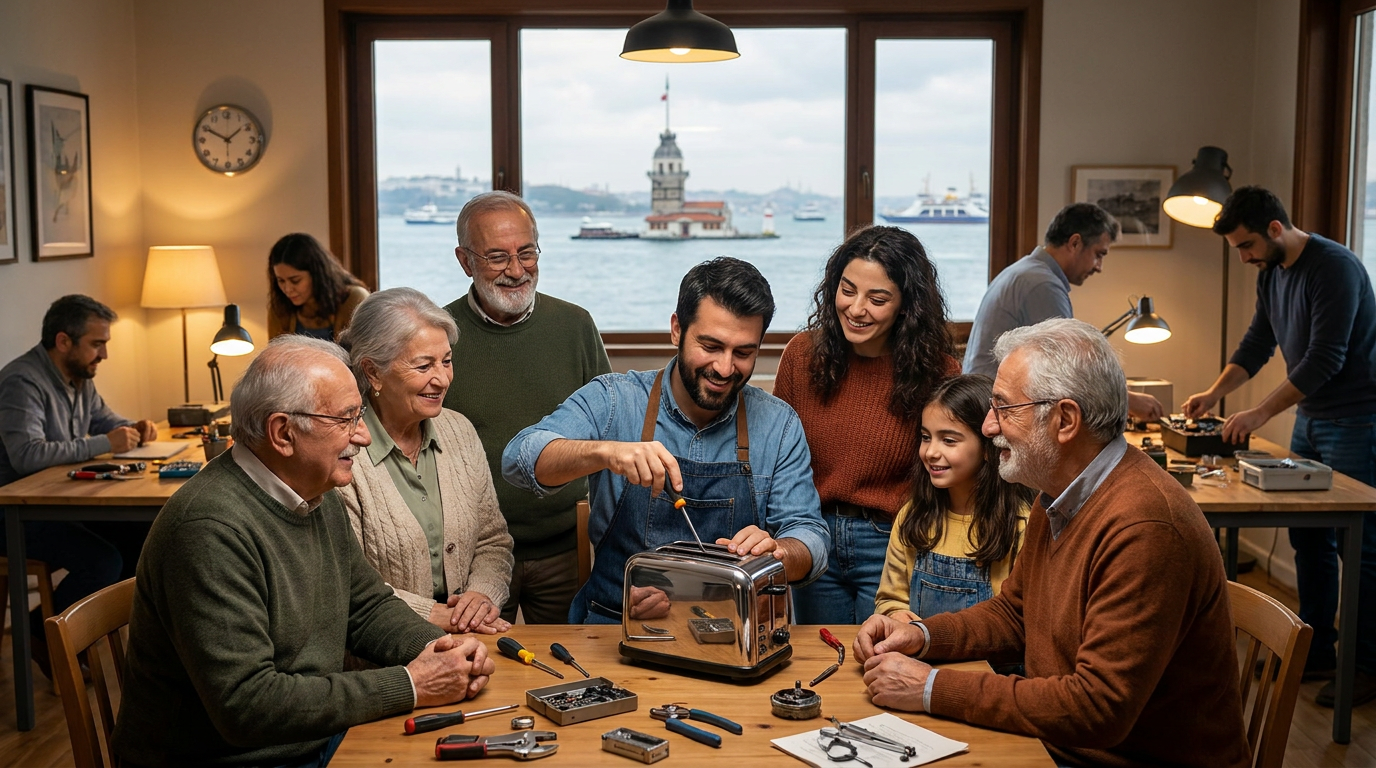
At a typical Repair Café, community members bring malfunctioning electronics, torn clothing, wobbly furniture, or broken bicycles to a local hall. There, volunteer experts—ranging from retired engineers to local seamstresses—diagnose the issues and teach the owners how to fix them for free. The focus is as much on skill-sharing and building social capital as it is on the physical repair.[1][3]
The tangible impact of these hyper-local events is substantial. In Richmond, British Columbia, a dedicated team of volunteer "repair experts" recently celebrated their 1,000th successful fix, with clothing and textiles making up 82 percent of the restored items. Across the Atlantic, a single Repair Café hosted at the Cambridge Museum of Technology successfully repaired 48 out of 69 items brought in, preventing an estimated 197 kilograms of waste and over a metric ton of carbon dioxide emissions.[3][4]

Parallel to the repair movement is the rise of the "library of things," most commonly manifested as tool libraries. These community organizations operate on a simple premise: rather than every household on a block purchasing a power drill that will be used for an average of 13 minutes over its lifetime, the neighborhood shares a centralized inventory.[5][6]
Tool libraries dramatically reduce the financial barrier to home maintenance and DIY projects. The Brisbane Tool Library in Australia, which built its inventory largely from private donations and items rescued from landfills, estimates that its sharing model has saved its members more than $1.1 million in retail costs. By prioritizing access over ownership, these hubs allow households to save money and free up domestic storage space.[6]
The environmental arithmetic of the sharing economy is equally compelling. Every tool borrowed is a tool that does not need to be manufactured, packaged, and shipped. A 2024 academic study evaluating the Shoreline Tool Library in Washington state quantified this impact, finding that in just one winter season, the facility prevented 528 kilograms of carbon dioxide equivalent from entering the atmosphere by offsetting new production, while simultaneously diverting 137 kilograms of material from local landfills.[5]

The environmental arithmetic of the sharing economy is equally compelling.
However, volunteer enthusiasm and community organization can only go so far when the products themselves are designed to be disposable. Repair advocates frequently encounter "planned obsolescence"—manufacturing choices that make items artificially difficult or expensive to fix. Volunteers often find that a simple battery replacement is impossible without proprietary tools, or that essential schematics are kept hidden by the manufacturer.[1][9]
This friction has birthed the "Right to Repair" movement, a legislative push demanding that manufacturers provide consumers and independent shops with the parts, tools, and diagnostic manuals necessary to fix their own property. After years of grassroots lobbying, this movement is securing major legal victories in 2025 and 2026.[8][9]
In Europe, the landscape will fundamentally shift on July 31, 2026, when the European Union's new Repair Directive (2024/1799) officially comes into force. The directive mandates that manufacturers of household appliances, mobile phones, and tablets must offer repair services at reasonable prices and provide clear information on spare parts. Crucially, it aims to establish a common repair platform across the EU, making it easier for consumers to find local fixers rather than defaulting to a replacement.[7]
In the United States, a patchwork of state laws is taking effect to force similar changes. Throughout 2026, comprehensive consumer electronics repair laws are going live in Colorado, Washington, and Texas. Many of these new statutes specifically target "parts pairing"—a controversial practice where manufacturers use software locks to ensure a device will only function with original, factory-approved replacement parts.[8]

The push is also reaching the federal level. In February 2026, a bipartisan coalition in the U.S. House of Representatives introduced the Fair Repair Act. If passed, the legislation would require original equipment manufacturers to make diagnostic data and physical parts available to third-party repairers on fair and reasonable terms, aiming to break the monopoly of authorized vendor networks.[9]
Manufacturers and industry trade groups have historically pushed back against these sweeping mandates. Opponents argue that forcing companies to release proprietary schematics could compromise intellectual property and expose devices to digital security vulnerabilities. They also raise safety concerns, suggesting that untrained consumers or unvetted third-party shops could improperly repair high-voltage electronics or lithium-ion batteries, creating fire hazards.[8]
Despite these corporate reservations, the momentum toward a circular economy appears firmly established. Corporate entities are even beginning to subsidize the grassroots movement; in the UK, waste management operator enfinium recently launched a £20,000 support fund to help local Repair Cafés cover operating costs and invest in new equipment.[2]
Ultimately, the synergy between community-led sharing hubs and top-down Right to Repair legislation is reshaping how neighborhoods function. By transforming the act of repair from a solitary, frustrating chore into a collaborative, supported civic event, these initiatives are doing more than just keeping toasters out of the landfill. They are rebuilding the "third place"—fostering local resilience, teaching tangible skills, and proving that the most sustainable economy is often the one right down the street.[3][6][10]
How we got here
2009
Journalist Martine Postma organizes the world's first Repair Café in Amsterdam.
2013
The Toronto Tool Library opens, helping catalyze the 'library of things' movement in North America.
2024
The European Union officially adopts the Right to Repair Directive (2024/1799).
Jan 2026
Comprehensive consumer electronics repair laws take effect in Colorado and Washington.
Feb 2026
The bipartisan Fair Repair Act is introduced in the U.S. House of Representatives.
July 2026
Deadline for all EU member states to implement the new Repair Directive.
Viewpoints in depth
Community Organizers
Focuses on the social benefits of shared spaces and skill-building.
For local organizers, the primary value of a Repair Café or tool library isn't just waste reduction—it's the creation of a 'third place.' These hubs serve as rare, non-commercial community squares where people of different generations and backgrounds interact. By teaching a neighbor how to solder a wire or safely operate a circular saw, volunteers build local resilience and social capital, transforming passive consumers into active, capable community members.
Consumer Rights Advocates
Views repair as a fundamental property right that must be protected by law.
This camp argues that when you buy a product, you should own it completely—including the right to fix it yourself or take it to an independent shop. Advocates are fiercely fighting 'planned obsolescence' and software locks like 'parts pairing,' which they view as anti-competitive tactics designed to force consumers into expensive authorized repair networks or premature upgrades. Their focus is on passing sweeping legislation that mandates open access to parts and schematics.
Original Equipment Manufacturers
Raises concerns about intellectual property, cybersecurity, and physical safety.
While many manufacturers support sustainability initiatives in principle, industry trade groups caution against overly broad Right to Repair mandates. They argue that forcing companies to publish proprietary schematics could expose devices to hackers and compromise intellectual property. Furthermore, they warn that encouraging untrained individuals to repair complex electronics—particularly items with high-voltage components or volatile lithium-ion batteries—poses significant fire and safety risks.
What we don't know
- How strictly the European Union will enforce the new Repair Directive across all member states starting in July 2026.
- Whether the federal Fair Repair Act will gain enough bipartisan traction to pass the U.S. Congress.
- How manufacturers will adapt their product designs to comply with the patchwork of new state-level repair laws.
Key terms
- Circular Economy
- An economic model focused on extending product lifecycles, repairing, and reusing materials, rather than the traditional 'take-make-dispose' linear model.
- Planned Obsolescence
- A manufacturing strategy where products are intentionally designed with a limited useful life, forcing consumers to purchase replacements.
- Parts Pairing
- A controversial practice where manufacturers use software locks to ensure a device will only function with factory-approved, serialized replacement parts.
- Library of Things
- A community hub where members can borrow infrequently used items—like power tools, camping gear, or kitchen appliances—instead of buying them.
- Third Place
- A sociological term for a social surrounding separate from the two usual social environments of home ('first place') and the workplace ('second place').
Frequently asked
What exactly is a Repair Café?
A Repair Café is a free community event where volunteer experts help neighbors fix broken household items, such as electronics, clothing, and bicycles, while teaching them repair skills.
How does a tool library work?
Similar to a traditional book library, a tool library allows community members to borrow specialized equipment—like power drills or gardening tools—for a short period, saving them the cost and storage space of buying the items.
What is the Right to Repair movement?
It is a legislative push demanding that manufacturers provide consumers and independent repair shops with the necessary parts, tools, and diagnostic manuals to fix their own property.
Why do manufacturers oppose Right to Repair laws?
Industry groups argue that mandated open access to schematics could compromise intellectual property, expose devices to cybersecurity threats, and pose physical safety risks if untrained individuals improperly repair complex electronics.
Sources
Source coverage
10 outlets
4 viewpoints surfaced










[1]Brampton Environmental AllianceConsumer Rights Advocates
Repair Café: Fostering Sustainability Through Community, Advocacy and Legislation
Read on Brampton Environmental Alliance →[2]enfiniumEnvironmental Economists
enfinium launches the second year of its Repair Café Support Fund
Read on enfinium →[3]MuseumNextCommunity Organizers
Why Your Museum Should Host a Repair Café
Read on MuseumNext →[4]City of RichmondCommunity Organizers
Volunteers mark over 1,000 items fixed through community reuse events
Read on City of Richmond →[5]University of WashingtonEnvironmental Economists
Measuring the Sustainable Impact of a Tool Library
Read on University of Washington →[6]ResearchGateEnvironmental Economists
Brisbane Tool Library: commoning and degrowth transitions
Read on ResearchGate →[7]CertifyComplyOriginal Equipment Manufacturers
Right to Repair – How the EU’s New Directive Affects Businesses
Read on CertifyComply →[8]Waste DiveConsumer Rights Advocates
Right-to-repair advocates expect a busy 2026 for state legislation
Read on Waste Dive →[9]U.S. House of RepresentativesConsumer Rights Advocates
Rep. Gluesenkamp Perez Introduces Bipartisan Fair Repair Act
Read on U.S. House of Representatives →[10]Factlen Editorial TeamCommunity Organizers
Synthesis by Factlen editorial team
Read on Factlen Editorial Team →

More in community
See all 22 stories →Civic Innovation
How Deliberative Polling and Participatory Budgeting Are Rewiring Local Democracy
6 sources

Shared Equity Housing
The Rise of Community Land Trusts: How Splitting the House from the Land is Reshaping Affordable Housing
8 sources

Digital Divide
How Community-Owned Networks Are Bridging the Global Digital Divide
7 sources
Food Access
Neighborhoods Build Their Own Grocery Stores as Community Co-ops Surge
6 sources

Every angle. Every day.
Get community stories with full source coverage and perspective breakdowns delivered to your inbox.