
How Portable Social Graphs Are Finally Letting Users Own Their Online Networks
A new wave of interoperable social media protocols has reached critical mass, allowing users to seamlessly move their profiles, followers, and content between competing platforms.
By Factlen Editorial Team
- Open-Web Advocates
- Argue that users must own their data and relationships to prevent corporate monopolies from dictating online speech and user experience.
- Protocol Developers
- Focus on the technical architecture required to make decentralized identity scalable, secure, and user-friendly without relying on central servers.
- Major Tech Platforms
- Seek to balance the demand for open interoperability with the need to maintain mass-market usability and protect their existing massive user bases.
- Academic Researchers
- Study the societal impacts of decentralization, particularly how algorithmic choice and data portability affect user agency and online privacy.
What's not represented
- · Independent creators relying on centralized monetization
- · Trust and safety moderators dealing with cross-server abuse
Why this matters
For two decades, leaving a social media platform meant abandoning your friends, followers, and digital history. The shift toward interoperable protocols means you now own your digital identity, giving you the freedom to change apps without losing your audience.
Key points
- Open protocols like ActivityPub and AT Protocol are dismantling the 'walled garden' model of social media.
- Users can now move their profiles, content, and followers seamlessly between competing applications.
- The integration of Meta's Threads brought over 200 million users into the interoperable web.
- Decentralization allows users to choose their own feed algorithms rather than relying on corporate curation.
- Cryptographic identities ensure that users never lose their audience even if their hosting server shuts down.
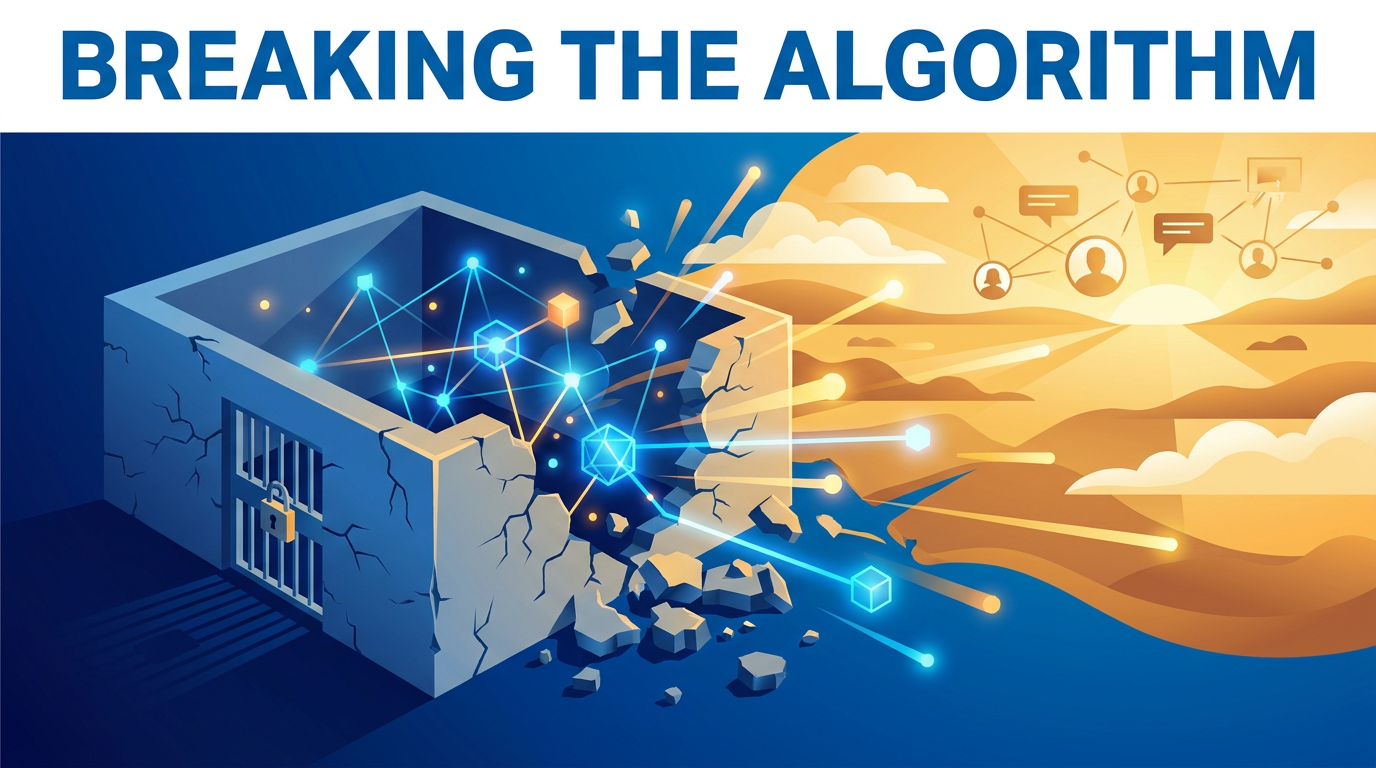
For the first two decades of the modern internet, social media operated on a hostage model. If a user grew tired of a platform's toxic algorithm, intrusive ads, or shifting moderation policies, they faced a stark choice: stay and tolerate it, or leave and permanently lose their friends, followers, and years of digital history. The networks were walled gardens, and the platforms held the keys.[3][6]
In 2026, that paradigm is quietly being dismantled. A critical mass of internet infrastructure has shifted toward "portable social graphs"—a system where your digital identity, your content, and your connections belong to you, not to a tech corporation. If you decide to move to a new application, your entire network moves with you, seamlessly and instantly.[5][6]
This transformation is being driven by two foundational technologies that have matured from niche experiments into global standards: ActivityPub and the Authenticated Transfer (AT) Protocol. Both operate on a simple but revolutionary premise: social media should work more like email.[1][2]
Consider how email functions. A person using Gmail can easily send a message to a person using Yahoo Mail or a custom corporate server. They do not need to be on the same platform to communicate because both services use a shared, open protocol (SMTP). For years, social media lacked this basic interoperability. A post on X (formerly Twitter) could not be liked from Instagram, and a TikTok creator could not carry their subscribers over to YouTube.[1][6]
ActivityPub, an official standard published by the World Wide Web Consortium (W3C), solves this by providing a universal language for social interactions. It defines how servers should format and exchange "Activities"—like creating a post, liking a photo, or following a user. This protocol forms the backbone of the "Fediverse," a decentralized network of thousands of independent servers that all talk to one another.[1]

The Fediverse operated as a quiet, nerdy alternative for years, peaking at around 12 million registered users across platforms like Mastodon. But the ecosystem experienced a seismic shift when Meta integrated ActivityPub into its Threads application. By allowing its 200-plus million users to opt into federation, Meta bridged the gap between a massive corporate walled garden and the open web.[4]
Today, a user on a small, community-run Mastodon server can follow, read, and reply to a creator posting on Threads, and vice versa. The creator does not need to manage two accounts, and the user does not need to download a Meta app to participate in the conversation. The protocol handles the translation invisibly in the background.[1][4]
Today, a user on a small, community-run Mastodon server can follow, read, and reply to a creator posting on Threads, and vice versa.
While ActivityPub connects different servers, the AT Protocol—originally developed by Bluesky—takes user autonomy a step further by focusing on cryptographic identity. On the AT Protocol, users are identified by Decentralized Identifiers (DIDs), which act like a permanent digital license plate. Your data is stored in a self-authenticating repository that you control.[2]
This architecture solves the "server lock-in" problem. If a user's chosen hosting provider shuts down, changes its rules, or starts charging exorbitant fees, the user can simply point their DID to a new server. Because their followers are subscribed to the cryptographic identity rather than a specific web address, the transition is invisible to the audience. The user loses nothing.[2][5]
Beyond data ownership, this decoupling of the interface from the underlying data has sparked a renaissance in algorithmic choice. In the walled-garden era, platforms used opaque, engagement-optimized algorithms to dictate what users saw, often prioritizing outrage to keep people scrolling. Users had no agency over their own feeds.[3][5]

On open protocols, the feed algorithm is unbundled from the network. A user can subscribe to a chronological feed of their friends, switch to a feed that only surfaces peer-reviewed science, and then toggle to a feed dedicated entirely to local sports. If an algorithm becomes toxic, the user can discard it without having to leave the network entirely.[2][6]
This modular approach also extends to content moderation, which has historically been the hardest problem in decentralized spaces. Instead of relying on a single corporate trust-and-safety team to police millions of posts, open networks utilize "composable moderation." Users and communities can subscribe to third-party labeling services—such as a community-maintained anti-spam list or a strict anti-harassment filter—layering them over their experience to curate a safe environment.[2][5]
The economic implications for creators and small businesses are profound. Historically, building an audience on a platform meant building on rented land. If the platform changed its monetization rules or algorithm, a creator's livelihood could vanish overnight. Portable social graphs convert that rented land into owned property, allowing creators to carry their hard-earned audiences to whichever interface serves them best.[3][6]

Challenges remain. The user experience of decentralized networks can still feel slightly more complex than downloading a single, centralized app. Bridging the two major protocols—ActivityPub and AT Protocol—requires intermediary services, though projects like Bridgy Fed are actively smoothing these borders to create one massive, unified social web.[4][6]
Ultimately, the maturation of portable social graphs represents a return to the internet's original promise: a decentralized, resilient network where users, not corporations, hold the power. By making our digital connections portable, the internet of 2026 is becoming a fundamentally healthier and more empowering place to communicate.[3][5][6]
How we got here
Jan 2018
The W3C officially publishes ActivityPub as a recommended standard for decentralized social networking.
Late 2022
Millions of users migrate to Mastodon, pushing the Fediverse into mainstream public awareness.
Mar 2024
Meta launches the public beta for Threads federation, allowing users to push posts to the Fediverse.
Dec 2024
Threads implements bidirectional following, allowing seamless interaction across the protocol boundary.
2026
Portable social graphs reach critical mass, establishing interoperability as a baseline expectation for new social platforms.
Viewpoints in depth
Open-Web Advocates
Believe that user data ownership is a fundamental digital right that protects against corporate overreach.
Organizations like the Electronic Frontier Foundation and the W3C argue that the centralized web was a historical anomaly. They view portable social graphs as a necessary correction that strips monopolistic power from tech giants. By ensuring that users can walk away from a platform without losing their digital lives, open protocols force companies to compete on the quality of their user experience and privacy protections, rather than relying on the hostage-taking mechanics of network effects.
Protocol Developers
Focus on solving the complex technical challenges of scaling decentralized systems to billions of users.
Engineers building systems like the AT Protocol emphasize that true decentralization requires more than just servers talking to each other; it requires cryptographic user autonomy. Their primary focus is on building self-authenticating data structures and Decentralized Identifiers (DIDs) that ensure a user's identity cannot be revoked by any single entity. They argue that unbundling the algorithm from the data layer is the only sustainable way to solve the internet's content moderation and algorithmic bias crises.
Major Tech Platforms
View interoperability as a feature to be adopted carefully, balancing openness with user safety and scale.
For massive incumbents like Meta, adopting open protocols is a strategic pivot. While they recognize the growing consumer demand for interoperability, they approach federation cautiously. Their engineering teams highlight the immense technical friction of connecting a network of 200 million users to thousands of independent, unvetted servers. They argue that while open protocols are the future, centralized platforms still play a vital role in providing the seamless, frictionless onboarding and robust safety tools that mainstream users expect.
What we don't know
- How decentralized networks will sustainably fund massive infrastructure costs without traditional advertising models.
- Whether smaller, independent servers can effectively defend against coordinated cross-server harassment campaigns.
- If completely closed legacy platforms will eventually be forced by regulators to adopt open protocols.
Key terms
- Portable Social Graph
- The ability for a user to take their digital identity, content, and list of followers with them when moving from one social media application to another.
- ActivityPub
- An open, decentralized social networking protocol established by the W3C that allows different servers to exchange posts, likes, and follows.
- AT Protocol
- A decentralized networking framework that uses cryptographic identifiers to ensure users can move their accounts between servers without losing their data.
- Decentralized Identifier (DID)
- A unique, cryptographically secure digital ID that belongs to the user rather than a specific platform, acting as a permanent digital address.
- Walled Garden
- A closed technology ecosystem where the service provider has total control over applications, content, and user data, preventing interaction with outside networks.
Frequently asked
What exactly is the Fediverse?
The Fediverse is a collection of thousands of independent social media servers that can all communicate with each other using a shared language called ActivityPub.
Do I have to pay to use these open networks?
Most decentralized networks are free to use, though some independent servers accept community donations to cover their hosting costs.
Can I move my current Instagram or X followers?
You can only move followers if the platform supports open protocols. While Threads allows federation, platforms like X and standard Instagram currently remain closed ecosystems.
What happens if the server I join shuts down?
On networks using the AT Protocol, your identity is cryptographic, meaning you can simply plug your account into a new server and instantly restore your profile and followers.
Sources
Source coverage
6 outlets
4 viewpoints surfaced




[1]W3COpen-Web Advocates
ActivityPub: A decentralized social networking protocol
Read on W3C →[2]BlueskyProtocol Developers
The AT Protocol: A standard for public conversation
Read on Bluesky →[3]Electronic Frontier FoundationOpen-Web Advocates
Decentralization Reaches a Turning Point
Read on Electronic Frontier Foundation →[4]Meta EngineeringMajor Tech Platforms
Threads has entered the fediverse
Read on Meta Engineering →[5]arXivAcademic Researchers
Decentralized Social Networks: User Autonomy and Data Portability
Read on arXiv →[6]Factlen Editorial Team
Synthesis by Factlen editorial team
Read on Factlen Editorial Team →

Every angle. Every day.
Get technology stories with full source coverage and perspective breakdowns delivered to your inbox.